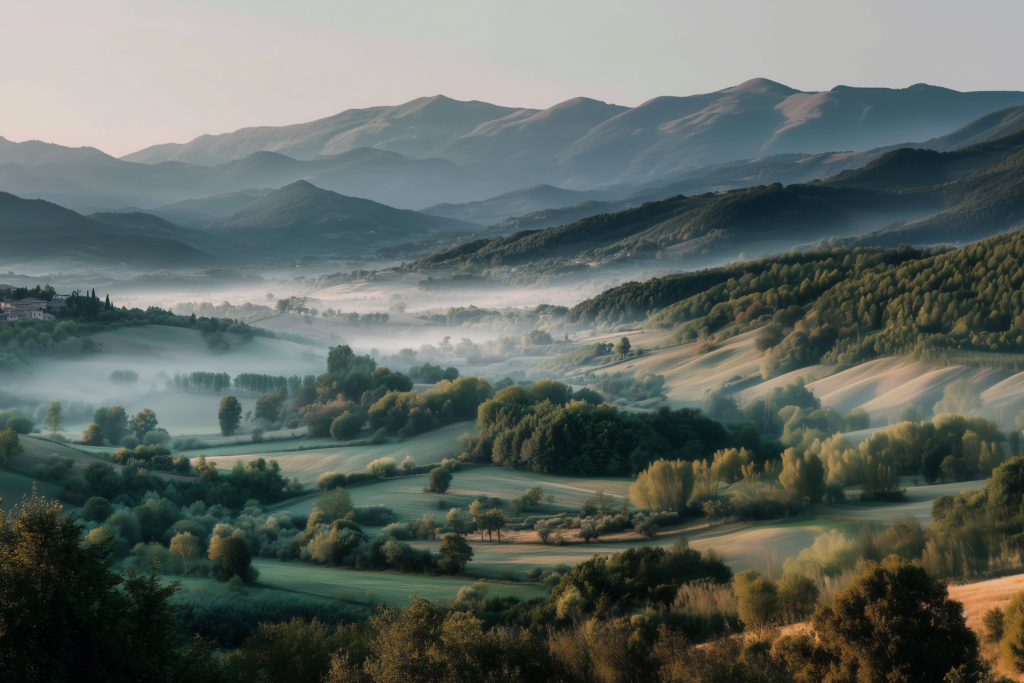
Mugello: Florence’s Green Backyard Nobody Told You About

Main Town: Borgo San Lorenzo

Known for: Medici origins, tortelli di patate, Pinot Noir wine, MotoGP circuit, knife-making, chestnuts, Giotto's birthplace

Most visitors to Florence never learn that the family who built the city — the Medici — came from a green, mountain-ringed valley just thirty minutes to the north. That the painter who changed Western art, Giotto, grew up drawing sheep on rocks near the River Sieve. That the architect of the Duomo’s dome, Brunelleschi, made a clock that still survives in a medieval tower in a town famous for handmade knives.
Mugello is all of this, and it’s also the place where Florentines go on weekends when they want to eat the best pasta in Tuscany and not see another tourist. Enclosed by the Tuscan-Emilian Apennines to the north and gentle ridges to the south, this broad valley of the River Sieve has quietly shaped Florentine civilization for a millennium. It supplied a third of the city’s food in the Middle Ages. It still supplies its best tortelli.
For travelers tired of elbowing through Ponte Vecchio crowds, Mugello is a revelation — not because it’s undiscovered (Italians know it well), but because almost nothing has been written about it in English. That changes here.

A Place Shaped by Mountains and Water

Mugello covers roughly 600 square kilometers of northern Tuscany, entirely within the Metropolitan City of Florence. The River Sieve — one of the Arno’s main tributaries — runs through a broad basin at around 150–200 meters elevation, while the surrounding Apennine peaks consistently exceed 1,000 meters. The result is a landscape of dramatic contrasts: fertile farmland on the valley floor, olive groves and vineyards on the hillsides, and dense forests of chestnut, beech, and oak climbing toward the ridges.
Historic mountain passes — the Futa Pass (903 m), the Giogo di Scarperia (882 m), the Colla di Casaglia (922 m) — have funneled trade, armies, and ideas between Tuscany and Emilia-Romagna for millennia. These are not gentle hills. The Apennines here are real mountains, and they give Mugello a climate, a character, and a cuisine that feels closer to Umbria or even the Alps than to the sun-baked imagery of Chianti.
The region also includes the Alto Mugello — the territory beyond the main ridge encompassing Firenzuola, Marradi, and Palazzuolo sul Senio. These towns are administratively Tuscan but culturally part of Romagna Toscana, a borderland where accents shift, tortellini compete with tortelli, and geography quietly undermines political boundaries.

The Towns and Villages

Mugello is a constellation of small towns strung along the Sieve and up into the surrounding hills. Each has its own personality.

Mugello is not the Tuscany of postcards. There are no cypress-lined roads rising to hilltop towns, no amber light on limestone walls. Instead: green valleys under Apennine clouds, chestnut forests turning gold in October, fog settling into the Sieve basin on winter mornings.
The deeper difference is social. This is a place where people live and work rather than a place curated for visitors. You’re more likely to share a bar with a stonemason than with another tourist. Seasonal rhythms still structure daily life — chestnuts in autumn, cheese through winter, wheat and wine in summer. The fourteenth-century pattern a chronicler described hasn’t entirely disappeared.
There’s a particular Mugellano character that locals acknowledge with mixed pride: reserved, independent, mountain-minded. The valley has always balanced separation and connection — being Florence’s essential hinterland while maintaining its own identity.
Mugello is not the Tuscany of postcards. There are no cypress-lined roads rising to hilltop towns, no amber light on limestone walls. Instead: green valleys under Apennine clouds, chestnut forests turning gold in October, fog settling into the Sieve basin on winter mornings.
The deeper difference is social. This is a place where people live and work rather than a place curated for visitors. You’re more likely to share a bar with a stonemason than with another tourist. Seasonal rhythms still structure daily life — chestnuts in autumn, cheese through winter, wheat and wine in summer. The fourteenth-century pattern a chronicler described hasn’t entirely disappeared.
There’s a particular Mugellano character that locals acknowledge with mixed pride: reserved, independent, mountain-minded. The valley has always balanced separation and connection — being Florence’s essential hinterland while maintaining its own identity.
Mugello food is mountain food — hearty, seasonal, specific.
**Tortelli di patate** are the undisputed signature. Large square parcels of egg pasta filled with potatoes, garlic, parsley, and tomato passata, served with meat ragù (duck ragù is the most traditional). Every family has their own recipe, every restaurant serves them, and the dish anchors summer sagre across the valley. Potatoes arrived here in 1817; before that, the same pasta was filled with chestnuts.
**Chestnuts** run deeper. The Marroni del Mugello IGP — large, sweet, easily peeled — sustained this mountain population for centuries. The chestnut tree was called *l’albero del pane* (the bread tree). Chestnut flour becomes castagnaccio (a dense, crackled cake with rosemary, pine nuts, and olive oil — no sugar), necci (chestnut flour crêpes), and the filling for ancestral tortelli.
**Raviggiolo** is a soft, rindless fresh cow’s milk cheese, traditionally wrapped in fern leaves. First documented in 1515 as a gift to Pope Leo X, it has Slow Food Presidium status and must be consumed within days. Available only October through March.
The wine story is unexpected. In the late 1990s, Pinot Noir was experimentally planted here — and thrived. The clay soils and continental climate produce elegant wines that have earned Mugello the description “a small Burgundy of Tuscany.” Around 17 producers now make some 192,000 bottles annually through the Provimu association. Marchesi Antinori have invested through Tenuta di Monteloro.
Three types of local honey — pale acacia, dark chestnut, and complex wildflower — reflect the landscape from valley floor to mountain ridge.
**Getting there:** The Ferrovia Faentina train connects Florence Santa Maria Novella to Borgo San Lorenzo in about 50 minutes (roughly hourly). By car, the A1 exit at Barberino di Mugello is ~30 minutes from Florence; the scenic SS65 via Vaglia is slower but more atmospheric. [VERIFY: Check current Faentina train schedule — ERTMS upgrades caused disruptions in 2025, full Marradi service expected early 2026] **Getting around:** A car is strongly recommended for the full region. Bus services connect major towns but are infrequent, especially to Alto Mugello. **Where to stay:** Agriturismi (working farms with rooms) are the heart of Mugello accommodation — often with pools, gardens, and farm-to-table restaurants. Prices are significantly lower than Florence or Chianti. Villa Campestri Olive Oil Resort is the luxury option; Locanda Senio in Palazzuolo is one of Italy’s finest *alberghi diffusi*. **No ZTL zones** to worry about — unlike Florence, parking in Mugello’s towns is straightforward and usually free.

Add Your Heading Text Here

more posts: