
Town · Casentino
Camaldoli
A Thousand Years of Silence in the Forest
Last updated:
- Region
- Casentino
- Province
- Province of Arezzo
- GPS
- 43.7945, 11.8136 (monastery); 43.8110, 11.8149 (hermitage)
- Best season
- Year-round (summer for forest walks; autumn for foliage; winter for solitude)
- Time needed
- Half day (monastery + hermitage + forest walk)
- Difficulty
- easy
- Known for
- Camaldolese monastic order (founded ~1012), Eremo (hermitage), ancient forest, historic pharmacy, Badia Prataglia
The road from Poppi to Camaldoli climbs through forest that grows progressively darker and more ancient as the altitude increases. Silver firs rise thirty meters above the road. Beech trunks, some centuries old, line paths that have been walked by monks since before the Norman Conquest of England. At 816 meters, you reach the monastery. At about 1,100 meters, after a further 3-kilometer walk or drive through some of the densest forest in Tuscany, you reach the hermitage — the Sacro Eremo — where Saint Romuald established his community of silence, by tradition around 1012 (historians favour the mid-1020s).
The Camaldolese order that Romuald founded was a deliberate fusion: cenobitic communal life at the monastery below, eremitic solitary life at the hermitage above. One thousand years later, both still function. Monks live in both. The forest that Romuald chose for its isolation is now the heart of the Foreste Casentinesi National Park — protected precisely because the monastic community managed it carefully for more than eight centuries, replanting fir trees as they harvested them.
What to See and Do
The Monastery (Monastero) at 816 m is the more accessible of the two sites. Its church contains works by Giorgio Vasari and other sixteenth-century painters. The cloister is tranquil and well-maintained. The principal attraction for many visitors is the Antica Farmacia (historic pharmacy) — a working pharmacy where Camaldolese monks have produced herbal remedies, liqueurs, cosmetics, and honey-based products since the Middle Ages (a monastic spezieria is documented from 1331). The beautifully preserved pharmacy room, with its original wooden cabinets and ceramic jars, is itself a minor museum. Products are sold on-site and are among the most distinctive souvenirs in the Casentino.
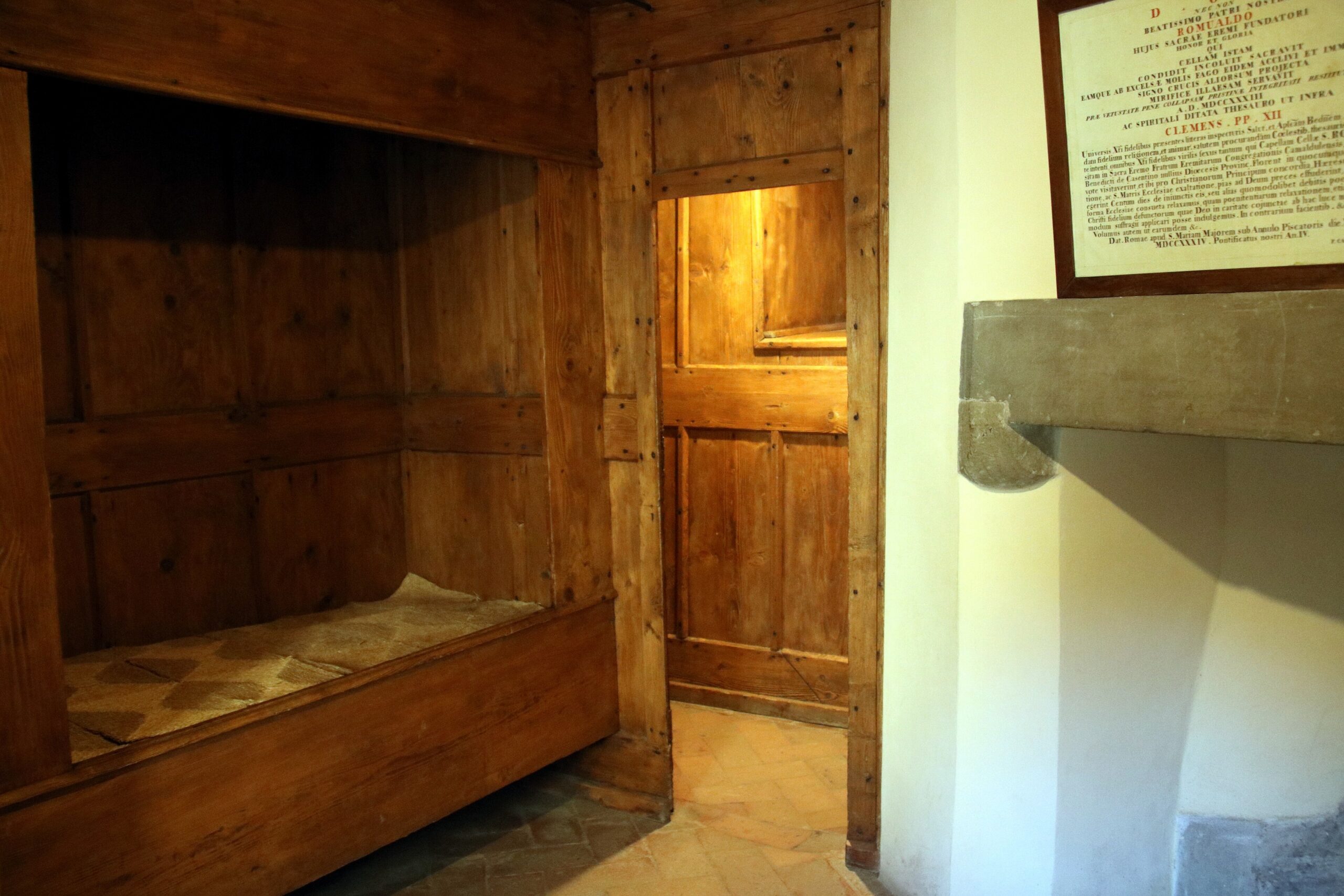
The Hermitage (Sacro Eremo) at about 1,100 m is the spiritual core. Twenty individual cells — small stone houses arranged along a forested path — each with a walled garden, chapel, and workspace, form a miniature village of silence. Only the Cella di San Romuald (Saint Romuald’s cell) is open to visitors; the others remain in monastic use. The church of the Eremo, dedicated to the Holy Saviour, is also open to visitors. The atmosphere is extraordinary: complete silence except for birdsong and wind in the fir canopy.
The forest between monastery and hermitage is one of the finest short walks in the Casentino. The path (about 3 km, roughly an hour uphill, mostly paved or well-maintained) passes through ancient silver fir and beech forest. In autumn, the canopy turns gold above the dark trunks. In winter, snow softens every surface. The Sasso Fratino Integral Nature Reserve — strictly protected since 1959, when it became Italy’s first integral nature reserve, with ancient beech trees inscribed as a UNESCO World Heritage Site in 2017 — lies in the adjacent forest, though it is closed to visitors to preserve its pristine state.
Badia Prataglia, a mountain village east of Camaldoli on the road to the Passo dei Mandrioli, is a key gateway to hiking trails in the Foreste Casentinesi National Park, with well-marked paths connecting with the long-distance GEA trail, the GEA (Grande Escursione Appenninica), and the Romagna side of the ridge.
Getting There
By car: From Poppi, 17 km north (~25 minutes) to the monastery; the hermitage is about 3 km further. From Bibbiena, ~20 km. The road is scenic, winding, and narrow in places. Parking is available at both the monastery and the hermitage.
By public transport: Very limited. Occasional buses from Bibbiena/Poppi. A car is essentially necessary.
Walking between monastery and hermitage: about 3 km on a well-maintained forest path. Allow roughly an hour uphill (monastery to hermitage), less coming down. Comfortable shoes recommended.
Nearby
- Poppi — 17 km south, the Guidi castle village
- Badia Prataglia — east across the forest, gateway to national park hiking
- Pratovecchio Stia — to the south-west, Romena Castle and Panno Casentino
- Foreste Casentinesi National Park — surrounding the monastery and hermitage on all sides
Information is provided in good faith and may change. Always confirm opening hours, prices, and event dates with the official source before you travel.