
Town · Casentino
La Verna
The Mountain Where Francis Received the Stigmata
Last updated:
- Region
- Casentino
- Province
- Province of Arezzo
- GPS
- 43.7077, 11.9307
- Best season
- Year-round (each season brings different atmosphere; autumn and spring most comfortable for walking)
- Time needed
- Half day
- Difficulty
- easy
- Known for
- Franciscan sanctuary, stigmata of Saint Francis (1224), Della Robbia glazed terracottas, sacred forest of beech and fir, pilgrim destination
La Verna is not a tourist attraction in the conventional sense. It is a place of pilgrimage that happens to contain extraordinary art, set on a mountain that happens to be one of the most dramatically positioned religious sites in Italy. The sanctuary clings to a massive rocky outcrop at 1,128 meters on the southern flank of Monte Penna (1,283 m), surrounded by ancient forest of beech and fir. The rock itself is fissured by deep crevasses that tradition attributes to the earthquake at Christ’s crucifixion. In September 1224, Saint Francis of Assisi withdrew to this mountain for a period of fasting and prayer, and here — according to Franciscan tradition — he received the stigmata, the five wounds of Christ, becoming the first person recorded to bear them.
Count Orlando dei Cattani of Chiusi della Verna donated the mountain to Francis in 1213. The saint had been drawn to its isolation and the drama of its rock formations — the Sasso Spicco, a massive overhanging boulder beneath which Francis prayed, remains one of the sanctuary’s most powerful spaces. The Franciscan community has maintained continuous presence here for over eight hundred years.
What to See and Do
The sanctuary complex includes several churches, chapels, and corridors that visitors follow along a clearly marked route. The Basilica (begun 1348, completed in 1509) holds significant artworks. But the artistic treasures that distinguish La Verna are the Della Robbia glazed terracottas — one of the richest collections of works by Andrea della Robbia and his workshop anywhere in Italy. The Annunciation and Nativity in the Basilica, the large Ascension in the Basilica’s Ridolfi chapel, and the Crucifixion in the Chapel of the Stigmata are works of luminous white and blue ceramic that transform stone walls into galleries of devotional art.
The Cappella delle Stimmate (Chapel of the Stigmata) marks the exact spot where Francis received the wounds. The atmosphere here is one of deliberate austerity — Franciscan simplicity rather than baroque splendor. The Corridoio delle Stimmate, a covered walkway leading to the chapel, is lined with frescoes, painted between the seventeenth and twentieth centuries, depicting Francis’s life.
Below the buildings, the sacred forest envelops the mountain in silence. Marked paths descend through ancient beech and fir to the rock crevasses and prayer sites associated with Francis. The Sasso Spicco, the Letto di San Francesco (Francis’s “bed” — a stone shelf in a cave), and the Precipizio viewpoint over the Casentino valley are all accessible on foot.
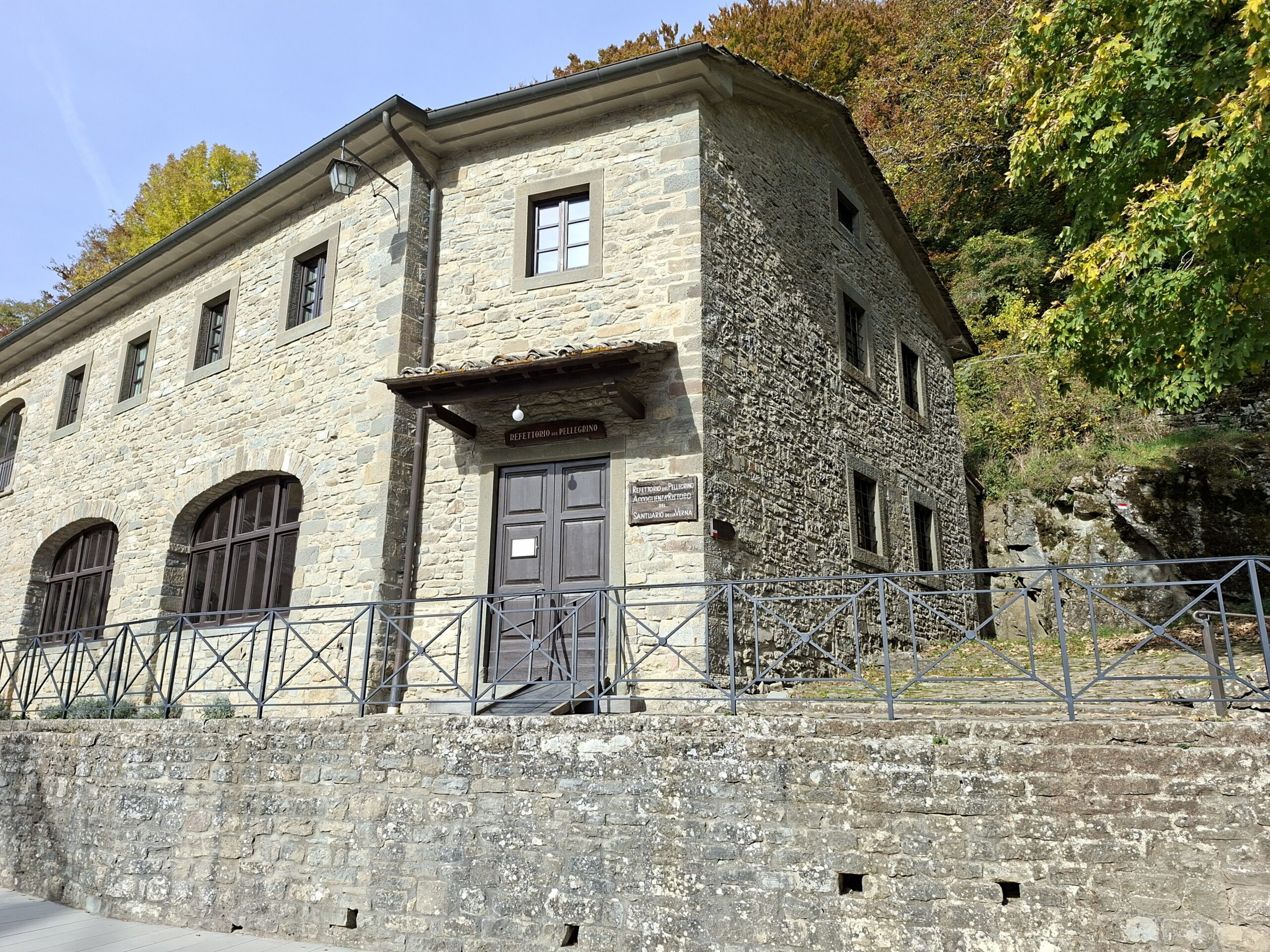
La Verna is an active Franciscan friary. Visitors are welcome, and there is no entrance fee. Masses and choral offices are celebrated daily. Modest dress is expected. The sanctuary operates a guest house for pilgrims and retreatants.
Getting There
By car: From Bibbiena, about 25 km east (roughly 35 minutes) via a mountain road through Chiusi della Verna. From Arezzo, about an hour. From Poppi, about 30 km (roughly 45 minutes). Parking is available below the sanctuary entrance.
By public transport: Limited bus service from Bibbiena. A car is strongly recommended.
Note: The sanctuary is at 1,128 m elevation — temperatures can be significantly cooler than the valley floor. Bring a layer even in summer.
Nearby
- Bibbiena — about 25 km west, the practical center of the Casentino
- Poppi — about 30 km northwest, the Guidi castle village
- Chiusi della Verna — the municipality below the sanctuary, a small mountain village
- Caprese Michelangelo — a short drive south-east, the birthplace of Michelangelo (technically in Valtiberina but easily combined)
Information is provided in good faith and may change. Always confirm opening hours, prices, and event dates with the official source before you travel.