
Town · Casentino
Poppi
The Castle That Became Palazzo Vecchio’s Prototype
Last updated:
- Region
- Casentino
- Province
- Province of Arezzo
- GPS
- 43.7232, 11.7679
- Best season
- Autumn (foliage, chestnuts, atmospheric mists) and spring (wildflowers, comfortable walking)
- Time needed
- Half day to full day
- Difficulty
- easy
- Known for
- Castello dei Conti Guidi (Borghi più belli d'Italia), Battle of Campaldino (1289), Taddeo Gaddi frescoes, Rilliana Library, Parco Zoo della Fauna Europea, gateway to Camaldoli
You see Poppi’s castle long before you reach it. Driving north from Arezzo along the Arno, the tower appears above the valley floor like a vertical exclamation mark — the same proportions, the same crenellated crown, the same austere authority as Florence’s Palazzo Vecchio. This is not coincidence. Giorgio Vasari credited the castle to a master he called Lapo, whom he believed to be Arnolfo di Cambio’s father. The later, late-thirteenth-century rebuilding, begun around 1274 for Count Simone Guidi, is traditionally attributed to Arnolfo di Cambio himself, and the tradition holds that he drew on it for the Palazzo della Signoria he began in Florence about a quarter of a century later. The prototype sits on a green hill above a town of about 6,000 people. The copy became the symbol of one of the world’s most famous cities.
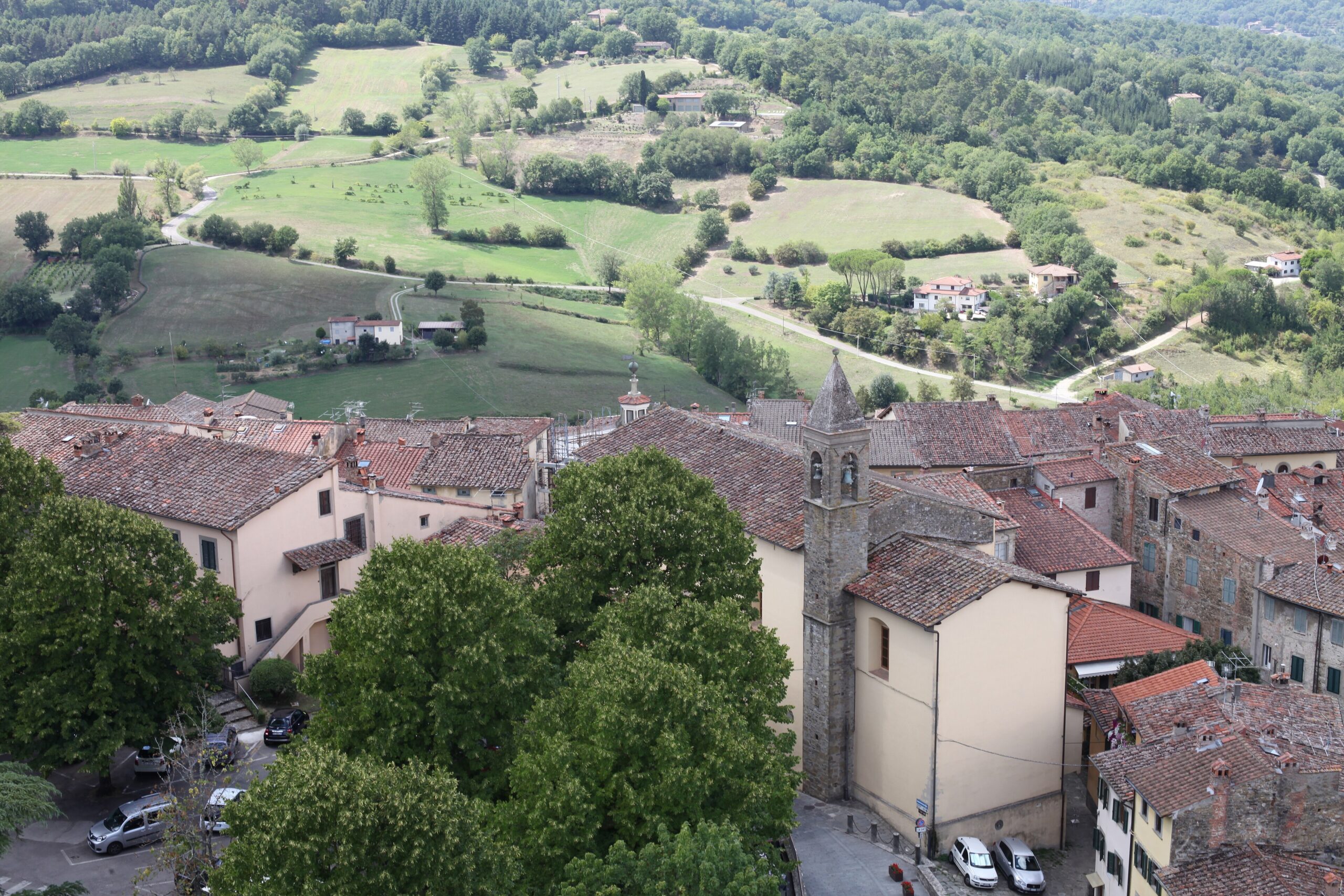
Poppi is a compact medieval village wrapped around this castle, a member of the Borghi più belli d’Italia and the undisputed visual symbol of the Casentino. It sits at the geographic center of the valley, overlooking the Piana di Campaldino — the flat ground where, on June 11, 1289, some twenty thousand soldiers fought one of the decisive battles of medieval Tuscany. A twenty-four-year-old Dante Alighieri was among them.
A Place Shaped by Time
The Guidi Counts controlled the Casentino from the eleventh century, building castles not only at Poppi but at Romena, Porciano, Montemignaio, and Castel San Niccolò. Their castle at Poppi is first documented in 1169, when two Guidi counts pledged from it to protect the property of the Abbey of San Fedele at Strumi. Count Simone Guidi commissioned the transformation from military fortress into noble residence around 1274, and the castle took on the form that survives today: a compact, asymmetric structure with a soaring square tower, mullioned windows, and an internal courtyard dominated by a magnificent fifteenth-century stone staircase.
The Battle of Campaldino (June 11, 1289) was fought on the plain directly below the castle. Florence’s Guelph forces marched over the Consuma pass to confront the Ghibelline army of Arezzo. Count Guido Novello dei Guidi — who held Poppi together with his brother Simone — sided with Arezzo. The battle was ferocious: the Aretine cavalry charged the Florentine center, including the elite feditori corps in which Dante served. The turning point came when Corso Donati’s reserve cavalry struck the Ghibelline flank; Count Guido Novello, judging the battle lost, withdrew his reserve cavalry to his castle at Poppi. The Bishop of Arezzo, Guglielmino degli Ubertini, and the nobleman Buonconte da Montefeltro (whom Dante would later place in Purgatorio V) died on the field. Florence’s victory consolidated Guelph control of the Casentino.
The Guidi ruled for another 150 years. In 1440, the last count, Francesco, sided with Milan’s Duke Filippo Maria Visconti against Florence — a catastrophic miscalculation. After the Battle of Anghiari he was forced to surrender Poppi to the Florentine Republic. The castle became the seat of the Florentine Vicariate; the stone coats of arms of successive vicars still line the courtyard walls. During World War II, the castle served as a depository protecting works of art from the Uffizi and other Florentine museums.
What to See and Do
The Castello dei Conti Guidi is one of the best-preserved medieval castles in Tuscany; check the castle’s official website for seasonal opening times. The visit includes the internal courtyard with its fifteenth-century staircase and heraldic collection; the Cappella dei Conti Guidi with a cycle of fourteenth-century frescoes attributed to Taddeo Gaddi, Giotto’s long-time pupil, depicting stories of the Virgin, St John the Baptist and St John the Evangelist; the Sala delle Feste (Banquet Hall) with its wooden truss ceiling; the Rilliana Library, an important collection of some 25,000 volumes including medieval manuscripts and incunabula (early printed books); and the exhibition “Inferno a Campaldino” — a museum dedicated to the 1289 battle, with a three-dimensional model of the battlefield and information on Dante’s role.
Climb the tower for the defining panorama of the Casentino — the green valley stretching north toward Monte Falterona, the Campaldino plain below, and on clear days the full sweep of the Apennine ridge.
Below the castle, the arcaded Via Cavour leads to the small Piazza Amerighi and the Oratorio della Madonna del Morbo (1656–1659), a hexagonal-plan chapel built in thanksgiving after plague epidemics in 1530 and 1631 spared Poppi.
The Parco Zoo della Fauna Europea, on approximately 50 hectares of forested land near the village, focuses on European species: wolves, Eurasian lynx, brown bears, otters, chamois and eagle owls among them. It bills itself as Italy’s first zoo park devoted to European fauna and is excellent for families.
From Poppi, the road to Camaldoli (17 km, ~25 minutes) climbs through the forest to the monastery and hermitage. The road to Badia Prataglia — a mountain village at the heart of the Foreste Casentinesi — offers access to the best hiking trails in the national park.
Eating Like a Local
Poppi’s restaurants serve the Casentino classics: tortelli di patate (the valley’s signature stuffed pasta, always ask if handmade), stracotto (slow-cooked beef), porcini mushrooms in season, and bistecca from Chianina or local breeds. Prosciutto del Casentino — a salted, aged ham from local pigs — is a specific specialty. In autumn, chestnut dishes appear on every menu: castagnaccio, necci with ricotta, and chestnut flour polenta.
The village’s restaurants and bars cluster around Piazza Amerighi and along the main street. The valley does not have a prestigious wine appellation, but local house wines are honest; this is a food-first territory.
Getting There and Getting Around
By car: From Arezzo, follow the SR71 north along the Arno — approximately 35 minutes (38 km). From Florence, take the scenic SS70 over the Passo della Consuma — approximately 1 hour. Park outside the walls (signed) and walk up.
By train: The LFI/TFT railway from Arezzo reaches Poppi station in about an hour. The station is in the valley below, a steep walk uphill from the old town; check the TFT timetable for current services.
Note: The castle is accessed on foot through the village. The final approach involves a moderate climb through medieval streets — manageable but not wheelchair-accessible in the upper sections.
Nearby
- Camaldoli — 17 km northeast, the Camaldolese monastery and hermitage in the ancient forest
- Pratovecchio Stia — 10 km north, Romena Castle, Pieve di Romena, Panno Casentino cloth
- Bibbiena — 7 km south, the valley’s largest town with Santa Maria del Sasso
- La Verna — 25 km east, the Franciscan sanctuary where Francis received the stigmata
- Campaldino plain — immediately below Poppi, site of the 1289 battle; a small memorial column marks the location
Information is provided in good faith and may change. Always confirm opening hours, prices, and event dates with the official source before you travel.