
Town · Casentino
Pratovecchio Stia
Where Dante’s Exile Began and Tuscan Cloth Is Still Made
Last updated:
- Region
- Casentino
- Province
- Province of Arezzo
- GPS
- 43.7836, 11.7072
- Best season
- Year-round (autumn for foliage and Monte Falterona; spring for Pieve di Romena)
- Time needed
- Half day to full day
- Difficulty
- easy
- Known for
- Castello di Romena (Dante connection), Pieve di Romena (Romanesque masterpiece), Panno Casentino cloth, birthplace of Paolo Uccello, source of the Arno on Monte Falterona, Museo dell'Arte della Lana
Pratovecchio and Stia were separate municipalities until January 1, 2014, when they merged into a single comune of roughly 5,500 inhabitants at the head of the Casentino valley. They remain distinct in character: Pratovecchio is the family home of the painter Paolo Uccello (1397–1475) and the gateway to the Pieve di Romena and Romena Castle; Stia is the textile town where Panno Casentino cloth has been produced since the Middle Ages, and the starting point for the ascent of Monte Falterona (1,654 m) to the source of the Arno.
Between and around them lies some of the most concentrated historical terrain in the Casentino — a castle Dante named in the Inferno, a Romanesque parish church considered one of the finest in Tuscany, and a living craft tradition widely credited with dressing Audrey Hepburn.
A Place Shaped by Time
Castello di Romena crowns a hilltop between the two towns, reached by a cypress-lined avenue. First documented in the eleventh century, it was one of the most powerful Guidi fortifications in the valley. Today three quadrangular towers survive from what was once a far larger complex. Dante is said to have stayed here during his exile from Florence, and he mentioned the castle in Inferno XXX, where he describes the counterfeiter Master Adam, who forged Florentine florins at Romena and was condemned to eternal thirst — “Li ruscelletti che d’i verdi colli / del Casentin discendon giuso in Arno” (“The little streams that from the green hills of the Casentino flow down into the Arno”).
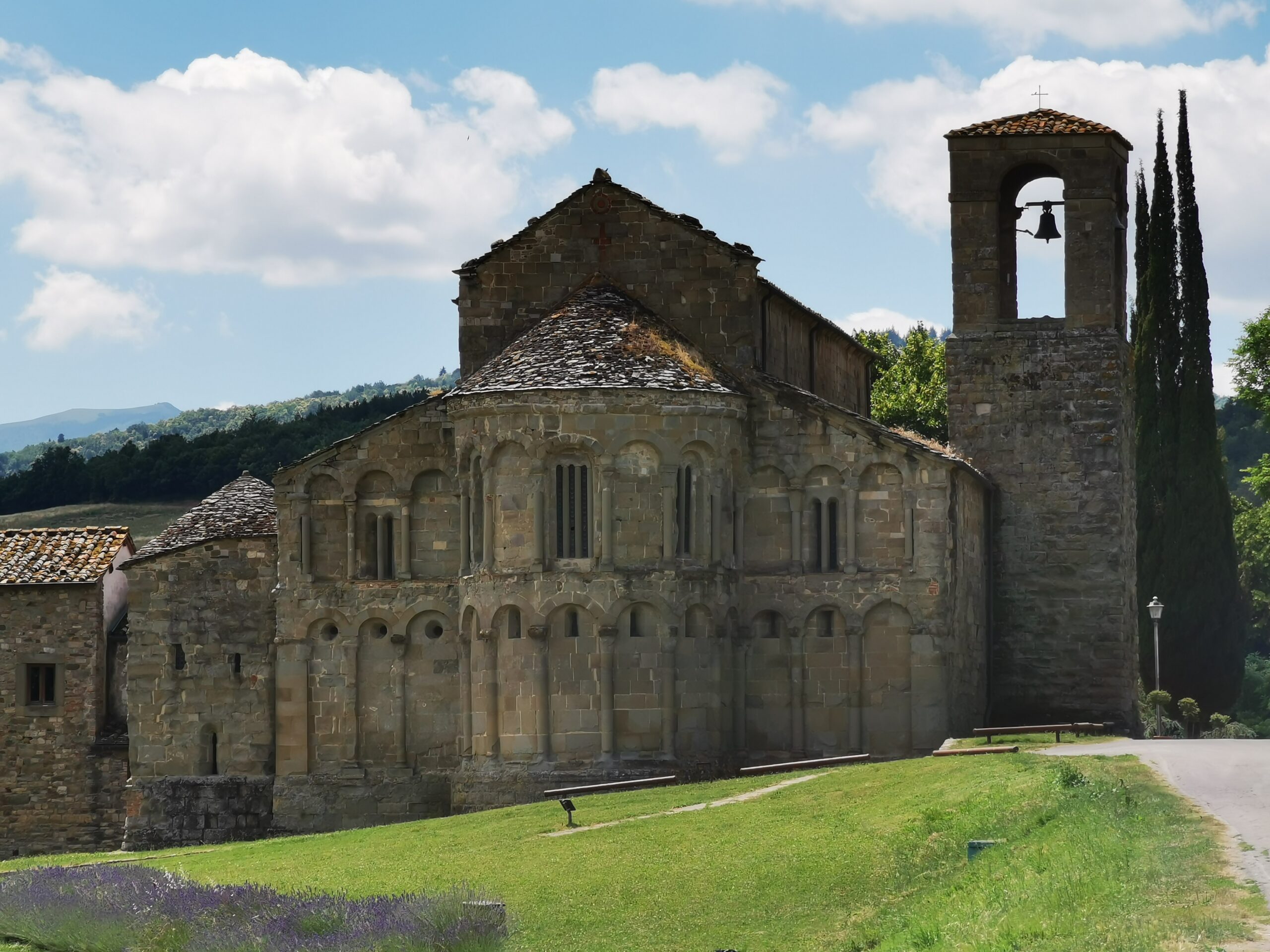
Less than two kilometers away, the Pieve di Romena (Pieve di San Pietro) is one of Tuscany’s most perfectly preserved Romanesque parish churches. Built in the twelfth century from local sandstone, it has a three-aisled nave with columns topped by extraordinary carved capitals — human and animal figures, stylised plants, and geometric motifs that reward close attention. The atmosphere is one of deep tranquility: the church sits in open countryside with views across the valley, home to the Fraternità di Romena community and best visited quietly.
Stia developed around its position at the confluence of the Arno and the Staggia stream, where water power drove the mills that processed wool. The Lanificio di Stia (Stia Wool Mill) was the industrial engine of the upper Casentino from its founding in 1852 until its closure in 2000. The tradition continues through small Stia producers such as Tessilnova and TACS, who make Panno Casentino using methods that combine historical techniques with modern equipment. The Museo dell’Arte della Lana (Museum of the Art of Wool, housed in the old mill complex) documents the history of Casentino wool production and of the Stia mill itself.
Paolo Uccello (Paolo di Dono, 1397–1475), the Florentine painter celebrated for his pioneering use of perspective — particularly the three panels of the Battle of San Romano — came from a Pratovecchio family: his father practised as a barber-surgeon here, though Paolo himself was probably born in Florence.
Monte Falterona (1,654 m), the second-highest peak of the Tuscan-Romagnol Apennines, after neighbouring Monte Falco (1,658 m), rises north of Stia. At roughly 1,350 m on its southeastern slope, a spring called Capo d’Arno marks the source of the river that will flow through Florence, past Pisa, and into the Tyrrhenian Sea. A plaque bearing Dante’s verses from Purgatorio XIV marks the spot. The hike from Stia takes approximately 3–4 hours to the summit; near the top, the Lago degli Idoli was an Etruscan worship site whose bronze votive offerings were scattered after their discovery in 1838; some are now in the British Museum and the Louvre.
What to See and Do
Pieve di Romena is the essential stop — arrive in the morning when the light enters the apse and the carved capitals are at their most legible. Free entry. The adjacent ruins of Castello di Romena (small entrance fee) offer views and a Dante connection. Between the two, a short walk on country roads through olive groves and pasture.
In Stia, visit the Museo dell’Arte della Lana to understand the Panno Casentino story, then walk to Piazza Tanucci — the town’s sloping, arcaded main square, overlooked by the Pieve di Santa Maria Assunta; across the Staggia stands the Palagio Fiorentino, a Guidi castle rebuilt in the early twentieth century that now hosts exhibitions. Ask at the museum which local workshops, such as Tessilnova on Via Sartori, currently sell Panno Casentino cloth directly — coats, scarves, blankets, and fabric by the meter in the classic orange, green, and other colors.
For hikers, the ascent of Monte Falterona to the Arno’s source is a memorable half-day or full-day excursion. The trail also connects to Mugello via the Croce ai Mori pass.
Eating Like a Local
Tortelli di patate, always. Stia has several restaurants and bars around Piazza Tanucci. In autumn, chestnut dishes dominate. Local food festivals liven up the town in summer and autumn; check the Pro Loco for the calendar.
Getting There and Getting Around
By car: From Poppi, 10 km north (~12 minutes). From Arezzo, 47 km (~45 minutes via SR71). From Florence, ~1.5 hours via the Consuma pass.
By train: Stia is the terminus of the LFI/TFT railway from Arezzo (about an hour; check the TFT timetable). Pratovecchio has its own station one stop before.
Nearby
- Poppi — 10 km south, the Guidi castle and valley’s visual icon
- Camaldoli — 20 km east, the ancient hermitage and monastery
- Monte Falterona — directly north, source of the Arno (3–4 hour hike from Stia)
- Mugello — connected via the Croce ai Mori pass (~40 minutes by car)
Information is provided in good faith and may change. Always confirm opening hours, prices, and event dates with the official source before you travel.