
Town · Garfagnana
Fabbriche di Vergemoli and Gallicano
A Cave That Breathes, a Cliff Hermitage
Last updated:
- Region
- Garfagnana
- Province
- Province of Lucca
- GPS
- 44.0341, 10.3575 (Grotta del Vento, Fornovolasco); 44.0667, 10.4333 (Gallicano)
- Best season
- Year-round for the cave (constant ~10.7 °C inside); May for pilgrimages to the hermitage
- Time needed
- Half day (one cave route plus the hermitage); full day with the longest cave route
- Difficulty
- moderate
- Known for
- Grotta del Vento show cave, Eremo di Calomini, Fornovolasco, Turrite di Gallicano valley, Trassilico
Across the Serchio from Barga, a narrow road climbs west from Gallicano up the valley of the Turrite di Gallicano stream. The Apuan Alps close in. The road gets steeper and tighter. At the end of it, two very different places wait inside the same limestone.
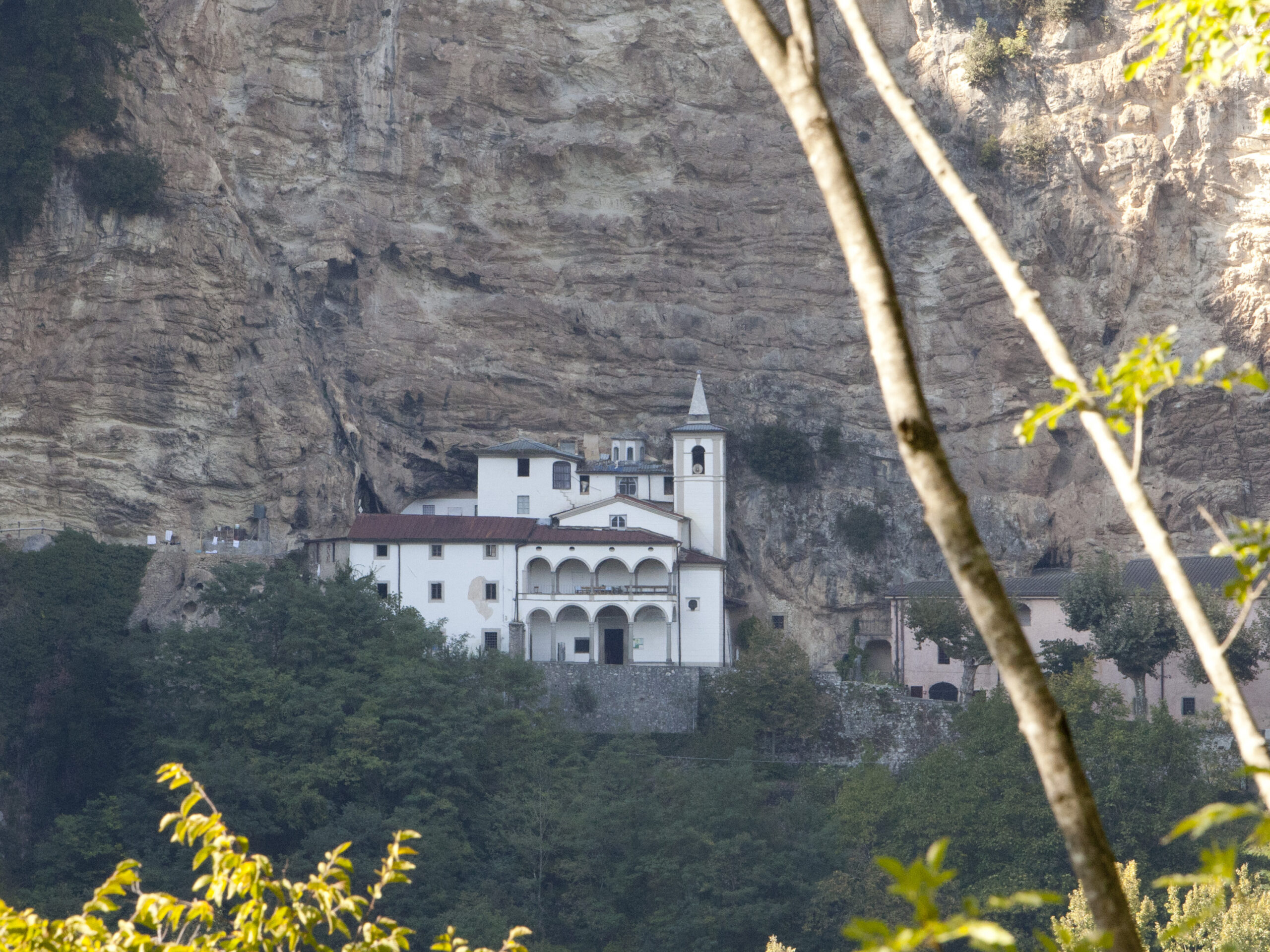
One is the Grotta del Vento (Cave of the Wind), one of Italy’s leading show caves. Air rushes between its two openings at different heights, which is how it got its name. The other is the Eremo di Calomini (Calomini Hermitage), a sanctuary carved into and leaning against a cliff face.
You can do both in half a day. Together they give you the Apuan Alps from the inside and from the edge.
A Place Shaped by Time
A cave that was explored, not discovered
In 1898 a four-year-old child squeezed a few meters inside. Florentine cavers explored the first 60 m in 1929, and the main system was opened up from 1961. The karst system runs for about 4.5 km, formed by water working through the Apuan limestone. The wind that gives the cave its name comes from the difference in air temperature and pressure between its two openings.
A hermitage in the rock
Tradition says the Madonna appeared here, and a wooden statue known as the Madonna della Penna is still venerated. Sources disagree on how early that story begins. The first document dates from 1361. From the 14th century the sanctuary was gradually enlarged against the cliff, and the double colonnade of its façade dates from the early 18th century.
Its custodians have changed many times. Hermits kept it until 1868. Later came parish priests, then Capuchin friars for much of the 20th century, and from 2011 other religious communities. Since June 1, 2023, the sanctuary has been in the care of Fratel Benedetto, a Cistercian hermit monk. Older guides that still mention the Capuchins are out of date.
Which municipality?
The Eremo is sometimes listed under Molazzana, but it belongs to Fabbriche di Vergemoli, a municipality formed by merging Fabbriche di Vallico and Vergemoli. The comune lists it among its own sights. The Grotta del Vento lies in the same municipality, at Fornovolasco.
What to See and Do
The Grotta del Vento
Visits are guided and follow three itineraries:
- Itinerary I: about 1 hour, 800 m, suitable for children
- Itinerary II: about 2 hours, 1,500 m, down to the underground stream
- Itinerary III: about 3 hours, 2,200 m, including a 90 m shaft and an underground canyon
Inside, the temperature stays at 10.7 °C with about 99% humidity all year. Bring a warm layer and shoes with grip, even in August.
The cave is open year-round except December 25, but times vary by season. Check current opening times and prices before you go.
Which route should you choose? If you have children or limited time, Itinerary I gives you the character of the cave. If you’re fit and curious, Itinerary III is the one people talk about afterward.
The Eremo di Calomini
The sanctuary of Santa Maria ad Martyres, known locally simply as “the Hermit,” sits against a sheer rock wall above the road to the Grotta del Vento. Its buildings are partly carved into the cliff. The setting is the point: a white façade on grey rock, with the valley falling away below.
It is a short, atmospheric visit and pairs naturally with the cave. May, the month traditionally dedicated to the Madonna, brings the most pilgrims. You can drive up and park, or walk up on local trails. Remember that this is an active place of worship, now cared for by a hermit monk. Keep your voice down. Opening varies by season, so check current visiting information with the comune before you go.
Fornovolasco
The small village at the cave is worth a short walk. It sits at the foot of the Pania della Croce, split in two by the Petrosciana stream, and has fewer than 100 residents. Its history is tied to iron: ore was mined and worked here for centuries. It is also a starting point for hikes to Monte Forato, the Apuan peak with a natural stone arch.
Trassilico
On a hilltop above Gallicano, at about 720 m, the village of Trassilico has an Este rocca (fortress). From 1430 it was the seat of a vicariate and the southern outpost of the Este lands in the Garfagnana. It’s another reminder that this whole valley was once Ferrara’s frontier. The walls and tower have been restored, and footpaths lead up from Gallicano. The view takes in both the Apennines and the Apuan Alps.
Eating Like a Local
This is chestnut and farro country, with trout from the mountain streams. Look for zuppa di farro, chestnut-flour necci with ricotta in autumn and winter, local trout, and porcini from the Apuan slopes.
For a wider choice of restaurants, plan lunch in Barga or Castelnuovo di Garfagnana.
Getting There and Getting Around
By car
From Gallicano, follow signs up the valley to Fornovolasco and the Grotta del Vento, about 12 km of mountain road. The road is narrow and winding, and it can be difficult in bad weather and winter. Allow extra time. The cave recommends setting your GPS to Gallicano, not to the cave, because satnavs can pick awkward back roads. The Eremo di Calomini is on the same road, so you pass it on the way to the cave.
By public transport
The nearest station is Barga–Gallicano (Mologno), on the Lucca–Aulla line. Buses up to the cave are limited and, according to the cave, run only during the school term. Check current routes and times before you go.
Timing
Book cave tours ahead in July, August, and on holiday weekends. Leave at least 30 minutes between a cave route and any fixed lunch booking.
Nearby
- Barga: the walled hill town across the valley, with its Scottish connection.
- Castelvecchio Pascoli: the poet Giovanni Pascoli’s last home.
- Castelnuovo di Garfagnana: the valley’s capital, farther north up the Serchio.
- Pania della Croce: the “Queen of the Apuan Alps” (about 1,858 m), for experienced hikers.
Information is provided in good faith and may change. Always confirm opening hours, prices, and event dates with the official source before you travel.