
Town · Garfagnana
Barga
Italy’s Most Scottish Town and Its Double Sunset
Last updated:
- Region
- Garfagnana
- Province
- Province of Lucca
- GPS
- 44.0750, 10.4817
- Best season
- July–August for festivals; January and November for the double sunset; spring and autumn for quiet walks
- Time needed
- Half day for the town; full day with Sommocolonia and Castelvecchio Pascoli
- Difficulty
- moderate
- Known for
- Scottish emigration, Duomo di San Cristoforo, the Monte Forato double sunset, Sommocolonia and Lt. John R. Fox, Barga Jazz, Casa Pascoli
Ask someone in Barga about their family, and the answer may well lead to Scotland. A grandparent who left for Scotland. A great-uncle who opened a fish-and-chip shop. Relatives who never came back.
Estimates of how many of Barga’s residents have Scottish relatives range from 40% to 60%. That’s why this medieval hill town above the Serchio calls itself “the most Scottish town in Italy.” It even has a red British telephone box in the center, now serving as a book exchange and billed as the smallest library in Tuscany.
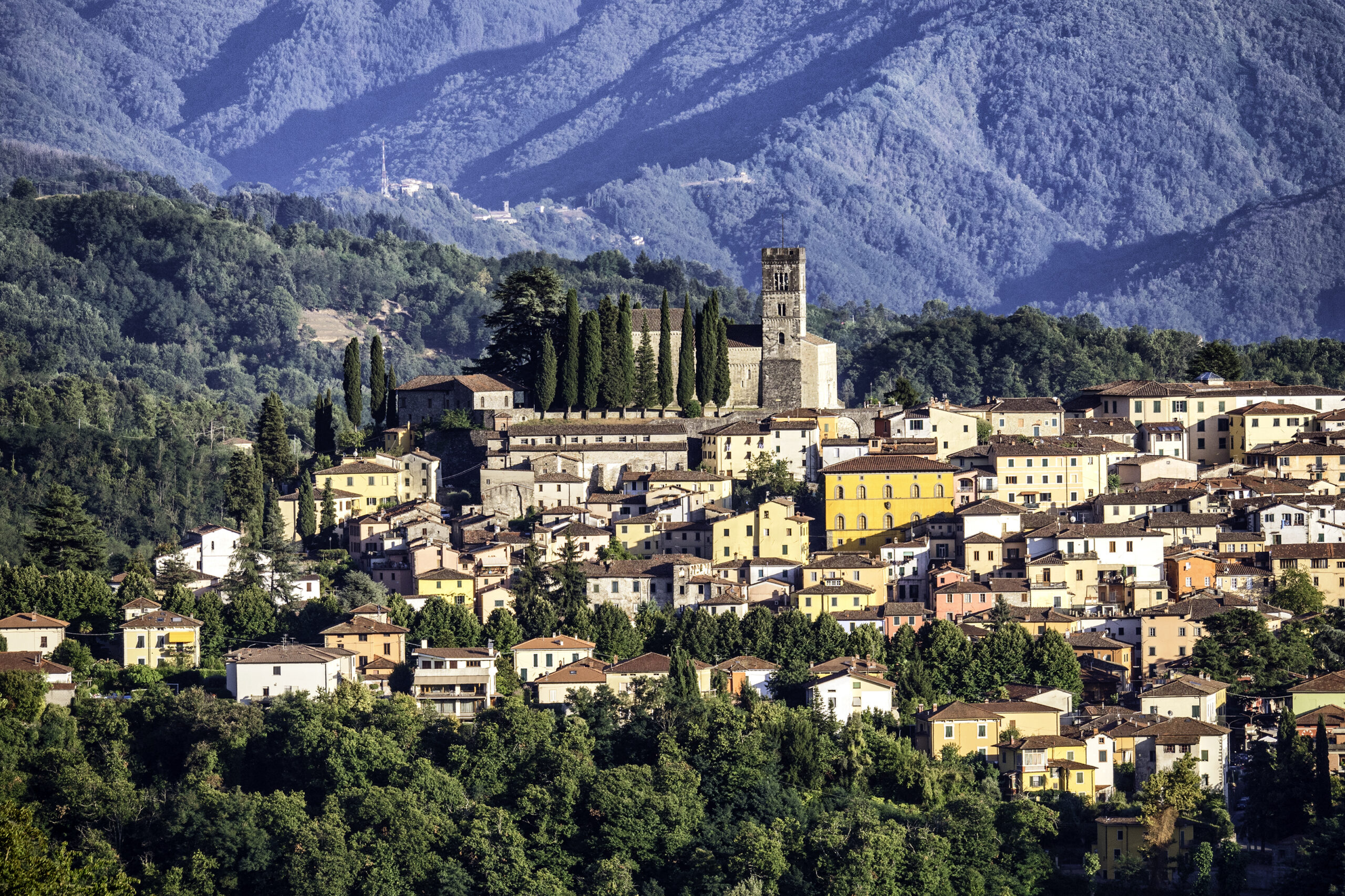
Barga is the best-known town in this part of the valley, and for good reason. It has a walled center on a steep hill, a Romanesque cathedral with a sweeping view, a serious summer music scene, and a sunset trick you can see only twice a year. Just above it, in the hamlet of Sommocolonia, is one of the most moving World War II stories in Tuscany.
A Place Shaped by Time
From Barga to Scotland
From the late 19th century, Barga’s people began to leave. Many Barghigiani went to Scotland. There they opened ice-cream parlors and fish-and-chip shops, businesses that became part of Scottish street life.
The ties have lasted. On April 15, 2024, Barga signed a friendship agreement with South Ayrshire. Every summer, the Sagra del Pesce e Patate (Fish & Chips Festival) celebrates the link with fried fish and potatoes.
Sommocolonia, December 1944
In the winter of 1944, the Serchio valley was a sector of the Gothic Line, Germany’s last major defensive line in Italy. On Christmas night, German troops infiltrated the hamlet of Sommocolonia, above Barga, some of them dressed as civilians. On December 26, they attacked.
First Lieutenant John R. Fox was an officer of the Cannon Company, 366th Infantry Regiment. He was serving as a forward observer with the 598th Field Artillery Battalion of the 92nd Infantry Division, the “Buffalo Soldiers.” It was the only African-American infantry division to see combat in Europe.
From his observation post in Sommocolonia, Fox directed artillery fire against the advancing Germans. As they overran his position, he called the fire down on his own location. “Fire it!” he told his commander. “There’s more of them than there are of us.” He was killed. The barrage killed about 100 German soldiers and slowed their advance.
A medal fifty years late
Fox received a Distinguished Service Cross in 1982. On January 13, 1997, President Bill Clinton presented the Medal of Honor posthumously to him and six other African-American World War II servicemen. His widow, Arlene Fox, accepted it.
About 25 Italian partisans fought alongside the Americans in Sommocolonia. The villagers later raised a monument to Fox and eight partisans who died defending the position. In 2000, they dedicated a peace park in memory of Fox and his unit.
What to See and Do
The Duomo di San Cristoforo
Barga’s cathedral stands at the top of the town, and the climb is part of the experience. The church dates back to before the year 1000 and was enlarged over the following centuries. Its walls are faced in Alberese di Barga, a pale local stone. Inside, look for the marble pulpit, attributed to the school of Guido Bigarelli da Como. It stands on four columns. The front two rest on lions, and one of the back columns rests on the bent back of an old man. Behind the high altar is a painted wooden statue of Saint Christopher.
The terrace in front looks out over the Serchio valley to the Apuan Alps on one side and the Apennines on the other. It’s the best free view in the Garfagnana.
The double sunset
Twice a year, in November and January, something odd happens from the Duomo terrace. The sun sets behind the Apuan ridge, reappears through the Monte Forato, a natural stone arch on the crest, and then sets again. The best days usually fall around November 11 and January 30, in the late afternoon. You need a clear sky, and the terrace fills up, so arrive early. Ask at the tourist office for the exact dates and time.
The walls and gates
Two medieval gates survive: Porta Reale and Porta Macchiaia. A third, the Porta di Borgo, was sold in 1835 and demolished for its stone. Enter through one gate, climb to the Duomo, and leave by the other.
Casa Museo Giovanni Pascoli
In the hamlet of Castelvecchio Pascoli, near Barga, is the house where the poet Giovanni Pascoli lived from 1895 until his death in 1912. It’s now a house museum owned by the Comune di Barga, and entry includes a guided tour. Pascoli is one of Italy’s best-loved poets, and this is where he chose to live and work away from the cities. Check current opening hours and tickets before you go.
Sommocolonia and La Rocca alla Pace
Drive up to Sommocolonia to see La Rocca alla Pace (Fortress to Peace). This peace park stands on the site of the village’s medieval fortress, where Fox died. It was inaugurated in 2000 in a spirit of reconciliation, and it remembers everyone who died in the battle. The village is small and quiet. Take your time.
Festivals
- Barga Jazz was founded in 1986 by Giancarlo Rizzardi and Bruno Tommaso as a composition and arranging competition for jazz orchestra. It runs every summer, with concerts at the 18th-century Teatro dei Differenti and around town. Check this year’s program.
- Opera Barga, founded in 1967, is known for Baroque opera, with Vivaldi a particular favorite. It has traditionally been staged in July at the Teatro dei Differenti.
- The Sagra del Pesce e Patate runs for several weeks in late July and August at the Stadio Moscardini.
Dates change every year. Check with the Comune di Barga before you plan around a festival.
Eating Like a Local
Barga’s food follows two traditions. The first is Garfagnana mountain cooking: zuppa di farro, chestnut-flour necci with ricotta, biroldo in winter, and pane di patate. The second, in summer, is fried fish and potatoes at the Sagra del Pesce e Patate, a Scottish-Italian dish in a Tuscan hill town.
In the old town, Scacciaguai (Via di Mezzo 23) is a well-reviewed restaurant run by a brother and sister. For coffee and pastries, Pasticceria Fratelli Lucchesi on Piazzale Matteotti is one of the town’s most highly rated stops.
Getting There and Getting Around
By train
The Barga–Gallicano station lies in the valley below, at Mologno, on the Lucca–Aulla line. There is also a station at Fornaci di Barga. From either station, you’ll need a bus or taxi up to the old town. Check train times and local buses. Castelvecchio Pascoli has its own stop on the same line.
By car
From Lucca, follow the SS12 north. At Chifenti, near Borgo a Mozzano, branch onto the SS445 up the Serchio valley. Turn off for Barga at Fornaci di Barga. Park outside the walls. Car access to the historic center is restricted, so check the current rules before you drive in.
Getting to Sommocolonia
Sommocolonia is a hamlet of Barga, reached by a road that climbs uphill from the town.
Nearby
- Fabbriche di Vergemoli and Gallicano: the Grotta del Vento and the Calomini hermitage, across the valley.
- Castelvecchio Pascoli: the poet Giovanni Pascoli’s last home.
- Borgo a Mozzano and Coreglia: the Devil’s Bridge and the plaster-figurine museum, down the valley.
- Castelnuovo di Garfagnana: the Garfagnana’s capital, further up the valley.
Information is provided in good faith and may change. Always confirm opening hours, prices, and event dates with the official source before you travel.