
Town · Garfagnana
San Romano in Garfagnana
A Fortress Where the Past Talks Back
Last updated:
- Region
- Garfagnana
- Province
- Province of Lucca
- GPS
- 44.1667, 10.3500 (San Romano)
- Best season
- Late spring to early autumn (check the fortress's current opening season); summer for the Orecchiella
- Time needed
- Half day (fortress visit plus lunch); full day with the Orecchiella
- Difficulty
- moderate
- Known for
- Fortezza delle Verrucole Archeopark, living history, Este military architecture, Orecchiella nature reserve, farro processing
Most castle museums in Italy follow the same script. You buy a ticket, walk through empty rooms, and read laminated panels. Maybe there’s a touch-screen.
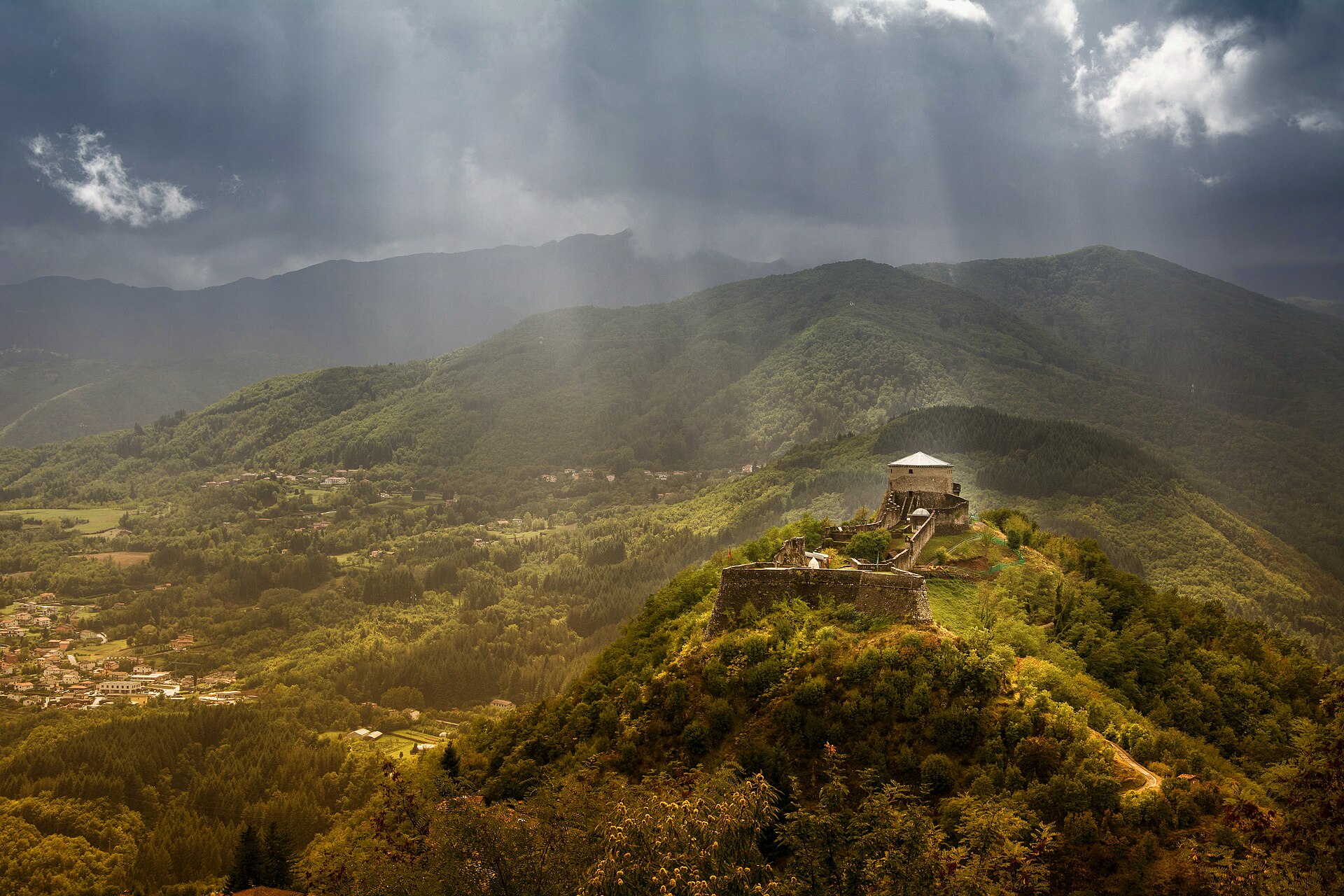
The Fortezza delle Verrucole takes a different approach. On a 600 m hill above San Romano in Garfagnana, guides in period dress lead you through a restored Renaissance citadel. Along the way, staff demonstrate the civilian and military activities of the garrison, and you are encouraged to handle objects rather than read about them. The whole point is that you talk to people.
It sounds like it could be kitsch. In practice, it’s one of the most engaging historic sites in the Garfagnana, and little known outside Italy. San Romano itself is a small, quiet municipality of about 1,300 people. It is also home to the cooperative that processes much of the valley’s farro, and to the Orecchiella nature reserve.
A Place Shaped by Time
From counts to dukes
The fortress began with the Gherardinghi, a local family of counts. After long struggles with Lucca’s northward expansion, it passed to the Republic of Lucca at the end of the 13th century.
When the Garfagnana went over to the House of Este in the 15th century, Verrucole became one of their key strongholds. The Este rebuilt it as a Renaissance citadel with two separate strongholds at either end of the hill: the Rocca Tonda (round keep) and the Rocca Quadra (square keep). Its perch on a rocky spur made it very hard to attack.
Working in pairs
Verrucole was not built to stand alone. Together with the Este fortress at Camporgiano, on the opposite side of the river, it controlled the main route into the upper Garfagnana. If you visit both, you’ll see the logic of the valley’s defense.
Ariosto was here
The poet Ludovico Ariosto, governor of the Garfagnana from 1522 to 1525, is documented at Verrucole on August 1, 1524. His usual seat was the fortress at Castelnuovo, but the job took him all over a valley he never managed to pacify.
From ruin to Archeopark
By the mid-1700s the fortress had lost its military importance, and it later passed into private hands. The municipality bought it in 1986 and began a long, conservative restoration. In the early 2010s it opened to the public as the Fortezza Verrucole Archeopark.
What to See and Do
The Fortezza delle Verrucole
Visits are guided. Guides in period dress take you through the keeps, the walls, and the working spaces of the garrison, with demonstrations of daily life along the way. Weather permitting, you may see the nearly 10 m reconstructed trebuchet in action. It works well for families, and adults usually end up asking as many questions as the children.
Opening days, hours, prices, and booking change by season. The fortress also runs themed events, such as evening storytelling walks in summer. Confirm this season’s opening times with the Archeopark before you go, using the events and booking contacts on its website, and book ahead on summer weekends.
The Orecchiella
The Riserva Naturale dell’Orecchiella, a state nature reserve managed by the Carabinieri biodiversity service, lies in the municipality of San Romano. Its visitor center has a nature museum, a birds-of-prey museum (Casa dei Rapaci), and a local history museum. Outside, there are enclosures with mouflon, roe deer, and bears, plus a mountain garden.
The bears you’ll see here live in an enclosure. The wild predator is the Apennine wolf, and you are very unlikely to see one. Check the visitor center’s current season and hours before you go.
The botanical garden
The Giardino Botanico “Maria Ansaldi” at 1,370 m holds about 400 native plant species. It lies in the territory of neighboring Villa Collemandina, just above the Rifugio Isera, and you can reach it on foot or by car. Go in early summer for the flowers. Check the garden’s current opening season before you go.
Eating Like a Local
Farro at the source
San Romano is home to Garfagnana Coop, which processes and packs Farro della Garfagnana IGP. The consortium that protects the IGP is based at the same site. Farro here is not a trendy grain. It’s the crop your neighbors grow. Order zuppa di farro (farro soup with beans) or farrotto (farro cooked like risotto) wherever you eat.
What to look for
Biroldo (the spiced sausage of pig’s head and blood) in winter, pane di patate (potato bread), and the upper valley’s chestnut dishes in autumn.
Getting There and Getting Around
By train
Villetta–San Romano station is on the Lucca–Aulla line, two stops north of Castelnuovo di Garfagnana. The fortress is uphill from the station, so plan on a taxi or a walk. The line has had long maintenance closures in recent summers. Check current timetables and RFI’s planned works notices for Tuscany before you travel.
By car
From Castelnuovo, follow the valley road north toward Piazza al Serchio and turn off for San Romano and Verrucole. San Romano is about 11 km from Castelnuovo, roughly 15 minutes by car. Follow signs for the Archeopark parking, then walk up.
For the Orecchiella
The reserve lies higher on the Apennine side. Mountain roads are narrow, and some can be affected by snow in winter.
Nearby
- Camporgiano and Piazza al Serchio: Verrucole’s partner fortress and the heart of farro country.
- Castelnuovo di Garfagnana: Ariosto’s fortress and the valley’s capital.
- Villa Collemandina and Corfino: Villa Collemandina was the epicenter of the 1920 earthquake; Corfino is the base for the Pania di Corfino.
- Sillano Giuncugnano: the upper-valley municipality whose high fields grow prized potatoes for the valley’s potato bread.
Information is provided in good faith and may change. Always confirm opening hours, prices, and event dates with the official source before you travel.