
Town · Garfagnana
Castiglione di Garfagnana
Lucca’s Island in Enemy Territory
Last updated:
- Region
- Garfagnana
- Province
- Province of Lucca
- GPS
- 44.1508, 10.4117
- Best season
- Spring (including Holy Week) to autumn
- Time needed
- 2–3 hours
- Difficulty
- moderate
- Known for
- 14th-century walls and Rocca, Lucchese enclave inside Este territory, church of San Michele, Crocioni Holy Thursday procession, Borghi più Belli d'Italia
Most Tuscan walls were built to keep a distant enemy out. Castiglione di Garfagnana‘s were built to keep the neighbors out.
For centuries, this hill town, whose municipality now has about 1,700 people, was a Lucchese outpost surrounded by the Este duchy. The valley below answered to Ferrara. Castiglione answered to the Republic of Lucca. The border ran through the Garfagnana itself, and Castiglione’s walls stood on the Lucca side of it.
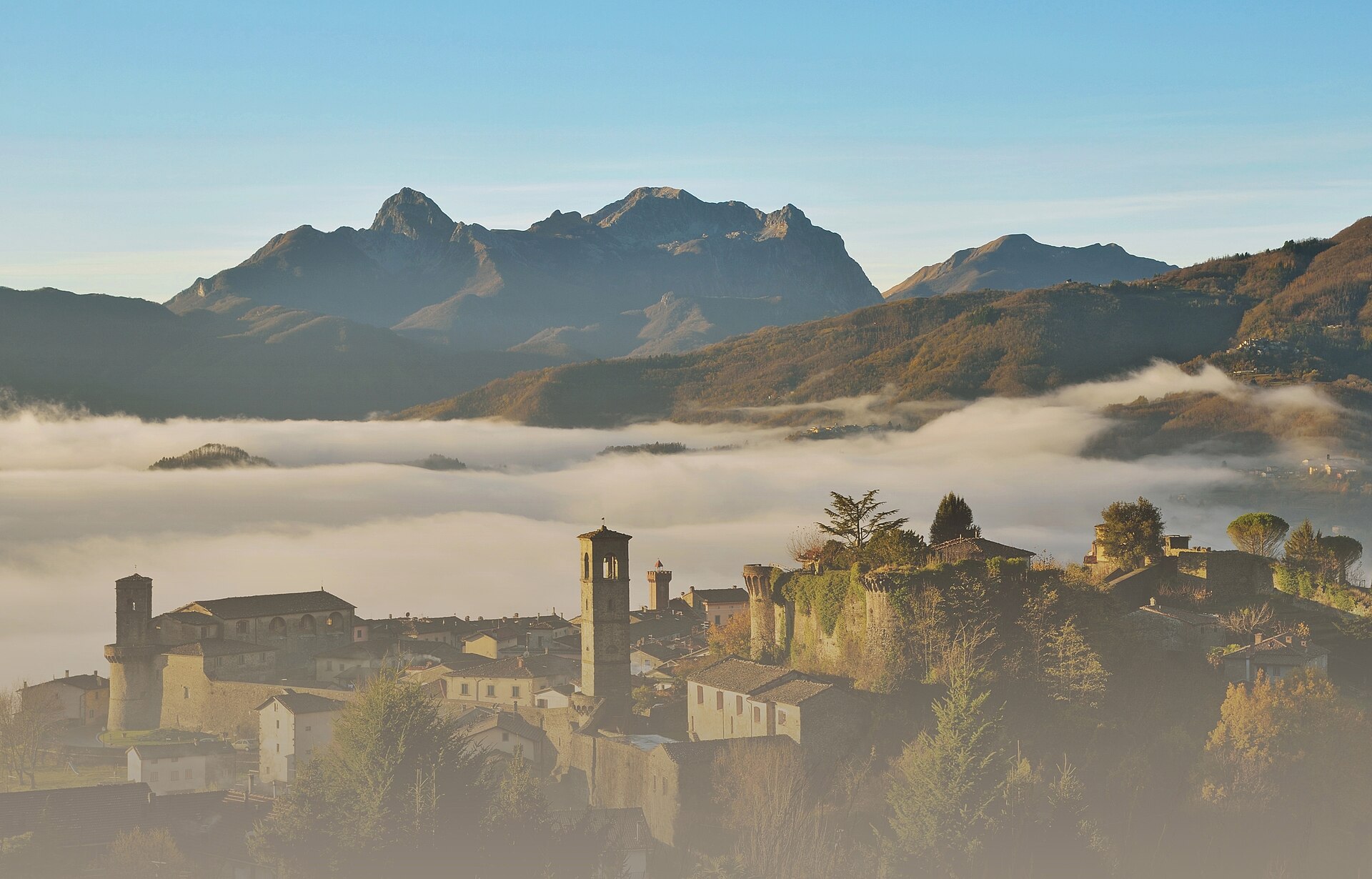
That odd political history left behind one of the best-preserved fortified villages in northern Tuscany. The medieval walls still wrap tightly around the village, the Rocca still crowns the hill, and the lanes inside feel lived-in rather than restored for show. Castiglione has been a member of I Borghi più Belli d’Italia (Italy’s most beautiful villages association) since 2011, and for once the label is earned.
A Place Shaped by Time
The frontier castle
Lucca regained Castiglione in 1371 and rebuilt it as a frontier stronghold. The powerful walls and the Rocca date from then: a circuit of about 750 m, with towers linked by curtain walls. Later works strengthened it further.
When the rest of the valley went over to the Este in the 15th century, Castiglione stayed Lucchese. Local historians call it “an island of Lucca in the Este province of the Garfagnana.” It stayed that way through the 17th century, a small Lucca-loyal outpost in the middle of Este territory.
A vow from 1631
In 1631, plague swept through the region. Castiglione credited the Madonna with sparing the town and made a vow of thanks. It is still kept at the Festa del Regalo (Feast of the Gift) on the first Sunday of the year. A child of Castiglione, no older than seven, offers gold, incense, and myrrh to the Madonna.
A myth to correct
Some English-language sources mention a “Palio of Castiglione.” We could not confirm any such event here. It appears to be a confusion with Castiglion Fiorentino, near Arezzo, which does hold a palio. The best-known ceremonies of Castiglione di Garfagnana are religious, and quieter.
What to See and Do
The walls and the Rocca
Start by walking the outside of the walls, then go in through the gate and climb toward the Rocca, with its three great towers. The walls are the reason you came. They are remarkably intact for a medieval circuit, and the views from the upper lanes run across the Garfagnana valley.
The church of San Michele
Inside San Michele (officially Santi Michele e Pietro) you’ll find a Madonna col Bambino (Madonna and Child) painted by Giuliano di Simone da Lucca in 1389. It is the only panel the artist signed and dated. It’s a rare survival of 14th-century Lucchese painting in a village church, which is exactly where you’d least expect it. Look also for the carved crucifix attributed to the Master of the Camaiore Crucifix, a follower of Giovanni Pisano.
Palazzo del Parlamento
A Renaissance palazzo from 1509, built as the seat of Lucca’s vicar and the local assembly. It now houses municipal offices. Look at it from the outside as part of your walk through the lanes.
The Crocioni
This is the reason to plan a visit around Holy Week. On the evening of Holy Thursday, the Mass in San Michele includes the washing of the feet and a reenactment of Judas’s betrayal and Christ’s arrest. Then, late in the evening, a barefoot man playing Christ carries a wooden cross through the village, with chains on his feet.
He falls and rises three times along the way, to the sound of drums. His identity is kept secret. The Arciconfraternita del SS. Sacramento (Confraternity of the Blessed Sacrament) chooses him, and few people know who he is. It is a penitential rite, not a performance. If you attend, dress quietly, stay back, and leave the flash off. Check the comune website for this year’s program.
Eating Like a Local
Castiglione is small. Most visitors combine a morning here with lunch in Castelnuovo, about 10 minutes’ drive down the valley. The historic Osteria Vecchio Mulino there serves tasting boards of Garfagnana cured meats and cheeses.
This is also farro and chestnut country. In autumn, look for necci (chestnut crêpes with ricotta) at local festivals. In winter, look for biroldo, the spiced sausage of pig’s head and blood that is a Slow Food Presidium.
Getting There and Getting Around
By car
Castiglione lies on the Apennine side of the valley, about 7 km north of Castelnuovo di Garfagnana, a drive of roughly 10 minutes. The road, the SS324, continues up to the Passo delle Radici (1,529 m) and over into the province of Modena.
By public transport
There is no train station in Castiglione. The nearest is Castelnuovo di Garfagnana, on the Lucca–Aulla line. Autolinee Toscane buses run between Castelnuovo and Castiglione. Check current bus timetables before you go.
Parking
Park outside the walls and walk in. A car park opened in 2022 just below the Porta degli Inferi gate. The lanes inside are steep and narrow and not for cars.
Nearby
- Castelnuovo di Garfagnana: the Este capital and Ariosto’s fortress, just down the road.
- Passo delle Radici: the pass into Emilia (1,529 m). Its small ski lifts have been closed for years, but it is a base for cross-country skiing and snowshoeing in winter.
- San Romano and the Fortezza delle Verrucole: one of the Este strongholds on the other side of the old border.
- Pieve Fosciana: the small lake of Prà di Lama, fed by warm underwater springs.
Information is provided in good faith and may change. Always confirm opening hours, prices, and event dates with the official source before you travel.