
Town · Garfagnana
Borgo a Mozzano and Coreglia
The Devil’s Bridge and the Figurine Makers
Last updated:
- Region
- Garfagnana
- Province
- Province of Lucca
- GPS
- 43.9853, 10.5525 (Ponte della Maddalena, Borgo a Mozzano); 44.0644, 10.5264 (Coreglia Antelminelli)
- Best season
- Year-round; October for Halloween; summer for the museum's longer hours
- Time needed
- 1 hour for the bridge; half day with Coreglia and the Gothic Line sites
- Difficulty
- moderate
- Known for
- Ponte della Maddalena (Devil's Bridge), Halloween festival, Gothic Line fortifications, Museo della Figurina di Gesso e dell'Emigrazione, Prosciutto Bazzone
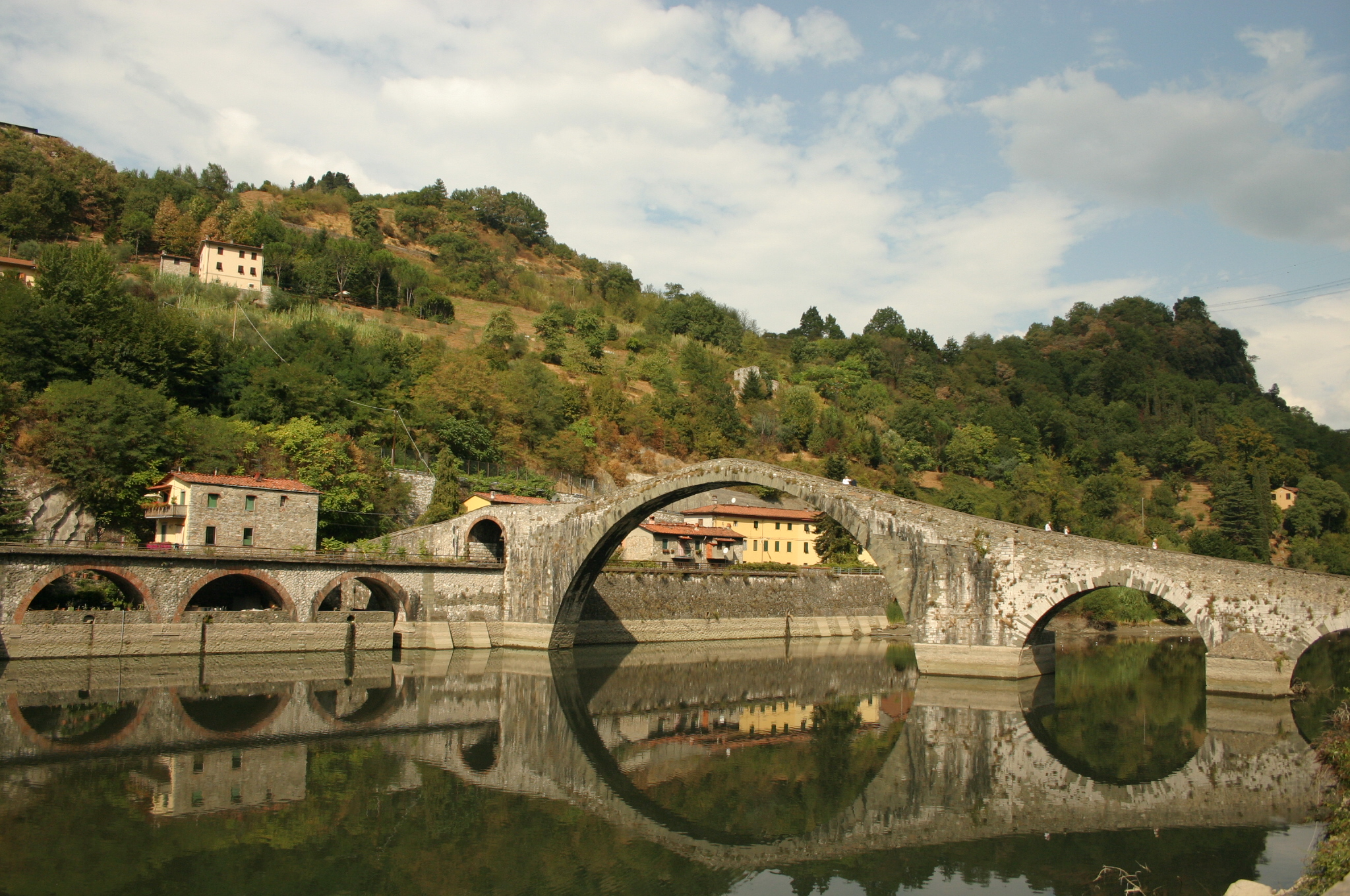
On the road north from Lucca, almost everyone stops at the same place. A stone bridge leaps over the Serchio in one enormous, lopsided hump. Its largest arch spans about 38 m. It looks less built than bent. Locals have always had a simple explanation: the Devil did it.
The Ponte della Maddalena at Borgo a Mozzano is the gateway to the Garfagnana. Most people photograph it and drive on. That’s a mistake. Stay an hour or two and the lower valley opens up: German bunkers in the hills, a town that throws one of Italy’s biggest Halloween parties, and, up the hill in Coreglia Antelminelli, a museum that tells how a mountain village exported plaster figurines to the world.
A Place Shaped by Time
A bridge for the countess
The Ponte della Maddalena was probably commissioned by Countess Matilda of Canossa around 1080–1100. She ruled much of Tuscany at the time. It was reshaped in the early 14th century under Castruccio Castracani, lord of Lucca. A flood in 1836 damaged it badly, and around 1900 a new arch was opened on the western side to let the Lucca–Aulla railway pass.
The Devil’s bargain
Everyone calls it the Ponte del Diavolo (Devil’s Bridge). The best-known legend goes like this. The master builder was running late and was desperate. The Devil offered to finish the bridge in a single night. His price: the soul of the first living thing to cross. The parish priest outwitted him by sending a dog across first. The furious Devil threw himself into the river and was never seen again.
The figurinai
From the 1600s onward, the Serchio valley, and Coreglia above all, sent out figurinai. These were makers and sellers of plaster figurines. They traveled far from home to sell their work, and many emigrated for good.
It was a hard, itinerant trade, and it spread a humble Tuscan craft across the world. That’s why Coreglia’s museum is about emigration as much as about plaster.
The Gothic Line
In 1944–45, the Gothic Line ran through the municipality of Borgo a Mozzano. Sections of the German fortifications are still well preserved.
What to See and Do
The Ponte della Maddalena
Walk across it, slowly. The steep climb to the top of the main arch is the best way to feel how odd the structure is. Then walk down to the riverbank and look at it side-on. Morning light is best for photos. The bridge stands right beside the main road.
Gothic Line fortifications
Near the chapel of the Madonna di Mao, a German anti-tank wall about 2.5 m high survives, reinforced by two casemates. At Anchiano, bunkers linked by tunnels are dug into the rock below the medieval castle. The bunkers are well camouflaged and easy to miss, so a guided visit is the best way to see them. It’s a quiet, sobering outing, and a good counterpoint to the Sommocolonia story in Barga. Ask the Comune di Borgo a Mozzano about guided visits.
Halloween in Borgo a Mozzano
Since 1994, Borgo a Mozzano has hosted a Halloween celebration now billed as Italy’s largest free-entry party. It is themed around the Devil’s Bridge and the legend of the noblewoman Lucida Mansi, who, the story goes, sold her soul to the Devil to stay young. Recent editions have ended with a procession to the bridge. Expect crowds, costumes, and traffic. Check this year’s program on the comune website.
Museo della Figurina di Gesso e dell’Emigrazione, Coreglia
The “Guglielmo Lera” Civic Museum of the Plaster Figurine and Emigration opened in 1975. It occupies Palazzo Vanni, once owned by Baron Carlo Vanni, a figurine maker who lived for many years in the Austro-Hungarian Empire. The collection holds about 1,300 plaster pieces from the 1600s to today, along with the molds and tools of the trade.
Audio guides are available in Italian, English, and French. Hours are longer in summer. Check current opening hours before you go. The address is Via del Mangano 17, tel. +39 0583 78082.
It’s a small museum with a big story. Allow an hour, and ask about the routes the figurinai walked.
Eating Like a Local
Prosciutto Bazzone
At Piano di Coreglia, Antica Macelleria Nutini is one of the producers in the Slow Food Presidium for Prosciutto Bazzone. This long, jutting ham gets its name from bazza, a protruding chin. It comes from pigs raised in semi-wild conditions and fed on farro, apples, pears, chestnuts, acorns, and whey. The hams can reach 16–18 kg after aging, mature for at least 24 months, and are cut by knife. If you buy one thing to take home, make it this. Check the shop’s website for opening times.
What else to look for
Chestnut-flour necci and castagnaccio in autumn, and zuppa di farro year-round.
Getting There and Getting Around
By car
Borgo a Mozzano lies on the SS12 north of Lucca. The bridge is right beside the main road. Coreglia Antelminelli is a steep drive up from the valley floor, north of Borgo a Mozzano.
By train
Borgo a Mozzano and Ghivizzano–Coreglia both have stations on the Lucca–Aulla line. From Ghivizzano, Coreglia’s historic center is uphill, so a taxi or bus helps. Check train times and local buses.
During Halloween
Expect road closures and packed car parks on the peak days. Take the train if you can.
Nearby
- Bagni di Lucca: the thermal town of the Lima valley, a short drive from the bridge.
- Barga: the walled hill town with the Scottish connection, further up the Serchio.
- Castelvecchio Pascoli: the poet Giovanni Pascoli’s last home.
- Lucca: the walled city, a short drive south.
Information is provided in good faith and may change. Always confirm opening hours, prices, and event dates with the official source before you travel.