
Town · Garfagnana
Castelnuovo di Garfagnana
The Capital a Poet Couldn’t Govern
Last updated:
- Region
- Garfagnana
- Province
- Province of Lucca
- GPS
- 44.1219, 10.4056
- Best season
- Year-round; September (historic fair) and October (chestnut season) are the highlights
- Time needed
- Half day for the town; ideal as a multi-night base
- Difficulty
- easy
- Known for
- Rocca Ariostesca, Ludovico Ariosto, Fortezza di Mont'Alfonso, Thursday market, September fair since 1430, Garfagnana food shops
In February 1522, one of the most celebrated poets in Europe arrived in a small mountain town to take up a post that would make him miserable. Ludovico Ariosto had written Orlando Furioso, the great chivalric romance of the Italian Renaissance. Now his employer, Duke Alfonso I d’Este, needed someone to restore order in the Garfagnana. Ariosto got the posting.
He spent three years in Castelnuovo di Garfagnana, writing letters about feuding factions and roaming bandits. He arrived with ten crossbowmen. Within two years he was asking to be moved.
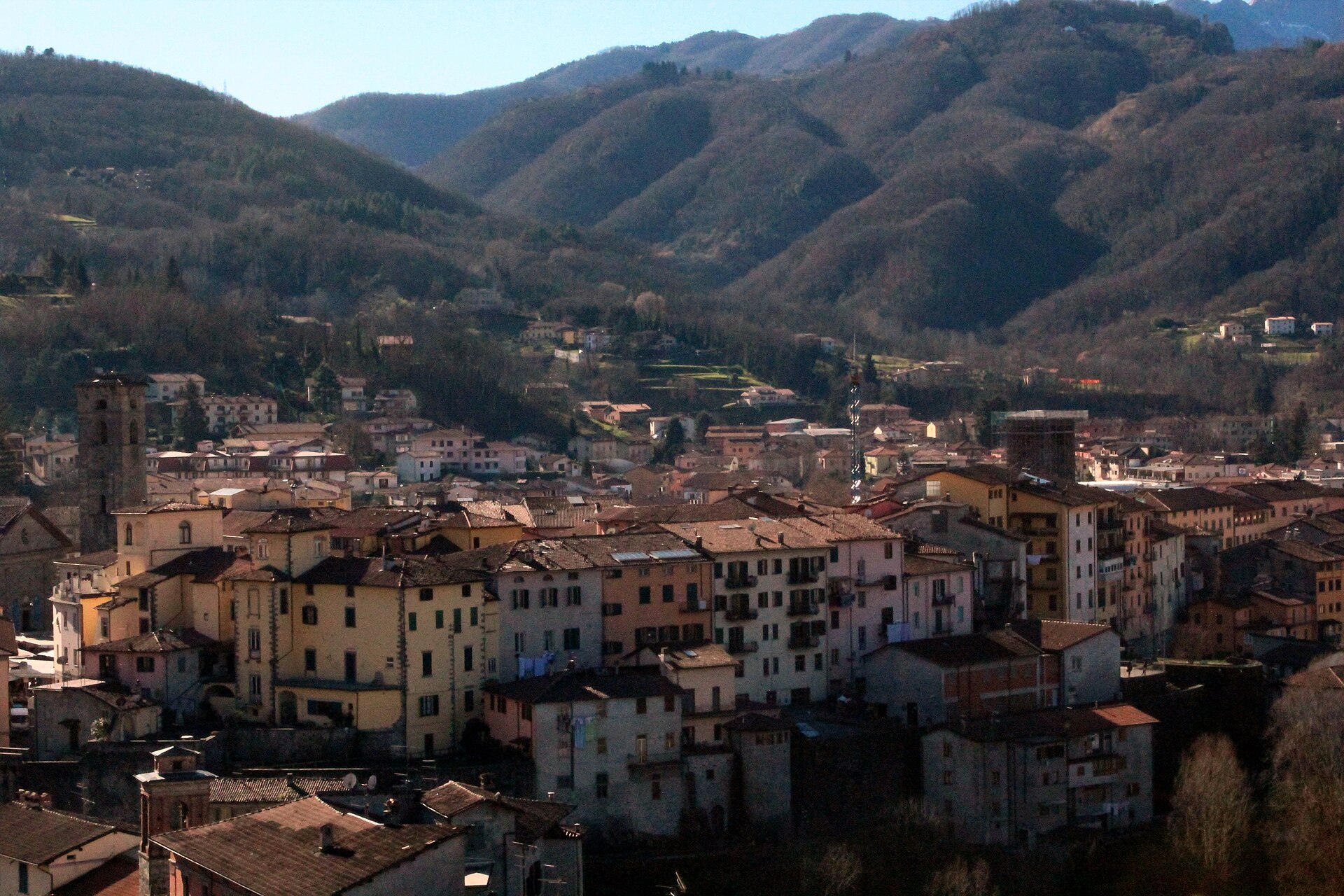
Today Castelnuovo is a busy, unpretentious market town of about 5,600 people at the meeting of the Serchio river and the Turrite Secca stream. It is not the prettiest village in the valley. It is, however, the one that makes the rest of the valley make sense. The fortress, the market, the food shops, and the railway station are all here, and most roads in the Garfagnana eventually pass through.
A Place Shaped by Time
The town that chose Ferrara
Castelnuovo was the first Garfagnana community to hand itself to the House of Este of Ferrara, in 1429–30. The reasons were practical. With Florence pushing into the region, the town looked to Ferrara for protection. The rest of the valley’s communities followed over the next two decades, and in 1452 the Garfagnana became an Este province with Castelnuovo as its capital.
Local tradition dates both the Thursday market and the September fair to 1430 and the rule of Niccolò d’Este. Nearly six centuries later, both still run.
Ariosto’s unhappy governorship
Ariosto took office as ducal commissioner on February 20, 1522. He governed from the fortress on the main square, now called the Rocca Ariostesca in his honor. His letters to the duke describe a grinding daily struggle. Two rival factions, one pro-French and one pro-papal, fought each other openly. Bandits controlled the roads. His crossbowmen were poorly paid, and there was only one trained judge in the whole province.
He asked to be transferred in January 1524 and left in 1525. It is one of literature’s odder episodes: the poet of knights and enchantments reduced to chasing highwaymen through chestnut woods. Another poet, Fulvio Testi, later served as governor from 1640 to 1642.
War and rebuilding
The Serchio valley lay on the Gothic Line in 1944–45. Between July 1944 and April 1945, Castelnuovo was hit by about 70 air raids. Some 80% of its buildings were damaged, the Rocca and the Duomo among them, and around 4,000 people lost their homes. Much of the center you walk through today was rebuilt after the war.
What to See and Do
Rocca Ariostesca and the Museo Furioso
The fortress dominates Piazza Umberto I. A small stronghold stood here as early as the 10th century. The present structure dates from the 12th century, was enlarged in the early 1300s under the Lucchese lord Castruccio Castracani, and gained its central tower and civic clock under Paolo Guinigi. The terrace over the square and the monumental arch were added in 1675.
Since 2024, the Rocca has housed Il Palazzo di Atlante – Museo Furioso (the “Furious Museum”). It is a multimedia, scenographic exhibition about Orlando Furioso and about Ariosto’s own years as governor here. The immersive installation in the tower needs a reservation. Check current hours, prices, and booking before you go.
The Rocca is also the home of the Museo Archeologico del Territorio della Garfagnana (Archaeological Museum of the Garfagnana), with finds from the Mesolithic through the Ligurian-Apuan, Etruscan, and Roman periods. The provincial museum network has listed it as temporarily closed for renovation, so check its current status first.
The Duomo
The Duomo dei Santi Pietro e Paolo is a 16th-century church with a Renaissance façade and a Baroque interior. It was built over an older Romanesque church and lost its roof in the Second World War. It’s a short walk from the Rocca and worth ten minutes.
Fortezza di Mont’Alfonso
On the hill just outside town stands the fortress that Duke Alfonso II d’Este built between 1579 and 1586. Its walls run for about 1,150 m, with seven bastions. Today it is a green space and cultural venue that hosts summer concerts and, in autumn, a castagnata (chestnut feast). A footpath, the Sentiero dell’Ariosto, circles the walls. The walk up gives you the best view of Castelnuovo and the Apuan Alps behind it. Check current opening times for the grounds before you go.
Teatro Vittorio Alfieri
A small town theater inaugurated in 1860 and reopened in 2006 after restoration. Check the program if you’re staying a few nights.
Market day
Come on a Thursday morning if you can. It’s a working local market, not a tourist show. The historic fair fills the streets and squares on the first Sunday of September, with a traditional tombola run by the Pro Loco. Check the comune website for this year’s program.
Eating Like a Local
Osteria Vecchio Mulino
The Osteria Vecchio Mulino on Via Vittorio Emanuele is a historic osteria from the early 1900s, with its old marble counters and wooden shelves still in place. It works as a tasting room for Garfagnana products and wine. Expect boards of local cured meats and cheeses, crostini, and savory tortes, not a full hot menu. Ask what’s local and in season.
Da Carlino
The Albergo Ristorante Da Carlino on Via Garibaldi is a hotel restaurant in the center. It’s an option if you want a full sit-down dinner rather than a tasting board.
What to order
- Zuppa di farro: farro soup with beans and vegetables, the valley’s signature dish
- Necci: chestnut-flour crêpes filled with ricotta, in autumn and winter
- Biroldo: the spiced sausage of pig’s head and blood, a Slow Food Presidium, sliced and eaten with chestnut or potato bread (made October–April)
- Pane di patate: the soft Garfagnana potato bread, dusted with cornmeal, from any good bakery
Getting There and Getting Around
By train
Castelnuovo is on the single-track, non-electrified Lucca–Aulla line, about an hour from Lucca. The line has had long maintenance closures in recent summers. Check current timetables and RFI’s planned works notices for Tuscany before you travel.
By car
From Lucca, follow the SS12 and then the SR445 “della Garfagnana”: about 46 km, allow roughly 50 minutes to an hour.
Parking
Paid parking covers the central streets and squares, including Piazza delle Erbe, Via Vittorio Emanuele, Via Garibaldi, and Via Farini. Piazza della Repubblica and Piazzale del Genio are in a cheaper tariff zone. Everything in the center is within a few minutes’ walk. Check the signs where you enter and the comune website for current traffic rules.
As a base
Castelnuovo sits at the center of the valley. Castiglione, San Romano, Barga, and Vagli Sotto are all within about 20 minutes by car.
Nearby
- Castiglione di Garfagnana: Lucca’s walled enclave, a short drive up the Apennine side.
- San Romano and the Fortezza delle Verrucole: the Este citadel turned living-history museum.
- Vagli Sotto and Careggine: the lake over the drowned village, via Poggio.
- Pieve Fosciana: the small thermal lake of Prà di Lama and the long-running Ristorante Il Pozzo, next door to Castelnuovo.
- Barga: the walled hill town of the middle valley.
Information is provided in good faith and may change. Always confirm opening hours, prices, and event dates with the official source before you travel.