
Town · Garfagnana
Bagni di Lucca
Where the English Came to Take the Waters
Last updated:
- Region
- Garfagnana
- Province
- Province of Lucca
- GPS
- 44.0094, 10.5794
- Best season
- Spring and early autumn; summer for the cool river valley and the Orrido di Botri (open June–September)
- Time needed
- Half day; full day with the Orrido di Botri
- Difficulty
- moderate
- Known for
- Thermal springs, the old Casinò, English Cemetery, Anglican church (now the town library), Ponte delle Catene, Byron and the Shelleys, Orrido di Botri
In the 19th century, if you were English, cultured, and could afford to escape the Tuscan summer, you went to Bagni di Lucca. The spa town in the cool, wooded valley of the River Lima had everything a Victorian traveler wanted: hot springs, society, a casino, and, eventually, its own Anglican church.
The guest list reads like a syllabus. Montaigne came in 1581 to treat his kidney stones. Later came Byron, Percy and Mary Shelley, Heinrich Heine, Giosuè Carducci, Giovanni Pascoli, and Eugenio Montale. Musicians followed: Paganini, Mascagni, and Puccini.
Today Bagni di Lucca is quieter, a little faded, and all the more interesting for it. It sits just off the main road into the Garfagnana, a few minutes from the Devil’s Bridge. Most visitors drive past. Take the turning.
A Place Shaped by Time
Ancient waters
Local tradition says the springs were known in Roman times, though they fell out of use after Rome’s collapse. The hot water still flows.
Elisa’s makeover
The town’s golden age began in the early 19th century under Elisa Baciocchi, Napoleon’s sister, who ruled Lucca from 1805 to 1814. She renovated the thermal establishments and made Bagni di Lucca the summer seat of her court. After her, the fashionable stayed.
The English colony
What followed was an unusually self-contained foreign community. In 1837 the town opened a casino, often billed locally as the first in Europe. Its present building, designed by Giuseppe Pardini, dates from 1839. Pardini also designed the Anglican church, completed in 1841. Because of local opposition, he gave it the look of an “English house” rather than a church. In 1842 the English Cemetery was authorized, a Protestant burial ground for the foreign community.
The cemetery is the most touching trace of that world. About 137 people rest there. They include the novelist Ouida (Maria Louise Ramé), one of the best-selling English writers of the Victorian era, and Rose Cleveland, sister of US President Grover Cleveland.
What to See and Do
The English Cemetery
Walk among the headstones and read the names of people who came for the season and never left. Ouida’s tomb is the one most people come to find. The cemetery stands about 300 m from the Anglican church, on the other side of the Lima. Burials ended in 1953, and the gates are not always open. Ask the Comune di Bagni di Lucca about access before you go.
The Anglican church
The former church now houses the town’s public library, the Biblioteca Comunale Adolfo Betti. It keeps about 1,000 volumes from the church’s original collection.
The Casinò and the old spa quarter
The casino building still stands as a reminder of the town’s social peak, but it has been closed and unused for years. You can see it only from outside. Stroll through the spa quarter to see the 19th-century villas and hotels.
The thermal baths
The historic Terme Jean Varraud at Bagni Caldi has been closed since 2021. In 2026 the comune approved a public-private plan to restore and reopen it, but no reopening date has been set. The nearby Terme Bagno Bernabò is open, with thermal baths, mud treatments, and a steam grotto. Check current hours and treatments before you go.
Ponte delle Catene
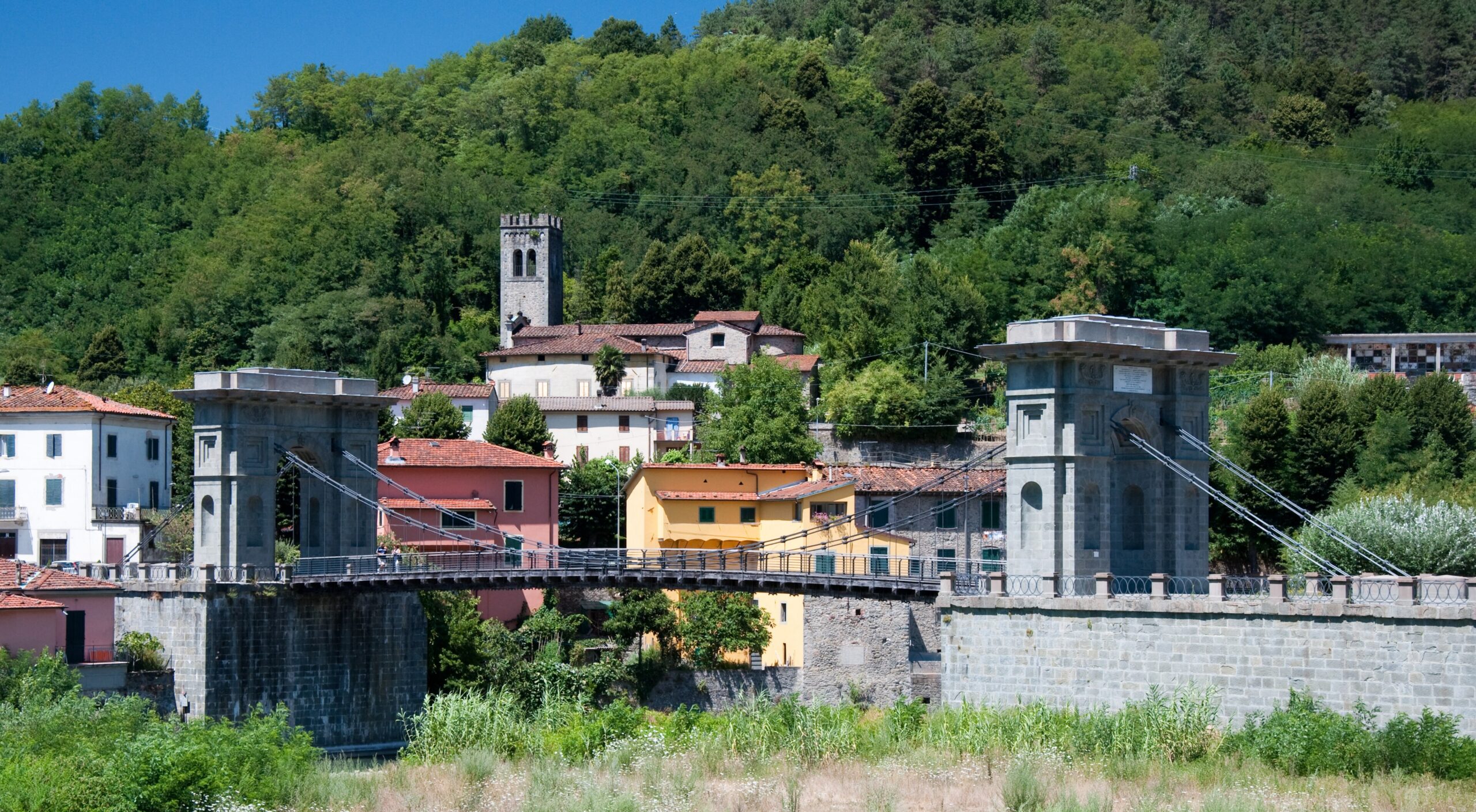
The Ponte delle Catene (Chain Bridge) is a 19th-century suspension bridge over the Lima, linking Fornoli and Chifenti. The Lucchese architect Lorenzo Nottolini traveled to England to study suspension bridges before he designed it. Work began in 1840, and the bridge was finished by 1860. Retreating German troops destroyed its wooden deck in World War II. After a restoration, it reopened to pedestrians in August 2023. It’s an elegant piece of engineering and a pleasant short walk.
The Orrido di Botri
In the mountains of the municipality, in the upper Val Fegana, the Orrido di Botri is a deep limestone gorge carved by the Rio Pelago. Its walls rise up to 200 m. It’s a wild, cold place and a real contrast to the genteel spa below. The reserve is managed by the Carabinieri Biodiversity Unit and opens only in summer. You walk in the streambed, so you’ll need a helmet and trekking shoes. Guided visits are available, and numbers are capped. Check this year’s rules and calendar before you go.
Eating Like a Local
Bagni di Lucca sits between the Lucca lowlands and the Garfagnana, and its food takes from both. Look for chestnut dishes in autumn: necci with ricotta, castagnaccio, and polenta di neccio. Farro soup appears on most menus.
Getting There and Getting Around
By car
From Lucca, take the SS12 north. Just past Borgo a Mozzano and the Devil’s Bridge, stay on the SS12 as it follows the Lima valley east. Bagni di Lucca is spread along the river in several parts, so a car helps.
By public transport
Bagni di Lucca station, on the Lucca–Aulla line, is at Fornoli, on the Serchio. It is not in the spa quarter, which lies further up the Lima valley. Check train times and bus routes.
Combining it
Bagni di Lucca pairs easily with Borgo a Mozzano and Coreglia for a half day on the way into or out of the Garfagnana.
Nearby
- Borgo a Mozzano and Coreglia: the Devil’s Bridge and the plaster-figurine museum, minutes away.
- Barga: the walled hill town of the middle valley.
- Lucca: the walled city, south down the valley.
- Orrido di Botri: the limestone gorge in the mountains of the municipality.
Information is provided in good faith and may change. Always confirm opening hours, prices, and event dates with the official source before you travel.