
Itinerary · 4 days · Colline Metallifere
4 Days in the Colline Metallifere
Mines, Moonscapes and the Sea
Last updated:
- Duration
- 4 days / 3 nights
- Best season
- Late May (Balestro crossbow tournament + warm weather + uncrowded coast) or September (warm sea + harvest + comfortable hiking)
- Budget
- Mid-range (€70–160/night; €20–35/person for meals)
- Best for
- Couples, culture travelers, families (Day 4 coast), anyone wanting Tuscany beyond the postcard
- Driving required
- Yes — essential for the full itinerary
This itinerary moves from the medieval hilltop interior through geothermal moonscapes and mining-heritage villages, then descends to the coast — following the same trajectory as the minerals that once traveled from mine shafts to the maritime loading points on the Gulf of Follonica. Each day has a distinct character: art and architecture, fire and geology, memory and landscape, water and sand.
Day 1: Massa Marittima — Art Above the Mines
Full day in Massa Marittima
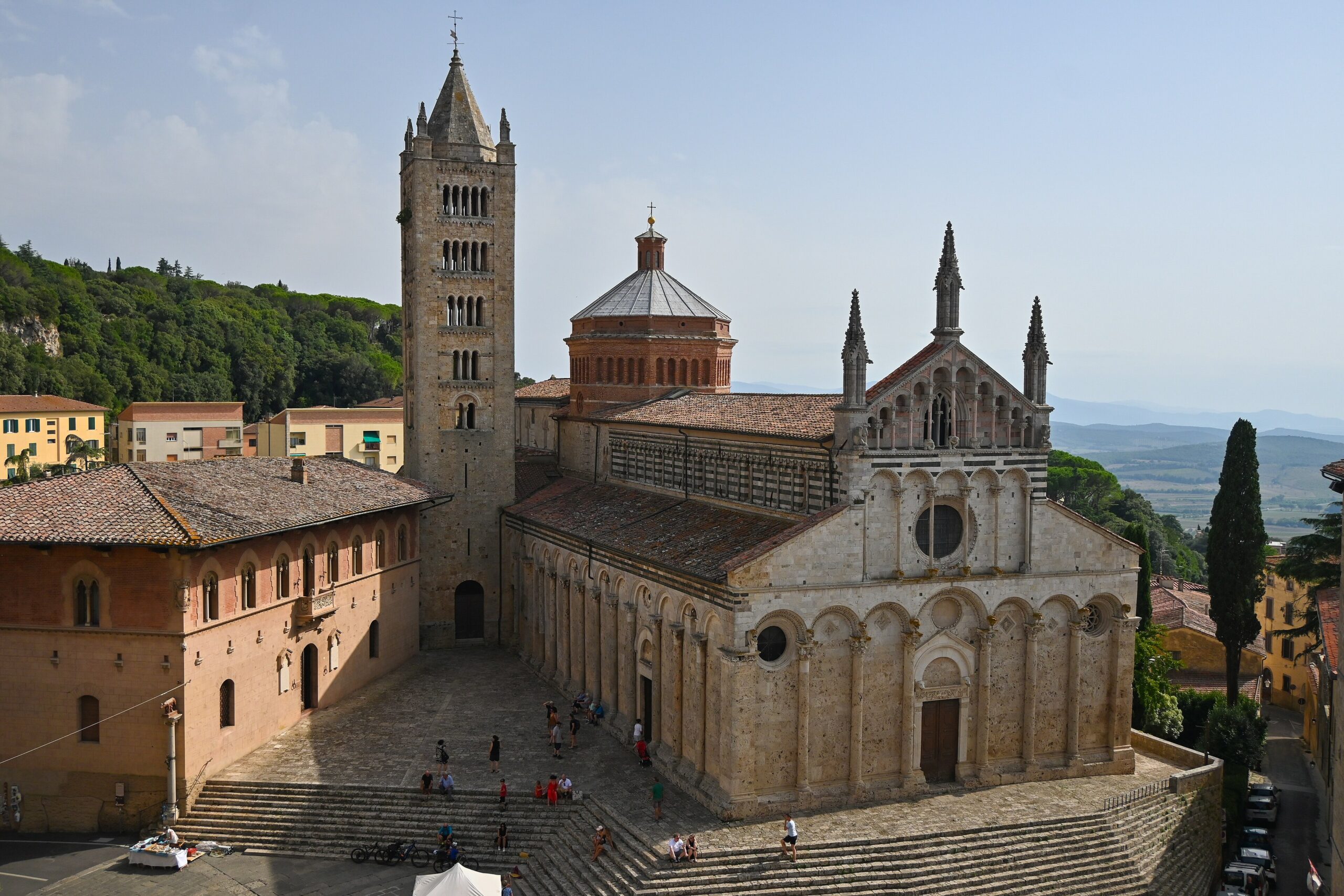
Morning: Arrive and park near Piazza XXIV Maggio. Walk up to Piazza Garibaldi — the cathedral on its diagonal podium, the morning light catching Giovanni Pisano’s Gothic upper façade. Visit the Cathedral of San Cerbone interior: the Madonna delle Grazie attributed to Duccio, the Arca di San Cerbone by Goro di Gregorio, the baptismal font on four lionesses. Then the Museo di San Pietro all’Orto for Ambrogio Lorenzetti’s Maestà. Allow 2 hours for both.
Mid-morning: The Fonti dell’Abbondanza for the Tree of Fertility fresco — 25 phalluses on a tree, eight women arguing beneath it. Brief but memorable.
Lunch: Trattoria in the streets off Piazza Garibaldi. Tortelli maremmani (ricotta-spinach, three sides sealed) with wild boar ragù. Monteregio di Massa Marittima DOC red.
Afternoon: Climb Via Moncini to the Città Nuova. The Torre del Candeliere for the view and the story of the Sienese cutting it down by a third. Walk the Arco Senese — the 21-meter flying arch connecting tower to fortress. Then descend to the Museo della Miniera for a 50-minute guided underground tour at a constant 12°C (bring a layer).
Evening: If visiting on a Balestro day (the fourth Sunday of May or August 14), the crossbow tournament and costumed procession fill the piazza from late afternoon. Otherwise, an evening passeggiata through the Città Vecchia, dinner at a local restaurant.
Sleep: Massa Marittima — agriturismo in the surrounding hills or a hotel in the centro storico.
Day 2: Fire and Copper — The Geothermal Interior
Monterotondo Marittimo → Montieri → Boccheggiano
Morning: Drive 20 minutes to Monterotondo Marittimo. Walk the Le Biancane geothermal park — free, always open. The short fumarole loop takes about an hour: steam jets, bubbling mud, bleached white formations, the Lagone Cerchiaio crater. If the weather is misty, even better — the geothermal steam and the fog merge into something primordial. Add the MUBIA GeoMuseo (€4) for the scientific context.
Lunch: Picnic brought from Massa Marittima (Monterotondo has limited dining), or drive to Montieri for a simple meal.
Afternoon: Drive 15 minutes to Montieri. Walk the stone alleys of the village. If the excavation site of the Canonica di San Niccolò (Italy’s only six-apsed church) is accessible, visit; otherwise, the story is context for what comes next. Follow the chestnut forest path to the Buca delle Fate — the medieval silver mine entrance (30-minute walk). Then drive to Boccheggiano for the red roste (copper-scoria heaps) and the ruined medieval gates. If time allows, continue to Gerfalco for the most remote hamlet in the Colline Metallifere — population roughly 60, no cell signal guaranteed, views of the Cornate di Gerfalco massif.
Evening: Return to Massa Marittima for dinner, or eat at a trattoria in Montieri if you can find one open.
Sleep: Massa Marittima or an agriturismo near Montieri for deeper immersion.
Day 3: Memory and Stone — The Mining Villages
Roccastrada → Gavorrano → move to coast base
Morning: Drive 30 minutes to Roccatederighi — the village where houses grow from rhyolite boulders. Walk the streets, photograph the integration of architecture and geology. Then drive to Montemassi — the ruined castle recognizable from the Simone Martini fresco in Siena (or at least from the fresco traditionally attributed to Simone Martini — the debate is part of the experience). Both villages take about 45 minutes each.
Optional detour: Ribolla (15 minutes south of Roccastrada) for the Monumento al Minatore and the memory of the 1954 mining disaster — a sober stop, but an honest one.
Lunch: A village trattoria in the Roccastrada area, or pack a lunch and eat in the landscape.
Afternoon: Drive to Gavorrano (20 minutes south). Visit the Parco Minerario — the underground gallery and the Ravi-Marchi ore-processing plant. If the Teatro delle Rocce is hosting a performance (check the summer schedule), buy tickets. If not, the empty quarry amphitheater is worth seeing for its scale alone. Walk to the Salto della Contessa viewpoint for the Pia de’ Tolomei landscape.
Late afternoon: Drive to your coastal base — Follonica (15 minutes) or a Scarlino agriturismo. Check in, decompress, and prepare for a beach day.
Dinner: Seafood in Follonica — the coast changes the menu from wild boar to fish.
Sleep: Follonica or Scarlino area.
Day 4: Sand and Sea — The Coast
Cala Violina → Scarlino fortress → Follonica
Morning: Cala Violina — book your reservation in advance (www.calaviolinascarlino.it, €1 per person, maximum 700 per day). Park at Val Martina (€10). Walk the 1.5-kilometer path through the macchia to the beach. Arrive early (before 10:00) for the best space and the clearest singing-sand effect on dry sand. Swim, read, listen to the beach.
Lunch: Picnic on the beach (no facilities at Cala Violina — bring everything) or walk the 6-kilometer Sentiero delle Scogliere cliff path to Cala Martina for a different cove and the Garibaldi escape memorial.
Afternoon — Option A: Return via the path and drive to Scarlino village. Climb to the Rocca Pisana for the pentagonal fortress and the views to Elba and Corsica. The village itself rewards 30 minutes of wandering.
Afternoon — Option B: Skip Scarlino and drive to Follonica. Visit the Chiesa di San Leopoldo — the cast-iron columns, the cast-iron Madonna — and the MAGMA museum (€5) in the former furnace. End with a gelato on the Pratoranieri seafront.
Evening: Final dinner — seafood in Follonica, with a Vermentino from the Monteregio DOC. The Colline Metallifere end where they began: at the sea that carried the copper, the pyrite, and the iron to the wider world.
Practical Tips for This Route
Car rental is essential. Distances between towns are 15–30 minutes, but public transport between the hill towns is virtually nonexistent (only Follonica–Massa Marittima has a regular bus).
Booking priorities: Cala Violina summer reservations should be made days in advance for weekends, especially in July–August. The Museo della Miniera in Massa Marittima is guided tours only — check the schedule and arrive on time. The MUBIA GeoMuseo in Monterotondo has limited hours — verify before driving.
What to pack: A warm layer for the Museo della Miniera (12°C underground). Comfortable shoes for Le Biancane (uneven volcanic ground). Everything for a beach day at Cala Violina (no facilities — water, food, sunscreen, towel). Cash for small villages (Montieri, Gerfalco — no guaranteed ATMs).
Budget: Mid-range. Agriturismo stays, trattoria meals and museum tickets are generally cheaper here than in Chianti or Florence. Cala Violina needs a paid reservation and parking in summer; check the current rates when you book.
Festival timing: Late May catches the Balestro del Girifalco — plan Day 1 around it. Early August catches Lirica in Piazza, the second Balestro, and the Teatro delle Rocce summer program. September avoids all crowds and combines warm sea with perfect hiking weather.
Information is provided in good faith and may change. Always confirm opening hours, prices, and event dates with the official source before you travel.