
Town · Colline Metallifere
Monterotondo Marittimo
Walking on a Volcano
Last updated:
- Region
- Colline Metallifere
- Province
- Province of Grosseto
- GPS
- 43.1482, 10.8640
- Best season
- Year-round (the geothermal features are permanent; dramatic in mist or rain); May–June and September for comfortable hiking
- Time needed
- 2–4 hours (short Biancane loop 1 hour; full Anello delle Biancane to Sasso Pisano ~2.5 hours; add MUBIA GeoMuseo)
- Difficulty
- easy
- Known for
- Parco Naturalistico Le Biancane (free geothermal park), fumaroles, MUBIA GeoMuseo, world's first geothermal energy, boreal heather at its southern limit
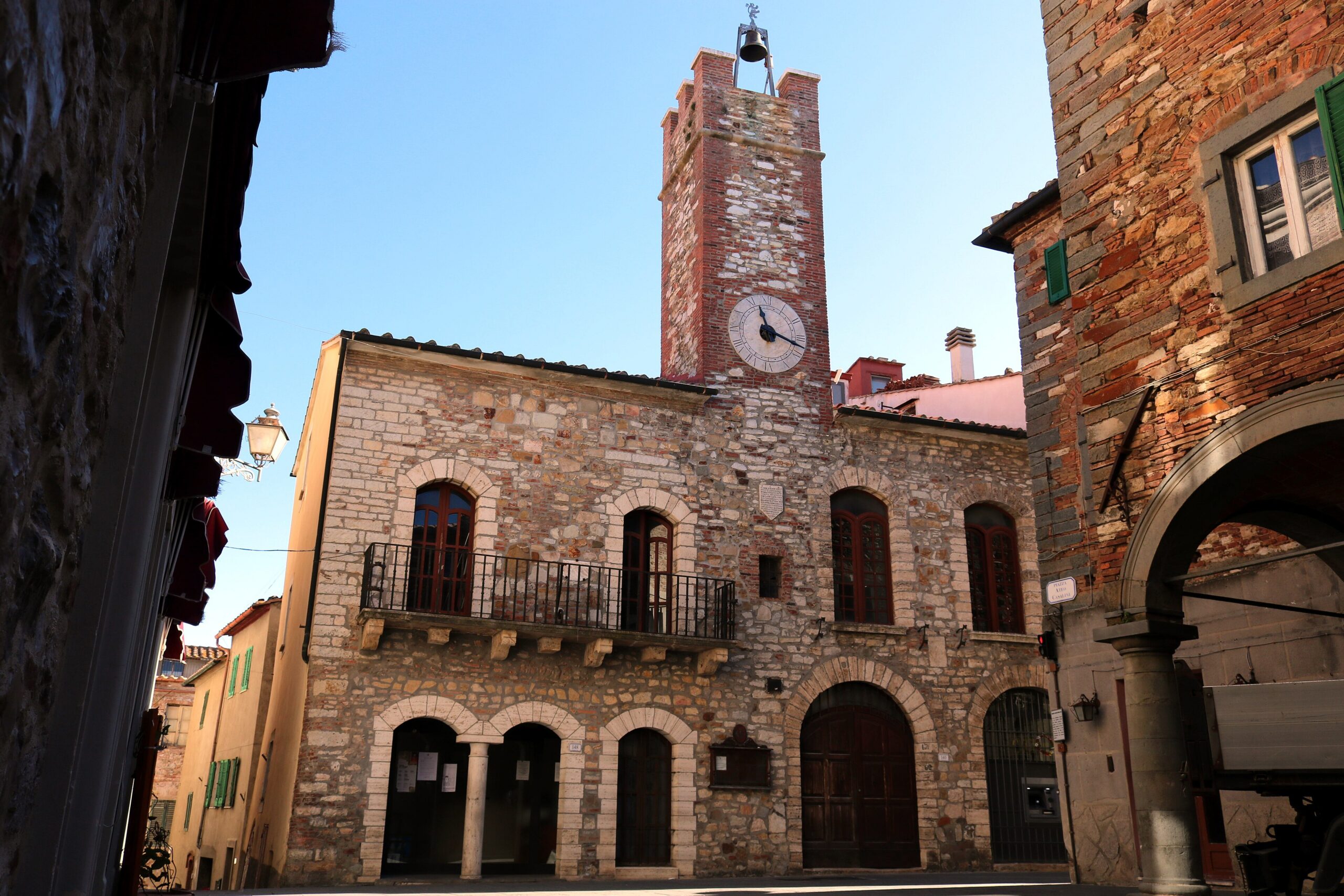
There is no adequate way to prepare someone for Le Biancane. You park outside a small Tuscan hill village — stone walls, a bar, a church — and walk five minutes down a marked path. Then the earth starts steaming.
Fumaroles jet from rock fissures with a hiss. Putizze vent hydrogen sulfide with the sharp, metallic smell of deep geology. Bulicami — mud pools — bubble slowly, grey and viscous, at close to boiling point. The rock beneath your feet is bleached brilliant white where hydrogen sulfide has transformed red limestone into gypsum — the biancane that give the park its name. Underground, temperatures exceed 200°C. You are walking on the roof of the same geothermal system that feeds the Larderello power district, and the only thing between you and it is a few hundred meters of Tuscan geology.
The Parco Naturalistico Le Biancane is free. It is always open. There is no ticket booth, no guided-tour requirement, no fence around most of the features. You simply walk among active geothermal manifestations that, anywhere else in Europe, would be inside a fenced-off national park with a €25 entry fee. This combination — extraordinary visual drama, zero cost, total accessibility — makes Le Biancane arguably Tuscany’s most remarkable free attraction. That almost nobody outside Italy has heard of it is one of those failures of English-language travel writing that this article exists to correct.
A Place Shaped by Fire
Monterotondo Marittimo sits at 539 meters on the western edge of the Colline Metallifere, about 20 kilometers from Larderello — the epicenter of Italy’s geothermal industry. The volcanic geology that produces the fumaroles at Le Biancane extends across the entire district, and the history of its exploitation is a story of world firsts.
The geothermal phenomena have been known since antiquity. In 1777, the chemist Hubert Franz Höfer discovered boric acid at the Lagone Cerchiaio, a crater-like pool at Le Biancane that reaches 100–150°C — a discovery that launched the industrial exploitation of the region’s chemistry. On July 4, 1904, Prince Piero Ginori Conti tested the world’s first geothermal energy generator at Larderello, lighting five bulbs. By 1913, the first commercial plant was operational. These hills are where humanity learned to turn the earth’s heat into electricity.
The village itself is small — roughly 1,270 people — and pleasant without being architecturally remarkable. A few stone streets, a modest piazza, views across the hills. The real attraction is beneath and around it.
What to See and Do
Le Biancane geothermal park
The short loop through the most concentrated fumarole area takes about one hour and is suitable for anyone comfortable on uneven ground. Boardwalks and marked paths keep visitors at a safe distance from the hottest vents, though “safe distance” here is relative — you can feel the heat on your skin from two meters away, and the smell of sulfur is inescapable.
The key features along the short loop: the fumarole field (steam jets from rock cracks, some with visible sulfur crystallization), the bleached biancane formations, and several bubbling mud pools. The Lagone Cerchiaio — the historical crater pool — is the most dramatic single feature.
The full Anello delle Biancane extends the walk to Sasso Pisano — a hamlet in the neighboring commune — covering about 7 kilometers in 2.5 hours. This longer route passes through mixed geothermal and forested landscape, including patches of heather (Calluna vulgaris) that thrive in the acidic soil created by the sulfur emissions.
Le Biancane is dramatic in any weather. On clear days, the steam plumes stand white against blue sky. On misty or rainy days, the entire landscape dissolves into a primordial fog where it becomes genuinely impossible to distinguish geothermal steam from cloud. Winter visits have a particular intensity — fewer people, lower air temperatures making the steam more visible, and a sense of isolation that amplifies the strangeness.
MUBIA GeoMuseo
The MUBIA (Museo delle Biancane), housed in a converted former power station, opened in 2019 and offers a multimedia introduction to the geothermal system. The centerpiece is the GeoNave — a virtual journey 7 kilometers underground through the geological layers that produce the surface phenomena. Admission €4. It’s a useful complement to the park, particularly for visitors with children or for anyone wanting the scientific context behind what they’ve just walked through. Opening days are seasonal and limited outside summer, so check mubia.it before you go.
Eating Like a Local
Monterotondo is not a dining destination — the village has a handful of bars and one or two simple restaurants. For a proper meal after visiting Le Biancane, drive 20 minutes to Massa Marittima or head toward Follonica for coastal options. Carry water and snacks if planning the longer trail.
Getting There and Getting Around
By car, Monterotondo Marittimo is about 20 minutes northwest of Massa Marittima, 30 minutes from Follonica, and roughly 2 hours from Florence. The road from Massa Marittima (SP5) is scenic and winding.
The Le Biancane park entrance is signposted from the village. Parking is free at the trailhead. There is no public transport to the park itself — a car is essential.
Practical warnings: The geothermal area has no shade in summer and the sulfur smell can be intense — visitors with respiratory sensitivities should be aware. Stay on marked paths: the ground near active vents can be unstable, and surface temperatures are genuinely dangerous. Dogs should be kept on short leads.
Nearby
Massa Marittima (20 minutes southeast) — Cathedral, Lorenzetti, Tree of Fertility, Museo della Miniera.
Montieri (15 minutes east) — The six-apsed church, 100% renewable commune, Boccheggiano‘s red scoria hills.
Larderello (20 minutes north, Province of Pisa) — The Museo della Geotermia documents the world’s first geothermal power generation; active power plants visible from the road.
Sasso Pisano (reachable via the Anello delle Biancane trail) — A hamlet with its own geothermal manifestations and the ruins of a medieval settlement.
Information is provided in good faith and may change. Always confirm opening hours, prices, and event dates with the official source before you travel.