
Town · Colline Metallifere
Montieri and Boccheggiano
The Mountain of Copper, Now Fossil-Free
Last updated:
- Region
- Colline Metallifere
- Province
- Province of Grosseto
- GPS
- 43.1337, 11.0164
- Best season
- May–June (chestnut forest walks, wildflowers); August (Il Soffionissimo race); October (chestnut harvest, autumn colors)
- Time needed
- Half day (Montieri + Boccheggiano combined; add time for Gerfalco or Buca delle Fate)
- Difficulty
- easy
- Known for
- Canonica di San Niccolò (Italy's only six-apsed church), Fibula di Montieri, Boccheggiano copper-scoria landscapes, 100% geothermal-powered commune, chestnut forests
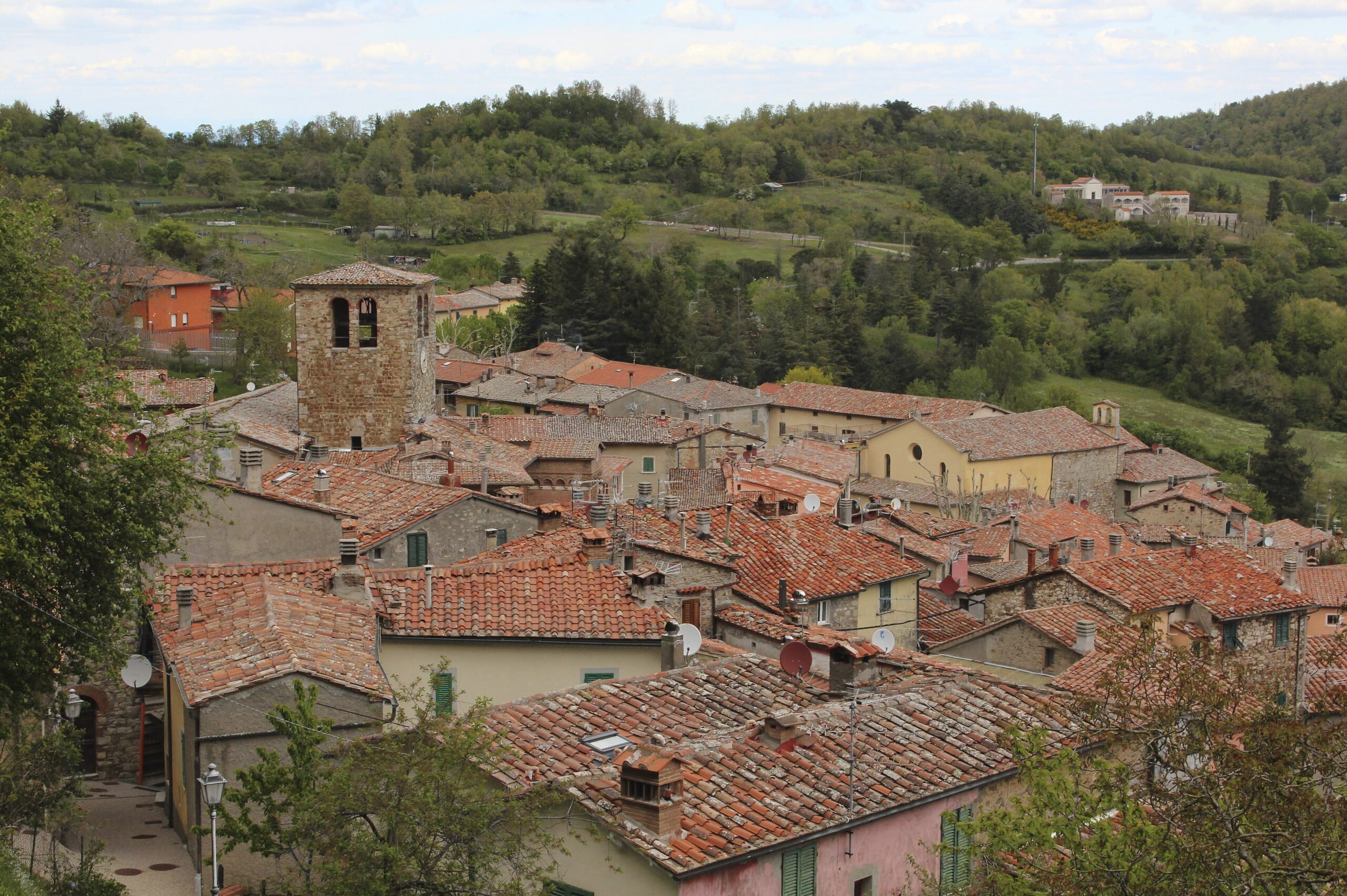
Montieri feels like the end of the road, and that is its value. At 705 meters, it is the highest town in the Colline Metallifere — barely 1,200 people spread through narrow stone alleys and thirteenth-century tower-houses, surrounded by the densest chestnut forests in the province. The name comes from the Latin Mons Aeris — mountain of copper — and copper mining has shaped this place since Roman times. What makes Montieri remarkable now is not the copper but what replaced it: geothermal district heating that has made the commune entirely fossil-fuel-free, and an archaeological discovery so unexpected that it rewrote the medieval history of the region.
In 2009, excavations beneath a collapsed structure near the village church uncovered the Canonica di San Niccolò — a hexapetal church, meaning it has six apses arranged like the petals of a flower. It is the only known church of this plan in Italy. During the excavation, archaeologists found the Fibula di Montieri — a medieval gold brooch with filigree, garnet, amethysts, and glass pearls that is now among the treasures of the Pinacoteca Nazionale in Siena. A village that most Tuscans have never visited produced one of the most significant medieval archaeological finds of the past two decades.
What to See and Do
The village itself rewards a slow walk — tower-houses, stone portals, the quiet of a place that has outlasted its economic purpose. The Buca delle Fate (Fairy Cave), a medieval silver mine entrance, is accessible via a scenic path through the chestnut forest above town — roughly 30 minutes’ walk, suitable for families, and atmospheric enough to justify the name.
The hamlet of Boccheggiano (roughly 300 inhabitants, 15 minutes south by car) is where the mining past is most visible. Dramatic roste — bright red scoria heaps from centuries of copper processing — spread across the landscape like abstract paintings. Medieval gates and castle ruins frame the village. The copper mine at Campiano, the last to operate in the district, closed in 1994.
For serious hikers, the Cornate di Gerfalco (1,059 meters) — a seven-peaked limestone massif near the tiny village of Gerfalco (population roughly 60) — offers the most dramatic summit in the Colline Metallifere. The hamlet itself is one of the most remote in Tuscany: no cell signal is guaranteed, no ATM exists, and the population continues to shrink. It is beautiful in the severe way that very empty places can be.
The annual Il Soffionissimo race in August takes runners through the geothermal landscape between Montieri and the steaming hills — one of Italy’s most unusual trail-running events.
Getting There and Getting Around
By car, Montieri is about 20 minutes north of Massa Marittima via the SP73bis — a winding road through chestnut forest that is scenic in every season. From Florence, roughly 2 hours. From Siena, about 1 hour 15 minutes. No public transport reaches Montieri in any practical sense.
Practical warning: Carry cash. The village has no guaranteed ATM. Cell signal can be unreliable, especially toward Gerfalco. These are not obstacles — they are part of the experience.
Nearby
Massa Marittima (20 minutes south) — Cathedral, Lorenzetti, mining museum.
Monterotondo Marittimo (15 minutes west) — Le Biancane geothermal park.
Radicondoli (25 minutes east) — A Sienese hill village in the expanded UNESCO Geopark territory, with thermal baths at the Terme di Galleraie.
Information is provided in good faith and may change. Always confirm opening hours, prices, and event dates with the official source before you travel.