
Town · Mugello
Borgo San Lorenzo
The Town Where Mugello Does Its Shopping
Last updated:
- Region
- Mugello
- Province
- Metropolitan City of Florence (formerly Province of Florence)
- GPS
- 43.9553, 11.3872
- Best season
- year-round
- Time needed
- half day
- Difficulty
- easy
- Known for
- Mugello capital, Pieve di San Lorenzo, Galileo Chini Art Nouveau, Fido the faithful dog, weekly market
Every region needs a capital, and Mugello‘s is Borgo San Lorenzo — not grand, not monumental, but solid. With roughly 18,000 inhabitants, it’s the largest town in the valley, the one with the hospital, the train station that works, the Tuesday market where farmers from the surrounding hills come to sell their oil and cheese and chestnuts. If Scarperia is the valley’s museum piece and Vicchio its artistic soul, Borgo San Lorenzo is the kitchen table where everybody sits.
This is not a town built for tourists. It’s a town built for living, and that’s precisely what makes it interesting. Between the largest Romanesque parish church in the entire Florentine territory, an Art Nouveau ceramics tradition you’ve never heard of, and the true story of a dog whose fourteen-year vigil at a bus stop became a national symbol of loyalty, Borgo San Lorenzo has more depth than its workday exterior suggests.
A Place Shaped by Time
Borgo San Lorenzo grew up at the point where the Sieve valley is wide enough for a proper town. Its position — at the intersection of roads heading toward Scarperia, Vicchio, Marradi, and the passes into Emilia-Romagna — made it a natural market center, and markets have defined its character ever since.
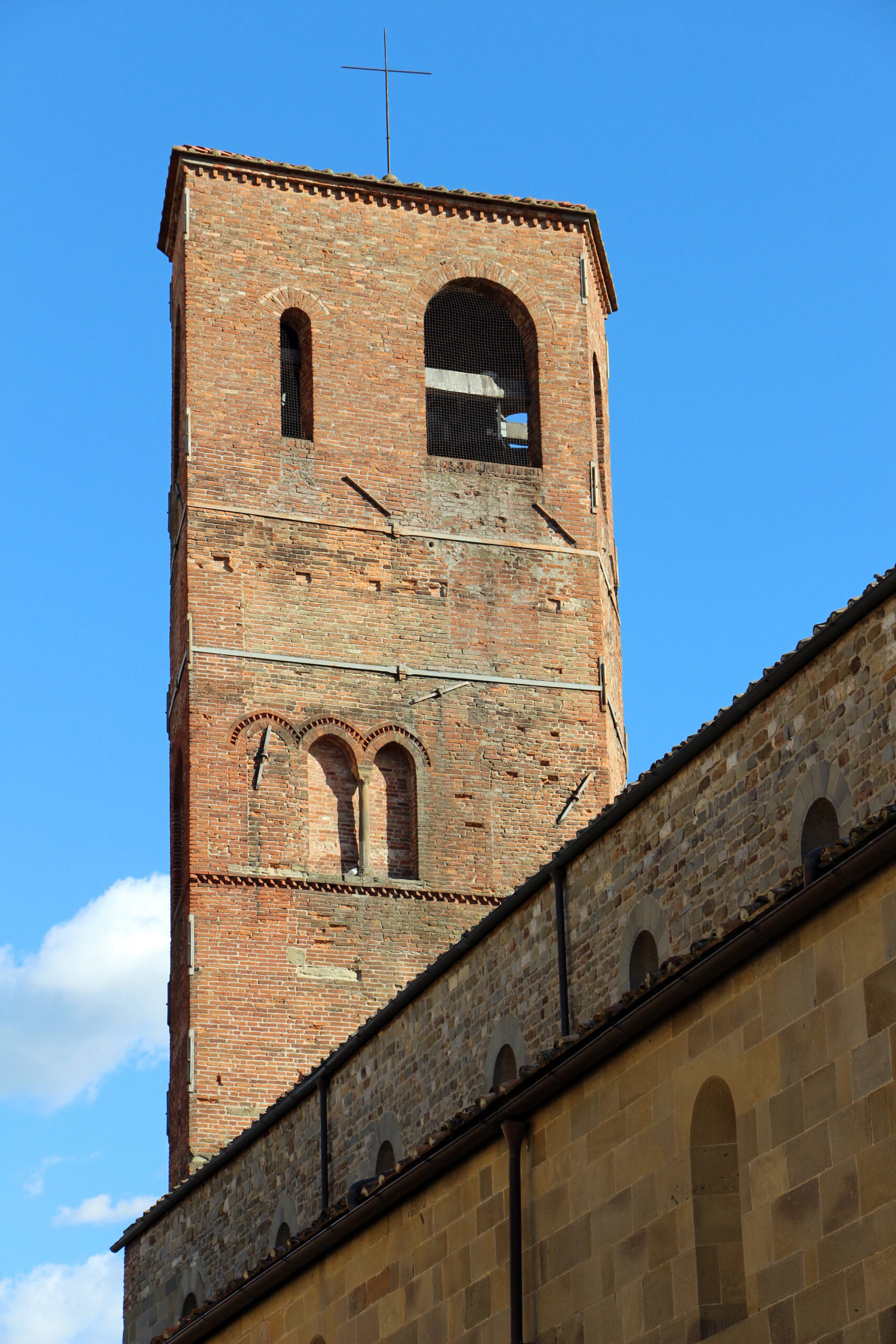
The Pieve di San Lorenzo, from which the town takes its name, has Romanesque origins dating to at least the tenth century, with documentation from the first half of the tenth century. It is the largest Romanesque parish church in the territory of Florence — a substantial building with a distinctive hexagonal brick bell tower that serves as the town’s visual signature. Inside, a Madonna attributed to Giotto (or his workshop) hangs as a quiet reminder that even the valley’s greatest painter left his mark in the local church.
The 1919 earthquake was devastating. Most buildings in Borgo San Lorenzo were declared uninhabitable after the June 29 quake, and the Pieve itself collapsed. The town was effectively rebuilt in the years that followed, which explains why the center feels more early-twentieth-century than medieval. What looks like a limitation — the absence of a perfectly preserved old town — is actually part of the story: this is a community that has rebuilt itself, literally, more than once.
The Chini Dynasty
Borgo San Lorenzo’s most distinctive cultural contribution is the Chini family — a dynasty of ceramicists, painters, and decorators who worked across the Art Nouveau period and beyond. Galileo Chini (1873–1956) was the most prominent: a ceramicist, painter, set designer, and decorator who exhibited at the Venice Biennale, designed sets for Puccini’s opera Turandot (the original 1926 production at La Scala), and spent years in Siam (Thailand) painting murals for King Rama V’s Ananta Samakhom Throne Hall in Bangkok.
Galileo’s cousin Chino Chini founded the family ceramics workshop, Fornaci San Lorenzo, in Borgo San Lorenzo in 1906, together with Galileo and his brother Pietro. The workshop produced Art Nouveau tiles, vases, and architectural decorations that were shipped across Italy and abroad. The family’s work adorns buildings throughout Borgo San Lorenzo and the Mugello, giving the town an unexpected thread of decorative beauty that most visitors don’t expect.
The Museo della Manifattura Chini at Villa Pecori Giraldi houses a collection of the family’s work — ceramics, paintings, preparatory sketches, and documentation of Galileo Chini’s international career. For anyone interested in Italian Art Nouveau (known as Stile Liberty in Italian), this is a significant and little-known collection.
Fido: Fourteen Years at the Bus Stop
The story of Fido is the kind of tale that sounds like it was invented for a children’s book, except it’s true. Fido was a mixed-breed dog adopted by Carlo Soriani, a worker at the Brunori brick factory in Borgo San Lorenzo. Every morning, Fido would accompany Soriani to the bus stop in the main square of Luco di Mugello, the village where they lived; every evening, the dog would be there when the bus returned.
On December 30, 1943, Allied bombs hit Borgo San Lorenzo. Soriani was killed in the bombing. Fido went to the bus stop that evening and waited. He came back the next day, and the next. For fourteen years — until his own death on June 9, 1958 — Fido returned to the bus stop every evening to wait for a master who would never come home.
The story gained national attention. The mayor of Borgo San Lorenzo awarded Fido a gold medal in 1957 in a ceremony attended by national press. A monument to Fido — by the sculptor Salvatore Cipolla — now stands in Borgo San Lorenzo’s Piazza Dante. It’s a small bronze statue, and it’s genuinely moving.
What to See and Do
Pieve di San Lorenzo
The largest Romanesque parish church in the Florentine territory deserves a proper visit. The exterior is handsome but restrained — Romanesque simplicity in local stone. The hexagonal brick bell tower is the visual landmark. Inside, look for the Madonna attributed to Giotto or his workshop, and take a moment with the building’s proportions: this is a church built for a community, not for display, and its scale feels right.
Museo della Manifattura Chini (Villa Pecori Giraldi)
The Chini museum is the reason to linger in Borgo San Lorenzo longer than you might expect. Galileo Chini’s range — from delicate Art Nouveau ceramics to monumental paintings to his Thai royal commissions — is startling. The ceramics are particularly beautiful: iridescent glazes, organic forms, colors that feel simultaneously Italian and international. The museum is housed in the villa that also serves as a cultural center, and it’s well-curated for a small municipal museum.
The Chini Museum belongs to the Mugello museum network; like most small municipal museums it keeps limited, seasonal hours, so check before you go.
The Town Center and Market
Borgo San Lorenzo’s center isn’t picturesque in the postcard sense, but it has the energy of a working town. The Tuesday market fills the streets around the center with vendors selling everything from local produce to clothing to household goods. This is a real market, not a tourist market — you’ll be shopping alongside Mugello families doing their weekly provisioning.
The main streets have a pleasant mix of shops, cafes, and everyday businesses. There are good gelaterias, solid bars for a morning cappuccino and cornetto, and the general atmosphere of a town where you can sit in a piazza without feeling like you’re in someone else’s vacation.
Autodromo del Mugello (Nearby)
The MotoGP circuit is closer to Scarperia, but Borgo San Lorenzo is where many visitors to the Grand Prix stay, eat, and drink. On race weekends (late May or June for MotoGP), the town comes alive with a particular energy. If you’re in the Mugello during a race weekend, Borgo San Lorenzo is the place to experience the social side of the event.
Eating Like a Local
Being the valley’s main town, Borgo San Lorenzo has the widest selection of restaurants in the Mugello. Tortelli di patate are mandatory — this is their homeland. Beyond tortelli, look for:
- Peposo — beef slow-cooked with an abundance of black pepper, traditionally credited to kiln workers who left the pot in the kiln overnight
- Bistecca from Calvana cattle — a small mountain breed related to the Chianina, raised in the Mugello and the Calvana hills
- Schiacciata — the local flatbread, bought at bakeries and eaten as a street snack or with cured meats
The weekly Tuesday market is the best place to source local ingredients: Mugello honey (chestnut, acacia, wildflower), fresh raviggiolo cheese, olive oil from valley producers, and seasonal vegetables.
Getting There and Getting Around
From Florence by train: The Ferrovia Faentina from Florence SMN reaches Borgo San Lorenzo directly, and trains also run via Pontassieve; check the current timetable on Trenitalia. This is the Mugello’s best-connected town by rail — the station is central and walkable to the main attractions.
From Florence by car: A1 motorway to Barberino di Mugello exit, then SP551 east through the valley. Or SS65 via Vaglia. Approximately 40 minutes.
Within town: Everything in the center is walkable. The Pieve, the Chini museum, the Fido monument, and the market area are all within a 10-minute walk of each other.
Parking: Available around the center. Easier than Florence (which isn’t saying much), but on market days the closest spots fill early.
As a base: Borgo San Lorenzo is arguably the best base for exploring the Mugello — it has the most accommodation options, restaurants, and services, plus the train station for Florence connections. From here, Vicchio is 8 km, Scarperia is 8 km, and the Marradi road heads east into the Alto Mugello.
Nearby
- Vicchio (8 km) — Giotto’s birthplace, Fra Angelico, Don Milani’s Barbiana school
- Scarperia (8 km) — Handcrafted knives, Palazzo dei Vicari, Brunelleschi Clock
- San Piero a Sieve (6 km) — Medici villas (Cafaggiolo, Trebbio), Bosco ai Frati convent
- Marradi (35 km) — Chestnut country, Dino Campana, autumn sagre
- Lake Bilancino (10 km) — Swimming, sailing, WWF bird sanctuary
Information is provided in good faith and may change. Always confirm opening hours, prices, and event dates with the official source before you travel.