
Town · Mugello
Vicchio
The Small Town That Made Two of the Greatest Painters in History
Last updated:
- Region
- Mugello
- Province
- Metropolitan City of Florence (formerly Province of Florence)
- GPS
- 43.9333, 11.4600
- Best season
- spring, autumn
- Time needed
- half day
- Difficulty
- easy
- Known for
- Giotto's birthplace, Fra Angelico, Don Milani's Barbiana school, Pinot Noir wine, Ponte di Cimabue
Something about this valley produced extraordinary eyes. Giotto di Bondone — the man who broke painting free from Byzantine flatness and gave figures weight, emotion, and space — grew up in the hamlet of Vespignano, just outside Vicchio, around 1267. More than a century later, Fra Angelico — the Dominican friar whose luminous frescoes in Florence’s San Marco convent remain among the most beautiful things ever painted — was born in the nearby hamlet of Rupecanina. Two of the most important painters in Western art history, from the same small corner of the Mugello valley.
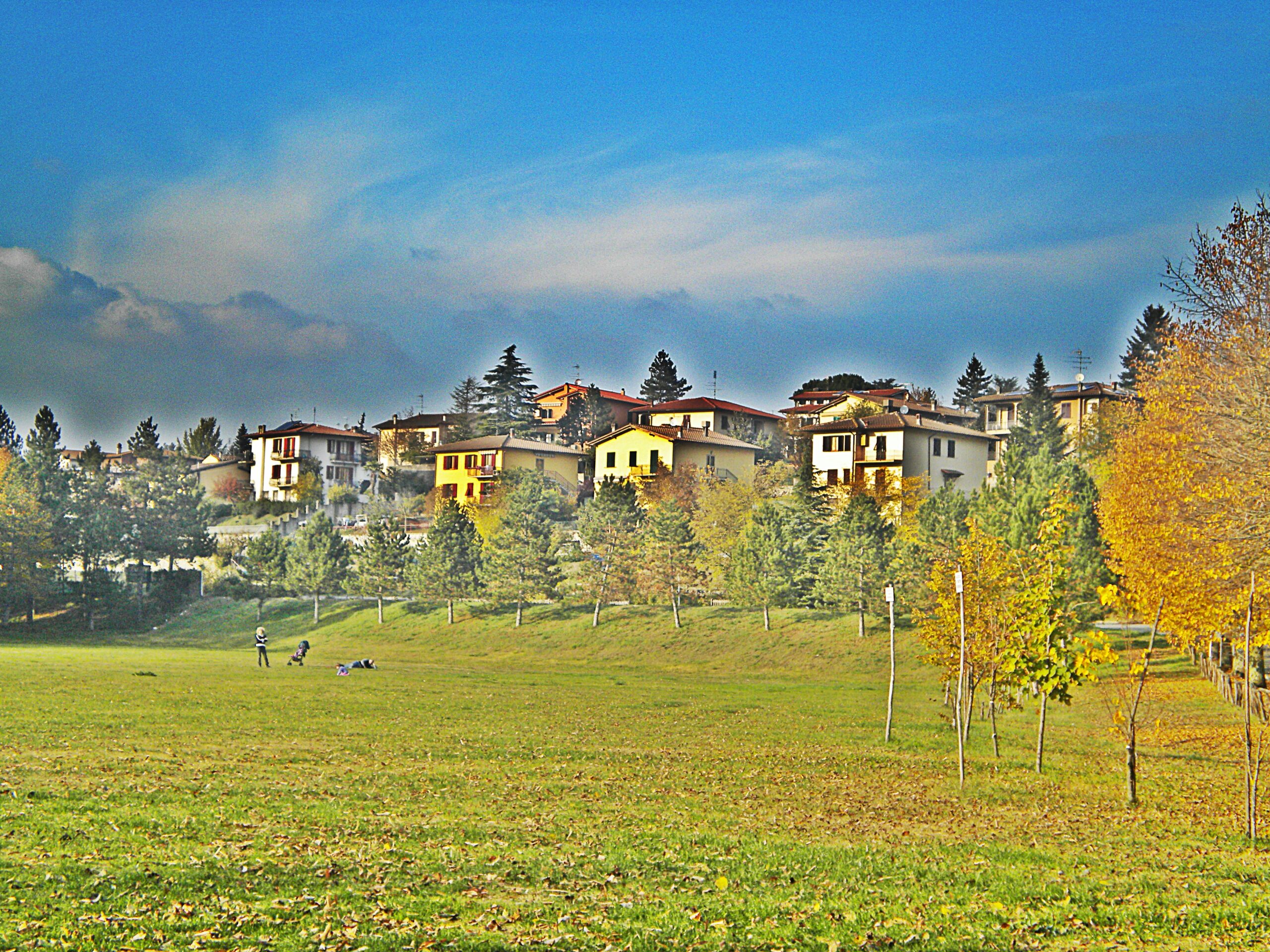
Vicchio itself is a quiet town of about 8,000 people strung along the River Sieve, with a main square, a couple of churches, and the feel of a place that is comfortable in its own skin. It doesn’t advertise its extraordinary artistic heritage aggressively. There’s a small museum, a walking path, some empty picture frames in a garden. The story unfolds at Vicchio’s own pace — which, it turns out, is the right pace.
A Place Shaped by Time
Vicchio has been settled since at least the Etruscan period, but its recorded history begins as a rural community in the medieval Mugello, subject to Florence. The town’s fortunes have always been tied to the Sieve valley’s agricultural rhythms — chestnuts, grain, livestock, olive oil — and to the road that connects Florence to the Romagna through the Apennine passes.
The 1919 earthquake hit Vicchio harder than anywhere else in the Mugello. The magnitude 6.38 quake struck on June 29, killing approximately 70 people in the town alone — out of roughly 100 total deaths across the region. Much of the town’s historic center was destroyed or severely damaged, including significant damage to Giotto’s birthplace in Vespignano. What you see in Vicchio today is partly a rebuilt town, carrying the scars of that afternoon beneath its quiet exterior.
In the twentieth century, Vicchio gained a different kind of fame through Don Lorenzo Milani (1923–1967), a Catholic priest who was effectively exiled to the remote parish of Barbiana in the hills above the town. There, in a tiny school with a handful of peasant children, he developed a radical educational philosophy built on the premise that language is power, and that the poor fail in school not because they lack ability but because the school speaks a language designed to exclude them. His students collectively wrote Lettera a una professoressa (Letter to a Teacher, 1967), which became one of the most influential texts in Italian education. The school at Barbiana — a few rooms beside a church in the mountains — is now a pilgrimage site for educators.
More recently, Vicchio has become the unlikely center of Mugello’s emerging Pinot Noir wine scene. In the early 1990s, a Florentine goldsmith named Paolo Cerrini, who had loved cycling the valley’s roads since his youth, began experimentally planting Pinot Noir vines here. The clay soils and continental climate — cool nights, warm days, significant temperature swings — proved ideal. His winery, Il Rio, helped spark a small revolution. Since then, more than a dozen Mugello producers have taken up Pinot Noir, and Vicchio sits at the heart of the zone.
What to See and Do
Casa di Giotto, Vespignano
The restored Casa di Giotto sits in the hamlet of Vespignano, about 3 km from Vicchio’s center, in the old walled hamlet of Vespignano, below the church of San Martino. The house itself is modest — a stone building with period furnishings and information about Giotto’s early life and the Mugello of his time.
But the genius move is in the garden. Empty picture frames have been positioned at various points, each framing a specific view of the Mugello landscape. The idea is simple and powerful: see the valley the way Giotto might have seen it. The rolling hills, the light, the colors — suddenly you understand why this particular landscape produced a painter obsessed with making flat surfaces feel like windows into real space. It’s one of the most thoughtful small museum experiences in Tuscany.
According to the legend that every art history student knows, the painter Cimabue was traveling through the Mugello when he discovered the young Giotto drawing a sheep on a stone with such naturalistic skill that he immediately took the boy as his apprentice. The Ponte di Cimabue — a small bridge near Vespignano — is traditionally identified as the spot where this encounter happened. Whether the story is literally true matters less than what it says about how the Mugello remembers itself: as a place where genius grew from the ground.
Museo di Arte Sacra Beato Angelico
In Vicchio’s center, this small museum of sacred art is dedicated to Fra Angelico (born Guido di Pietro, c. 1395–1455), who grew up in the Rupecanina area near Vicchio before becoming a Dominican friar and one of the greatest painters of the early Renaissance. The museum holds a modest but carefully curated collection of sacred art from local churches, providing context for understanding the artistic environment that shaped both Giotto and Fra Angelico.
Fra Angelico is better known by his religious name, Fra Giovanni da Fiesole, after the convent he entered — but he was a son of the Mugello. The museum makes the argument, quietly but effectively, that the Mugello’s particular light and landscape informed the luminous quality of his painting.
The Path of the Painters (Sentiero dei Pittori)
A walking route connects the key sites associated with Giotto and Fra Angelico — from Vicchio’s center through Vespignano to Rupecanina, passing through the landscape that both painters knew. The full loop is about 13.5 km, mostly on quiet roads and paths. It’s a moderate walk in any season, and the views across the Sieve valley are consistently beautiful.
This is the kind of walk where you don’t need a destination because the walk itself is the point. The landscape is gentle, agricultural, human-scaled — and it hasn’t changed as dramatically as you might expect in seven centuries.
Barbiana and the School of Don Milani
The parish of Barbiana is located in the hills about 9 km above Vicchio, on a narrow road that climbs through chestnut and oak forest. The school — essentially a few rooms beside the small church of Sant’Andrea — is preserved as Don Milani left it, with maps on the walls, student desks, and the tools of a radical education that prioritized critical thinking and collective work over rote learning.
Don Milani’s grave is in the small cemetery beside the church, marked by a simple white marble slab. For Italians of a certain generation, particularly those involved in education or social justice, this is a deeply meaningful place. For international visitors, it offers an unexpected window into twentieth-century Italian intellectual history — and a beautiful drive through the Mugello hills.
Visits to Barbiana are coordinated by the Fondazione Don Lorenzo Milani — contact them before going.
The Town Center
Vicchio’s main square, Piazza Giotto, is anchored by a statue of the painter. The Loggia is a pleasant porticoed area for a coffee or aperitivo. The town has a comfortable, lived-in quality — this is not a museum-village but a working community where people shop, argue, and eat gelato.
The weekly market (Thursday mornings) brings local producers to the square and surrounding streets — a good opportunity to buy Mugello honey, fresh raviggiolo cheese (in season), and olive oil.
Eating Like a Local
Vicchio is at the heart of tortelli di patate country. Every trattoria serves them; they will be excellent. Every village claims its own version — and this is the kind of micro-distinction that starts arguments across the Sieve valley.
This is also the center of Mugello’s Pinot Noir wine zone. If you’re interested in tasting, the Provimu association of local producers can point you toward cellars that accept visitors. Il Rio (Paolo Cerrini‘s original estate) and Podere Fortuna are among the most notable producers. The wines are labeled as Toscana IGT and offer a freshness and elegance completely unlike the big Sangiovese-based wines that dominate the Tuscan wine image.
In autumn, look for anything involving chestnuts — castagnaccio, necci, chestnut flour pasta. The chestnut forests above Vicchio are part of the Marrone del Mugello IGP zone, and the flour from these trees has been a staple for centuries.
Raviggiolo — the soft, rindless fresh cheese of the Tuscan-Romagnol Apennines — is traditionally made in the upper Mugello between October and March. If you’re here in that window, find it at a farm shop or the weekly market. It lasts only days, so you eat it here or not at all.
Getting There and Getting Around
From Florence by train: The Ferrovia Faentina from Florence SMN stops directly in Vicchio. Check current timetables on trenitalia.com. With a station in town, Vicchio is a viable car-free day trip from Florence.
From Florence by car: Take the A1 to Barberino di Mugello, then follow the SP551 through the valley to Vicchio. Or take the scenic SS65 through Vaglia. Total drive: about 45 minutes.
Getting to Vespignano/Casa di Giotto: 3 km from Vicchio center. Walkable (a pleasant 30-minute stroll), cyclable, or a very short drive. Signposted from the town center.
Getting to Barbiana: 9 km from Vicchio, on a narrow mountain road. Car required. The road is winding, and the final stretch is on foot: park below and walk up the last section of unpaved track.
Parking: Easy and free in and around the town center.
Best combined visit: Vicchio + Casa di Giotto in the morning, lunch in Vicchio, Barbiana in the afternoon (if the school is open). Add Scarperia (15 km) or Borgo San Lorenzo (8 km) if you have the energy.
Nearby
- Borgo San Lorenzo (8 km) — The Mugello capital, Galileo Chini Art Nouveau museum, the Pieve, weekly market
- Scarperia (15 km) — Handcrafted knives, Palazzo dei Vicari, Brunelleschi Clock
- Vespignano / Casa di Giotto (3 km) — Giotto’s birthplace and the famous empty frames
- Barbiana (9 km, hills above Vicchio) — Don Milani’s school
- Lake Bilancino (about 20 km) — Swimming, sailing, birdwatching
Information is provided in good faith and may change. Always confirm opening hours, prices, and event dates with the official source before you travel.