
Town · Mugello
Firenzuola
The Town That Had to Start Again
Last updated:
- Region
- Mugello
- Province
- Metropolitan City of Florence (formerly Province of Florence)
- GPS
- 44.1178, 11.3792
- Best season
- spring, autumn
- Time needed
- half day
- Difficulty
- easy-moderate
- Known for
- WWII Gothic Line, pietra serena sandstone, German Cemetery at Futa Pass, complete postwar reconstruction, Città Slow
On September 12, 1944, Allied bombers hit Firenzuola. When the dust settled, there was essentially nothing left. The town — founded in 1332 by the Florentine Republic and named “Little Florence” by the chronicler Giovanni Villani — had stood for six centuries on the road between Tuscany and Bologna, guarding the Apennine passes. In a single day, it ceased to exist.
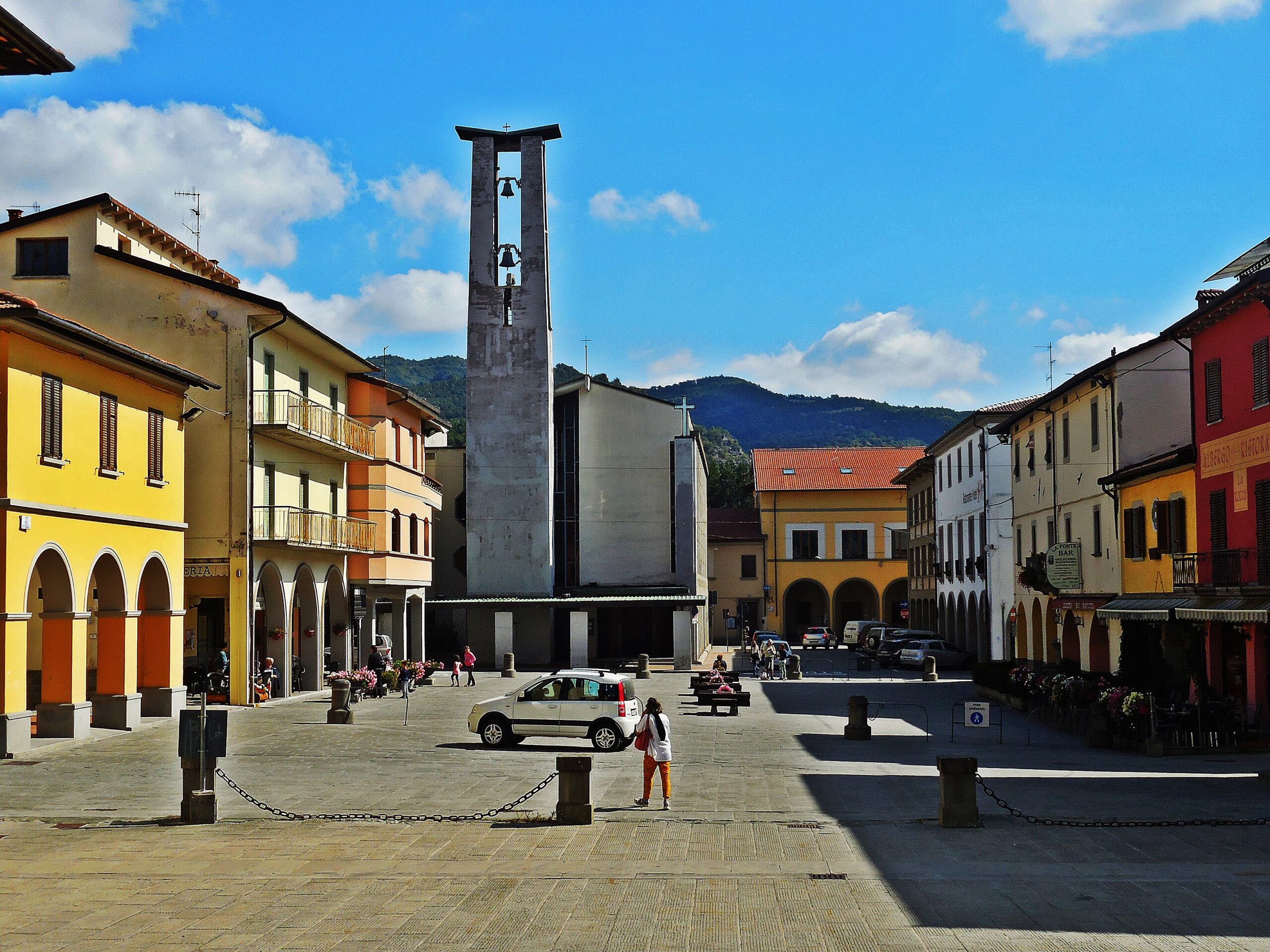
What you see in Firenzuola today is entirely rebuilt. Almost every building, street and piazza dates from the postwar reconstruction. This gives the town a quality unlike any other place in Tuscany — austere, orderly, made of the local grey pietra serena sandstone that is both Firenzuola’s geological inheritance and its aesthetic identity. There are no medieval alleys, no Renaissance facades, no layers of accumulated centuries. There is only what people chose to build when they had to start from nothing.
This is not a cheerful story, and Firenzuola is not a cheerful town in the conventional touristic sense. It is something more interesting: a place where the weight of history is carried not in picturesque ruins but in the very fact that everything looks new. The German Cemetery at the nearby Futa Pass — holding more than 30,000 burials, the largest German military cemetery in Italy — ensures that the war is never entirely in the past here.
A Place Shaped by Time
Firenzuola was founded on April 8, 1332, as a fortified settlement on the road from Florence to Bologna. The Florentine Republic, having broken the Ubaldini family’s control of the Apennine passes, needed a loyal town on the northern route. Villani’s chronicle records the founding and the name — Firenzuola, Little Florence — which expressed both Florence’s ambition and the town’s intended role as a miniature outpost of Florentine order in the mountains.
For six centuries, Firenzuola served that purpose. Its position at 422 meters elevation, in a high valley between the Santerno River and the Apennine ridge, made it a natural stopping point on the road north. The town developed a quiet prosperity based on mountain agriculture, livestock, and the quarrying of pietra serena — the fine-grained grey sandstone that Brunelleschi used for the interior columns of Florence’s great churches and that remains one of the most prized building stones in Italy.
Then came the Gothic Line. In the summer of 1944, the German army established a major defensive line across the Italian peninsula, running through the Apennine passes directly above Firenzuola. The town found itself in the path of the Allied advance northward. The bombing on September 12, 1944, was devastating — nearly total destruction. The population had been largely evacuated, which limited civilian casualties, but the physical town was obliterated.
The Battle of Il Giogo Pass (September 13–18, 1944), fought on the ridgeline just south of Firenzuola, was among the fiercest combat in the Italian campaign. Company B of the US 91st Division’s 363rd Infantry set out for the crest of Monticelli with nearly 200 men; by the time it reached the ridgeline, only about 70 were left. The passes around Firenzuola — Futa, Giogo, Raticosa — were fought over meter by meter through September and October 1944.
The reconstruction took years. Firenzuola was rebuilt on a rational plan, using the local pietra serena extensively. The result is a town that looks unlike any other in Tuscany — uniform, stone-grey, dignified but stripped of the organic accumulation that characterizes most Italian towns.
What to See and Do
The German Cemetery at the Futa Pass (Cimitero Militare Germanico)
The Deutscher Soldatenfriedhof am Futa-Pass sits at around 950 meters elevation on the Futa Pass, about 10 km south of Firenzuola. It holds the remains of more than 30,000 German soldiers who died in the Italian campaign — making it the largest German military cemetery in Italy. The cemetery was designed by architect Dieter Oesterlen and completed in 1969.
The setting is stark and powerful. Concentric terraces of stone descend the hillside, lined with simple grey granite grave slabs. There are no flags, no rhetoric, no attempt at justification — only names, dates, and the vast Apennine landscape. The cemetery receives fewer visitors than its Allied counterparts, which gives it a particular silence. Whatever your relationship to this history, the scale — more than 30,000 names on a single Italian hillside — demands a pause.
The Futa Pass itself was a critical point on the Gothic Line and the site of intense fighting. The road over the pass (SS65, the old Via Bolognese) is now a scenic drive connecting Florence to Bologna through the mountains. A few hundred meters from the cemetery, you’re on one of the most important military and trade routes in Italian history.
Museo della Pietra Serena
Inside the reconstructed Rocca (fortress) of Firenzuola, a museum dedicated to pietra serena tells the story of the stone that defines this part of the Apennines. Pietra serena — literally “serene stone” — is a fine-grained grey sandstone quarried in the hills around Firenzuola for centuries. Brunelleschi chose it for the columns and architectural details of San Lorenzo and Santo Spirito in Florence; Michelangelo used it; it remains a premium building material today.
The museum covers the geology, quarrying techniques, and artistic uses of the stone through tools, samples, and documentation. It’s a small museum, but it illuminates something you’ll see everywhere in Firenzuola and the Alto Mugello: the grey stone that gives buildings, walls, and even road surfaces their particular austere beauty.
The Museo della Pietra Serena is part of the Mugello museum network and keeps limited, seasonal hours — check before you go.
The Rebuilt Town Center
Walking through Firenzuola’s center is a different experience from other Tuscan towns. The streets are straight, the buildings regular, the proportions rational. There are no hidden medieval courtyards, no surprise Renaissance loggia around a corner. Instead, there is the quiet dignity of a town that made itself again from nothing, using the same grey stone that its mountains provide.
The Rocca — the fortress on the main square, reconstructed after the war — houses both the stone museum and municipal functions. The main church, also rebuilt, anchors the piazza. A few cafes and shops line the main street. The atmosphere is mountain-town authentic: unhurried, slightly reserved, more interested in its own life than in impressing visitors.
The Gothic Line Sites
The passes around Firenzuola are dotted with memorials, bunker remnants, and information panels documenting the Gothic Line battles. The area between the Futa Pass and the Giogo di Scarperia (882 m) can be explored by car, and on foot the Via degli Dei hiking trail from Bologna to Florence crosses the Futa Pass, right through this battle zone.
On Monte Giovi (closer to the southern Mugello), a partisan memorial park commemorates the resistance fighters who gathered on the mountain after September 8, 1943 — the day Italy’s armistice was announced — sheltered by local farmers and shepherds. The park has memorial trails and information panels.
For visitors with a specific interest in WWII history, the entire Alto Mugello is a landscape where the war is legible in the terrain — in the age of buildings, in the monuments at passes, in the stories that older residents still carry.
The Surrounding Mountains
Firenzuola sits in genuinely mountainous country. The Apennine ridges above town reach well over 1,000 meters, and the forests — beech, chestnut, oak — are extensive and largely undisturbed. This is excellent walking country, with trails leading to the Apennine crest and views into both Tuscany and Emilia-Romagna.
The road from Firenzuola toward the Passo della Raticosa (968 m) is a beautiful mountain drive. The original 1914 Mugello racing circuit — a road course of around 67 km over the Giogo and Futa passes that predated the modern Autodromo — also ran through Firenzuola itself.
Eating Like a Local
Firenzuola’s food is mountain food — heavier, heartier than the valley below. Chestnuts are important here as in the rest of the Alto Mugello. Look for:
- Tortelli di patate — the Mugello staple, served with meat ragù
- Game — wild boar, deer, and hare are hunted in the surrounding forests and appear on trattoria menus in season (autumn and winter)
- Polenta — more common here than in lower Mugello, served with ragù or mushrooms
- Mushrooms — porcini in particular, foraged from the surrounding forests in autumn
- Chestnut honey — from the mountain forests, dark and intensely flavored
The food here is not refined, and restaurants don’t compete for guide stars. They serve honest mountain cooking at mountain prices, and there’s nothing wrong with that.
Getting There and Getting Around
From Florence by car: The most direct route is the SS65 (Via Bolognese) through Vaglia, over the Futa Pass, and down to Firenzuola. The drive is approximately 50 km and takes about 1 hour. It’s a scenic mountain road with good surfaces but many curves. Alternatively, the A1 motorway to Barberino di Mugello and then north on the SS503 is faster but less atmospheric.
From Bologna by car: The SS65 south through the Futa Pass, or the A1 to the Roncobilaccio exit and then local roads. About 1 hour.
By train: Firenzuola has no train station. The nearest rail access is Borgo San Lorenzo (approximately 30 km south on the Faentina line) or Barberino di Mugello area. A car is essential for visiting Firenzuola.
Within and around Firenzuola: The town center is small and walkable. The German Cemetery, the passes, and the mountain trails all require a car.
Parking: Free and easy in the town center.
Best combined visit: Firenzuola + German Cemetery at Futa Pass + Giogo di Scarperia (descending to Scarperia for the knife museum). This makes a full day loop through the Alto Mugello with a mix of war history, mountain scenery, and artisan culture.
Nearby
- German Cemetery at Futa Pass (10 km) — more than 30,000 burials, the largest German military cemetery in Italy
- Scarperia (20 km south via Giogo pass) — Knife-making, Palazzo dei Vicari, Brunelleschi Clock
- Palazzuolo sul Senio (25 km east) — Borghi più belli d’Italia, 1,000 inhabitants, medieval reenactment
- Passo della Raticosa (15 km) — Mountain pass, historic racing circuit route, Apennine views
- Barberino di Mugello (25 km south via Futa Pass) — Medici villas, Lake Bilancino, outlet shopping
Information is provided in good faith and may change. Always confirm opening hours, prices, and event dates with the official source before you travel.