
Town · Valdichiana
Foiano della Chiana
487 Years of Giant Puppets and Garlic
Last updated:
- Region
- Valdichiana
- Province
- Province of Arezzo
- GPS
- 43.2525, 11.8108
- Best season
- February–March (Carnival); April–June (quiet exploration); September–October (harvest, local pace)
- Time needed
- Half day (2–3 hours for churches and centro storico; a full day if visiting during Carnival)
- Difficulty
- easy
- Known for
- Carnevale di Foiano (Italy's oldest, since 1539), Della Robbia glazed terracottas, Luca Signorelli's last painting, aglione (giant garlic)
Every Italian town believes its Carnival is the oldest, the loudest, the most authentic. Foiano della Chiana has paperwork. The claim runs back to 1539 — documented, cited, defended with the quiet stubbornness that characterizes this compact agricultural town on the valley floor of the Valdichiana. While Viareggio has the seafront spectacle and Venice has the masks, Foiano has been building giant papier-mâché floats, burning a straw king in the piazza, and settling neighborhood feuds through allegorical sculpture for nearly five centuries. Not many traditions anywhere can say that.
But here is the thing that almost no one mentions, the detail that makes Foiano worth visiting even if you have no interest in Carnival at all: this small town of 9,000 people contains one of the highest concentrations of Della Robbia glazed terracotta anywhere in Italy — works by Andrea and Giovanni della Robbia spread across three churches within a few hundred meters of each other, alongside Luca Signorelli’s last completed painting. It is, in effect, an open-air museum of late-fifteenth and early-sixteenth-century devotional art, hidden in a town that most English-language guidebooks either ignore or reduce to a single line about Carnival.
A Place Shaped by Time
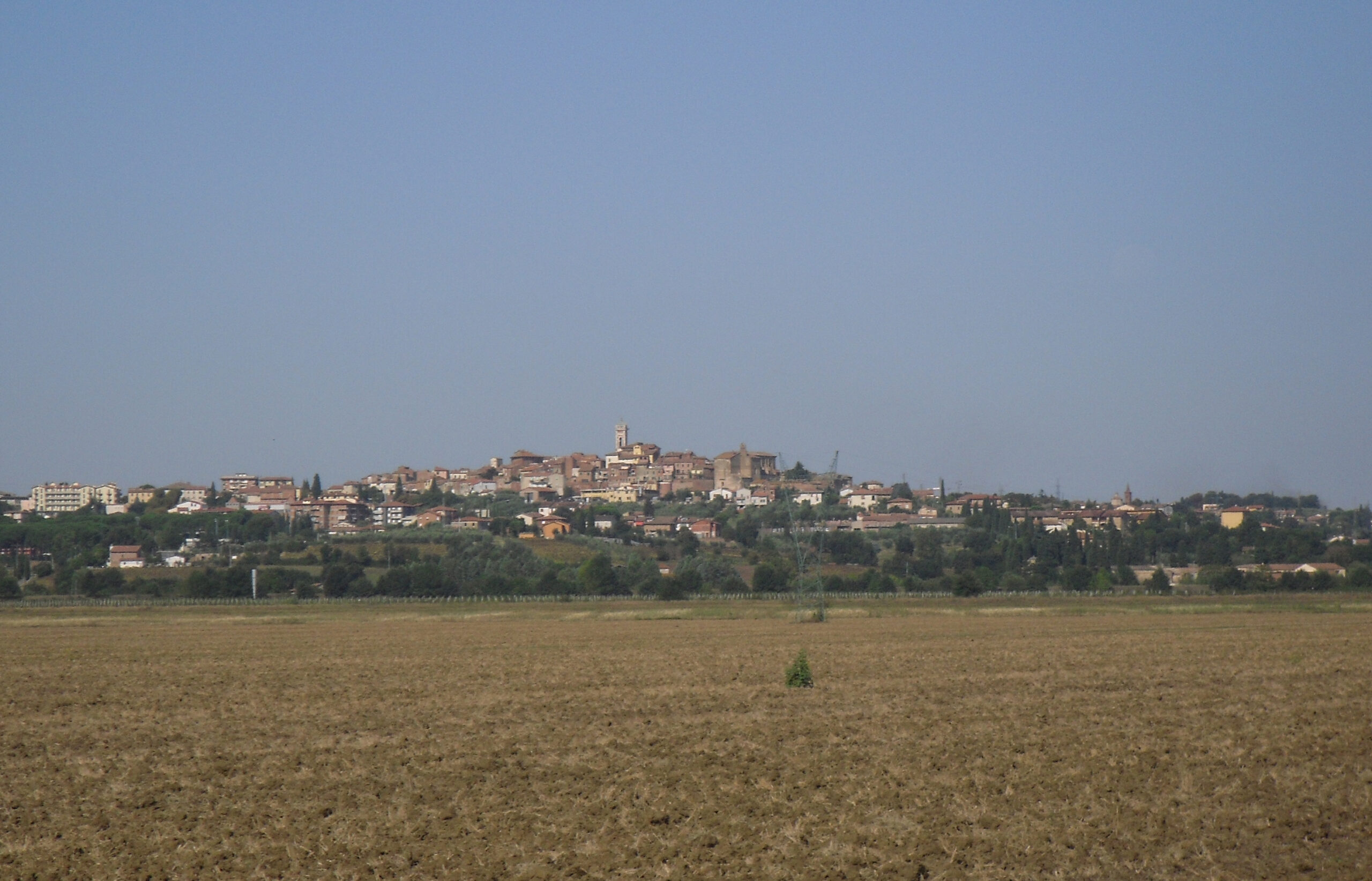
Foiano sits at 318 meters on a low hill above the Valdichiana plain, enclosed by walls that were rebuilt in 1480 into a distinctive heart shape — a piece of military geometry that doubles as unintentional romance when seen from above or on a map. The town’s position on the valley floor, between the Arezzo-Siena road and the rich agricultural lands of the reclaimed Chiana, gave it a steady prosperity based on farming rather than the strategic drama that defined hilltop neighbors like Cortona or Castiglion Fiorentino. This is a place that grew grain, pressed olives, and raised cattle while the hill towns fought wars.
Like every Valdichiana settlement, Foiano changed hands between Arezzo, Siena, and Florence. Siena held it only briefly in the twelfth century; Foiano was ruled by Arezzo until Florence took it in 1336, stayed under Florentine dominion from then on, and settled into the productive obscurity that characterizes much of the Aretine Chiana under the Grand Duchy. The Medici liked it well enough to use it for hunting: the Palazzo delle Logge on the main piazza began life as a sixteenth-century Medici hunting lodge and now houses the municipal library.
What distinguishes Foiano’s history is not political upheaval but artistic accumulation. Between the late fifteenth century and 1523, the town’s churches received an extraordinary sequence of works from the Della Robbia workshop and from Luca Signorelli, and many of them are still in Foiano today, almost entirely unknown to international visitors. What was placed here in the Renaissance is still here, watched over by parishioners whose families have been cleaning the same naves for generations.
What to See and Do
The Della Robbia trail
Start at the Collegiata di San Martino, the main parish church, which holds two major works side by side. Andrea della Robbia’s “Madonna della Cintola” (1502) — the Virgin giving her belt to St. Thomas — is a large glazed terracotta lunette in the white-and-blue palette that is the Della Robbia signature: luminous, calm, and surprisingly modern in its clean lines. Directly nearby hangs Luca Signorelli’s “Incoronazione della Vergine” (1523), the Coronation of the Virgin, painted when Signorelli was already an old man. It is regarded as his last work, painted in 1523, the year he died, and carries the weight of a career’s accumulated craft: monumental figures, rich drapery, a compositional assurance that speaks of decades of practice. The combination of the two — Andrea’s serene ceramic and Signorelli’s final canvas — is quietly devastating.
Walk two minutes to the Chiesa di Santa Maria della Fraternità, where a glazed terracotta Madonna and Child known as the “Madonna della Neve,” attributed to the Della Robbia workshop (most often to Andrea), is perhaps an even more beautiful work in the family’s distinctive glazed technique. The Madonna of the Snow legend — a miraculous August snowfall that traced the footprint of the Basilica di Santa Maria Maggiore in Rome — is rendered here with a tenderness that makes the theological narrative feel almost domestic.
A third church, San Michele Arcangelo, holds a late-fifteenth-century glazed terracotta Ascension attributed to Andrea della Robbia and his son Giovanni, who carried the family technique into its final, more elaborate phase. Giovanni’s style is more colorful and more decorative than his father’s austere elegance, and the Ascension in Foiano shows both the ambition and the slight excess of the later workshop.
Three churches, two generations of the most important ceramic-sculpture family in Renaissance Italy, all within a five-minute walk. And unlike the Della Robbia works in Florence’s museums — removed from their contexts, lit by spotlights, surrounded by crowds — these pieces are still in Foiano’s churches, doing the devotional work they were designed for. That is worth the drive to Foiano on any day of the year.
The centro storico
Beyond the churches, the heart-shaped walls enclose a compact and pleasingly unpolished centro storico. The Palazzo delle Logge — the Medici hunting residence — anchors the main piazza. The streets are narrow without being claustrophobic, the architecture is functional Tuscan vernacular rather than grand, and the atmosphere on a non-Carnival weekday is of a working Italian town that happens to have very good art inside its churches. There is a municipal theater, a handful of bars, and the kind of alimentari where the proprietor will slice your prosciutto while telling you about the Carnival float his neighborhood is building.
The Carnevale di Foiano
The claim is bold: Italy’s oldest documented Carnival, running since 1539. The modern form, with its competitive float-building, dates from the 1930s, but the tradition of Carnival celebration in Foiano is documented across nearly five centuries of municipal records.
The structure is straightforward and intensely local. Four cantieri — neighborhood workshops, each with their own identity, colors, and fierce pride — spend months building enormous papier-mâché allegorical floats. The four are Azzurri (established 1933), Rustici (also 1933), Bombolo, and Nottambuli (established 1961). The floats are paraded through the streets over the Carnival Sundays of February and early March. A jury of painters, sculptors, scenographers, critics, and journalists scores each float and awards the Coppa del Carnevale to the winning cantiere.
The climax is the burning of Re Giocondo — a straw-and-rag effigy representing the Spirit of Carnival. His ceremonial execution on the final Sunday is part farewell, part purification: the old season dies, Lent begins, and the cantieri immediately start arguing about next year’s themes. The name “Re Giocondo” — King Joyful — makes the ritual both festive and elegiac. You are literally burning joy.
What makes Foiano’s Carnival different from Viareggio or Venice is scale and intimacy. This is a town of 9,000 people, and the entire population seems to be either building floats, watching floats, feeding float-builders, or arguing about the judging. The parade route is short enough that you can watch the same float pass three times. Children ride on fathers’ shoulders. The papier-mâché figures tower four or five stories high. The whole thing feels less like a public spectacle and more like a family argument conducted with art supplies.
Practical info for 2026: The Carnival runs on Sundays in February and early March; the dates are published each winter. Note that unlike many Italian Carnivals, Foiano does not hold its final parade on Shrove Tuesday — it is strictly a Sunday affair. Admission is charged on parade days; check the official website for current prices and concessions. The floats are built in strict secrecy by the four cantieri (Azzurri, Bombolo, Nottambuli and Rustici) and revealed to the public only at the ceremonial uscita dei carri, when the great workshop doors open. For the current program, check the official Carnevale di Foiano website or ask at the Pro Loco office.
Eating Like a Local
Foiano sits in the heart of aglione country — the giant garlic of the Valdichiana that has been quietly climbing from near-extinction to culinary stardom over the past decade. The ivory-white bulbs, weighing up to a kilogram each, are sweeter and more delicate than regular garlic and virtually free of the compound that causes garlic breath. Locals call it aglio del bacio — the kissing garlic. The classic preparation is pici all’aglione: thick hand-rolled eggless pasta with a slow-cooked tomato-and-aglione sauce that is the Valdichiana’s answer to Rome’s cacio e pepe — deceptively simple, endlessly debated, impossible to replicate outside the territory because the garlic itself is the point.
The aglione is grown across the Valdichiana, with a concentration of producers in the Montepulciano and Foiano areas. Production has grown sharply since growers began reviving it in the 2010s, and an application for IGP (Protected Geographical Indication) status has passed its Italian review and gone to the European Union. The Monday morning market in Foiano is a good place to find fresh aglione in season (typically harvested in July), along with the Chianina-country standards: local olive oil, pecorino, salumi, and seasonal vegetables.
For restaurants, Foiano’s dining scene is honest trattoria territory rather than destination dining. Look for hand-rolled pici, bistecca from Chianina beef, and a local Chianti Colli Aretini that does its job without fuss.
Getting There and Getting Around
Foiano sits on the Valdichiana plain between Arezzo and Cortona, making it one of the valley’s most accessible towns. By car, it is about 25 minutes south of Arezzo (A1 exit Valdichiana/Bettolle, then SS73, or A1 exit Monte San Savino), 20 minutes west of Cortona, and about 10 minutes from Lucignano. From Florence, expect roughly 1 hour 20 minutes via the A1.
By train, Foiano has a stop on the Arezzo–Sinalunga regional line operated by TFT, but service is limited and a car remains the practical choice. The Sentiero della Bonifica cycle path passes near Foiano — cyclists on the Chiusi-to-Arezzo route can detour into town.
Parking is straightforward: spaces outside the walls near the main gates are free and almost never full outside of Carnival weekends. The centro storico is compact enough that everything is walkable within 10–15 minutes. During Carnival, follow the temporary parking signs — the town organizes overflow areas on the approach roads.
Nearby
Lucignano (10 minutes west) — The elliptical hill town with four concentric ring streets and the Albero d’Oro, an extraordinary tree-shaped Gothic reliquary.
Monte San Savino (15 minutes northwest) — Sansovino and Sangallo architecture, a vanished Jewish quarter, and the Sagra della Porchetta in September.
Castiglion Fiorentino (15 minutes east) — The nine-arched loggia, Cassero pinacoteca, and Benigni’s birthplace.
Cortona (20 minutes east) — Etruscan MAEC museum, Severini mosaics, photography festival, Sagra della Bistecca.
Marciano della Chiana (10 minutes north) — The Battle of Scannagallo (1554), which sealed the fate of the Sienese Republic, was fought nearby; the octagonal Tempio di Santo Stefano della Vittoria at Pozzo della Chiana, within Foiano’s own municipality, commemorates the Medici victory.
Information is provided in good faith and may change. Always confirm opening hours, prices, and event dates with the official source before you travel.