
Town · Valdichiana
Lucignano
Four Rings, One Golden Tree
Last updated:
- Region
- Valdichiana
- Province
- Province of Arezzo
- GPS
- 43.2756, 11.7478
- Best season
- Late May–June (Maggiolata + spring light), September–October (harvest calm)
- Time needed
- Half day (2–3 hours for town and museum; full day if combining with Monte San Savino or Foiano)
- Difficulty
- easy
- Known for
- Elliptical medieval urban plan, Albero d'Oro reliquary, Maggiolata festival, *Certified Copy* filming location, Borghi più Belli d'Italia
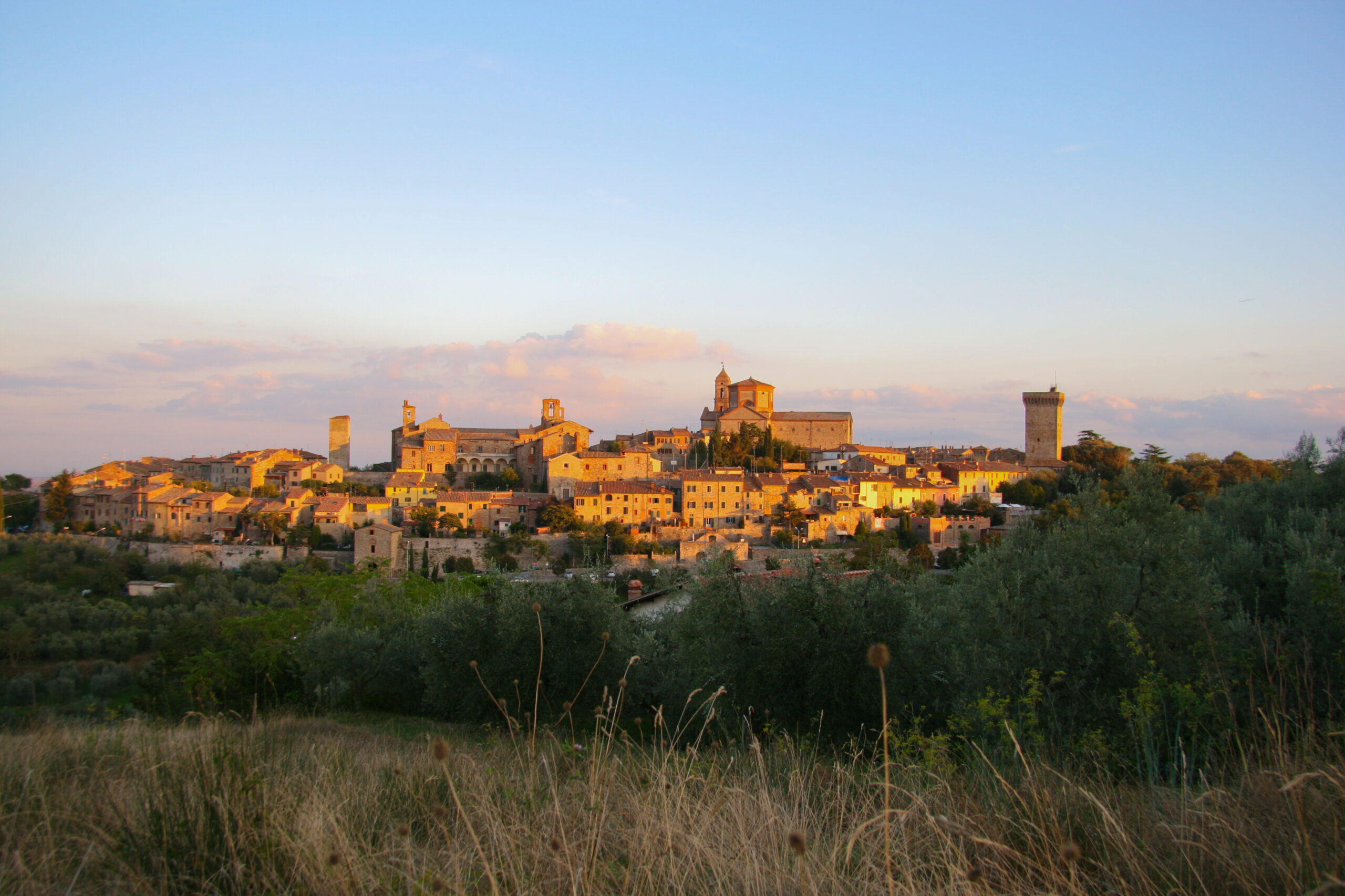
There is a particular pleasure in arriving at Lucignano for the first time without having seen a map. You enter through one of the medieval gates, step onto a curving street that bends just enough that you cannot see where it leads, and begin walking. The street curves again. And again. At some point you realize you are not walking a street at all — you are walking a spiral. Four concentric elliptical rings climb gently toward a central piazza, and the entire town is contained within them like the chambers of a nautilus shell.
This is not accidental. Lucignano has one of Italy’s best-preserved concentric medieval town plans — four ring streets curling around Piazza del Tribunale at the summit, where the Palazzo Comunale stands guard over a view that stretches across the Val di Chiana to the hills of Umbria. The plan is so distinctive that urban historians use it as a textbook example of organic medieval design, and so intact that walking it today feels less like touring a monument than inhabiting a diagram. The town has been called La Perla della Valdichiana — the Pearl of the Chiana Valley — for as long as anyone can remember, and it is a member of the Borghi più Belli d’Italia, which held its national festival here in 2023.
But the real reason to come to Lucignano is not the streets. It is what waits inside the Museo Comunale at the top of the spiral: a 2.7-meter-tall reliquary in the shape of a tree, made of gilded copper, silver, enamel, coral, rock crystal, and Renaissance miniature paintings. There is nothing else quite like it. And it is, by any measure, one of the strangest and most beautiful things in Tuscany.
A Place Shaped by Time
Lucignano’s position on a 400-meter hill between Arezzo and Siena meant that every power in medieval Tuscany wanted it, and none could keep it for long. The town changed hands repeatedly between the thirteenth and sixteenth centuries — Arezzo, Siena, Florence, Perugia, back to Siena, back to Florence — each conquest leaving its mark in the form of walls, gates, coats of arms, and architectural layers that accumulate like geological strata. The elliptical plan itself predates most of the fighting, probably evolving organically from an eleventh- or twelfth-century settlement that wrapped its streets around the contours of the hill for maximum defensive advantage. What makes Lucignano exceptional is not that this happened — many Italian hill towns follow their terrain — but that the resulting form was never overwritten. No Renaissance prince straightened the streets. No nineteenth-century engineer drove a boulevard through the rings. The spiral survived.
Under Florentine rule, which became permanent after the definitive Medici victory in 1554, Lucignano settled into a prosperous calm. It sat on the road between Arezzo and Siena, collecting tolls and growing olives. The Palazzo Comunale — also called the Palazzo Pretorio — accumulated heraldic crests from successive podestà and became the seat of the town’s modest civic life. In 1812, the neoclassical painter Luigi Ademollo frescoed the council hall, an unexpectedly grand gesture for so small a town. The population, which today stands at roughly 3,400, has probably never been dramatically larger.
The real surprise of Lucignano’s history is how much high-quality art accumulated here despite the town’s size. The Franciscans and their thirteenth-century church brought one treasure. The Comune commissioned another. And the combination of strategic location and civic pride meant that Lucignano attracted work by artists — Bartolo di Fredi, the circle of Luca Signorelli, the Aretine goldsmiths — who might logically have been expected to ignore it entirely.
What to See and Do
The Albero d’Oro
The Albero d’Oro — the Golden Tree, also called the Albero della Vita or Albero dell’Amore — is the reason art historians know Lucignano’s name. It stands in the Museo Comunale, inside the Palazzo Pretorio at the top of the spiral, and it stops most visitors mid-sentence.
It is a reliquary in the form of a branching tree: 2.70 meters tall, made of gilded copper and silver, with branches that hold rock crystal fruits, coral ornaments, enameled medallions, and small Renaissance paintings on copper. The branches spread symmetrically. The effect is somewhere between a Christmas tree, a medieval diagram of the universe, and a jeweler’s hallucination.
The tree was made in two phases. The first, begun around 1350, is attributed to an Aretine workshop working under strong Sienese influence — probably commissioned for the Chiesa di San Francesco, which originally housed it. The upper portion, including the Renaissance miniatures and the most elaborate crystal and coral work, was completed in 1471 by the Sienese goldsmith Gabriello d’Antonio, financed by a bequest from a local noblewoman named Madonna Giacoma. The theological inspiration is St. Bonaventure’s Lignum Vitae — the Tree of Life as a devotional meditation — but the physical result looks less like theology and more like a medieval workshop’s attempt to build the most extraordinary object they could imagine.
The Tree has had a dramatic afterlife. It was partially stolen in 1914 — pieces cut from the branches and smuggled out of Italy. The missing fragments were recovered between 1927 and 1929. In 1933, the entire reliquary was restored at the Opificio delle Pietre Dure in Florence, Italy’s premier conservation workshop. Today it sits in a darkened room behind glass, the gilding catching whatever light reaches it.
Iranian filmmaker Abbas Kiarostami featured the Tree — and Lucignano itself — in “Certified Copy” (2010), starring Juliette Binoche, which uses the town and the museum as settings for a conversation about originals, copies, and authenticity. For a film about whether replicas can carry the emotional weight of the real thing, a town built in concentric rings around a unique, irreplaceable object was the perfect location.
The museum also holds a Bartolo di Fredi triptych (Madonna and Child with Saints) and a lunette attributed to the workshop of Luca Signorelli, dated to around 1510–12. Neither is a masterpiece on the level of the Tree, but both reward attention and confirm that Lucignano attracted better art than its population might suggest.
Museo Comunale practical info: Located in the Palazzo Pretorio on Piazza del Tribunale. Open Tuesday through Sunday; hours vary seasonally (typically 10:00–13:00 and 14:30–17:30 in winter, extended to 18:30 or 19:00 in summer). Closed Mondays. Hours change with the season, and outside summer the museum closes on some weekdays, so check the museum’s website (museodilucignano.it) for current times and admission before you go.
The Chiesa di San Francesco
The Franciscan church at the edge of the innermost ring dates to the thirteenth century and preserves fragments of thirteenth- and fourteenth-century frescoes — Sienese school, in various states of preservation — that would draw serious attention if they were anywhere more accessible. This was the original home of the Albero d’Oro before it moved to the Palazzo Pretorio. The church itself has the sturdy simplicity of early Franciscan architecture: a single nave, a timber roof, stone walls that hold the cold in summer and the warmth of candles in winter.
The Collegiata di San Michele Arcangelo
The main parish church on Piazza del Tribunale, rebuilt in the late sixteenth century, houses several altarpieces worth pausing for and an internal arrangement that reflects the Counter-Reformation’s fondness for bringing the congregation’s attention firmly forward and upward. Its position at the top of the spiral, directly opposite the Palazzo Pretorio, creates a civic-religious dialogue that would have been immediately legible to any medieval visitor: God on one side, the law on the other, and the town circling beneath both.
Walking the Rings
The best thing to do in Lucignano, honestly, is walk. Enter through Porta San Giusto on the south side (the most common approach from the parking area) and let the streets pull you upward. The innermost ring — the most intimate, with the narrowest streets and the oldest stone — opens to sudden views through arches and gaps in the walls where the valley below appears like a painting in a frame. The outer rings are wider, quieter, and lined with modest palazzi whose ground floors occasionally reveal workshops or small shops. The full circumnavigation of the outermost ring takes perhaps fifteen minutes. The climb to Piazza del Tribunale from any gate takes five. The temptation to walk it twice — once in each direction — is universal.
Eating Like a Local
Lucignano sits squarely in the pici-and-Chianina belt of Valdichiana. The signature first course is pici all’aglione — the thick hand-rolled pasta with a slow-cooked tomato-and-giant-garlic sauce that defines the valley’s table. The aglione (giant garlic) grown in the surrounding countryside is sweet and mild enough that locals call it aglio del bacio, the kissing garlic — you can eat a plate of it at lunch and still be sociable at dinner.
For second courses, this is Chianina country: bistecca alla fiorentina, tagliata, or simply grilled filetto from the white cattle that have grazed the valley since Roman times. The local olive oil is Toscano IGP with a peppery bite that improves everything.
Lucignano is small enough that restaurant options are limited, which in this case is an advantage — what exists tends to be honest and local rather than tourist-oriented. La Rocca Gourmet, on Piazza Ser Vanni, is among the tables most often recommended in town. The Thursday morning market brings produce, cheese, salumi, and household goods to the town, but for a fuller market experience, the Saturday markets in Arezzo or Cortona are worth the short drive.
Wine here is typically Chianti Colli Aretini DOCG or broader Toscana IGT reds — pleasant, drinkable, and secondary to the food. The valley’s serious wine ambitions live in Montepulciano, 40 minutes south.
The Maggiolata: When the Spiral Fills with Flowers
The Maggiolata Lucignanese is Lucignano’s signature festival — a flower-float parade that fills the ring streets with color, music, and the kind of fierce neighborhood rivalry that small Italian towns do better than anyone.
The festival dates back generations and has grown into a proper multi-day event. It usually runs over the last days of May and the first days of June, including the dramatic notturna, a nighttime parade. Four rioni — Via dell’Amore, Porta San Giovanni, Porta San Giusto, and Porta Murata — build elaborate flower-covered floats and compete for the Grifo d’Oro (Golden Griffin) trophy. The floats are paraded through the ring streets, which, given their narrow curvature, creates a far more intimate spectacle than the wide-boulevard parades of larger cities.
The Maggiolata is complemented by smaller events through the year: Segni d’Amore around Valentine’s Day (the Albero d’Oro’s secondary identity as the “Tree of Love” makes this a natural fit) and Memorie del Passato, a September re-creation of nineteenth-century daily life. None of these draw the crowds of the Maggiolata itself, but all reinforce the sense that Lucignano’s civic identity runs through its festivals as surely as its streets run in circles.
Getting There and Getting Around
Lucignano sits roughly halfway between Arezzo and Siena, just off the main Valdichiana corridor. By car, it is about 30 minutes south of Arezzo via the SS73 or the A1 (exit Monte San Savino), and about 50 minutes east of Siena via the Raccordo Siena-Bettolle. From Florence, expect about 1 hour 20 minutes via the A1. From Cortona, it is a 25-minute drive northwest.
By train, the nearest station is Lucignano-Marciano-Pozzo on the Arezzo–Sinalunga regional line operated by TFT, down on the valley floor below the town. Trains run a few times daily but service is infrequent; a car is the realistic choice for most visitors.
Parking is outside the walls — the ring streets are pedestrian-only. A small parking area sits near Porta San Giusto on the south side, with additional spaces along the approach road. Parking is free and rarely full except during the Maggiolata. The walk from the parking area through the gate and up to the museum takes about five minutes.
There is no ZTL in the strict camera-enforced sense — the town’s layout simply does not permit car access to the center. This is one of Lucignano’s accidental advantages: no ZTL fines, no confusion, no need for permits. You park, you walk, you spiral.
Nearby
Monte San Savino (10 minutes north) — Renaissance architecture by Sansovino and Sangallo, the former Jewish quarter with its surviving synagogue building and cemetery, and the Sagra della Porchetta in September.
Foiano della Chiana (10 minutes east) — Italy’s oldest Carnival, an extraordinary concentration of Della Robbia glazed terracottas, and Signorelli’s last painting.
Castiglion Fiorentino (20 minutes east) — The loggia that isn’t Vasari’s, a Cassero tower with a fine pinacoteca, and Roberto Benigni’s birthplace.
Cortona (25 minutes east) — Etruscan MAEC museum, Severini mosaics, Under the Tuscan Sun country.
Arezzo (30 minutes north) — Piero della Francesca frescoes in San Francesco, the monthly Fiera Antiquaria in Piazza Grande, and Vasari’s house.
Information is provided in good faith and may change. Always confirm opening hours, prices, and event dates with the official source before you travel.