
Town · Mugello
Marradi
Where the Chestnuts Fall and the Map Gets Confused
Last updated:
- Region
- Mugello
- Province
- Metropolitan City of Florence (formerly Province of Florence)
- GPS
- 44.0756, 11.6128
- Best season
- autumn
- Time needed
- half day to full day (full day if combining with steam train)
- Difficulty
- easy
- Known for
- Marroni del Mugello IGP chestnuts, Dino Campana poet, Sagra delle Castagne, vintage steam train, Città Slow
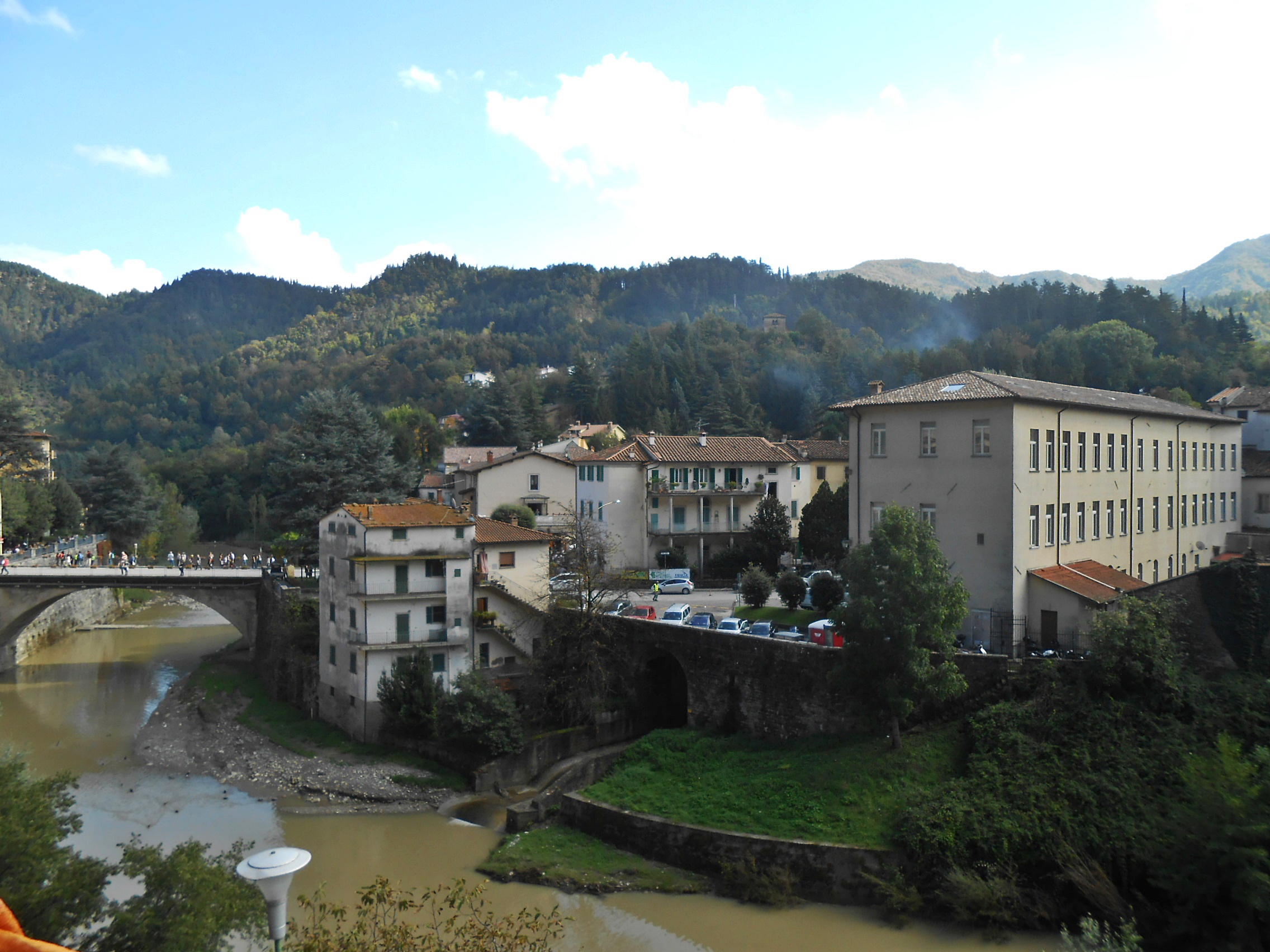
Marradi belongs to Tuscany, but it isn’t entirely sure about that. Sitting in the Alto Mugello along the Lamone River — which flows not toward the Arno and Florence but north toward Faenza and the Adriatic — this small town of about 3,000 people lives on a cultural fault line. The accent shifts here. The pasta gets rounder. The loyalties of geography pull in two directions at once: administratively Florentine, temperamentally Romagnolo.
None of this matters much in October, when the only thing that matters is chestnuts. The Sagra delle Castagne — held on the Sundays of October and running since 1964 — fills Marradi’s streets with roasted chestnuts, chestnut tortelli, chestnut beer, marrons glacés, and crowds, some of whom arrive on historic trains, often steam-hauled, that wind through autumn forests along the old Faentina railway. On those October Sundays, this quiet Città Slow becomes the chestnut capital of Italy.
But Marradi has a story that runs much deeper than sagre and steam trains. This is where Dino Campana was born — arguably the most brilliant and most damaged Italian poet of the twentieth century, a man who wandered across Europe and as far as South America, wrote one book of hallucinatory genius, and spent his last fourteen years in a psychiatric hospital. Marradi carries his memory with a mixture of pride and unease that tells you everything about small-town Italy’s relationship with its difficult sons.
A Place Shaped by Time
Marradi has been inhabited since at least the Roman period — its position on the route between Florence and Faenza, through the Apennine passes, gave it strategic and commercial importance long before anyone was counting chestnuts. The town grew up along the Lamone, a river that cuts a narrow valley through the mountains and gives Marradi its particular character: enclosed, intimate, oriented toward the north.
The town’s medieval history was shaped by the same forces that defined the wider Mugello: the Guidi counts and then the Manfredi lords of Faenza, the expansion of Florentine power (Florence took Marradi in 1428), the slow transition from feudal to civic governance. Marradi’s position on the Romagna border meant it was always a contested zone — culturally ambiguous, politically useful, economically dependent on the chestnut forests that covered the surrounding hills.
The chestnuts are the deeper story. The mountains around Marradi have been covered with chestnut trees for centuries — the Marrone Fiorentino variety, large and sweet and easily peeled, which now carries the Marroni del Mugello IGP designation. The chestnut tree was called l’albero del pane (the bread tree) because for mountain communities with little arable land, chestnuts were the primary carbohydrate. They were dried in stone metati — small buildings where chestnuts were smoked over slow-burning wood for forty days — then ground into flour that became bread, pasta, polenta, and castagnaccio. The chestnut forests were managed as carefully as any farm, with individual trees sometimes named and inherited.
The decline came in the twentieth century, when chestnut blight, rural depopulation, and cheaper wheat flour made the old chestnut economy obsolete. But Marradi held on longer than most, and the Sagra delle Castagne — which began in the 1960s as a local festival and has grown into a major regional event — represents both a genuine tradition and a conscious act of cultural preservation.
Dino Campana
Dino Campana (1885–1932) is Marradi’s most famous and most complicated son. He was a poet of extraordinary vision — his single published work, Canti Orfici (Orphic Songs, 1914), is considered among the greatest Italian poetry of the twentieth century, a hallucinatory, musical, visionary book that broke with every convention of its time.
Campana’s life was a catastrophe of genius and mental illness. He traveled compulsively — to Argentina, to Belgium, across Italy on foot — unable to settle, unable to stop writing, unable to find stability. He submitted the manuscript of Canti Orfici to the literary magazine Lacerba in Florence; the editors, including Ardengo Soffici, lost it. Campana rewrote the entire book from memory. (The original manuscript was found decades later in Soffici’s papers.)
In 1918, Campana was committed to the psychiatric hospital in Castel Pulci, near Florence. He spent the last fourteen years of his life there, dying on March 1, 1932. The diagnosis was schizophrenia, though modern scholars have debated whether his condition was accurately understood by the medicine of his time.
Marradi’s relationship with Campana is telling. The town has a small museum dedicated to him, and his poetry is quoted on walls and plaques. But there’s an undercurrent of ambivalence — pride in his genius, discomfort with his madness, uncertainty about how to claim a man who spent most of his adult life trying to leave. A street, a prize, a cultural center bear his name. Whether the town has fully reckoned with his story is a question that visitors more attuned to literary history will feel hanging in the air.
What to See and Do
The Sagra delle Castagne (October)
If you visit Marradi, do it in October. Every Sunday of the month, the Sagra delle Castagne transforms the town into an open-air chestnut festival. Streets are lined with vendors selling caldarroste (roasted chestnuts), marrons glacés, castagnaccio, necci (chestnut flour crêpes), chestnut tortelli, and chestnut beer. The smell of roasting chestnuts fills every corner.
The festival is well-organized but not overly commercialized — it still feels like a town celebration that happens to attract visitors from across Tuscany and Romagna rather than a theme park event. Local producers sell directly. There’s live music, traditional demonstrations, and an atmosphere that falls somewhere between a harvest festival and a family reunion.
The steam train is the way to arrive. Historic trains, often steam-hauled, run from the Florence side via Borgo San Lorenzo up the old Faentina railway to Marradi, winding through tunnels and across bridges with autumn forests blazing on both sides. It’s one of the most scenic train rides in Tuscany, and seats go quickly on sagra Sundays.
Historic steam trains run to the sagra on festival Sundays from both the Florence and Faenza sides. Seats are limited and booking is mandatory, through the operator named in each year’s programme. The Pro Loco di Marradi publishes each year’s dates, programme and booking details.
Centro Studi Campaniani / Campana Sites
The Centro Studi Campaniani in Marradi preserves Campana’s legacy through a library of editions of Canti Orfici (including the 1914 first edition), archival documents and the only portrait of Campana painted in his lifetime. It’s a modest space, but for anyone who knows Campana’s poetry, being in his hometown adds a dimension that no library can replicate.
Campana’s family home still stands in the town centre. The town has placed quotes from his poetry on walls at various points — a short literary walk that is more atmospheric than it sounds, particularly if you’ve read even a few pages of Canti Orfici beforehand.
The Centro Studi Campaniani “Enrico Consolini” keeps limited hours — contact the Pro Loco di Marradi before visiting.
The Town Center
Marradi’s center is compact and pleasant — a main street, a church, a few piazzas, stone buildings that show the local Apennine character. The main church, San Lorenzo, has Romanesque origins but was rebuilt in neoclassical style in the 1780s; the Badia di Santa Reparata, an abbey documented since 1025, stands in the hamlet of Badia del Borgo outside town. The town has a well-preserved theatre (Teatro degli Animosi) from the eighteenth century that hosts a small cultural program.
What makes Marradi’s center distinctive is its pace. This is a Città Slow — a certified member of the Slow City movement — and you feel it. Shops close for lunch. People stop to talk in the street. The bar on the main square serves coffee that costs what coffee should cost. The rhythm is not lazy but deliberate, as if the town has decided that hurrying is for people who don’t know where they’re going.
The Lamone Valley and Surrounding Nature
The valley around Marradi offers quiet walking through chestnut and mixed forests. The chestnut groves themselves are beautiful, particularly in autumn when the forest floor is carpeted with fallen leaves and the air smells of wood smoke from the metati (if any traditional drying is happening nearby).
The road from Marradi toward the Passo della Colla di Casaglia (913 m) climbs through increasingly dramatic mountain scenery to the Apennine ridge. At the pass, you’re on the Apennine watershed between the Sieve and Lamone valleys, with views in both directions. It’s a satisfying drive or an ambitious cycling climb.
Eating Like a Local
Chestnut is the dominant flavor. In season (October–December), you’ll find:
- Caldarroste — roasted chestnuts, eaten from a paper cone on the street
- Castagnaccio — the definitive chestnut cake: nothing but chestnut flour, olive oil, rosemary, pine nuts, raisins, and salt. No sugar, no eggs, no butter. The surface should be crackled and slightly caramelized. Every family insists their version is correct.
- Necci — chestnut flour crêpes cooked between iron pans, served with ricotta or fresh raviggiolo cheese
- Tortelli di castagne — the original tortelli, before potatoes took hold after the famine of 1817, filled with chestnut paste
- Chestnut flour polenta — a mountain staple, heavier and sweeter than corn polenta
Beyond chestnuts, Marradi’s food shows its Romagna borderland character. Pasta here trends rounder — you’ll find tortellini alongside tortelli. The meat ragù may have a slightly different seasoning than what you’d find in Borgo San Lorenzo, some 35 kilometers to the south-west but a cultural world away.
Local honey — particularly dark, bitter chestnut honey — is excellent and widely available. Marroni del Mugello IGP chestnuts, fresh or in processed forms (flour, marrons glacés, cream), make outstanding gifts and travel well.
Getting There and Getting Around
From Florence by train: The Ferrovia Faentina runs from Florence SMN directly to Marradi. This is the scenic route through the Mugello, crossing the valley to Borgo San Lorenzo before climbing into the mountains toward Marradi.
Engineering works and weather alerts can suspend services, particularly between Marradi and Faenza, so check the current timetable on Trenitalia before you travel.
From Florence by car: Take the SR302 (Via Faentina) through the Mugello valley, or the A1 to Barberino and then east through the valley. The drive is approximately 65 km and takes about 1.5 hours. The road beyond Borgo San Lorenzo climbs through increasingly mountainous terrain — scenic, winding, and not fast.
From Faenza / Romagna: Marradi is equally accessible from the Romagna side. The SS302 from Faenza to Marradi is a dramatic mountain road through the Lamone gorge. If you’re combining Marradi with a visit to Brisighella, Faenza, or Ravenna, approaching from this direction makes more sense.
Within Marradi: The town is entirely walkable. The chestnut forests and surrounding trails require a car or willingness to walk significant distances.
Parking: Free and straightforward on normal days. During sagra Sundays in October, arrive early — designated parking fills quickly, and shuttle services may operate from outlying lots.
Nearby
- Palazzuolo sul Senio (20 km) — One of Italy’s most beautiful villages, 1,000 inhabitants, medieval reenactment
- Borgo San Lorenzo (35 km) — Mugello capital, Chini museum, weekly market, train connections
- Brisighella (30 km, Romagna side) — One of the most beautiful villages in Romagna, olive oil, thermal baths
- Passo della Colla di Casaglia (15 km) — Apennine pass with views over the Mugello and the Lamone valley
- Parco Nazionale delle Foreste Casentinesi (accessible from mountain roads east of Marradi) — Ancient beech forests, hiking, wolves
Information is provided in good faith and may change. Always confirm opening hours, prices, and event dates with the official source before you travel.