
Town · Mugello
Palazzuolo sul Senio
Population 1,000, and That’s the Point
Last updated:
- Region
- Mugello
- Province
- Metropolitan City of Florence (formerly Province of Florence)
- GPS
- 44.1128, 11.5475
- Best season
- spring, summer, autumn
- Time needed
- half day to overnight
- Difficulty
- moderate
- Known for
- Borghi più belli d'Italia, Medioevo alla Corte degli Ubaldini reenactment, Museum of Mountain People, albergo diffuso, extreme tranquility
There are villages in Italy that are small because people left. And there are villages that are small because the mountains never invited many people in the first place. Palazzuolo sul Senio is the second kind. Sitting at 437 meters elevation in the forested isolation of the upper Senio valley, at the far northeastern edge of Tuscany where the region dissolves into Romagna, this village of about 1,100 inhabitants has the quality of a place that exists entirely on its own terms.
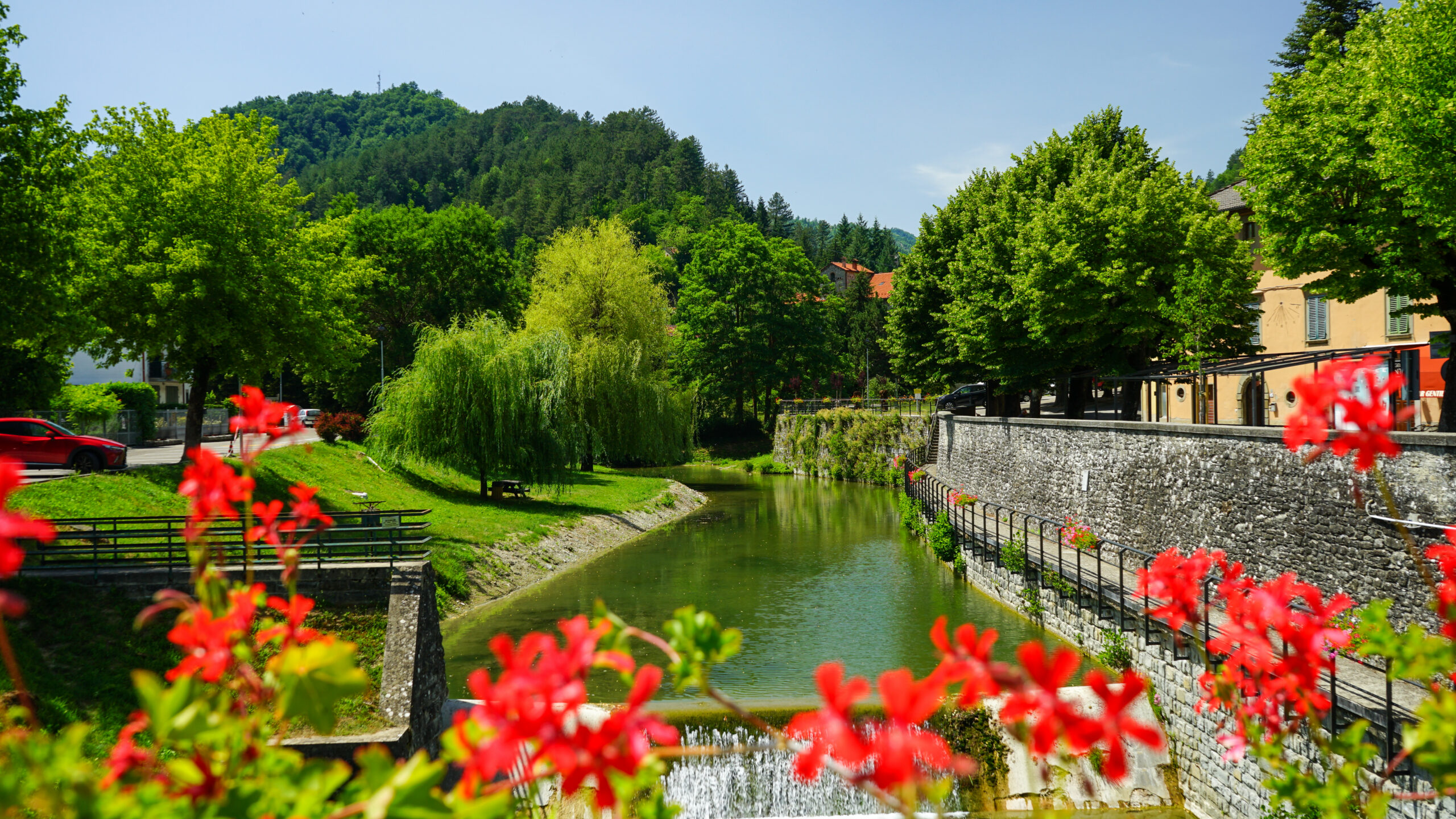
In 1991, Airone magazine named it Italy’s “Villaggio Ideale” — its ideal village. In 2018, it joined the Borghi più belli d’Italia — Italy’s association of most beautiful villages. These recognitions describe two different things: livability is about the quiet rhythms of daily life in a place where everyone knows everyone; beauty is about the stone houses, the medieval tower, the Senio river, and the mountain forests that surround the village like a green wall.
What Palazzuolo offers is not a list of attractions. It is an experience of a place where time has a different texture — slower, denser, more physical. You hear the river. You hear birds. You hear the bell. Not much else.
A Place Shaped by Time
Palazzuolo’s history is defined by the Ubaldini, the powerful Ghibelline feudal family who controlled the Apennine passes and the borderland between Tuscany and Romagna from the eleventh to the fourteenth century. The Ubaldini built castles across the Alto Mugello — their principal fortress at Montaccianico (destroyed by Florence in 1306) was said to be among the strongest in the Tuscan countryside. Palazzuolo was part of their territory, a mountain settlement governed by feudal law while Florence was building its republic on the valley floor below.
Several Ubaldini appear in Dante’s Divine Comedy: Cardinal Ottaviano degli Ubaldini in Inferno (Canto X, among the heretics), Archbishop Ruggieri (Canto XXXIII, frozen in the ice of Cocytus for his betrayal of Count Ugolino). The family’s power in the Mugello ended in the fourteenth century — but in Palazzuolo, the Ubaldini live on through an annual medieval reenactment.
The village’s later centuries were quieter. Far from main roads, too mountainous for large-scale agriculture, Palazzuolo survived on chestnut forests, livestock, and the stubbornness that mountain communities develop when the alternative is leaving. The twentieth century brought the same rural depopulation that emptied mountain villages across the Apennines — young people left for Florence, for the factories of the Po Valley, for anywhere with work. Palazzuolo shrank but never quite emptied. The thousand-odd people who remain are the ones who decided, or whose families decided, that this valley was worth staying for.
What to See and Do
The Village Itself
Palazzuolo is the kind of place where the main attraction is the place itself. The village clusters along the Senio River, with stone houses rising on both banks, a medieval tower, narrow streets, and a main square that doubles as the social center of everything. The architecture is mountain Romanesque — heavy stone walls, small windows, steep roofs designed for snow that occasionally falls at this altitude.
Walk the village end to end in fifteen minutes. Then walk it again more slowly, because the first time you were moving too fast. The details are in the doorways, the window boxes, the way the stone changes color through the day, the cat asleep on a wall that has been warming cats for five hundred years.
Museo delle Genti di Montagna (Museum of Mountain People)
This small ethnographic museum documents the life of the mountain communities that inhabited the upper Senio valley — the tools, the techniques, the seasonal rhythms of a society organized around chestnuts, livestock, and forest. It’s the kind of museum that exists in many Italian mountain villages, but Palazzuolo’s version is well-curated and genuinely informative about a way of life that disappeared within living memory.
The museum helps you understand what you’re seeing when you look at the landscape around Palazzuolo: the terraced hillsides were fields, the stone huts in the forest were metati for drying chestnuts, the paths through the woods were routes between seasonal pastures. The landscape is not wilderness but an abandoned workspace.
Medioevo alla Corte degli Ubaldini
Every summer (typically July), Palazzuolo hosts the Medioevo alla Corte degli Ubaldini — a medieval reenactment honoring the feudal family that once controlled these lands. The village transforms: costumes, processions, craft demonstrations, medieval food, music, and staged scenes from life under the Ubaldini. For a village of 1,000 people, it’s an ambitious production, and the fact that virtually everyone participates gives it an authenticity that larger, more commercial medieval festivals can’t match.
The reenactment is also a statement of identity. Palazzuolo claims the Ubaldini heritage — the feudal lords who defied Florence — rather than positioning itself as a Florentine outpost. This is borderland identity: Tuscan on the map, independent in the spirit.
The festival is held in July, usually across two weekends; the dates are announced locally each year.
Locanda Senio — The Distributed Hotel
The Locanda Senio is a well-known example of an albergo diffuso — a “distributed hotel” where guest rooms are scattered across multiple buildings woven into the fabric of the village rather than concentrated in a single structure. You check in at one building, sleep in another, eat in a third. The village itself becomes the hotel.
The concept is both a hospitality model and a preservation strategy: it gives economic purpose to buildings that might otherwise stand empty, keeps the village alive with visitors, and offers an experience that no conventional hotel can replicate. Staying at an albergo diffuso means living — temporarily — as a resident rather than as a guest. You buy your morning bread at the village bakery. Your room might be above someone’s house. The distinction between hotel and village dissolves.
The Senio Valley and Surrounding Forests
The valley around Palazzuolo is densely forested and remarkably quiet. Walking trails lead into chestnut and beech forests that extend for kilometers without a road or a building. The Senio River itself — a modest stream in summer, more substantial in spring — is the valley’s thread, and paths follow it in both directions.
For more ambitious walkers, trails climb to the Apennine ridge along the Tuscany–Romagna watershed. The forests here are extensive, with beech woods on the higher slopes, and wolves have returned to this stretch of the Apennines.
This is not hiking for people who need waymarked interpretive panels every 500 meters. It’s hiking for people who want to be in a forest.
Eating Like a Local
Palazzuolo’s food is Alto Mugello mountain cooking at its most fundamental. Expect:
- Tortelli di patate — the valley staple, served here as everywhere in the Mugello
- Game and foraged foods — wild boar, mushrooms (porcini in autumn), herbs, and forest fruits appear on menus seasonally
- Chestnuts — castagnaccio, necci, chestnut polenta, chestnut flour pasta. The trees are everywhere; the food follows.
- Raviggiolo — the delicate fresh cheese of the Tuscan-Romagnol Apennines, traditionally made between October and March (its Romagna cousin is a Slow Food Presidium)
Restaurant options are limited by the village’s size. The Locanda Senio’s restaurant is the most notable dining option, offering refined mountain cooking that uses local ingredients with more sophistication than you’d expect in a village of this size. Beyond that, there may be one or two simple trattorias or agriturismi in the surrounding area.
Getting There and Getting Around
A car is essential. Palazzuolo has no train station, limited bus service, and sits on mountain roads that are the only way in or out.
From Florence by car: Take the SR302 (Via Faentina) through Borgo San Lorenzo and toward Marradi, then follow the SP306 up the valley to Palazzuolo. The drive is approximately 75 km and takes about 1.5–2 hours. The last section on the SP306 is a winding mountain road through forest — scenic, well-paved, but slow.
From Marradi: 20 km on the SP306, about 30 minutes. This is the most practical approach if you’re combining the two.
From the Romagna side: Accessible from Casola Valsenio or Borgo Tossignano via mountain roads. These are narrow, winding, and beautiful.
Within Palazzuolo: The village is entirely walkable in minutes. The surrounding trails and forests require walking readiness.
Parking: Not a problem. There are spots around the village.
Important note: Come with supplies if you need specific things. Palazzuolo has basic services — bars, a few shops, a pharmacy — but this is not a place with a supermarket. It is a village of 1,000 people in the mountains. Plan accordingly, and appreciate accordingly.
Nearby
- Marradi (20 km) — Chestnuts, Dino Campana, Sagra delle Castagne, historic trains from Florence during the chestnut festival
- Firenzuola (25 km west) — Pietra serena, WWII Gothic Line history, German Cemetery
- Brisighella (30 km, Romagna side) — One of Italy’s most beautiful villages, olive oil, thermal springs
- Parco Nazionale delle Foreste Casentinesi (further east along the Apennines) — Ancient beech forests, UNESCO World Heritage, wolves
- Casola Valsenio (20 km, Romagna side) — Herb gardens, the Giardino delle Erbe
Information is provided in good faith and may change. Always confirm opening hours, prices, and event dates with the official source before you travel.