
Town · Mugello
Scarperia
The Town that Florence Built to Break a Dynasty
Last updated:
- Region
- Mugello
- Province
- Metropolitan City of Florence (formerly Province of Florence)
- GPS
- 44.0075, 11.3531
- Best season
- spring, autumn
- Time needed
- half day to full day
- Difficulty
- easy
- Known for
- handcrafted knives, Palazzo dei Vicari, Brunelleschi Clock, Borghi più belli d'Italia, MotoGP circuit
In 1306, the Florentine Republic needed to solve a problem. The Ubaldini — a feudal family who had controlled the Apennine passes for centuries — were strangling trade between Tuscany and Emilia-Romagna. Florence’s solution was blunt: raze the Ubaldini fortress at Montaccianico to the ground. Then build a new town on the valley road, loyal to Florence, to replace feudal power with civic order.
That town was Scarperia. Seven centuries later, it is still here — a member of the Borghi più belli d’Italia (Italy’s most beautiful villages), home to five hundred years of knife-making tradition, and keeper of one of the most extraordinary small museums in Tuscany. Somewhere inside the Palazzo dei Vicari, a clock mechanism made by Filippo Brunelleschi — the architect of Florence’s dome — continues to exist as the only known surviving clockwork from his hands.
This is not a village that waits to be discovered. It is a village that has been quietly doing its work since the fourteenth century, largely unbothered by the fact that the wider world hasn’t noticed.
A Place Shaped by Time
Scarperia’s origin story is unusually precise. The Florentine government formally founded it on September 7, 1306, as a fortified settlement (terra murata) positioned at the strategic crossroads where the road from Florence splits toward the Futa and Giogo mountain passes. The name likely comes from scarpa — the slope or escarpment on which it sits.
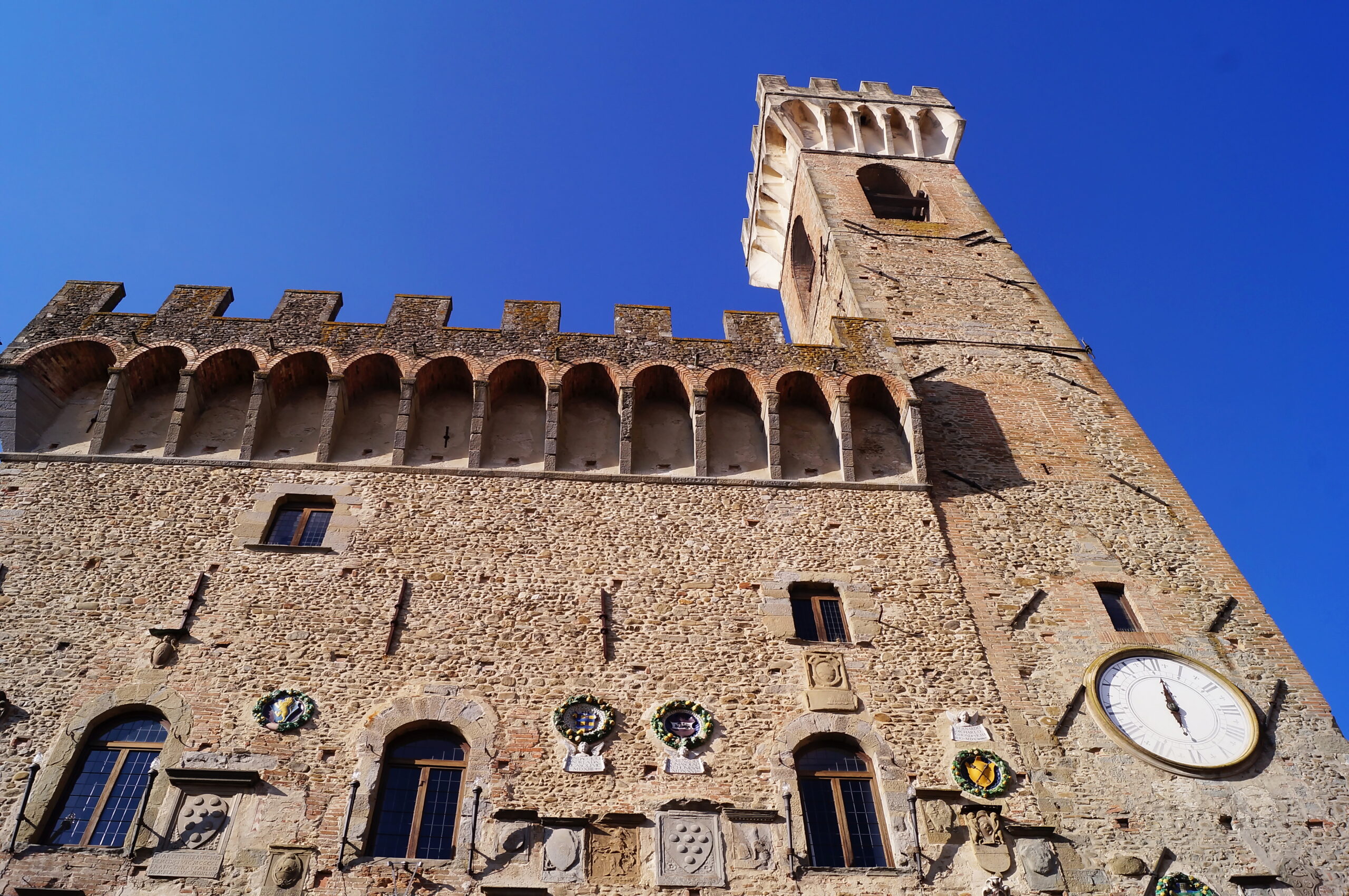
The plan was deliberate. Florence offered tax exemptions and free building plots to attract settlers from surrounding villages. The town was laid out on a grid around a central square, dominated by a fortress that was both a seat of government and a symbol of Florentine authority. The Palazzo dei Vicari — the fortress-palace that still dominates the piazza — was begun in the fourteenth century and clearly modeled on Florence’s own Palazzo Vecchio. The message was clear: this is Florence’s territory now.
For centuries, the Vicari (governors) sent from Florence to administer the Mugello region sat in this palace. Each one left their coat of arms on the facade — an extraordinary tradition that turned the building’s exterior into an open-air gallery of heraldic art. Today, the facade is studded with dozens of glazed terracotta coats of arms, several from the Della Robbia and Buglioni workshops, each representing a different governor across the centuries. It is one of the most visually striking building facades in all of Tuscany, and almost nobody outside the region knows it exists.
The knife-making tradition began to develop in the fifteenth century, likely connected to Scarperia’s position on a trade route. By the sixteenth century, the town was already renowned for its blades. Surviving records point to a well-organized craft. The craft survived wars, earthquakes, and industrial competition — and it survives today, with workshops in the town center still forging knives by hand using techniques that haven’t fundamentally changed in centuries.
What to See and Do
Palazzo dei Vicari and the Museo dei Ferri Taglienti
The Palazzo dei Vicari is the heart of Scarperia — a fortified palace with a 42-meter tower that you’ll see from every approach to the town. Start outside: the facade’s collection of heraldic coats of arms in glazed polychrome terracotta is extraordinary, spanning centuries of Florentine governors. Look for the Della Robbia pieces — the quality and color are remarkable.
Inside, the Museo dei Ferri Taglienti (Museum of Cutting Implements) documents five centuries of blade-making across five thematic sections. This is not a dusty display-case museum. There’s a workbench where visitors can handle knives, learn about different blade types, and understand the forging process. The collection ranges from historic regional blades to the iconic Zuava pocket knife — Scarperia’s signature product, with its sturdy build, ox horn handle, and handmade forged blade.
The museum also provides access to the Brunelleschi Clock in the Sala dell’Oriolo. Documented through the request by Brunelleschi’s heir, Il Buggiano, in 1446 to settle the account for it (c. 1445), this clock mechanism is believed to be the only surviving clockwork made by the architect who solved the engineering challenge of the Florence Cathedral dome. It is also one of the oldest public tower clocks in Italy. The mechanism is not immediately spectacular to look at — it is a medieval machine, not a jewel — but knowing whose hands designed it gives the room a particular weight.
Guided tours of the museum and palazzo can be booked in advance through the Museo dei Ferri Taglienti website. They’re worth it — the guides know the knife-making story intimately.
The Knife Workshops
Scarperia’s identity as a knife-making center is not historical theater — it is a living industry. Several workshops in the town center still produce knives by hand, and some welcome visitors to watch the forging process. The Antica Bottega del Coltellinaio, a workshop that operated from the early 1900s to 1970, has been preserved and has hosted live forging demonstrations — ask at the museum for current arrangements.
The knives make exceptional souvenirs or gifts. The Zuava pocket knife is the classic choice, but workshops produce everything from kitchen knives to specialized blades. Prices are reasonable for handmade work. If you buy a knife, ask the maker about the steel, the handle material, and the forging technique — they are craftspeople, and they enjoy talking about their work.
The Piazza and Town Center
Scarperia’s main square — Piazza dei Vicari — is compact and handsome. The Palazzo dei Vicari on one side, a church on another, a few cafes with outdoor tables. It’s the kind of square where you sit for a coffee and realize you’ve been watching the light change on the facade for an hour.
The Propositura dei Santi Jacopo e Filippo, the main parish church facing the palazzo, contains a marble tondo attributed to Benedetto da Maiano and a wooden crucifix from the Florentine school. The Oratorio della Madonna di Piazza, a small oratory on the square, houses a Madonna and Child enthroned attributed to Jacopo del Casentino (c. 1347–49) — one of the town’s oldest artworks.
Walk the streets behind the palazzo. Scarperia is small enough to explore in an hour on foot, but the side streets have a quiet medieval character that rewards slow wandering. The town walls are largely intact in sections.
The Autodromo del Mugello
The Autodromo Internazionale del Mugello — owned by Ferrari since 1988 — sits just outside Scarperia. Its 5.245-kilometer circuit is the long-time home of the MotoGP Italian Grand Prix, drawing tens of thousands of spectators who turn the hillsides into a sea of Valentino Rossi yellow (or Ducati red).
Racing in this valley dates to 1914, when a 66-kilometer road circuit wound through Firenzuola and the Futa Pass. Enzo Ferrari himself raced here in 1921. The permanent circuit opened in 1974 and hosted its first Formula 1 race in September 2020 — the Tuscan Grand Prix, marking Ferrari’s 1,000th Grand Prix. The circuit holds the highest FIA environmental certification and has been ranked among the world’s most sustainable racetracks.
If you’re not visiting during a race weekend, the circuit area is still worth a drive-by for context — the landscape around it, with the Apennines rising behind the grandstands, explains why this valley has drawn speed and ambition for over a century.
Bosco ai Frati and the Medici Villas
A short drive from Scarperia (via San Piero a Sieve) leads to two of Mugello‘s most important Medici sites. The Convento di Bosco ai Frati is a Franciscan convent rebuilt by the Medici, where a dramatic wooden Crucifix attributed to Donatello was rediscovered in the crypt in the 1950s. The atmosphere is austere, devotional, and powerful. Saint Bonaventure received his cardinal’s insignia here in 1273.
The Villa Medicea di Cafaggiolo — now a UNESCO World Heritage Site — was Cosimo de’ Medici’s country retreat, transformed by Michelozzo in the 1450s. Lorenzo il Magnifico spent time here too. The nearby Villa del Trebbio, also by Michelozzo and also UNESCO-listed, completes the triangle of Medici power in the valley.
Both villas are privately owned; guided visits have been offered in past years, but access changes — check with the Mugello tourist office before planning a day around them.
Eating Like a Local
You are in the heartland of tortelli di patate. Order them everywhere — they will be good everywhere, though every restaurant will insist theirs are the best in the valley. The classic pairing is with a rich meat ragù; duck ragù is a local favorite. They should be freshly made, not reheated.
For something beyond tortelli: look for peposo (a slow-cooked beef stew heavy with black pepper, originally a kiln workers’ dish), ribollita in winter, and anything involving chestnuts in autumn. Local honey — chestnut, acacia, or wildflower — is an excellent thing to buy.
Scarperia’s restaurants tend toward honest trattoria cooking rather than fine dining. The weekly market is a good place to find local producers selling direct.
Getting There and Getting Around
From Florence by car: Take the A1 motorway north toward Bologna and exit at Barberino di Mugello. From the exit, follow signs toward Scarperia — it’s about 15 minutes on the SP503. Total drive from central Florence: approximately 40 minutes. Alternatively, the scenic SS65 (Via Bolognese) through Vaglia and over the hills to San Piero a Sieve is slower but more atmospheric.
From Florence by train: The Ferrovia Faentina from Florence SMN reaches San Piero a Sieve (check current timetables on trenitalia.com), but Scarperia itself has no train station. From San Piero a Sieve, you’ll need a bus, taxi, or a 5 km walk/cycle. This is the one practical limitation — Scarperia really requires a car for comfortable access.
Parking: There are parking areas just outside the town center, a short walk from the main square; follow local signage for any traffic restrictions in the historic center.
Best time of day: Morning for the best light on the Palazzo dei Vicari facade. Market day brings the square to life.
Combine with: San Piero a Sieve (Bosco ai Frati, Medici villas — 5 km), Borgo San Lorenzo (market town, Giotto museum — 8 km), or a drive up to the Giogo di Scarperia pass for Apennine views.
Nearby
- San Piero a Sieve (5 km) — Scarperia’s municipal partner, gateway to the Medici villas of Cafaggiolo and Trebbio, and the Convento di Bosco ai Frati
- Borgo San Lorenzo (8 km) — The valley’s main town, with the Chini ceramics museum and its fine Romanesque Pieve di San Lorenzo
- Vicchio (15 km) — Giotto’s birthplace, Fra Angelico’s home ground, the Barbiana school
- Lake Bilancino (10 km) — Swimming, sailing, birdwatching at one of Tuscany’s largest artificial lakes
- Autodromo del Mugello (3 km) — MotoGP circuit, just outside town
Information is provided in good faith and may change. Always confirm opening hours, prices, and event dates with the official source before you travel.