
Town · Valdichiana
Castiglion Fiorentino
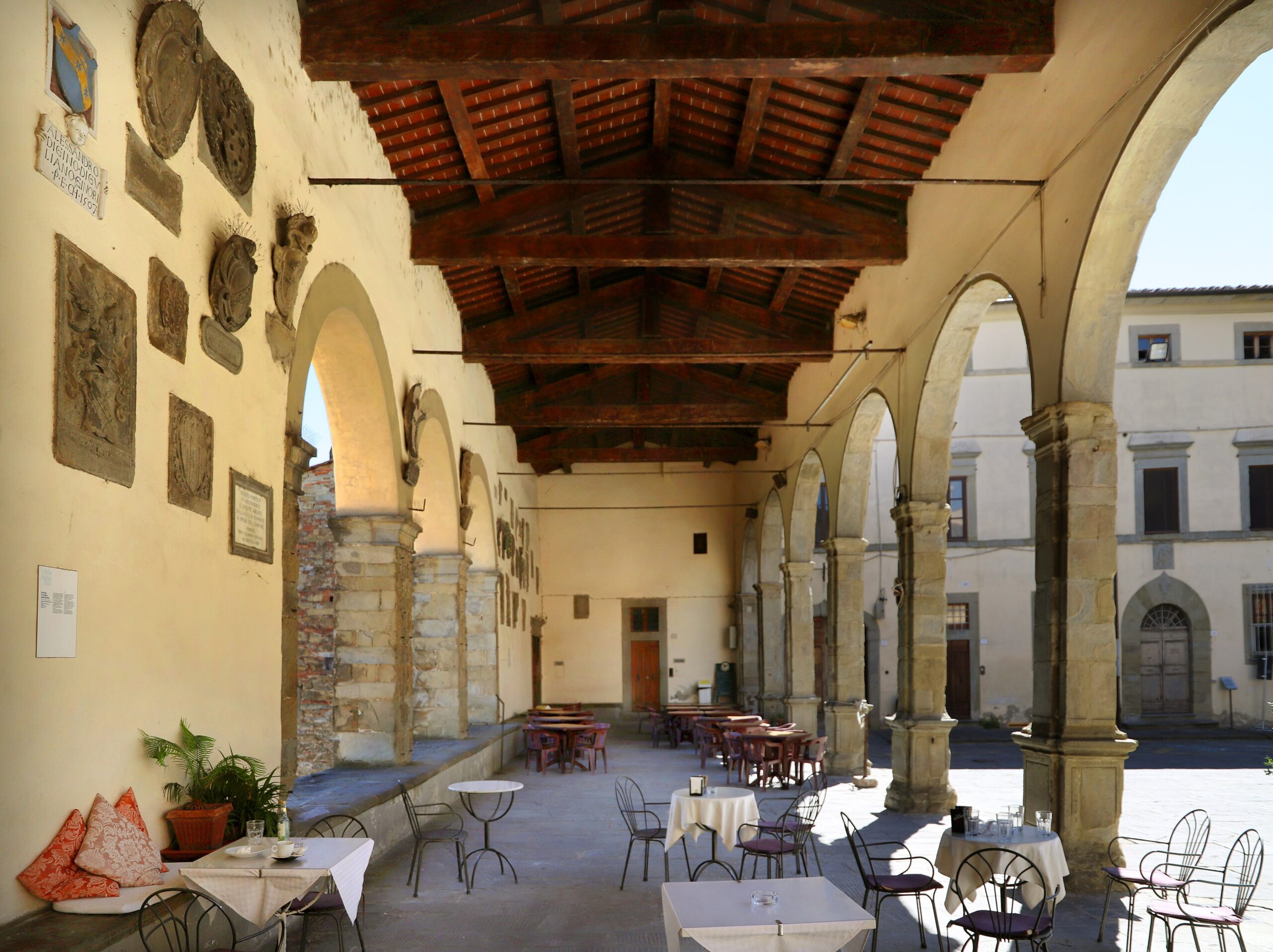
The Loggia That Isn’t Vasari’s
Last updated:
- Region
- Valdichiana
- Province
- Province of Arezzo
- GPS
- 43.3445, 11.9215
- Best season
- June (Palio dei Rioni + long days), April–May (spring quiet), September–October (harvest light)
- Time needed
- Half day (3–4 hours for loggia, Cassero, churches, and a walk through the Val di Chio views)
- Difficulty
- easy
- Known for
- Loggiato Vasariano, Cassero tower and pinacoteca, Etruscan archaeological finds, Roberto Benigni connection, Palio dei Rioni, Via Romea Germanica
Castiglion Fiorentino is the town that everyone drives past on the way to Cortona. It sits on a hill just off the SS71, fifteen minutes north of its famous neighbor, visible as a line of walls and a tower above the vineyards — and almost everyone keeps going. This is a mistake.
What they miss is a walled medieval town with Etruscan foundations, a nine-arched loggia that frames one of the most beautiful valley views in Tuscany, a fourteenth-century tower housing a serious pinacoteca, a genuine Vasari painting (as opposed to the loggia, which is not by Vasari at all despite what every guidebook says), the birthplace of Roberto Benigni, and a June horse palio with three competing neighborhoods. All of this, with roughly one-twentieth of Cortona‘s tourist traffic and parking that is both free and available.
If Cortona is the town that an American bestseller made famous, Castiglion Fiorentino is the town that the same valley made real. It is a working place — a market town with a Friday morning bustle, a medieval center where people actually live, and a relationship to its surrounding countryside that is practical rather than picturesque. For travelers willing to trade Instagram recognition for substance, it may be the best base in the entire Valdichiana.
A Place Shaped by Time
Castiglion sits at about 340 meters between two valleys: the broad Valdichiana to the west and the narrow, intimate Val di Chio to the east. This double exposure — one side facing the engineered plain, the other a quiet agricultural valley with its own microclimate — gives the town a character that shifts depending on which direction you look. Westward, the landscape is large-scale: sunflower fields, the Canale Maestro in the distance, the ridge of hills where Cortona rises. Eastward, the Val di Chio drops away into olive groves and small farms, enclosed and sheltered. The loggia that defines Castiglion’s skyline faces east, into the intimate valley, not west toward the famous one. This is the first clue that Castiglion keeps its best qualities turned away from the main road.
The town’s layers go deeper than most visitors suspect. Etruscan walls from the fourth century BC were discovered under Piazzale del Cassero — the hilltop where the medieval fortress stands — and an Etruscan temple lies beneath the Church of Sant’Angelo. This was a settlement long before it was a castle, and the archaeology suggests it occupied the same strategic position between the Clanis valley and the eastern hills that made it valuable to every later power.
That strategic value brought centuries of turbulence. Castiglion was Aretine, then Florentine (from 1336), then Perugian — for 25 years from 1344, it was renamed “Castiglione Perugino” and administered from Umbria. The Papacy held it briefly. Florence reclaimed it permanently in 1384, and it became one of those Florentine subject towns that were close enough to matter but distant enough to develop their own character. The name “Fiorentino” is both a political declaration and a geographic deception — the town is closer to Perugia than to Florence, and its dialects and food traditions show it.
The most dramatic medieval connection is to the Castello di Montecchio Vesponi, a fortress on a hill just south of town that belonged briefly to Sir John Hawkwood — Giovanni Acuto, the English mercenary captain whose painted memorial by Uccello rides the north wall of Florence’s Duomo. Hawkwood received Montecchio Vesponi from the Florentines as a gift for his military services. The castle is privately owned, but guided tours, concerts, and cultural events can be arranged through the local association that manages visits (see VisitValdichiana for current contacts); even from the approach road, it adds an unexpected English footnote to the Aretine landscape.
The worst chapter came in the summer of 1944. The German Trasimeno Line and Arezzo Line ran through this part of the valley, and the countryside around Castiglion saw fierce fighting as British forces pushed north. The town itself was spared the worst — Cortona was liberated on July 3 and Castiglion on July 12 — but the nearby Civitella in Val di Chiana massacre on June 29, 1944, in which 244 civilians were killed by the Hermann Göring Division, cast a shadow across the entire valley that has not entirely lifted.
What to See and Do
The Loggiato Vasariano — and why the name is wrong
The Loggiato Vasariano in Piazza del Municipio is Castiglion Fiorentino’s defining image: a graceful nine-arched loggia on the east side of the main square, its open arches framing a panorama of the Val di Chio that hits with physical force the first time you see it. Hills, olive groves, a patchwork of fields falling away into a valley that catches the morning light — it is one of those views that makes you understand why the Renaissance happened in Tuscany and not in Flanders.
The name, however, is misleading, and this matters for anyone trying to understand the building honestly rather than repeating tourist-office copy. The loggia was not designed by Giorgio Vasari. The original structure was built in 1513 by two otherwise little-known craftsmen, Bernardo di Ghirba and Filippo da Bellinzona. Vasari probably intervened only later, with work that included placing the Medici coat of arms on the central exterior arch, updating an existing structure for the new Medici political order. Three of the valley-side arches were walled up in 1733 for structural reasons and reopened at the townspeople’s request in 1930, restoring the view that the original builders intended.
This distinction matters because it changes the story. The loggia is not a Vasari design parachuted into a small town. It is a local commission, built by local architects, that Vasari — a native Aretine with deep connections to Medici patronage — later helped modernize. It belongs to Castiglion Fiorentino in a way that a pure Vasari project would not.
The Cassero and the Pinacoteca
Beside the Cassero — the fourteenth-century tower and fortress at the highest point of town — the former church of Sant’Angelo al Cassero houses the Pinacoteca Comunale, a collection that punches well above its municipal weight class. The climb through the medieval streets to the tower is part of the experience: narrow alleys, sudden openings to valley views, walls that still show defensive construction.
Inside, the collection includes works by Taddeo Gaddi (a direct pupil of Giotto), Bartolomeo della Gatta (the Arezzo-based painter-monk who was also an architect and miniaturist), Jacopo del Sellaio (a Florentine contemporary of Botticelli), and Margarito d’Arezzo — one of the earliest named Italian painters, active in the thirteenth century, whose stiff Byzantine-influenced panels are moving precisely because of their austerity. It is not the Uffizi. It is something more unusual: a provincial collection that tells a coherent story about artistic production in the Arezzo territory across four centuries, displayed beside the fortress that defended the territory that produced it.
Below the Cassero, the archaeological finds from Piazzale del Cassero — including material from the fourth-century BC Etruscan walls and the temple beneath Sant’Angelo — confirm that this hilltop has been continuously important for at least 2,400 years.
The Chiesa di San Francesco — and the real Vasari
If you want to see actual Vasari work in Castiglion Fiorentino, skip the loggia and go to the Chiesa di San Francesco. Its altarpiece is Vasari’s “Madonna and Child with Saints Anne, Sylvester, and Francis” (1548), an authentic panel by the Aretine master painted twelve years before he began the Uffizi. Like many important altarpieces, it is occasionally lent to exhibitions, so if it is the reason for your visit, check with the parish before you go. It is not Vasari’s best work, but it is genuinely his, and seeing it in the same town where a loggia incorrectly carries his name adds a layer of irony that the art-historically minded will appreciate.
Walking the walls and gates
Castiglion Fiorentino’s walls are well-preserved enough to walk in sections, and the circuit offers views in both directions — the Valdichiana to the west, the Val di Chio to the east. The town’s gates — built and rebuilt through centuries of changing allegiances — carry the heraldic marks of their successive masters. The walk from Porta Fiorentina up through the medieval center to the Cassero and then along the wall toward Porta Romana takes about 30 minutes at a pace that allows for pausing and looking.
Eating Like a Local
Castiglion Fiorentino’s food culture is Aretine rather than Sienese — a distinction that matters at the table. This means porchetta (the herb-stuffed roast pork that is an Arezzo obsession), the valley-standard pici all’aglione, scottiglia (the mixed-meat stew slow-cooked in terracotta), and Chianina beef in all its forms. The Friday morning market is one of the larger weekly markets in the Valdichiana — a genuine local affair with produce, cheese, salumi, clothing, and household goods spread through the lower town streets.
The town has enough permanent population (roughly 12,900) to support a restaurant scene that caters to locals rather than tourists, which tends to keep quality honest and prices reasonable. Look for trattorias in the streets below Piazza del Municipio rather than anything positioned for the loggia view.
The Palio dei Rioni
On the third Sunday of June, Castiglion Fiorentino holds its Palio dei Rioni — a horse race between the town’s three neighborhoods that condenses an entire year of rivalry into a single evening.
Check with the town’s tourist office for each year’s exact date. Three rioni compete: Porta Fiorentina (orange and green), Porta Romana (yellow and red), and Cassero (white and blue). The day begins with a Mass at the Santuario della Madonna delle Grazie del Rivaio at 10:00, followed by a historical parade through the center at 15:00, and culminates in the horse race at Piazzale Garibaldi at 19:00.
Like all Italian neighborhood palii, the race itself is short and chaotic — a few laps around a makeshift track, jockeys riding bareback or nearly so, the outcome as much about luck and nerve as horsemanship. But the atmosphere is the point: the town completely given over to its three colors, the streets thick with families whose allegiances run back generations, the evening light falling across the medieval walls while the horses run below. It is exactly the kind of event that rewards travelers who plan around local calendars rather than monument checklists.
Roberto Benigni and La Vita è Bella
Roberto Benigni was born on October 27, 1952, in the frazione of Manciano La Misericordia, a small settlement just outside Castiglion Fiorentino. The connection to the town is direct and personal: this is where Benigni was born, although his family moved to the Prato area in 1958. He grew up there before his career took him to Rome and, eventually, to international fame.
The film connection is even more specific. The Piazza del Municipio scene in La Vita è Bella (1997) — the moment where Benigni’s character Guido is mistaken for King Vittorio Emanuele III as he arrives in a car and a crowd surges forward — was filmed here in Castiglion Fiorentino, not in Arezzo as is sometimes reported. The piazza, with its loggia and medieval buildings, provided the small-town Tuscan setting that the film’s first act requires — a place where fascism arrives not as a dramatic rupture but as a slow, almost farcical intrusion into ordinary life.
The film won three Academy Awards, including Best Actor for Benigni, and remains one of the most internationally recognized Italian films of the past fifty years. For Castiglion Fiorentino, it is a source of pride that the global image of wartime small-town Italy carries the specific light of their piazza. There is no dedicated Benigni museum or formal film trail — this is not that kind of town — but locals will point out the filming locations with the matter-of-fact precision of people who watched it happen.
The Via Romea Germanica
Castiglion Fiorentino has served as capofila (lead municipality) for a Tuscan funding project on the Via Romea Germanica, the roughly 2,200-kilometer pilgrimage route from Stade in northern Germany to Rome. The route’s Tuscan stages pass through Arezzo, then Castiglion Fiorentino, then Cortona before crossing into Umbria toward Lake Trasimeno — following, almost exactly, the ancient Etruscan and Roman road alignment through the Val di Chiana.
This is a growing practical reality, not just a historical footnote. The Via Romea Germanica has been recognized as a Cultural Route of the Council of Europe, and the stretch from Castiglion Fiorentino toward Cortona passes the Castello di Montecchio Vesponi and the Etruscan tumuli of Sodo. For hikers and pilgrims, the town is a natural overnight stop with services, accommodation, and a centro storico that rewards an evening’s exploration.
Getting There and Getting Around
Castiglion Fiorentino is one of the easiest towns to reach in the Valdichiana. By train, it has its own station on the Arezzo-Chiusi regional line — roughly 15 minutes from Arezzo and 20 minutes from Terontola-Cortona. Trains run several times daily. The station is at the foot of the hill, about a 10-minute uphill walk to Piazza del Municipio.
By car, the town sits just off the SS71 between Arezzo and Cortona. From the A1, take the Valdichiana/Bettolle exit and follow signs east. Driving times: Arezzo 20 minutes, Cortona 15 minutes, Florence roughly 1 hour 20 minutes, Perugia about 50 minutes.
Parking is straightforward and mostly free. Spaces are available in the lower town near the station and along the approach roads. The centro storico itself is largely pedestrian in its upper reaches, but there is no strict camera-enforced ZTL — access is simply impractical by car in the narrowest streets. The town is compact enough that everything of interest is within a 15-minute walk from any parking spot.
Castiglion Fiorentino as a base: This is one of our strongest recommendations in the Valdichiana. The town has enough services (supermarkets, pharmacy, bank, restaurants) for a comfortable stay, train access that Lucignano and Foiano lack, free parking, and a position that puts Cortona, Arezzo, Lucignano, and Foiano all within 15 to 25 minutes by car. Accommodation is cheaper than Cortona and more available — a combination of B&Bs, small hotels, and agriturismi in the surrounding Val di Chio. For travelers who want to explore the entire Aretine Valdichiana without paying Cortona prices, this is the answer.
Nearby
Cortona (15 minutes south) — Etruscan MAEC museum with the Tabula Cortonensis, Fra Angelico in the Museo Diocesano, Severini’s mosaic Via Crucis, the Cortona On The Move photography festival, and the August Sagra della Bistecca.
Arezzo (20 minutes north) — Piero della Francesca’s Legend of the True Cross frescoes in San Francesco, the monthly Fiera Antiquaria in Piazza Grande (first weekend of every month, central Italy’s largest), Vasari’s house, and the Duomo.
Foiano della Chiana (15 minutes west) — Italy’s oldest Carnival and three churches full of Della Robbia terracottas.
Lucignano (20 minutes west) — The elliptical hill town with the Albero d’Oro.
Civitella in Val di Chiana (20 minutes northwest) — The memorial to the 1944 massacre and a hilltop town with commanding views across the entire valley. A somber but important visit.
Information is provided in good faith and may change. Always confirm opening hours, prices, and event dates with the official source before you travel.