
Town · Valdichiana
Cortona
What “Under the Tuscan Sun” Didn’t Tell You
Last updated:
- Region
- Valdichiana
- Province
- Province of Arezzo
- GPS
- 43.2753, 11.9856
- Best season
- July–November (Cortona On The Move photography festival); mid-August (Sagra della Bistecca); April–June (spring light, manageable crowds)
- Time needed
- Full day minimum (MAEC museum + Etruscan tombs + Severini Via Crucis + Museo Diocesano = a very full day)
- Difficulty
- moderate
- Known for
- Etruscan Dodecapolis city, MAEC museum (Tabula Cortonensis, Bronze Chandelier), Fra Angelico *Annunciation*, Gino Severini mosaic Via Crucis, Cortona On The Move photography festival, Sagra della Bistecca, *Under the Tuscan Sun*
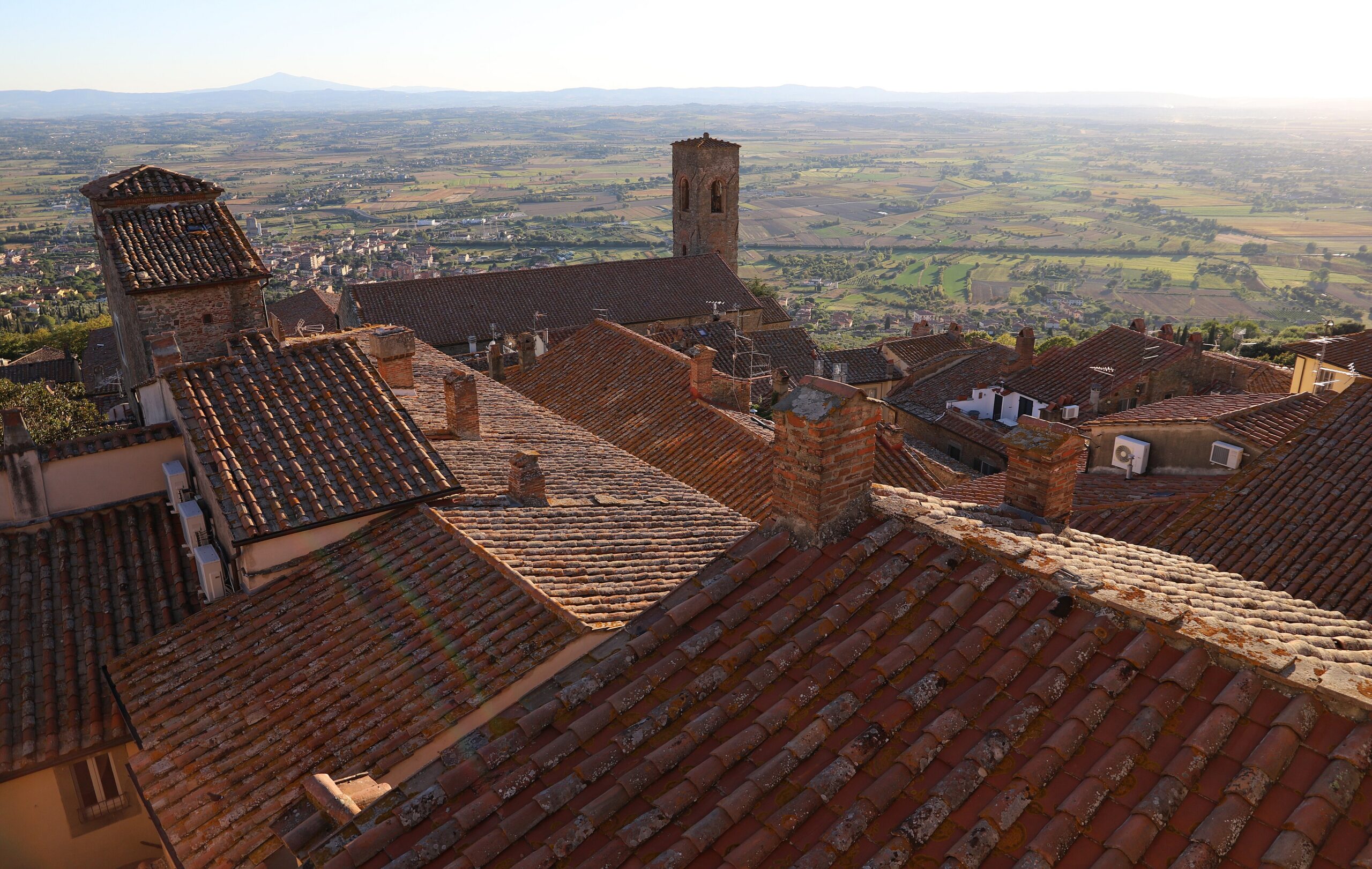
Everyone knows one thing about Cortona: it is the town from Frances Mayes’s Under the Tuscan Sun. The 1996 memoir and 2003 film put this steep Etruscan hill town on the anglophone map so thoroughly that a generation of American and British visitors has arrived looking for Mayes’s restored villa, her olive-harvest narrative, and the particular quality of light that the book describes. Most of them find what they came for — Cortona is genuinely beautiful, its streets are steep and stone-paved, and the light across the Valdichiana at sunset is as good as advertised.
What they miss, usually, is older. And stranger. And better.
Cortona is one of the twelve cities of the Etruscan Dodecapolis — a founding member of the most important political league in pre-Roman Italy, with 3 kilometers of fourth-century BC walls still forming the foundations of the medieval circuit. Its MAEC museum holds the Tabula Cortonensis, a bronze tablet discovered in 1992 that is the third-longest Etruscan inscription known — a legal document from a civilization that remains only partially deciphered. In the same museum sits an extraordinary fourth-century BC bronze chandelier with sixteen burners alternating Silenus figures with sirens. Outside the walls, Etruscan tumulus tombs include one with a monumental staircase guarded by sphinx sculptures found nowhere else in Italy.
In the twentieth century, the Futurist painter Gino Severini — born here in 1883 and a signatory of the 1910 Manifesto of Futurist Painters — returned to mosaic and created a Via Crucis of fifteen stone aedicules with mosaics climbing from Porta Berarda to the Basilica of Santa Margherita, commissioned as an ex-voto after the town survived World War II unscathed. It is one of the most unusual devotional artworks in Tuscany — Futurist geometry in the service of medieval piety — and almost nobody who hasn’t walked it knows it exists.
This is the Cortona we want to write about: the Etruscan capital, the Severini pilgrimage, the museum treasures, and the annual rituals — the photography festival, the steak sagra, the medieval crossbow tournament — that keep a town of 20,000 people alive beyond the tourist season.
The Etruscans: Deeper Than You Think
Cortona’s Etruscan name was Curtun. The settlement predates written records, and the fourth-century BC walls — massive dressed-stone blocks, some still visible at the base of the medieval circuit — testify to a city of substantial power and engineering capability. The Porta Bifora, a unique surviving double-arched Etruscan gate, is the most visible reminder at street level.
The MAEC — Museo dell’Accademia Etrusca e della Città di Cortona — occupies Palazzo Casali in the center of town. The Accademia Etrusca was founded in 1727 (formally constituted 1728) by the Venuti brothers, making it one of Europe’s earliest archaeological societies. The museum’s two signature objects justify a trip to Cortona on their own:
The Tabula Cortonensis is a bronze tablet discovered in 1992, dated to the second or third century BC, bearing a long Etruscan text — the third-longest Etruscan inscription known, after the Zagreb mummy wrappings and the Capua tile. It is a legal document recording a land transaction, and it names “Larth Cucrina Lausisa, zilath mechl rasnal” — a holder of a high magistracy whose exact scope scholars still debate. For anyone interested in the mystery of Etruscan language and civilization, this tablet is one of the most important single objects in Italy.
The Etruscan Bronze Chandelier from Fratta, acquired in 1840 for 1,600 Florentine scudi, is a late-fourth-century BC masterwork: a disc with sixteen oil burners alternating figures of Silenus (the wild god of wine and fertility, depicted playing panpipes) with sirens or harpies. The craftsmanship is extraordinarily fine, and the object radiates the sophisticated, slightly eerie elegance that characterizes the best Etruscan decorative art.
The top floor holds the Gino Severini collection, donated by the artist — a useful counterweight to the ancient material below.
Outside the walls, the Etruscan tombs are equally compelling. The Melone del Sodo (Tumulus II) is the standout: a large tumulus tomb with a monumental stone staircase flanked by sphinx sculptures, a rare find in Etruscan archaeology. The Melone di Camucia and the smaller Tanella di Pitagora (Tomb of Pythagoras, named from a long-standing local tradition linking Cortona to the Greek philosopher) complete the archaeological circuit. The Sodo archaeological area now has regular seasonal opening hours and its own ticket office run with the MAEC; check cortonamaec.org for current times and for access to the other tombs.
Severini’s Via Crucis: A Futurist Pilgrimage
Gino Severini (1883 Cortona – 1966 Paris) lived one of the twentieth century’s most dramatic artistic arcs. He moved to Paris in 1906, signed the Manifesto of Futurist Painters in 1910, married the daughter of the poet Paul Fort, and became one of the movement’s most technically accomplished painters. After World War I, he underwent a spiritual crisis and returned to classicism and, eventually, to mosaic — the medium of Byzantine churches and Roman floors — which he reinvented in a modern idiom.
The Via Crucis di Cortona was commissioned by Bishop Giuseppe Franciolini as an ex-voto to Santa Margherita for protecting Cortona from the bombings that devastated much of Tuscany in 1944. Severini designed the cartoons in the mid-1940s, and the mosaics were set into the aedicules along the road in the years after the war. Fifteen stone aedicules climb the steep Via Santa Margherita from Porta Berarda at the base to the Basilica of Santa Margherita at the summit — a walk of roughly 20 minutes, most of it uphill, past mosaics that fuse Futurist fragmentation with devotional narrative.
The Via Crucis is not widely known outside Cortona. It does not appear in most English-language guidebooks. It is not signposted from the tourist areas of the center. You find it by walking to Porta Berarda and looking up the hill. The cartoons for the fourteen stations are preserved in the Museo Diocesano. The cartoon for the fifteenth aedicule, dedicated to Santa Margherita, was given to Pope Paul VI in 1973 and is now in the Vatican Museums. For anyone interested in the intersection of modernism and sacred art, this is one of the most important sites in Italy.
Fra Angelico, Signorelli, and Sangallo
The Museo Diocesano, across from the Duomo, holds Fra Angelico’s Annunciation and a triptych (1433–38) — painted for the Convent of San Domenico, where Fra Angelico lived before moving to Florence’s San Marco. The Annunciation alone is worth the admission: luminous, geometrically precise, and possessed of the serene certainty that makes Fra Angelico’s best work feel like visible prayer.
Major Luca Signorelli works hang nearby — Signorelli, who was born in Cortona’s territory, is the local master, and the Museo Diocesano holds several of his best surviving panels.
Below the walls to the south, Santa Maria delle Grazie al Calcinaio — by Francesco di Giorgio Martini (late fifteenth century) — is one of Tuscany’s most harmonious Renaissance churches: a Greek-cross plan in pale stone, set among olive groves, with an interior that achieves the kind of spatial clarity that architecture theorists write dissertations about. Santa Maria Nuova, a Greek-cross domed church by Vasari (1554), adds a later Renaissance layer. The Laudario di Cortona (Codex 91, thirteenth to fourteenth century), preserved in the municipal library, is one of the oldest collections of vernacular sacred music in Italy.
The Annual Rituals
Cortona On The Move is one of Italy’s finest photography festivals — founded in 2011, it runs from mid-July into the autumn, with exhibitions in venues including the Fortezza del Girifalco, Palazzo Baldelli, and the Camucia train station. Artistic director Renata Ferri curates international exhibitions that use the town’s medieval and Renaissance spaces as galleries.
The Sagra della Bistecca, held every mid-August, is Cortona’s most democratic festival. A 14-meter grill (claimed as Italy’s largest) is set up in the Giardini del Parterre, and teams of grill-masters cook to a fixed menu: a 750–800-gram steak with a side dish, water, and bread, at a fixed price. The atmosphere is communal, outdoor, and entirely unrefined.
The Giostra dell’Archidado, a crossbow tournament that re-creates a medieval contest and is held each year in late spring, sends the town’s quintieri into competition with historical costumes, processions, and the particular intensity of neighborhood rivalries. Cortona Antiquaria has run annually since 1963.
Getting There and Getting Around
By train, Cortona is served by two stations: Terontola-Cortona (main regional stop, about 1 hour 30 minutes from Florence, 10 km from the center) and Camucia-Cortona (closer at 5 km, but fewer services). Both require a bus, taxi, or car to reach the hilltop center.
By car, Cortona is about 1 hour 30 minutes from Florence (A1 to Valdichiana exit, then SS71 south), 35 minutes from Arezzo, 15 minutes from Castiglion Fiorentino, and roughly 2 hours from Rome.
ZTL warning: Cortona’s entire historic center is a 24/7 camera-enforced ZTL. Do not drive in. The most convenient parking is Spirito Santo (€1.50 per hour — older guides say it is free), with escalators up into the historic center. Mercato Vecchio and Porta Bifora are the main alternatives; check current parking rules on the comune’s website. The town is steep — comfortable shoes are not optional.
Nearby
Castiglion Fiorentino (15 minutes north) — The loggia, the Cassero, Benigni’s birthplace, and free parking. A quieter, cheaper alternative base.
Montepulciano (40 minutes southwest) — Vino Nobile, Piazza Grande, underground cellars.
Lake Trasimeno (20 minutes east, across the Umbrian border) — Italy’s fourth-largest lake, with the island of Isola Maggiore accessible by ferry.
Arezzo (35 minutes north) — Piero della Francesca, the Fiera Antiquaria, Vasari’s house.
Information is provided in good faith and may change. Always confirm opening hours, prices, and event dates with the official source before you travel.