
Town · Valdichiana
Monte San Savino
The Sculptor’s Town That Lost Its Synagogue
Last updated:
- Region
- Valdichiana
- Province
- Province of Arezzo
- GPS
- 43.3314, 11.7277
- Best season
- September (Sagra della Porchetta + harvest atmosphere), April–June (quiet spring)
- Time needed
- Half day (2–3 hours for the Corso, churches, and palazzo; longer if combining with Lucignano or Gargonza)
- Difficulty
- easy
- Known for
- Andrea Sansovino (sculptor), Pope Julius III, Antonio da Sangallo the Elder architecture, vanished Jewish quarter, Sagra della Porchetta, ceramics tradition
Monte San Savino is one of those towns that makes more sense the more you know about Renaissance patronage networks. On the surface, it is a pleasant Aretine hill town of about 8,500 people, strung along a single main street — the Corso Sangallo — with handsome palazzi, a couple of good churches, and an exceptional September food festival. Visitors who stop for an hour see a nice enough town. Visitors who know what they are looking at see something more interesting: a small place that punched absurdly above its weight because one local family produced a pope, and the sculptor born here went on to reshape Venetian architecture, and the combination of power and talent left a Renaissance town center that reads like a textbook of early-sixteenth-century civic design.
The name you need is Ciocchi Del Monte. This Savinese family produced cardinals, bishops, and ultimately Pope Julius III (Giovanni Maria Ciocchi del Monte, born in Rome in 1487, papacy 1550–1555) — the pope who reopened the Council of Trent in 1551, commissioned Vignola to design the Villa Giulia in Rome, and poured enough patronage back into his family’s hometown to turn its main street into a minor architectural exhibition. The other name is Andrea Contucci, born here in 1467, who took the professional name Andrea Sansovino after the town — Monte San Savino shortened to Sansovino — and became one of the most influential sculptors of the High Renaissance. His pupil Jacopo Tatti, who took his master’s name as Jacopo Sansovino, went further still, designing the Biblioteca Marciana and the Zecca in Venice. Between the pope and the sculptor, this small town left marks on Rome and Venice that vastly exceed any reasonable expectation for a settlement of fewer than 10,000 people.
There is also a darker story here — one that most guides omit entirely. Monte San Savino once had one of the most important Jewish quarters in the Arezzo territory, centered on Via Salomon Fiorentino. In 1799, during the anti-French “Viva Maria” uprising that swept through Tuscany, the Jewish community was expelled in a pogrom. They never returned. The former synagogue on Via Salomon Fiorentino and the Campaccio Jewish cemetery outside town survive as traces of a community that lasted nearly two centuries.
A Place Shaped by Time
Monte San Savino sits at 330 meters on a gentle ridge between the Valdichiana to the east and the rolling hills toward Siena to the west. The A1 motorway exit carries its name, which gives it a practical visibility that its population would not otherwise command. The town’s prosperity was always agricultural — olives, wine, grain — augmented by the Ciocchi Del Monte family’s political rise and the resulting flow of patronage.
The medieval town was organized, like so many Tuscan terre murate, along a single main axis between two gates. What makes Monte San Savino distinctive is how thoroughly the Renaissance remade that axis. Between roughly 1500 and 1570 — the period spanning Sansovino’s maturity, Julius III’s papacy, and the subsequent consolidation under the Medici — the Corso was lined with palazzi, loggias, and church façades that transformed a medieval street into a showcase of the new architectural language. Walk the Corso today and you are essentially walking through a single generation’s ambition, built in stone and travertine.
What to See and Do
The Palazzo di Monte (Palazzo Comunale)
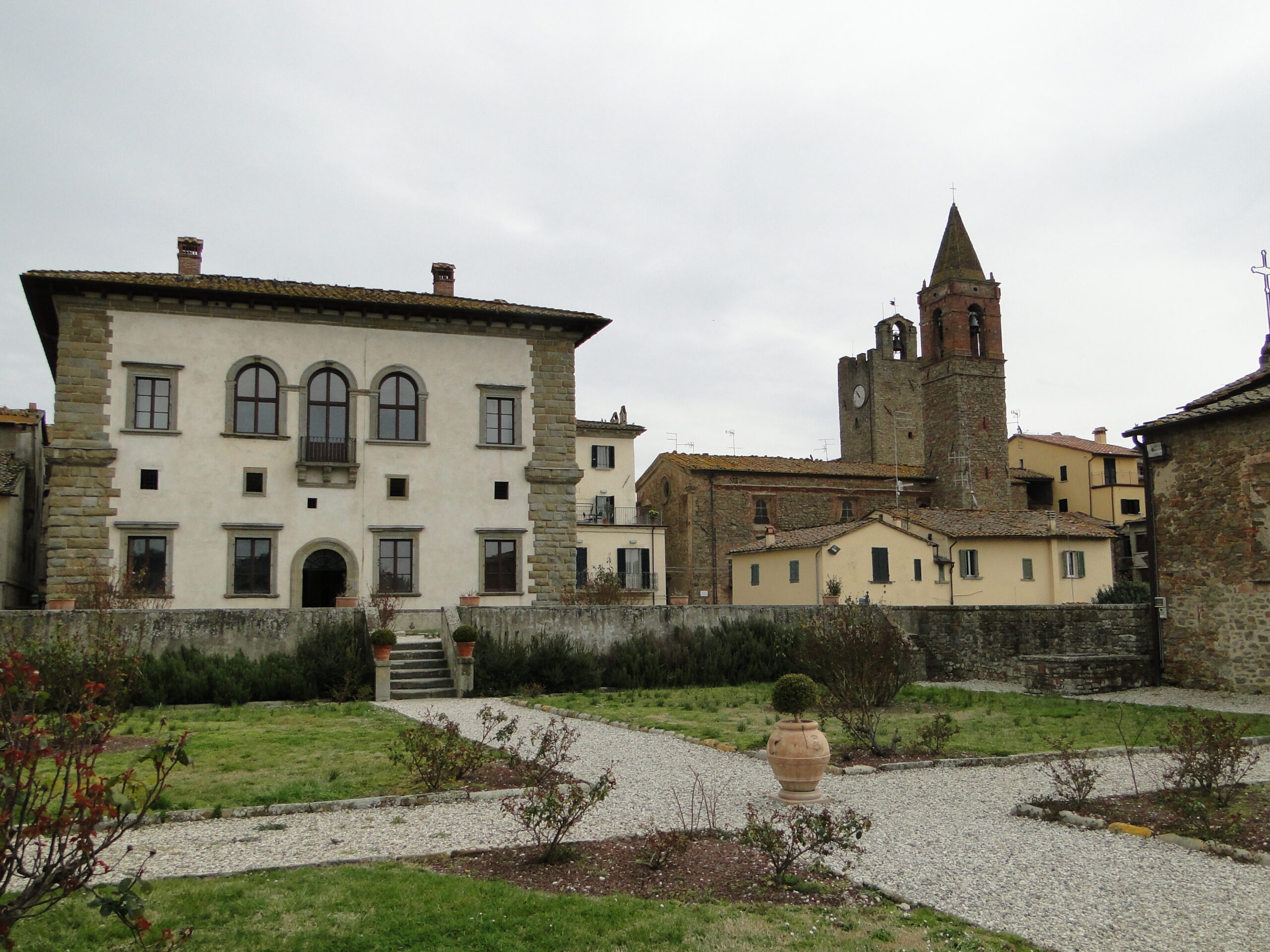
The town’s administrative heart was commissioned by Antonio Ciocchi Del Monte — one of the family’s earlier cardinals — and designed by Antonio da Sangallo the Elder in the early sixteenth century. The rear section was added by Nanni di Baccio Bigio for Giovanni Maria di Monte before his election as Julius III. Inside, beyond the municipal offices, is a surprise: a hanging Italian garden built atop the sixteenth-century Cisternone (a massive cistern that still underlies the building), and a finely carved door by Fra Giovanni da Verona, the celebrated intarsia craftsman whose work also appears in the Monte Oliveto Maggiore abbey and the Stanza della Segnatura in the Vatican.
The garden is one of those small, unexpected pleasures that reward the curious traveler — a green room suspended above a water reservoir, enclosed by Renaissance walls, with views out over the valley. It is rarely crowded because few visitors know to ask for it.
The Logge dei Mercanti — and who really built them
On Corso Sangallo, the Logge dei Mercanti are Monte San Savino’s most photographed feature: five round arches on fluted Corinthian columns, elegant and proportional, facing the street with the confidence of a building that knows it belongs in a larger city. Older guidebooks and tourism materials routinely credit them to Andrea Sansovino. This is almost certainly wrong.
Modern art-historical consensus — supported by Vasari’s own testimony in Le Vite — attributes the execution to Nanni di Baccio Bigio, a Florentine architect active in Rome who worked for the Ciocchi Del Monte family. Sansovino may have influenced the design concept — the proportions are characteristic of his classicizing style — but the building itself is now credited to Nanni. The attribution confusion likely stems from the town’s understandable desire to credit its most famous native son with its most prominent building.
This matters for travelers who care about what they are looking at. The Logge are not a work by one of Italy’s greatest sculptors moonlighting as an architect. They are the work of a competent architect executing a commission for the Del Monte family in a provincial town — which is its own interesting story about how Renaissance patronage networks operated.
The Chiesa di Sant’Agostino
The Augustinian church on the Corso holds the densest concentration of significant art in town. Vasari’s signed Assunta (1539) — an Assumption of the Virgin — hangs as a confirmed, documented work by the Aretine painter-architect-biographer. A rose window of 1524 by Guillaume de Marcillat — the French stained-glass master who created the windows in Arezzo’s cathedral — shows St. Augustine between two angels. Frescoes by Giovanni d’Agnolo di Balduccio and Paolo Schiavo fill subsidiary spaces. And on the left wall of the nave, a tomb slab bearing the Sansovino coat of arms marks the burial place of the sculptor, who died in Monte San Savino in the spring of 1529.
The combination is quietly remarkable: a signed Vasari, a Marcillat window, and the tomb of the sculptor who gave the town its most famous name, all in a single Augustinian church on a small-town main street.
The Chiesa di Santa Chiara
A short walk from Sant’Agostino, the Church of Santa Chiara displays two terracotta altarpieces modeled by Sansovino himself, one of them later glazed by the Della Robbia workshop. These are among the more unusual objects in Valdichiana‘s churches: a major Renaissance sculptor working in a technique associated with the Della Robbia monopoly, producing devotional pieces for a convent in his hometown. They are not Sansovino’s greatest work — his marble groups in Rome and Loreto surpass anything here — but they are authentically his, and seeing them in the town that formed him gives them a context that a museum could not provide.
The vanished Jewish quarter
Via Salomon Fiorentino — named for the eighteenth-century Jewish poet from Monte San Savino — marks the line of what was once one of the Arezzo territory’s most significant Jewish communities. Jewish families are recorded here in the sixteenth century, and an organized community flourished from 1627 until 1799.
In 1799, the “Viva Maria” uprising — an anti-French, counter-revolutionary insurrection that swept through Arezzo and the Valdichiana — turned violently against Jewish communities across the territory. In Monte San Savino, the Jewish quarter was attacked and its residents expelled. They never returned. Much of the quarter was absorbed into the general fabric of the town, but the former synagogue at Via Salomon Fiorentino 13–14, owned by the municipality since 1924, still shows its rusticated portal, the niche for the Torah ark, and traces of the ritual bath. The other survivor is the Campaccio Jewish cemetery outside the town walls — a small enclosure with Hebrew-inscribed headstones.
This is not a comfortable story to include in a travel guide, and most guides skip it. But the cemetery is visitable, it is historically important, and the story of a community’s presence and violent erasure is part of what Monte San Savino is — not just what it was built to look like. The cemetery is cared for by the Jewish Community of Florence, and access arrangements can change, so check with the community or the town’s tourist office before you go. Travelers who visit the Campaccio should do so with the quiet attention the place deserves.
Eating Like a Local
Monte San Savino shares the Valdichiana table — pici, Chianina, aglione, local olive oil — but adds its own specific passion: porchetta. The Arezzo-style roast pork, herb-stuffed and slow-cooked until the skin cracks and the interior is fall-apart tender, is elevated here to a civic event at the annual Sagra della Porchetta in September.
The sagra was founded in 1965 and has grown into a multi-day festival filling Piazza di Monte and Piazza Gamurrini. The headline number: in 2010, Monte San Savino set a Guinness World Record for the longest porchetta ever roasted — 44.93 meters. It is held in September; check the Pro Loco for each year’s dates.
Beyond the sagra, Monte San Savino’s ceramics tradition has produced some notable local artisan work — the town’s connection to Sansovino’s terracotta pieces and the broader Aretine ceramic culture means that hand-made pottery is still produced here. The Wednesday morning market brings local produce, cheese, and household goods to the town center.
Getting There and Getting Around
Monte San Savino has its own A1 motorway exit, which makes it one of the easiest Valdichiana towns to reach by car. From the exit, the town center is about 5 minutes. Driving times: Florence roughly 1 hour 10 minutes, Arezzo 20 minutes, Siena about 50 minutes, Lucignano 10 minutes.
By train, Monte San Savino has a stop on the Arezzo–Sinalunga regional line operated by TFT, but service is limited and the station is not close to the historic center. A car is the practical choice.
Parking is available outside the walls near the main gates and along the approach roads. Free, uncomplicated, and rarely full. The Corso is the main axis, and everything of interest sits along it or within a two-minute walk — the entire town can be explored on foot in an hour or two.
Nearby
Lucignano (10 minutes south) — The elliptical hill town with the Albero d’Oro reliquary.
Foiano della Chiana (15 minutes east) — Italy’s oldest Carnival and three churches of Della Robbia terracottas.
Gargonza (10 minutes west) — A remarkably intact medieval castello (fortified hamlet) now operating as a hotel and event venue. The entire village — stone walls, tower, central courtyard — is a single hospitality property. Worth a visit even if you are not staying.
Civitella in Val di Chiana (15 minutes north) — The 1944 massacre memorial and a hilltop town with commanding Valdichiana views.
Castiglion Fiorentino (20 minutes east) — The loggia, the Cassero, and Benigni’s birthplace.
Information is provided in good faith and may change. Always confirm opening hours, prices, and event dates with the official source before you travel.