
Town · Valdichiana
Torrita di Siena and Montefollonico
Donkeys, Vin Santo and a Hilltop Secret
Last updated:
- Region
- Valdichiana
- Province
- Province of Siena
- GPS
- 43.1698, 11.7753 (Torrita); 43.1458, 11.7339 (Montefollonico)
- Best season
- March (Palio dei Somari), late April (Vin Santo festival at Montefollonico), September–October (harvest)
- Time needed
- Half day (Torrita town + Montefollonico combined)
- Difficulty
- easy
- Known for
- Palio dei Somari (donkey race), Fra Jacopo da Torrita, Montefollonico Vin Santo tradition, Bandiera Arancione (Montefollonico)
Most travelers in the Valdichiana pass through Torrita di Siena without stopping, which is understandable — the town sits on the main road between Sinalunga and Montepulciano, and the newer parts have the functional character of a Tuscan service center. But Torrita has a walled medieval core with four original gates, a tradition of civic theater dating to the eighteenth century, and one of the most entertaining festivals in the valley: the Palio dei Somari, a donkey race between eight contrade that has been running since 1966 and manages to be simultaneously absurd, fiercely competitive, and genuinely moving.
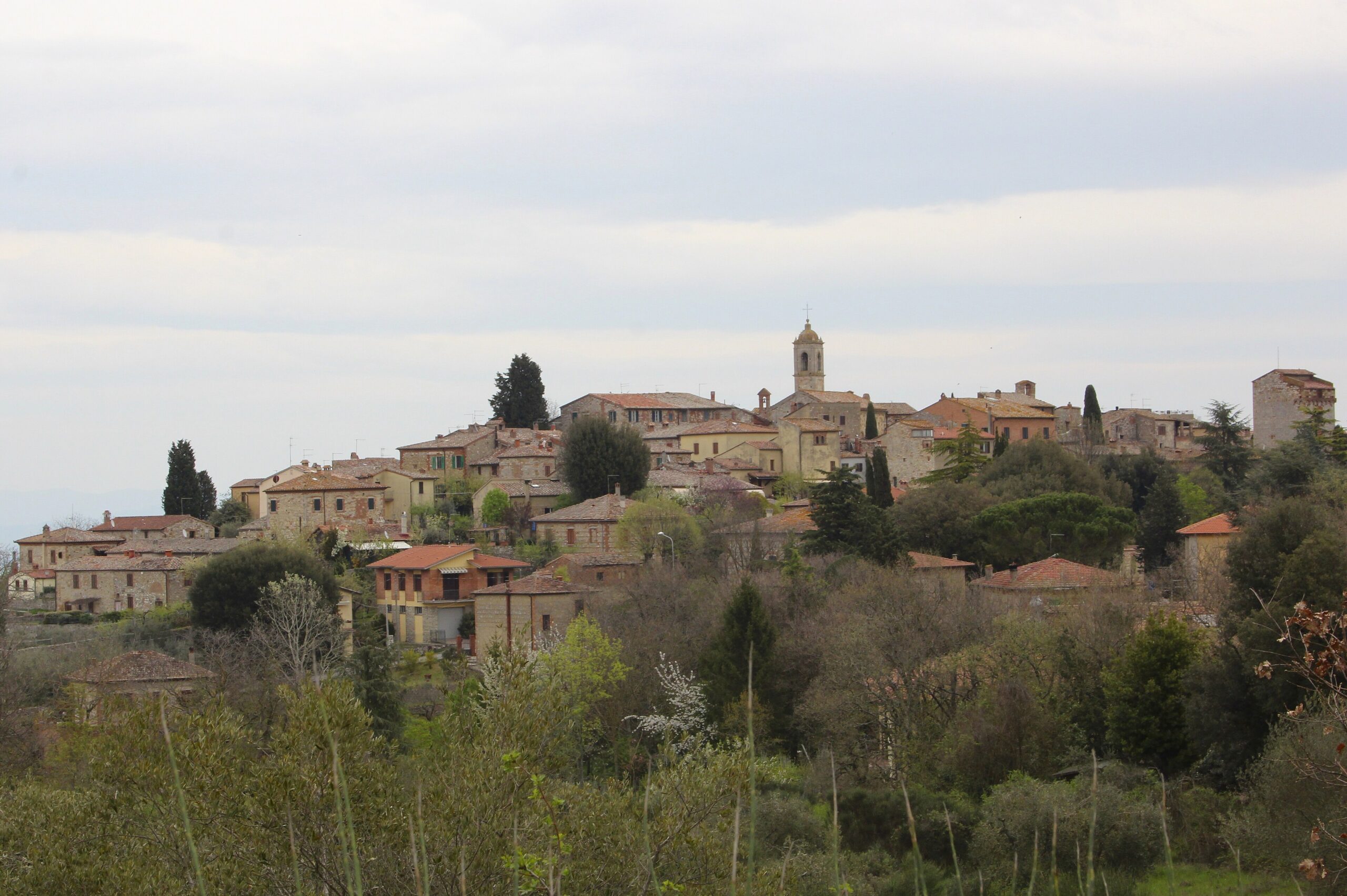
The real secret, though, is above. The frazione of Montefollonico — population roughly 500, perched on a hilltop between the Val d’Orcia and the Val di Chiana — is a Bandiera Arancione village that has styled itself the “Borgo del Vin Santo.” Each year, a festival judges homemade Vin Santo from local amateur producers, and the village’s medieval streets fill with the scent of the sweet, unfortified wine made in cellars throughout the hamlet. Together, Torrita and Montefollonico offer a combination that captures the Senese Valdichiana at its most local: a town that races donkeys and a village that judges dessert wine, neither of which has much interest in performing for tourists.
A Place Shaped by Time
Torrita appears in documents from 1037 as a fortified Sienese castrum — one of the defensive outposts that Siena built along its eastern border to watch Montepulciano, which switched allegiances with exhausting regularity. The four gates of the medieval walls still define the town’s contrade. The Sienese heritage is visible in the civic architecture and the street layout, which follows the hilltop contours in the typically compact manner of a border garrison town.
Local tradition claims as its most distinguished son Jacopo Torriti, the thirteenth-century mosaicist (probably a Franciscan) who executed one of the most important commissions in medieval Rome: the apse mosaic of Santa Maria Maggiore, completed around 1295–96, depicting the Coronation of the Virgin; his birth in Torrita is a scholarly hypothesis rather than a documented fact. Fra Jacopo’s work places Torrita — improbably — in the lineage of Roman monumental art. If the tradition is right, a mosaicist from a Sienese border town worked on one of Rome’s four papal basilicas: medieval patronage networks reached further than anyone might guess.
The Chiesa delle Sante Flora e Lucilla, the main parish church, contains a marble relief lunette of the Blood of Christ attributed to Donatello or his workshop, a Crucifixion triptych by Michele di Matteo (1444), and Sienese panels by Bartolo di Fredi and Benvenuto di Giovanni. The Teatro Comunale degli Oscuri — named for the local Accademia degli Oscuri, founded in 1760 — grew out of the academy’s meeting hall and took its present form in the nineteenth century, reopening in 1870; it is one of those tiny, jewel-box provincial theaters that Italy does better than any other country, with an atmosphere that makes La Scala feel impersonal.
The Palio dei Somari
The Palio dei Somari — the Donkey Palio — was established on March 19, 1966, dedicated to San Giuseppe, and has been running ever since. It is raced in March in the town’s Gioco del Pallone arena.
Eight contrade compete: Porta a Pago, Porta a Sole, Porta Gavina, Porta Nova, Stazione, Refenero, Le Fonti, and Cavone. Each sends a donkey and rider into three-lap elimination heats, and the heat winners meet in a four-lap final. If you are expecting the elegant precision of Siena’s horse palio, recalibrate. Donkeys are not horses. They stop when they want to. They turn around. They refuse to start. The jockeys are as much persuaders as riders, and the crowd — packed into a tiny arena — oscillates between passionate support and helpless laughter.
The comedy is the point, but the competition is real. Contrada pride is generational. The week before the race fills with dinners, ceremonies, and the particular tension of neighborhoods that have been trying to beat each other for six decades. The palio banner, painted each year by a different artist, goes to the winner. Bragging rights last a full year.
Do not confuse the Palio dei Somari with Siena’s Palio. The scales are different, the animals are different, and the tone is different. Torrita’s version is self-aware, intimate, and rooted in the specific humor of a town that chose donkeys rather than horses and has never pretended otherwise.
Montefollonico: The Borgo del Vin Santo
Drive about fifteen minutes uphill from Torrita and you arrive at Montefollonico — a walled hamlet of roughly 500 people on a ridge between the Valdichiana and the Val d’Orcia. It holds the Touring Club’s Bandiera Arancione quality mark, which is the Italian equivalent of a Michelin star for small towns: certification that a place is well-preserved, welcoming, and worth a detour.
Montefollonico’s claim to distinction is Vin Santo — the amber, intensely sweet (or sometimes dry) wine made from Trebbiano and Malvasia grapes dried on straw mats and then aged for a minimum of three years in small caratelli barrels. Vin Santo is made across Tuscany, but Montefollonico has turned it into a civic identity. The annual festival judges homemade Vin Santo from amateur producers. The festival, ‘Lo gradireste un goccio di Vin Santo?’ (‘Would you care for a drop of Vin Santo?’), is held once a year. Check the Pro Loco Montefollonico website for the next edition’s dates.
The festival includes the Sentiero del Vin Santo, a walking trail from Torrita up to Montefollonico that passes through olive groves and vineyards, arriving at the village for tastings. The idea is simple and effective: you walk, you arrive thirsty, you taste. The amateur production element is crucial — these are not commercial wines but household productions, each reflecting the specific cellar, barrel, grape mix, and patience of its maker. The variation from producer to producer is enormous, and arguing about which is best is the festival’s social engine.
Beyond Vin Santo, Montefollonico has the Chiesa di San Leonardo (Romanesque, twelfth century), the Oratorio di Santa Caterina d’Alessandria, and a local PAT-listed cheese called “Grande Vecchio di Montefollonico” — an aged pecorino produced in the surrounding countryside. The village streets are medieval, steep, and almost entirely empty of tourists even in high season. The views from the walls alternate between the Valdichiana to the east and the Val d’Orcia to the west — one of those positions where two of Tuscany’s most celebrated landscapes meet.
Eating Like a Local
The combined territory of Torrita and Montefollonico straddles the border between Valdichiana and Val d’Orcia cuisines. Expect pici (here sometimes called pinci, the Montepulciano-area variant), Chianina beef, local pecorino including the aged Grande Vecchio, and the standard Tuscan salumi. Vin Santo is the obvious digestivo, especially if you can source a bottle from one of Montefollonico’s amateur producers.
The Friday morning market in Torrita is a local affair with produce, cheese, and clothing.
Getting There and Getting Around
By car, Torrita is on the SS327 between Sinalunga and Montepulciano — about 15 minutes from either. From the A1, take the Valdichiana/Bettolle exit and head south. Montefollonico is a further 10 minutes uphill on a winding road.
By train, Torrita has a station on the regional Empoli–Siena–Chiusi line, which makes it one of the few Senese Valdichiana towns with direct rail access. Service is infrequent but functional.
Parking in Torrita is straightforward — spaces outside the walls. Montefollonico has limited parking outside its walls; the village, entered through three gates, is best explored on foot.
Nearby
Montepulciano (15 minutes southeast) — Vino Nobile DOCG, Piazza Grande, underground cellars, and the Bravio delle Botti.
Chiusi (20 minutes south) — Etruscan museum, labyrinth, catacombs, and Lake Chiusi.
Sinalunga (10 minutes north) — The Chianina’s spiritual home at Bettolle, a Collegiata with Il Sodoma works, and the spot where Garibaldi was arrested in 1867.
Pienza (25 minutes west) — Pius II’s ideal Renaissance city, pecorino capital, and the heart of the Val d’Orcia.
Information is provided in good faith and may change. Always confirm opening hours, prices, and event dates with the official source before you travel.