
Town · Versilia
Seravezza
Michelangelo’s Marble, a Medici Palace, and Donkey Races
Last updated:
- Region
- Versilia
- Province
- Province of Lucca
- GPS
- 43.9960, 10.2297 (town hall)
- Best season
- spring and autumn
- Time needed
- half day for the town; full day with Malbacco or the quarry trails
- Difficulty
- easy in town; moderate for the mountain valleys and quarry trails
- Known for
- Michelangelo's marble campaign, Palazzo Mediceo (UNESCO), Monte Altissimo, Palio dei Micci, olivo quercetano
Seravezza stands where two mountain streams, the Serra and the Vezza, meet and become the Versilia river. The streams give the town its name. Visit Tuscany calls it “the natural gateway to the Apuan Alps park,” and the marble mountains begin right behind it.
Most English-language accounts tell you that Michelangelo came here for marble, and stop there. The real story is better. He spent much of three years opening quarries and a road for a façade that was never built. Then, in 2021, restorers in Florence found that one of his sculptures was carved from Seravezza marble all along.
Add a UNESCO-listed Medici palace with a medieval traveler buried under it, and a district that races donkeys every spring. Seravezza is not a postcard town. Come for the stories and the valleys behind it.
A Place Shaped by Time
The pope’s marble
A papal arbitration by Leo X, the Medici pope, placed the four comuni of the old Capitanato di Pietrasanta under Florence on 29 September 1513. Seravezza was one of them.
In 1517 a letter from Cardinal Giulio ordered “si piglino li marmi di Pietrasancta et non altri”: take the marbles of Pietrasanta and no others. Michelangelo first visited Monte Altissimo that year. A letter of January 1517 also planned a new road, the “strada del padule,” to link Seravezza and its quarries directly with the coast.
In 1518 Leo X wanted marble for Michelangelo’s planned façade of San Lorenzo in Florence to come from the newly Florentine Versilia rather than from Carrara. On 18 May 1518 the communities of Seravezza and Cappella donated Monte Altissimo to Florence. Their deliberations also ceded Monte di Ceragiola “and all the other mountains.”
Three hard years
Michelangelo spent much of 1518–1520 opening quarries and a road down to the coast. It went badly. In 1518 a worker died in an accident at the Seravezza quarries, as Michelangelo reported in a letter. That September a column broke during lowering and fell into the river.
In December 1518 he wrote to Domenico Buoninsegni that he could not quarry a sound column: hidden veins or breakage spoiled every attempt. The façade was canceled in 1520 and never built.
You will read elsewhere that Michelangelo came to Seravezza for the tomb of Pope Julius II. Casa Buonarroti’s documents tie his stay to the San Lorenzo façade, contracted in January 1518. The road he worked on survives in name: locals still call it the Via di Michelangelo.
The twist of 2021
For centuries the campaign looked like a pure failure. Then came the restoration of Michelangelo’s Pietà Bandini, now in the Museo dell’Opera del Duomo in Florence. In 2021 the restorers found that its marble comes from the quarries of Seravezza, not from Carrara, as had long been believed.
How the block reached Michelangelo’s studio in Rome is still a mystery. But it means Seravezza’s stone did end up in one of his works.
Marble firms and a flood
The Medici stayed interested: Cosimo I built a palace here in the early 1560s. In 1821 a former Napoleonic officer, Jean Baptiste Alexandre Henraux, and a Versilian entrepreneur, Marco Borrini, founded the Henraux marble company in Querceta. Henraux owns the whole mountain, Il Post reported in 2017.
The same two streams were at the center of a disaster. The flood of 19 June 1996 struck the Serra and Vezza basins. About 470 mm of rain fell on Alta Versilia in a few hours. Fourteen people died: 12 at Cardoso, one at Fornovolasco in the Garfagnana, and one near Pietrasanta. Our Alta Versilia profile covers Cardoso.
What to See and Do
Palazzo Mediceo
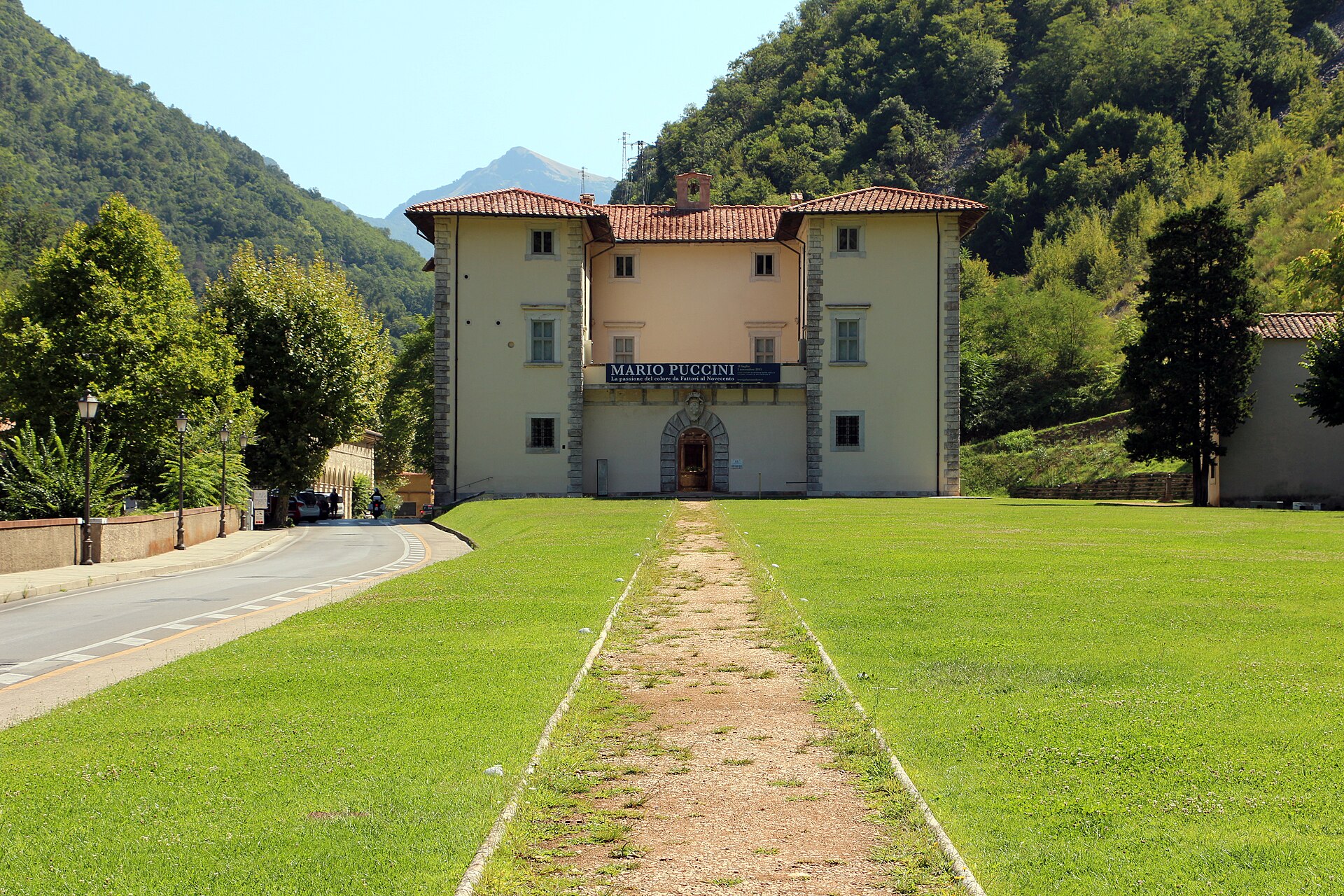
The palace was built for Cosimo I de’ Medici in the early 1560s. Regione Toscana credits David Fortini as site director under Bartolomeo Ammannati’s supervision. A recent study proposes a young Buontalenti as well, and the external chapel is attributed to a Buontalenti design. The Italian state gave the building to the comune in 1864, and it served as the town hall until 1967.
Since 2013 it has been part of the UNESCO World Heritage site “Medici Villas and Gardens in Tuscany.” Giusto Utens painted Seravezza in his lunette series of Medici villas for Grand Duke Ferdinando I (1599–1602). The surviving lunettes hang at the Villa Medicea La Petraia near Florence. There you can see the palace as the Medici saw it.
Inside are the Sirio Giannini library and the Museo del Lavoro e delle Tradizioni Popolari della Versilia Storica, a museum of work and folk traditions open to the public since 1996. As of November 2026, the Lucca provincial museum network lists the museum as temporarily closed. Check its current status on the museum site or the palace site before you go. The palace is at Viale Leonetto Amadei 230.
The traveler under the foundations
The palace cellar is now an antiquarium. Restoration work, including work on the lift, uncovered a burial at the base of the foundations. It belonged to a traveler, perhaps a pilgrim on the Via Francigena, and is dated to AD 790–1000. Someone was laid to rest on this spot more than five centuries before the Medici built here.
Michelangelo’s road and the quarry mountains
The regional portal Toscana Ovunque Bella calls the Via di Michelangelo a “cultural and historical road” between the mountains and the sea, and illustrates it with the Cappella, Ceragiola, and Henraux Cervaiole quarries. It is not a waymarked trail, and no official route or length has been published, so follow it in pieces and ask the comune for advice.
At the Cervaiole quarry on Altissimo the marble is arabescato: white with gray veins. You can see the quarry from marked trails, such as CAI 142 (formerly 31) from Azzano, but that is not a quarry visit. We found no official public tour of Henraux, Cervaiole, or Altissimo.
Quarrying also cuts trails. CAI’s own table marks a break in trail 141 “because of quarry activity,” and in May 2025 quarry concessionaires gated the Sentiero della Tacca Bianca on Altissimo. Montagna.TV reported that the gate ruled out any land-based rescue by the Soccorso Alpino (mountain rescue) in case of an accident. Stay on marked trails, obey quarry signs, and check current trail status with the Apuan Alps Park before you go.
For a guided quarry experience, go to Levigliani in Alta Versilia. Corchia Park runs 4×4 marble-quarry visits by advance booking; details are on its official page.
Cappella, the other community that gave Altissimo away in 1518, makes a good stop on the same outing. Near its Pieve di San Martino is the Area archeomineraria del Bardiglio Cappella, an archaeological mining site. The Apuan Alps Park opened it to the public in 2005.
Malbacco
Up the Serra valley, Malbacco is a string of pools and waterfalls inside the Apuan Alps Park. The best known is the Pozzo della Madonna, where a waterfall drops into a deep pool with a natural rock slide. The water stays cold even in midsummer. Toscana Ovunque Bella includes the spot in its pages on the Via di Michelangelo.
You reach it from Seravezza through Riomagno, then on foot from the road barrier. In summer 2025 the comune closed the valley road to daytime through traffic and ran a shuttle from Seravezza. The rules are set again each year, so check the Comune di Seravezza before you go.
Querceta and the Palio dei Micci
Querceta is Seravezza’s district on the plain, home of Henraux and of the area’s railway station. Its big event is the Palio dei Micci, the donkey palio (“micci” is local dialect for donkeys). The race is usually on the first Sunday of May, within a March-to-July program that includes a song festival, the Miccio canterino.
The first Palio was held on 18 March 1956 to give more weight to the feast of the patron saint, San Giuseppe. Visit Tuscany suggests it began as a satirical copy of Siena’s Palio. By its second edition it had become a historical-folklore event. Donkeys and jockeys represent Querceta’s eight contrade: Pozzo, Leon d’oro, Ranocchio, Ponte, Quercia, Cervia, Lucertola, and Madonnina. The Pro Loco di Querceta organizes it; check dates on the Visit Tuscany Seravezza page.
Two more regular events are worth knowing. Enolia, usually in April around the Medici palace, is a food village built around olive oil. The Fiera del Nove fair is usually in the first week of September.
Eating Like a Local
Tordelli for feast days
Visit Tuscany’s recipe for Versilian tordelli lists Seravezza first among the towns that serve them on feast days: meat-filled half-moons dressed with ragù and parmesan. Treat any recipe as one version among many. There is no codified one, and versions vary by place and by family, down to the thickness of the pasta edge and the choice of meats and herbs.
The olive named after Querceta
The olivo quercetano takes its name from Querceta. Its raised plain escaped the waterlogging that affected the rest of the coast. Slow Food says its oil was once valuable enough to serve as a trade good and even as currency. Only about sixty plots survive. It is a Slow Food Presidium and on Tuscany’s list of traditional products, but it is not an IGP, whatever some pages say. The Lucca DOP olive oil also covers Seravezza.
Local wine
Versilia has no wine DOC of its own; local wines are sold as Toscana or Costa Toscana IGT. A Visit Tuscany guide to Versilia’s food and wine roads singles out two local names from the Seravezza hills, Strinato and Monte di Ripa.
Restaurants
We have no guide-confirmed restaurant to recommend in Seravezza itself. For guide-recommended tables, look next door: Pietrasanta has a Slow Food Chiocciola osteria and several MICHELIN-listed restaurants, and Forte dei Marmi has several MICHELIN-starred ones.
Getting There and Getting Around
By train: the Forte dei Marmi-Seravezza-Querceta station, in central Querceta, is on the Tirrenica coastal line. Check times on Trenitalia.
By bus: Autolinee Toscane runs local buses; timetables are on at-bus.it.
Into the mountains: the Apuans are one of the rainiest areas of the Italian peninsula, according to the Apuan Alps Park. Check the regional weather alerts at cfr.toscana.it the day before any valley or quarry outing. Do not start a mountain route on an orange or red alert. Expect working quarry traffic on the roads above town.
Timing: spring brings the Palio and Enolia; autumn brings the Fiera del Nove and quieter trails.
Nearby
- Pietrasanta: the workshop town of foundries, bozzetti, and Botero frescoes.
- Forte dei Marmi: a marble-shipping beach long before it was a resort; marble was loaded from the beach there for centuries, and today’s pier was rebuilt in 1955 after the war.
- Alta Versilia: Levigliani, the mercury mines, and the Antro del Corchia, Italy’s longest known karst system, with more than 50 km of explored passages.
- Sant’Anna di Stazzema: the village where SS troops killed hundreds of civilians on 12 August 1944, now a national place of memory.
For the bigger picture, start with our Versilia and the Apuan Alps hub.
Information is provided in good faith and may change. Always confirm opening hours, prices, and event dates with the official source before you travel.