
Town · Versilia
Massarosa and Lake Massaciuccoli
Roman Baths, Reed Beds, and Puccini’s Lake
Last updated:
- Region
- Versilia
- Province
- Province of Lucca
- GPS
- 43.8686, 10.3407 (Massarosa town hall)
- Best season
- spring and autumn
- Time needed
- full day (Roman site, oasis, and a walk or ride)
- Difficulty
- easy
- Known for
- Roman villa and baths, Lake Massaciuccoli, LIPU bird reserve, land reclamation, Puccini's hunting grounds
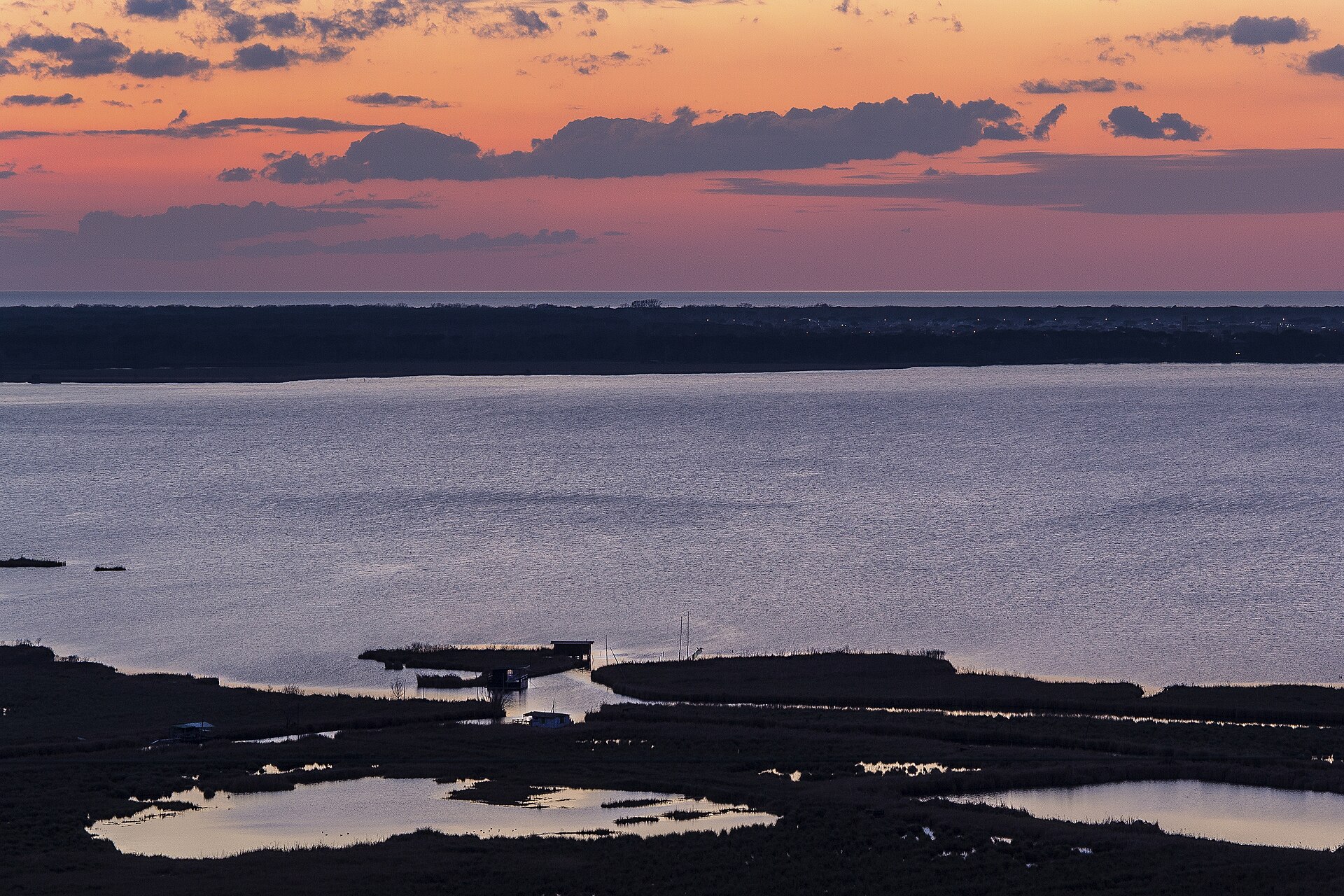
Most visitors see Lake Massaciuccoli (Lago di Massaciuccoli) from one spot: the Torre del Lago shore, in front of Puccini’s villa. Cross to the far bank and the lake tells a longer story. A Pisan family built a villa with a bathhouse here in the 1st century AD. Engineers fought the marsh for centuries. Today wooden stilts carry you out over the reeds.
That far bank belongs to the comune of Massarosa. To be honest, the town of Massarosa itself is not the reason to come. It is the municipal seat for a spread of hamlets on the plain and the hills behind it. Your day is in Massaciuccoli, the lakeside hamlet with the Roman remains, a small port, and the LIPU bird oasis.
Tourist pages can get the lake’s size wrong. One itinerary on Tuscany’s regional tourism portal claims “over 2,000 square kilometers.” The real figure is just under 7 km², nearly 300 times smaller. It is still Tuscany’s largest back-dune wetland, a former brackish lagoon that was gradually reclaimed.
A Place Shaped by Time
A villa for a family from Pisa
In the 1st century AD the Venulei, a family from Pisa, built a villa on two terraces on the slopes of Monte Aquilata, above the lake. Their name survives on a copper water pipe. The site is older than the villa, with remains from the 7th to the 4th century BC. The villa was largely abandoned in the late 3rd century. The church of San Lorenzo now stands on the upper terrace, over the former living rooms.
The baths are why specialists care. In 1920 Antonio Minto identified a bath complex. He found a cold room (frigidarium) and an apsed hot bath over a hypocaust, a raised floor heated from a furnace room. A newer reading sees one room as a sudatio (sweating room), comparable to rooms at Domitian’s villa at Sabaudia and Hadrian’s Villa at Tivoli. A lead plate set into the floor at the hottest point matches a technique used at Tivoli. A lakeside villa in Versilia shares a building trick with an emperor’s retreat.
The painting that kept a mosaic
The ruins were never quite forgotten. A property exchange of 874 mentions a “wall said to be antique.” Lucca’s chronicles refer to the site in 1472. The first dig, in 1756, behind the apse of San Lorenzo, was poorly documented. What survives of it is an anonymous 18th-century canvas copying a mosaic found at the time. That canvas is now in the Museo Nazionale di Villa Guinigi in Lucca. Later digs in the 1930s found a building described as a rest station (mansio), with a black-and-white mosaic, at the foot of the slope.
Lucca’s side of the lake
In its historic sense, Versilia is the four comuni of the old Capitanato di Pietrasanta: Pietrasanta, Seravezza, Stazzema, and Forte dei Marmi. A papal arbitration by Leo X, the Medici pope, placed them under Florence on 29 September 1513. Camaiore and Viareggio stayed with Lucca. Today’s tourist Versilia also takes in Viareggio, Camaiore, and Massarosa.
Massarosa, under Lucchese rule since the 14th century, stayed with Lucca too. Between the 16th and 19th centuries, 27 noble villas went up here. The best known, Villa Baldini at Compignano, was once home to Paolina Bonaparte. Massarosa became a comune only in 1869, when it separated from Viareggio.
Three centuries against the marsh
The lake is what remains of the marshes that once covered the Versilia plain. The Romans already faced the drainage problem, and attempts recur from the 14th century. The medieval schemes failed. In 1741 the Venetian Bernardino Zendrini built floodgates between the lake and the port of Viareggio. They kept salt water out. In the early 19th century, Lorenzo Nottolini planned works involving the Bientina basin and the Serchio. Cost and the dispute between Lucca and Tuscany sank the plan.
From the mid-19th century, dredgers took siliceous sand from the lake bed for building and glassmaking. The marsh also bred malaria. Large-scale reclamation came only in the 20th century. So the “natural” lake you see is an engineered landscape, and a fragile one. Its plants and wildlife have declined since the 20th century, through eutrophication and the spread of the Louisiana crayfish.
In 1979 the lake became part of the Parco Naturale Regionale Migliarino San Rossore Massaciuccoli, Tuscany’s second regional park after the Maremma. An Italian decree of 2013 lists it as a Ramsar wetland. It notes more than 100 regular bird species and calls this Italy’s most important bittern site.
Puccini’s lake, and why he left
Puccini first came to Torre del Lago in 1891. He bought the villa in 1899 and moved into the rebuilt villa in 1900. He hunted in these marshes, and his recorded favorite dish was coot, folaghe alla Puccini. In the early 20th century a peat-extraction works on the lake drove him to build a house in Viareggio. He moved there in December 1921. He was buried in the villa’s chapel in 1926; our Torre del Lago Puccini profile has the full story.
What to See and Do
Massaciuccoli Romana
This is the reason to cross the lake. The museum and archaeological area are on Via Pietra a Padule, in Massaciuccoli. Walk the villa’s terraces and look for the baths’ floor mosaic of light marble and obsidian. The Guglielmo Lera exhibition pavilion holds a mosaic of marine animals. Check hours and tickets on the official museum page.
The LIPU oasis
The Oasi LIPU Massaciuccoli, on Via del Porto in the same hamlet, covers 47 hectares. Wooden walkways on stilts lead to bird hides. A small marsh museum, the Museo sull’Ecologia della Palude, explains the wetland. Species include little bitterns, diving ducks, grebes, cormorants, coots, herons, and the marsh harrier. In spring, black-winged stilts nest near the lake. The oasis also lists boat trips through the reed beds and canoe and kayak outings. Check hours, fees, and trips on the official oasis site.
By bike
The regional portal’s route “Il lago di Puccini in bicicletta” (Puccini’s lake by bike) is 12.7 km and very easy. Note that it meets the lake at Torre del Lago, not Massaciuccoli. From Viareggio station it follows the seafront and canal port, then crosses the Pineta della Lecciona on a dirt track (or an asphalt alternative). The Lecciona is a dune reserve inside the regional park; there are no beach establishments, so treat it as a protected area. You finish at Torre del Lago station and can take the train back with your bike.
From Lucca, the Lucca–Massaciuccoli cycle and footpath starts at Ripafratta. It crosses the reclaimed fields on unpaved roads and small wooden bridges to Massaciuccoli’s port and the oasis.
On foot, and into the hills
A 12 km loop, about 4.5 hours, links Massaciuccoli harbor with Compignano. In spring, lotus flowers bloom at Bozzano, beside a walking and cycling trail. In the hills, the Romanesque Pieve di San Pantaleone a Elici stands on the Monte Pitoro road. It is first mentioned in 892.
In July 2022 a fire burned 908 hectares of the Massarosa hills. It displaced about 1,000 people, half of them in Massarosa. You may still see its traces on the slopes.
Eating Like a Local
Massarosa’s table leans toward Lucca. Look for biroldo, made from pork blood and offal and spiced with cinnamon, cloves, and nutmeg, with pine nuts and sultanas. Most comes from the Lucchesia, with a smaller amount from Massarosa.
Tordelli, meat-filled pasta half-moons with ragù, are feast-day food here, as across Versilia. There is no codified recipe; every family has its own. Bozzano makes its own sweet, the pupporina, each year for San Bartolomeo on the evening of 24 August. It shares top billing with the tordello at the Festa della Pupporina e del tordello. Gualdo holds its Festa delle Fate every August. Check dates locally.
The local olive oil falls under the Lucca DOP (protected designation of origin), which covers all seven Versilia comuni. For guide-listed restaurants, see our Viareggio profile.
Getting There and Getting Around
- By train: Massarosa has its own station, Massarosa-Bozzano (RFI station page). For the bike route, use Viareggio and Torre del Lago Puccini on the Tirrenica coastal line. Check timetables on Trenitalia.
- By bus: Autolinee Toscane runs local buses; see at-bus.it.
- By car or bike: the lake hamlets are spread out, so wheels make the day easier.
The Roman site and the oasis share a hamlet. Pair them in the morning and keep the afternoon for a walk or ride.
Nearby
- Torre del Lago Puccini: Puccini’s villa, grave, and open-air opera festival, across the lake.
- Viareggio: the Liberty seafront and Carnival city that Massarosa left in 1869.
- Camaiore: the other Lucchese corner of Versilia, to the north.
- Vecchiano and Migliarino: the Pisa side of the same regional park.
- Lucca: Villa Guinigi keeps the 18th-century canvas of Massaciuccoli’s lost mosaic.
For the wider picture, start with our Versilia and the Apuan Alps hub.
Information is provided in good faith and may change. Always confirm opening hours, prices, and event dates with the official source before you travel.