
Region guide · Province of Arezzo
Casentino
The Forest Valley Where the Arno Begins
Last updated:
- Province
- Province of Arezzo
- Main town
- Bibbiena
- Best season
- Autumn (October–November for spectacular foliage and chestnut festivals), spring (April–May for wildflowers and hiking), summer (cooler than lowland Tuscany)
- Known for
- Foreste Casentinesi National Park (UNESCO ancient beech forests), Poppi Castle, La Verna Franciscan sanctuary, Camaldoli hermitage, Battle of Campaldino (1289, Dante fought here), Panno Casentino cloth, tortelli di patate, source of the Arno River
- Getting there
- By car from Florence ~1 hour via Passo della Consuma; from Arezzo ~30 minutes via SR71. Train: LFI/TFT railway Arezzo–Bibbiena–Poppi–Stia (~35 daily services)
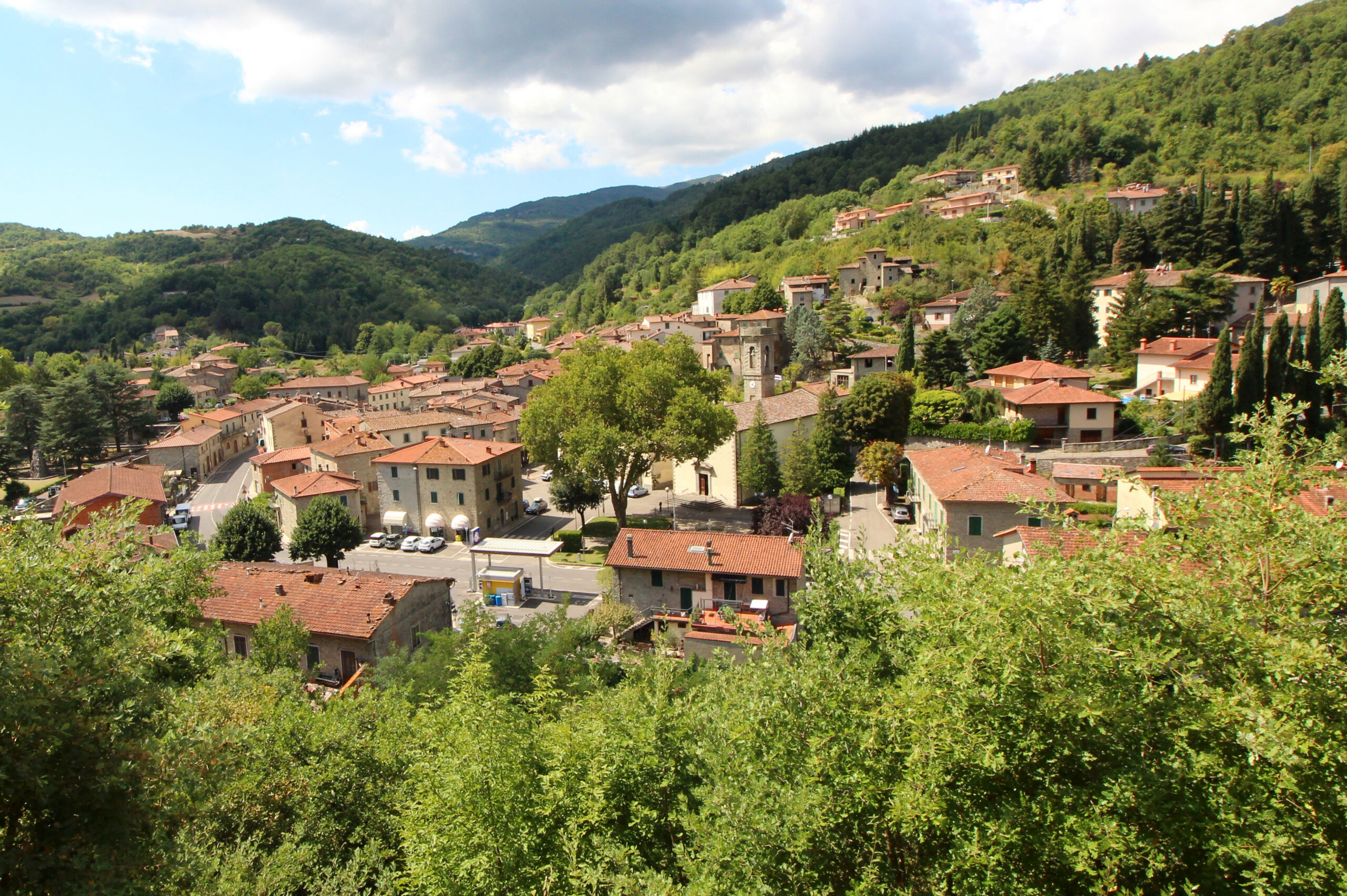
The Casentino is an oval basin about 60 kilometers long. It runs from the sources of the Arno on Monte Falterona (1,654 m) down to the town of Subbiano. Mountains close it in on every side. The Apennine ridge lies to the north and east, separating it from Romagna and the Valtiberina. The Pratomagno massif rises to the west, facing the Valdarno. The Alpe di Serra and Alpe di Catenaia complete the ring to the east.
No highways or long-distance railways cross the valley. As a result, you almost never pass through the Casentino by chance. You come here because you mean to.
This isolation preserved one of the largest and best-preserved forests in Italy. Today it forms the core of the Parco Nazionale delle Foreste Casentinesi, Monte Falterona e Campigna, a national park whose ancient beech forests around Sasso Fratino were added to UNESCO’s World Heritage list in 2017.
Twelve municipalities make up the valley, and two forces have shaped their history. The first is the Guidi Counts, the feudal dynasty that built castles on every strategic hilltop from the eleventh century on. The second is the great monastic orders, Camaldolese and Franciscan, who chose this forest isolation for spiritual retreat.
In 1289, the valley saw the Battle of Campaldino, one of medieval Tuscany’s decisive conflicts. A young Dante Alighieri fought in it as a cavalryman. Memories of exile, battle, and sacred silence still layer every corner of the Casentino.
The towns and villages
Poppi
Poppi is the valley’s visual icon. This compact medieval village is crowned by the castle of the Guidi Counts. Tradition credits the castle as the prototype for Florence’s Palazzo Vecchio.
Poppi belongs to the Borghi più belli d’Italia (Most Beautiful Villages in Italy) and overlooks the Campaldino plain where Dante fought. Inside the castle, you’ll find Taddeo Gaddi’s frescoes, the Rilliana Library of medieval manuscripts, and an exhibition on the battle.
Pratovecchio Stia
Pratovecchio Stia has been a single municipality since 2014. It sits at the head of the valley and joins two towns. One was the home of painter Paolo Uccello’s family (the painter himself was probably born in Florence). The other is the historic home of Panno Casentino, the curly wool cloth said to have been used for Audrey Hepburn’s coat in Breakfast at Tiffany’s.
Between the two towns stand the magnificent Romanesque Pieve di Romena and the atmospheric ruins of Romena Castle. Dante names Romena in the Inferno.
Bibbiena
Bibbiena is the largest town and the practical center, with just under 12,000 inhabitants. It has a Renaissance-era historic center and the Santuario di Santa Maria del Sasso, which holds a Madonna from the school of Donatello. Every June, the Sagra delle Sagre (Festival of Festivals) gathers food traditions from across the whole valley in one place.
La Verna
La Verna is one of the most important Franciscan pilgrimage sites in the world. On this mountain, Saint Francis received the stigmata in September 1224. Its churches and chapels are filled with extraordinary glazed terracotta by the Della Robbia family.
Camaldoli
Camaldoli holds the monastery and hermitage of the Camaldolese order. Tradition dates its founding by Saint Romuald to around 1012 (historians favour the mid-1020s), and spiritual life has continued here for a thousand years, deep in the ancient forest. The monks have made remedies here since the Middle Ages (a spezieria is documented from 1331), and the historic pharmacy is still active.
The smaller villages
The smaller municipalities are Castel San Niccolò, Montemignaio, Ortignano Raggiolo (with its Chestnut Museum), Chitignano, Talla, Capolona, Subbiano, Castel Focognano, and Chiusi della Verna. Together they dot the valley with fortified villages and Romanesque parish churches. Here, the rhythms of farm life have not fundamentally changed in centuries.
Food and drink
Tortelli di patate
The Casentino’s signature dish is tortelli di patate: large square pasta parcels filled with potatoes, garlic, parsley, and Parmigiano. They come with a meat ragù, classically duck or beef. Local lore says chestnuts filled similar pasta before potatoes became a staple.
Every household has its own recipe, and every sagra (food festival) serves them. The debate over whose are best is a valley-wide obsession.
Chestnuts, the “bread trees”
Chestnuts are the deeper story. The mountain forests above 500 meters were once “bread trees.” They provided the flour for castagnaccio, necci, and baldino. No chestnut DOP or IGP covers the Casentino itself; the nearest, the Marrone di Caprese Michelangelo DOP, lies just over the ridge in the Valtiberina. Chestnut culture also survives in villages like Raggiolo, where the Ecomuseo della Castagna documents the drying, grinding, and cooking traditions.
Cured meats, cheese, and wine
Other essentials include prosciutto and salsiccia from the Casentino’s local pig breed, the Grigio del Casentino. Look out too for raviggiolo, the soft fresh cheese shared with neighboring Mugello, and for porcini mushrooms in autumn. Tuscan staples like ribollita, pappa al pomodoro, and bistecca complete the table.
The valley has no major wine appellation. Still, the local wines, often sold directly from farms, are honest and food-friendly.
What makes this region different
A valley of castles and monasteries
Enclosure defines the Casentino’s character. With mountains on every side, the valley feels self-contained. That quality attracted both feudal lords looking for defensible positions and monks seeking isolation from the world.
The result is an unusual density of military and spiritual architecture. The valley has more castles per square kilometer than almost anywhere in Tuscany. It also has two of Christianity’s most significant monastic sites within a few hours’ walk of each other.
An old-growth forest
The Foreste Casentinesi National Park contains some of the best-preserved old-growth forest in Western Europe. The Sasso Fratino reserve has been strictly protected since 1959, when it became Italy’s first integral nature reserve. In 2017, its ancient beech trees joined the UNESCO World Heritage list.
Wildlife includes wolves (one of the most important populations in the northern Apennines), deer, wild boar, golden eagles, and red deer, reintroduced in the 1950s. In autumn, especially late October, the forest puts on some of Italy’s most spectacular foliage. Beech, oak, chestnut, and maple turn the canopy gold, russet, and crimson.
Panno Casentino
The valley’s isolation also preserved its textile tradition. Stia has produced Panno Casentino, a distinctive curly-surfaced wool cloth. Wool cloth has been made here since the Middle Ages: by the fourteenth century, it is said, residents of Palagio Fiorentino paid their Florentine taxes in cloth rather than coin.
A felting and brushing process called ratinatura creates the fabric’s characteristic “curls.” The result is a double-layered cloth that is waterproof, windproof, and warm. The classic colors are orange and green, which Gabriele D’Annunzio is said to have described as “the fire of the sunset and the green of the woods of the Arezzo valley.” They remain the most iconic. Givenchy is said to have chosen the orange cloth for Audrey Hepburn’s coat in Breakfast at Tiffany’s.
When to visit
Autumn (October–November) is the Casentino’s finest season. The forests put on some of Italy’s finest foliage, and chestnut festivals fill the village calendars. Mushroom season peaks, and the valley is at its most atmospheric.
Spring (April–June) brings wildflowers, comfortable hiking temperatures, and the reawakening of the monasteries’ gardens.
Summer (July–August) is cooler than lowland Tuscany, thanks to the forests and the elevation. The Sagra delle Sagre in Bibbiena (June) and various local festivals bring the valley to life.
Winter (December–March) is quiet and cold, with occasional snow above 800 m. The forests in snow are extraordinary, and accommodation prices hit their lowest.
Practical tips
Getting there: From Florence, the most scenic route crosses the Passo della Consuma (1,050 m) via Pontassieve. It takes about 1 hour to Poppi. From Arezzo, follow the SR71 along the Arno, and you’ll reach Bibbiena in about 30 minutes.
By train: The LFI/TFT railway runs from Arezzo to Bibbiena, Poppi and Stia; check TFT’s website for current timetables. It is one of Tuscany’s most useful local rail lines, and you can bring your bicycle on board.
Getting around: We recommend a car for the monasteries, the castles, and the smaller villages, since Camaldoli and La Verna are up in the mountains. On the valley floor, both the train and the cycle path along the Arno connect the towns.
Best bases: Poppi for atmosphere and central position. Bibbiena for services and access to La Verna. Stia for the northern valley, Monte Falterona, and the Mugello connection.
Accommodation: Agriturismi (farm stays) and B&Bs dominate; this is not hotel territory. Prices are much lower than in Chianti or the Val d’Orcia.
Nearby
- Arezzo — 30 minutes south, with Piero della Francesca’s frescoes, the monthly antiques fair, and the Giostra del Saracino
- Mugello — connected via the Croce ai Mori pass from Stia (~40 minutes), Giotto and Medici country
- Vallombrosa — west across the Pratomagno (monastery founded in 1036, spectacular forests)
- Sansepolcro / Valtiberina — east over the Alpe di Catenaia, birthplace of Piero della Francesca
- Chianti — southwest via Arezzo, though a world apart in character
Information is provided in good faith and may change. Always confirm opening hours, prices, and event dates with the official source before you travel.