
Region guide · Province of Massa-Carrara
Lunigiana
The Land of a Hundred Castles at Tuscany’s Forgotten Edge
Last updated:
- Province
- Province of Massa-Carrara
- Main town
- Pontremoli (population ~7,000)
- Best season
- ["[\"Spring (April\\u2013June) for wildflowers and hiking; autumn (September\\u2013November) for chestnuts, mushrooms, and harvest festivals\"]"]
- Known for
- Malaspina castles, prehistoric stele statues, testaroli, Via Francigena, chestnut forests, panigacci, DOP honey
- Getting there
- A15 motorway (Parma–La Spezia) exits at Pontremoli and Aulla; rail via Parma–La Spezia line; 90 km south of Parma, 120 km northwest of Florence
The name comes from Luni, a Roman colony founded in 177 BC on the coast near present-day Sarzana. It was once a thriving harbor that shipped Carrara marble across the Mediterranean. Today it is an archaeological site surrounded by artichoke fields.
Some say the name refers to the moon, luna in Italian, whose beauty is supposedly unsurpassed against the white peaks of the Apuan Alps. Others point to moon-worshipping cults that may have existed here in pre-Roman times. The truth is probably simpler and more Roman than that. Still, the lunar mythology has stuck, and it suits a place this atmospheric.
Lunigiana is essential for anyone who wants to understand Tuscany beyond the postcard, because for most of history it was not really Tuscany at all. It was a borderland. Genoa, Milan, Florence, Parma, Modena, Lucca, and Pisa fought over it for centuries. All of them wanted the mountain passes that connected the Mediterranean coast to the Po Valley and northern Europe.
This produced two things. The first is an extraordinary concentration of castles: well over a hundred at the medieval peak, and many still stand. The second is a fiercely independent local identity that persists to this day. People here will tell you they are Lunigianese first, Tuscan second, and Italian only when the national football team is playing.
A castle on every hill, and the family that built them all
The Malaspina and their inheritance law
The story of Lunigiana is, in large part, the story of one dynasty: the Malaspina. Descended from the powerful Obertenghi family, they ruled the Magra Valley and its mountains for roughly six centuries, from around 1100 until Napoleon arrived in 1797. At their peak, they controlled the land from the Apennine ridge to the coast, with every pass, bridge, and trade route in between.
Their inheritance law explains the impossible density of castles in this small region. Most Italian noble families followed primogeniture, where everything goes to the eldest son. The Malaspina, however, divided their lands among all male heirs. The result was predictable. With each generation, the fiefdoms grew smaller, the branches more numerous, and the need for fortified homes more urgent. Every new marquis needed his own castle. By the time the dynasty faded, Lunigiana had sprouted fortresses like mushrooms after rain.
The critical split came in 1221, when the family divided into two branches along the Magra River. The Spino Secco (Dry Thorn), centered on Mulazzo, held the right bank plus Villafranca. The Spino Fiorito (Flowering Thorn), based at Filattiera, held the left bank. Both branches then split again, and again. Each splinter set up its own tiny court, its own castle, and its own local allegiances.
Schemers, lovers, and a famous guest
The Malaspina were not just castle builders. They were patrons, schemers, lovers, and occasionally monsters. In Treschietto, the notorious Giovan Gasparo Malaspina was said to throw his enemies from the cliff below his circular tower. In Fosdinovo, Princess Bianca Maria Aloisia was sentenced to death for an impossible love story. And the Marquise Annetta of Bastia is said to have rivaled Madame de Pompadour at the courts of Parma and Paris.
In 1306, a more famous guest arrived. Dante Alighieri, exiled from Florence, came to Lunigiana as a diplomatic envoy for the Malaspina. At the castle of Castelnuovo di Magra, he negotiated peace with the bishops of Luni. He repaid the family’s hospitality in verse. In Canto VIII of Purgatorio, he meets Corrado Malaspina and praises the family’s honor. In Canto XX of Inferno, he gives the soothsayer Aruns a cave among the white marbles of the mountains of Luni, with an open view of the stars and the sea.
Castles you can visit
The castles range from crumbling towers swallowed by ivy to fully restored medieval homes you can sleep in. Fosdinovo is the most imposing, perched dramatically above the Magra plain with views to the sea. It is nine centuries old and still owned by Malaspina descendants. Today it is partly a B&B, where you can sleep in rooms that haven’t forgotten the Middle Ages.
The Castello del Piagnaro crowns the hill above Pontremoli‘s old town and houses the region’s most important museum. The Fortezza della Verrucola in Fivizzano was the site of a bloody massacre in 1418; the late sculptor Pietro Cascella restored it. Finally, the castle at Monti in Licciana Nardi is one of only two in Lunigiana still owned by the original family. Its arms halls, libraries, and monumental fireplaces look exactly as they did in feudal times.
Before the castles: five thousand years of stone warriors
The Malaspina may have defined Lunigiana’s medieval character. Yet the region’s identity reaches far deeper, to the stele statues, one of the most haunting and mysterious archaeological phenomena in Europe.
The stele statues
The peoples of the Magra Valley carved these human-shaped sandstone figures between roughly 4,000 and 1,000 BC, from the Copper Age through the Bronze Age to the arrival of the Etruscans. Eighty-five have been found so far; the most recent turned up in Pontremoli in 2021.
The figures are male and female, in stark, geometric forms. Look for the distinctive U-shaped face, the “carabiniere hat” head, and fingers arranged like the teeth of a comb. The men carry daggers and axes, while the women wear necklaces and earrings. They stand one to three meters tall and were driven upright into the ground. Precisely why is still debated. Were they ancestor worship, boundary markers, or gods?
What is certain is that they are unique to Lunigiana. Similar megalithic traditions exist across Europe, but these specific forms belong to this valley and nowhere else. For millennia, farmers dug them up and reused them as building material: lintels, windowsills, chicken-coop walls, and church foundations. Only in the 1950s, when Professor Augusto Cesare Ambrosi began collecting them systematically, were the stele recognized as a cultural phenomenon of European importance.
The museum in Piagnaro Castle
The Museo delle Statue Stele Lunigianesi inside Piagnaro Castle in Pontremoli is one of those small museums that changes how you see a place. A 2015 redesign doubled the exhibition space. The statues now stand in chronological order against medieval castle walls, one era’s mysteries displayed inside another era’s fortifications. There are interactive exhibits, multimedia content, and English-language panels. Budget at least an hour, ideally more.
The towns of the Magra Valley
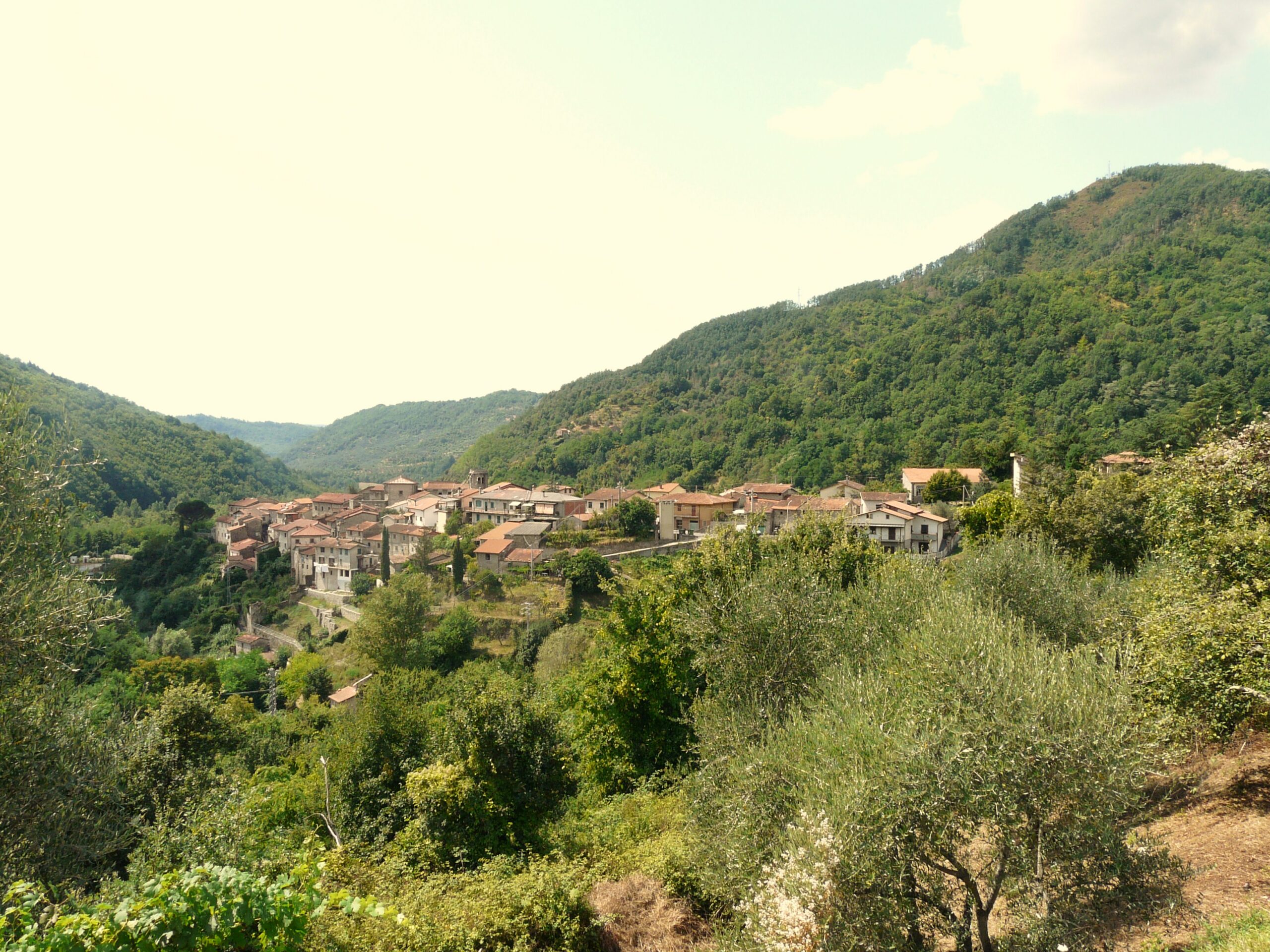
Lunigiana is strung along the Magra River and its tributaries. Its small towns were once fiefdoms, each with its own castle, its own market square, and its own fierce sense of separateness.
Pontremoli
Pontremoli is the northernmost town in all of Tuscany and Lunigiana’s cultural capital. The name means “Trembling Bridge” (pons tremulus). Either the original bridge over the River Verde was built from poplar wood that shook, or the poplar tree itself was called tremulus. The old town sits on a narrow spit of land between two rivers, the Verde and the Magra, and climbs to Piagnaro Castle on the hill above.
In the Middle Ages, Pontremoli was called the “sole key and gateway to Tuscany.” Its wealth came from controlling that gate: the Cisa Pass, the most important Apennine crossing between the Tyrrhenian coast and the Po Valley. It was also a stop on the Via Francigena. When Archbishop Sigeric of Canterbury recorded his 80-stage journey from Rome to England around 990 AD, Pontremoli was stage XXXI.
That wealth produced the Baroque palaces that are Pontremoli’s hidden glory. Among them are the Dosi Magnavacca, the Pavesi-Ruschi Noceti, and the Zucchi Castellini, lined along Via Garibaldi and the two connected piazzas. Their frescoed interiors are rich in quadraturismo (Baroque trompe-l’oeil architecture painted on walls and ceilings). They normally open to the public only during the Pontremoli Barocca weekend in April, though you can visit some by arrangement.
The 14th-century Campanone tower was built to physically separate the warring Guelph and Ghibelline factions, and it still divides the town center. The Teatro della Rosa, built for the Accademia della Rosa (founded in 1739), is an intimate 18th-century jewel.
Pontremoli is also a Città del Libro (City of Books) and the birthplace of the Premio Bancarella, a literary prize awarded every July. The area’s itinerant booksellers founded it. Among them were those from nearby Montereggio, who once carried crates of books across Italy on their backs.
Fivizzano
Fivizzano was called “the Florence of Lunigiana” for its long period under Medici rule. Cosimo I built imposing walls around it in 1540, and parts of them survive. Its elegant main square, with a fountain and aristocratic palaces, was the commercial and social heart of the upper Magra Valley.
Palazzo Fantoni-Bononi was home to the Museo della Stampa (Museum of Printing). It honors Jacopo da Fivizzano, who printed books here with movable type from 1471, among the earliest printers anywhere. The museum has been closed since the 2013 earthquake damaged the building. The 1920 earthquake and World War II also caused serious damage, but the town keeps its Renaissance character.
Above Fivizzano, the Fortezza della Verrucola guards a narrow valley. In 1418, conspirators murdered the elderly Marquis Niccolò Malaspina and his family here.
Bagnone
Bagnone is a picture-book borgo (village) cascading down a hillside above the river of the same name, crowned by a Malaspina castle. Its narrow streets, stone bridges, and overhanging houses make one of Lunigiana’s most photogenic streetscapes. In 2024, the Touring Club Italiano awarded Bagnone its Bandiera Arancione (Orange Flag) for small towns of quality.
Villafranca and Filetto
Villafranca in Lunigiana is the guardian of rural memory. Its Ethnographic Museum fills an old watermill set against the town walls. Inside are farm tools, shepherding equipment, household objects, and local religious artifacts, a detailed portrait of the mountain life that defined this region for centuries. Above the town stand the ruins of the Malaspina castle of Malnido, badly damaged by bombing in World War II.
Nearby Filetto is a perfectly preserved medieval walled village that hosts a famous August market. Stele statues were found in the surrounding forests, and the area held sacred pagan significance in pre-Roman times.
Licciana Nardi
Licciana Nardi controls the Taverone Valley and the road to the Lagastrello Pass into Emilia-Romagna. Around it stand two notable castles. Bastia is famous for its oval towers and unusual curved architecture, a more refined approach to military engineering. Monti is still in Malaspina family hands.
Aulla and Equi Terme
Aulla sits at the strategic crossroads where the Cisa, Cerreto, and Lagastrello Pass routes meet. World War II almost completely destroyed it. The rebuilt town preserves the Abbey of San Caprasio, where the saint’s relics were rediscovered during excavations in the early 2000s. It also has the Brunella Fortress on the hill above and the Lunigiana Museum of Natural History.
Equi Terme, a hamlet of Fivizzano, packs in a burst of natural wonders. There are prehistoric caves with stalactites and traces of cave bears, and a small but atmospheric thermal spa. Above the village runs the Solco di Equi, a narrow gorge.
What Lunigiana tastes like
The food of Lunigiana is unlike anything else in Tuscany. It sits where three culinary traditions collide: Tuscan, Ligurian, and Emilian. What emerges is older and more elemental than any of them.
Testaroli and panigacci
Many food historians consider testaroli the oldest form of pasta in Italy, possibly Roman and certainly medieval. The method is almost absurdly simple. Cooks pour a batter of wheat flour, water, and salt onto a scorching cast-iron plate called a testo and cook it over an open flame. The result is a thick, flat disk about 40–45 centimeters across. They cut it into diamonds, blanch them briefly in boiling water, and dress them. Pesto is the classic choice (this is practically Liguria, after all), but olive oil and Parmigiano or a mushroom sauce are common too.
The artisanal Pontremoli testarolo is a Slow Food Presidium. Unlike the dense industrial versions, it is thin, soft, and light, cooked on a two-piece cast-iron testo over a wood fire. It is both a first course and a cultural artifact.
Panigacci belong to the same family but differ in execution. The batter is denser, and they cook in stacked terracotta testi rather than cast iron. The result is a thin, round flatbread. You eat them hot with stracchino cheese and cured meats, or with honey and Nutella for dessert.
Podenzana is the spiritual home of panigacci and celebrates them with an annual August fair. During World War II, when Podenzana was cut off, residents survived on panigacci made with acorn and chestnut flour. These are not quaint traditions. They are survival strategies written down as recipes.
Chestnuts
Chestnuts run through Lunigiana’s cooking like a bass note. The chestnut forests of the Tuscan-Emilian Apennines produce flour with DOP certification. Producers dry the chestnuts in traditional gradili over slow wood smoke, then stone-grind them. The resulting flour tastes intensely sweet without any added sugar.
This flour becomes castagnaccio (the flat chestnut cake), lasagne bastarde (chestnut flour pasta), pattona (chestnut cake in the local style), and necci (crêpes filled with ricotta). It also goes into the Marocca di Casola, a bread of chestnut flour, wheat flour, and crushed boiled potatoes, and another Slow Food Presidium.
Lamb, honey, and pastries
The Agnello di Zeri (Zeri lamb) is the third Slow Food Presidium from this small territory. It is raised in the mountain pastures of upper Lunigiana, where the Zerasca sheep breed has adapted to high altitude over centuries.
Lunigiana’s DOP honey was the first in Italy to receive Protected Designation of Origin status, thanks to the variety of the landscape. Acacia honey comes from the valley, dark chestnut honey from the forests, and wildflower honey from the mountain meadows. The torta d’erbi (herb pie) varies from house to house, but it always wraps wild greens from the surrounding fields in thin pastry.
In Pontremoli, look for the Amor, a delicate pastry filled with a secret cream recipe. Look too for the spongata, a Christmas cake of puff pastry, marmalade, honey, raisins, and nuts. Locals say six families in one building will produce six entirely different versions.
Walking where the pilgrims walked
Lunigiana is, above all, a land of passage. No route defines this character more than the Via Francigena.
The Via Francigena
When Archbishop Sigeric of Canterbury recorded his journey from Rome to England around 990 AD, three of its 80 stages fell within Lunigiana: Pontremoli, Aulla, and the area around Sarzana. This was the medieval superhighway, linking northern Europe to Rome. Pilgrims, merchants, armies, and ideas all crossed the Apennines on it.
The Lombards laid the groundwork in the 6th century, seeking an outlet from the Po Valley to the Tyrrhenian coast. The Franks expanded it, and the medieval church formalized it. Today, the Via Francigena is enjoying a renaissance as Italy’s answer to the Camino de Santiago, with more walkers on the trail every year.
In Lunigiana, the route enters Tuscany at the Cisa Pass (1,041 meters). It then descends through the whole Magra Valley, passing Pontremoli, Filattiera, Villafranca, and Aulla before briefly entering Liguria. The trail is fully signposted and mixes forest paths, dirt roads, and paved stretches.
Along the way, you’ll pass the Romanesque parish church of Sorano, the medieval village of Filetto, the Malaspina castles of Terrarossa and Malgrate, and the Abbey of San Caprasio in Aulla. Places to sleep range from pilgrim hostels inside churches to agriturismi in converted stone farmhouses.
Other trails and bike routes
Beyond the Francigena, two other historic routes cross the territory. The Via del Volto Santo (Way of the Holy Face) connects Lunigiana to Lucca. The Via degli Abati (Way of the Abbots) links Bobbio to Pontremoli through some of the wildest Apennine terrain in northern Italy.
The Sentiero Italia, the long-distance trail along the Apennine ridge, crosses Lunigiana’s higher ground. It offers five days of backpacking through the Tuscan-Emilian Apennines National Park and the Apuan Alps Regional Park. Down in the valley, the Lunigiana Bike Area offers a network of mountain-bike trails through forests and castle-dotted hills.
When to visit
Spring (April–June) is perhaps the ideal season. Wildflowers cover the mountain meadows, the rivers run full, and the trails are at their best without the summer heat. Traffic on the Via Francigena grows from Easter onward, and Pontremoli’s palazzo openings usually fall in this period.
Summer (July–August) brings warmth to the valleys, but the higher ground stays pleasant. The Premio Bancarella book festival fills Pontremoli’s piazzas in July. The Sagra del Panigaccio in Podenzana runs in August. Medieval reenactments, including Pontremoli’s Medievalis in late August, bring the castles back to noisy life.
Autumn (September–November) is harvest season and arguably the most atmospheric time. Porcini appear in the forests, and chestnuts fill the markets. The fog that settles into the Magra Valley makes the landscape feel ancient and dreamlike. The chestnut festivals in Casola, Fivizzano, and smaller villages are among the most authentic food events in Tuscany.
Winter (December–March) is the quietest season, and some services close, especially in smaller villages. But the castles are empty, prices are low, and the cooking is at its most robust: chestnut soups, game ragù, steaming testaroli, and the wood-fire warmth of testi cooking. In January, Pontremoli holds the Disfida dei Falò (Bonfire Challenge). In this centuries-old rivalry, each parish builds the tallest bonfire it can to secure a fertile harvest year.
Getting there and getting around
Lunigiana’s old isolation is now a paradox, because it sits right on the A15 motorway between Parma and La Spezia. You can reach Pontremoli from Parma in about 45 minutes and from La Spezia in about 40. From Florence, it takes around two hours via the A11, A12, and A15.
The Parma–La Spezia railway serves Pontremoli, Aulla, and several smaller stations, with onward connections to Pisa, Genoa, and Milan. Maintenance work sometimes suspends sections of the line and replaces trains with buses, so check Trenitalia before you travel. Autolinee Toscane buses connect the main towns, but service to remote villages can be infrequent.
A car is essential for exploring properly. Many of the best castles, viewpoints, and villages sit at the end of narrow mountain roads that no bus will ever serve. Parking is generally easy; this is not Florence.
The nearest airports are Pisa (about 90 minutes by car to southern Lunigiana), Parma (about 60 minutes to Pontremoli), and Genoa (about 90 minutes to northern Lunigiana).
Practical tips
Accommodation is mostly agriturismi: converted farmhouses with rooms, apartments, and often home-cooked meals from local products. Fosdinovo Castle offers the extraordinary option of sleeping in a medieval fortress. In the villages, small B&Bs and the occasional albergo diffuso (distributed hotel) are authentic alternatives to conventional hotels. Prices are markedly lower than anywhere in central Tuscany.
Language: English is less widely spoken here than in more touristed parts of Tuscany. Basic Italian goes a long way, and the effort is genuinely appreciated. Restaurant menus may be Italian-only, which is usually a good sign.
Connections to other regions: Lunigiana is the gateway to the Cinque Terre (30 minutes from Aulla to La Spezia) and the Apuan Alps, with Carrara’s marble quarries on the doorstep. The Garfagnana valley lies over the Cerreto Pass, and the food cities of Parma and Bologna lie over the Cisa Pass. That makes it an exceptional base if you want mountains, coast, and cities within easy reach.
Nearby: what connects to Lunigiana
- Garfagnana — the neighboring valley to the east, separated by the Apuan Alps, with its own distinct culinary and hiking traditions
- Versilia & Apuan Alps — the coast and marble mountains immediately to the south
- Mugello — another “hidden” mountain valley north of Florence, sharing Lunigiana’s character as Tuscany’s overlooked hinterland
- Cinque Terre (Liguria) — 30 minutes by train from Aulla
- Parma (Emilia-Romagna) — 60 minutes north via the Cisa Pass, for the gastronomic capital of Italy
Information is provided in good faith and may change. Always confirm opening hours, prices, and event dates with the official source before you travel.