
Region guide · Province of Grosseto, Province of Siena
Monte Amiata
Tuscany’s Volcano of Springs, Chestnuts, and Fire
Last updated:
- Province
- Province of Grosseto, Province of Siena
- Main town
- Abbadia San Salvatore
- Best season
- Autumn for chestnuts and mushrooms; December for the fire festivals
- Known for
- Extinct volcano, Castagna del Monte Amiata IGP chestnuts, mercury mining heritage, Christmas fire rituals, the Codex Amiatinus, Seggiano DOP olive oil
- Getting there
- Rail to Chiusi-Chianciano Terme (Florence–Rome line) or Buonconvento (Siena–Grosseto line), then Autolinee Toscane buses; a car is realistically needed for multi-village days
Not Just Val d’Orcia with Trees
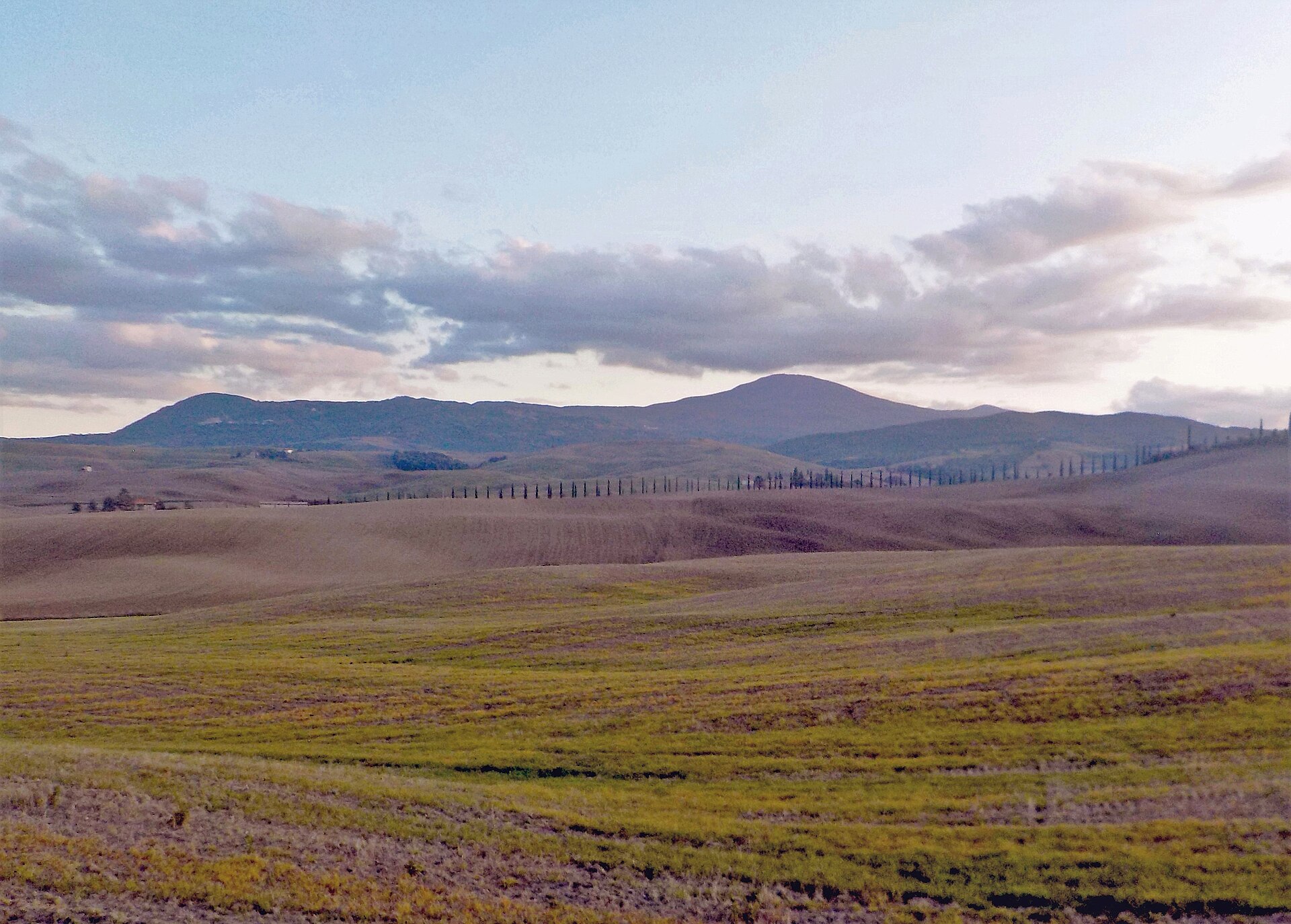
Seen from the Val d’Orcia, Monte Amiata is the wooded mountain on the southern horizon. It is easy to treat it as a backdrop to its famous neighbor. That undersells it badly.
Amiata is an extinct lava-dome volcano, 1,738 m high. Its main eruptions date to roughly 300,000 years ago, with a later lava flow about 240,000 years ago. There has been no eruption in the Holocene. The mountain is quiet, but its geology helps explain where the villages sit and how people have made a living.
Why the Villages Form a Ring
Start with the water. Rain soaks into the permeable volcanic cap of the upper mountain. Lower down, it meets the clay underneath and can sink no further. So it runs out at mid-height, as springs.
That is where the villages are. They form a ring around the mountain, each one close to its water. Four rivers rise on Amiata: the Fiora, the Albegna, the Paglia, and the Vivo.
The springs matter far beyond the mountain. In 1914, water from the Vivo reached Porta San Marco in Siena through about 63 km of cast-iron pipe. Today the Acquedotto del Fiora runs water services for 55 comuni in the provinces of Grosseto and Siena. Amiata springs also supply parts of northern Lazio.
Chestnuts, Mercury, and Heat from Below
Around that ring of springs, three things shaped life. The first is the chestnut, long central to life here. The second is mercury. The first furnace was lit at Abbadia San Salvatore on 31 January 1899. According to the Pro Loco of Abbadia, the area produced about a quarter of the world’s mercury between 1900 and 1920.
The third is geothermal energy. Enel Green Power runs power plants near Santa Fiora and at Piancastagnaio. The mountain’s heat, like its water, is still being used.
Prophets and Fires
Amiata has also drawn visionaries. In the 19th century, the carter David Lazzaretti gathered a following and built a tower on Monte Labbro. In 1981, the Tibetan master Chögyal Namkhai Norbu founded a Buddhist center at Arcidosso.
And every winter, the mountain lights its fires. The Fiaccole (Christmas torches) light up Abbadia San Salvatore on 24 December. The Carboniere (great wood pyres) blaze at Santa Fiora on 30 December. A month earlier, on 24 November, the Focarazza (great bonfire) is lit at Santa Caterina, near Roccalbegna.
Two Sides of One Mountain
The Siena side and the Grosseto side are different worlds. On the Siena side, the great early landmark is the abbey at Abbadia. Abbadia is also where the mercury industry began, and its mining museum tells that story.
On the Grosseto side, the Aldobrandeschi counts held castles from Arcidosso to Roccalbegna, and Santa Fiora and Castell’Azzara later passed to the Sforza. Its lower slopes produce Seggiano DOP olive oil and Montecucco wine. Even the ski areas and bus lines are split between the two sides. Treat them as two trips, or use our 4-day Monte Amiata itinerary to circle the whole mountain.
The Towns and Villages
We start on the Siena side, in the north, and go around the mountain.
Vivo d’Orcia
Vivo d’Orcia sits at around 900 m, a frazione (hamlet) of Castiglione d’Orcia. It began as a hermitage, the Eremo del Vivo, first recorded in a papal bull of 1113. Tradition credits St Romuald as founder, but no document confirms it.
In 1538 the abandoned monastery passed to Marcello Cervini. He was elected pope as Marcellus II in 1555 and died after just 22 days. His family’s Palazzo Cervini is still privately owned and lived in. According to the Pro Loco, the woods here hold one of the few surviving native stands of silver fir in Tuscany.
Campiglia d’Orcia
Campiglia d’Orcia stands at 810 m on a limestone outcrop. Its four ring-shaped streets follow a plan older than the year 1000.
Outside the village, a restored dry-stone path leads to Campigliola. The ruined tower was a Visconti stronghold that watched the Via Francigena. Local legend says fairies reaped the wheat there on June nights.
The Festa del Marrone (chestnut festival) has run on the last Sunday of October since 1978. The hot springs of Bagni San Filippo are about 3 km away.
Abbadia San Salvatore
Abbadia, at 822 m, grew around the Abbey of San Salvatore. Tradition credits its founding to the Lombard Ratchis in 742–743. The abbey church was consecrated on 13 November 1035. Its crypt has more than thirty columns, with capitals that include a Gordian knot.
The abbey once owned the Codex Amiatinus, a huge Latin Bible made at Wearmouth-Jarrow in England for Abbot Ceolfrith. A full-size facsimile is in the abbey museum. The town’s other story is mercury, told in the Parco Museo Minerario (mining museum park). The summit and its 22 m cross, first inaugurated in 1910, lie within the comune of Abbadia.
Piancastagnaio
Piancastagnaio, at 772 m, has a Rocca Aldobrandesca (Aldobrandeschi fortress). On 18 August its four contrade (districts), Borgo, Castello, Coro, and Voltaia, race bareback for the painted cencio (banner). The modern Palio dates from 1954.
Around 1 November comes the Crastatone, a chestnut festival held since 1967. Check the Pro Loco page for this year’s dates. The town is also home to Enel’s PC3–PC5 geothermal plants.
Santa Fiora
Santa Fiora, at 687 m, was the seat of a county. It passed from the Aldobrandeschi to the Sforza in 1439, when Cecilia Aldobrandeschi married Bosio Sforza. In 1633 Mario Sforza sold sovereignty to Ferdinando II de’ Medici but stayed on as feudatory.
The Pieve delle Sante Flora e Lucilla holds glazed terracottas by Andrea della Robbia and workshop. In the Montecatino district, the Peschiera is a 16th-century reservoir that collects the springs of the Fiora. Santa Fiora’s historic center has a limited-traffic zone, so park outside.
Arcidosso
Arcidosso, at 679 m, was an Aldobrandeschi stronghold. Its castle now houses MACO, the Museum of Oriental Art and Culture, opened in 2016.
Arcidosso is the town of both Amiata prophets. David Lazzaretti was born here in 1834 and built his tower on Monte Labbro (1,193 m). Merigar West, Namkhai Norbu’s Buddhist center, lies where Amiata’s slopes meet the Monte Labbro nature reserve. The Castagna del Monte Amiata IGP association was founded in Arcidosso in 2000.
Castel del Piano
Castel del Piano, at 637 m, appears in 890 as “Casale Plana” in the abbey’s records. Siena took it for good in 1331, after a siege led by Guidoriccio da Fogliano.
Its Palio is run on 8 September, the Marian patronal feast. According to the Ministry of Culture, the first documented race took place on 7 July 1771. Above the town, the Prato delle Macinaie (1,370 m) got its first ski lifts in 1958.
Seggiano
Seggiano, at 491 m, is olive country. Seggiano DOP oil must be at least 85% Olivastra Seggianese, and has held DOP status since 2011. You can meet one family of growers in our profile of La Casina di Giannetto.
The sanctuary of the Madonna della Carità was built in 1588–1603 after a vow to end a famine. Seggiano is also home to the Giardino di Daniel Spoerri, opened in 1997, with more than 110 works by about 55–60 artists.
Roccalbegna
Roccalbegna, at 522 m, has both a Rocca Aldobrandesca and a Cassero Senese (Sienese keep). Its Gothic church of Santi Pietro e Paolo was begun in 1296. At the high altar are three panels by Ambrogio Lorenzetti, painted around 1340.
In December 1943, eight Jewish refugees interned here were arrested and deported. All but one were killed at Auschwitz in 1944; Teresa Kapitz survived. In the frazione of Santa Caterina, the Focarazza burns on the evening of 24 November.
Semproniano
Semproniano, at about 622 m, is traditionally named after the Roman gens Sempronia. It regained its status as a separate comune in 1963.
Its frazione of Rocchette di Fazio has a 13th-century Pieve di Santa Cristina and sits next to the Bosco dei Rocconi reserve. In October the Pro Loco runs Il Risveglio delle Cantine (the waking of the cellars), when local cellars open their doors.
Castell’Azzara and Selvena
Castell’Azzara, at 815 m, is the highest comune seat in the province of Grosseto. Its name comes from “zara”, a medieval dice game.
Nearby Selvena has been a cinnabar (mercury ore) area since Etruscan and Roman times. Guided visits link the Rocca Silvana to the Miniera del Morone, which closed in 1981. The Riserva Naturale Monte Penna, set up in 1996, covers 1,050 ha of karst landscape.
Food and Drink
Chestnuts First
The Castagna del Monte Amiata has been an IGP (protected geographical indication) since 2000. Its varieties are Marrone, Bastarda Rossa, and Cecio. New production rules in March 2026 added Castell’Azzara, Semproniano, and Sorano to the area.
On Amiata the drying house is called a seccatoio, not a metato. According to That’s Amiata, the chestnuts lie on a slatted floor over a slow fire at about 30 °C for about 40 days. The dried nuts are ground into flour for polenta di castagne (chestnut polenta), which Santa Fiora lists among its local foods.
Piancastagnaio has its own vocabulary. Crastate are scored, roasted chestnuts. Suggioli are boiled. Monne are shelled and cooked with wild fennel.
Mushrooms: Know the Rules
If you plan to pick mushrooms, know the rules first. Anyone picking in Tuscany needs a paid regional permit, and non-residents pay by the day or the week. The daily limit is 3 kg per person, and plastic bags and rakes are banned. Read the Regione Toscana rules before you head out.
Oil, Wine, and Sweets
The lower Grosseto slopes grow olives and vines. Seggiano DOP oil comes from eight comuni, from Arcidosso and Seggiano to part of Castell’Azzara. Montecucco became a DOC in 1998, and Montecucco Sangiovese a DOCG in 2011.
For something sweet, look for ricciolina, a tart of shortcrust, chocolate-hazelnut cream, and meringue. It is linked to Abbadia and Piancastagnaio.
Santa Fiora also lists acquacotta (a soup of stale bread) among its local foods. At Roccalbegna, try the biscotto salato, a figure-of-eight biscuit of flour, oil, anise, and white wine. It is boiled, then baked, and is listed as a traditional agri-food product (PAT).
What Makes This Region Different
Setting the Record Straight
Amiata attracts a lot of repeated errors. Here are five we correct.
The volcano is not 700,000 years old. Its main eruptions date to roughly 300,000–200,000 years ago.
The Orcia does not rise on Amiata. It rises on Monte Cetona, and Amiata streams such as the Vivo feed it.
The Ratchis and Astolfo charters, the “proof” of the abbey’s royal founding, are suspect. Treccani regards them as 11th-century monastic forgeries. The abbey is documented from 762, and a Lombard noble from Friuli called Erfo is regarded as its real founder.
The terracottas at Santa Fiora are by Andrea della Robbia and his workshop, not by his uncle Luca.
And one English-language page calls the Contea dei Cervini the “County of the Matterhorns”. Cervino is the Italian name for the Matterhorn, but here Cervini is simply the family name.
A Plain Account of Geothermal Power
Geothermal energy is part of the landscape here, and it is contested. Enel Green Power runs Bagnore 3 and 4 near Santa Fiora and PC3–PC5 at Piancastagnaio, fitted with AMIS filters.
The regional health agency, ARS, found higher male mortality in the area, falling in recent years. Its InVETTA study found no link to hydrogen sulfide and pointed to natural sources. Local groups still dispute the plants’ impact.
A Mountain for Walking
The Anello del Monte Amiata (Amiata ring) is CAI trail 601. It runs about 29 km, mostly at 1,000–1,300 m, through chestnut and beech woods. It takes 6–8 hours, and there are no services on the way. Access points include Abbadia, Capomacchia, Capovetra, and Catarcione. See the trail page for details.
At the summit stands a 22 m cross from Luciano Zalaffi’s Siena workshops. It was inaugurated on 18 September 1910. Retreating German troops brought it down on 17 June 1944, and it was rebuilt and re-inaugurated in 1946.
When to Visit
Autumn
Autumn is chestnut season, and the festival calendar fills up. Vivo holds its Sagra del Fungo e della Castagna over two Sundays in mid-October. Campiglia follows on the last Sunday of October, and Piancastagnaio’s Crastatone falls around 1 November. Santa Fiora’s Festa del Marrone is in early November. As Vivo’s festival name suggests, mushrooms share the season.
Winter
Late November and December belong to fire. Go to the Focarazza on 24 November, the Fiaccole on 24 December, or the Carboniere on 30 December.
Skiing is possible, but be realistic. Two operators run lifts: I.S.A. at Contessa–Macinaie on the Grosseto side, and Amiata Impianti Senese on the Siena side. Snow is unreliable, and the lifts stayed shut for lack of snow in some recent winters. Check before you go.
Summer
Summer brings the palios. Piancastagnaio races on 18 August, after a month of events. Selvena holds its Palio dei Somari (donkey race) in mid-August, and Castel del Piano races on 8 September. In summer you can also walk the Anello.
Practical Tips
Getting There and Around
The nearest railway stations are Chiusi-Chianciano Terme, on the Florence–Rome line, and Buonconvento, on the Siena–Grosseto line.
Autolinee Toscane runs the buses. Line 54A links Abbadia with Siena via Castiglione d’Orcia, San Quirico, and Torrenieri. Line FT9 runs from Chiusi station via Sarteano and Radicofani to Abbadia and Piancastagnaio. Line 42A serves Arcidosso on the Grosseto side. Check the AT timetables before you travel.
Buses work for a single town. For days that string several villages together, you realistically need a car.
Where to Stay
Abbadia and Santa Fiora have the widest choice of places to stay. For a full circuit, split your nights between the Siena side and the Grosseto side.
Before You Go
- Book the mining museum at Abbadia in advance. See the museum page.
- Buy a regional permit before picking mushrooms.
- Park outside Santa Fiora’s limited-traffic zone.
- Check snow and lift status before a ski day.
- Visiting from the Val d’Orcia? Our Val d’Orcia hub covers the valley below, and the Maremma hub covers the land to the south.
Information is provided in good faith and may change. Always confirm opening hours, prices, and event dates with the official source before you travel.