
Region guide · Province of Grosseto
Maremma
Tuscany’s Reclaimed South
Last updated:
- Province
- Province of Grosseto
- Main town
- Grosseto
- Best season
- Spring and autumn
- Known for
- Tufa towns and Etruscan sunken roads, thermal springs, Morellino di Scansano wine, butteri and Maremmana cattle, the Orbetello lagoon, Spanish coastal forts, land reclaimed from marsh
- Getting there
- Rail on the Tirrenica coastal line (Pisa–Grosseto–Rome) and the Siena–Grosseto line; the inland towns need a car
There is a folk song every Tuscan knows, and it is not a love song to the landscape. “Maremma amara” (“bitter Maremma”) is an anonymous lament that emerged in the early decades of the 1800s. Its opening line is “Tutti mi dicon Maremma, Maremma…” (“Everyone tells me Maremma, Maremma…”), and it goes on to warn against the place. Caterina Bueno is credited with rediscovering it in 1964. Since then it has been recorded by Amália Rodrigues, Maria Carta, Gianna Nannini and Nada, among others.
The bitterness was real. In 1934 the Treccani encyclopedia still defined the Maremma as “zone costiere paludose e malsane”: marshy, unhealthy coastal zones. Malaria kept this coast almost empty for centuries, even though it lies within easy reach of Rome. That is the key to understanding Maremma Tuscany today. Almost everything you see on the plain, from the straight drainage channels to the scattered farmhouses, was made after the marsh was beaten.
Malaria, reclamation and land reform
The fight lasted more than three centuries. Grand Duke Ferdinando I set up a drainage office, the Ufficio dei Fossi di Grosseto, in 1592. In the 1760s the Jesuit engineer Leonardo Ximenes tried to manage the old coastal lake by regulating its water rather than draining it. In 1828 Grand Duke Leopoldo II backed a different plan: fill the lake with river silt. Progress was painfully slow. By 1861, Treccani notes, only 5,500 of a targeted 62,000 hectares had been reclaimed, and the big push came only after 1905.
Malaria shaped how the province was governed. Under a custom called the estatatura, Grosseto’s public offices packed up every summer and moved to healthier hill towns, above all Scansano. A law abolished the practice in 1897, but people kept fleeing the plain in summer until the disease was gone. Local reporting puts the Maremma’s last recorded malaria cases in the early 1950s. The last act was social. The 1950 land reform expropriated large estates and handed the land to smallholders, 178,800 hectares of it in the Tuscan and Lazio Maremma, mainly in Grosseto province.
Which Maremma?
English-language marketing uses “Maremma” for everything from the Livorno coast to northern Lazio. Historically there was a northern Maremma pisana, reaching Piombino, and a southern Maremma grossetana; Treccani put nine-tenths of the Tuscan Maremma in the province of Grosseto. The name also stretches south into Lazio, the Maremma laziale. On Tuscan Embassy, “the Maremma” means the Maremma grossetana, south and west of the mining hills. The Colline Metallifere have their own region hub, and so does Monte Amiata.
The Towns and Villages
The Maremma is not one landscape but five: a volcanic plateau, a band of vine-covered hills, a reclaimed plain, a coastal ridge of wild hills, and a lagoon coast with a long Spanish past. We group the towns the same way.
The tufa country
Pitigliano rises straight out of a cliff of volcanic tuff. It was called “Little Jerusalem” for its Jewish community, whose synagogue was completed in 1598 and whose ghetto the Medici imposed in 1622. Local Catholic families who sheltered Jews during the Second World War have been recognised as Righteous Among the Nations.
Sorano is a darker, more vertical town, dominated by the Fortezza Orsini, completed in 1552. Its territory hides a story almost unknown in English: the tiny County of the Ottieri, a micro-state that stayed independent until 1616. The rock-cut village of Vitozza, abandoned in the late 18th century, is nearby.
Sovana had just 122 residents at the 2011 census, yet it has a cathedral and an Etruscan necropolis of about 100 monumental tombs. Tradition names it as the birthplace of Pope Gregory VII, though the Dizionario Biografico degli Italiani says only “perhaps”. The deep sunken roads, the vie cave, start at its edge.
The Albegna and Fiora hills
Saturnia is known for its hot water, and the free pools of the Cascate del Mulino below the village draw crowds all year. Up in the village, the story is Roman: Saturnia, which Pliny calls Aurinia, became a Roman colony in 183 BC, and the Porta Romana still stands. The tale that it was born from a thunderbolt has no classical source.
Montemerano is a small walled village in the comune of Manciano. Its church of San Giorgio holds the Madonna della Gattaiola, a 15th-century panel that was later cut down into a door, with a round hole that tradition calls a cat flap. It is also home to Da Caino, one of Italy’s most celebrated kitchens.
Scansano was the Maremma’s summer capital under the estatatura. That explains why a hill town of its size has a 19th-century theatre and a cluster of palazzi. It gives its name to Morellino di Scansano, the region’s anchor wine, and its museum combines archaeology with the history of the vine.
Magliano in Toscana keeps its walls, begun in the Middle Ages and finished in the Renaissance. Outside them stand the roofless ruin of San Bruzio and the Olivo della Strega (witch’s olive), which grows next to the church of SS. Annunziata. The Piombo di Magliano, a lead disc carrying one of the longest known Etruscan inscriptions, was found here; it normally lives in Florence.
Capalbio is enclosed by a double ring of walls on a hill above the coastal plain. In the 1980s it became “piccola Atene” (little Athens), the summer colony of Rome’s left-wing intelligentsia. Nearby are Niki de Saint Phalle’s Giardino dei Tarocchi (Tarot Garden) and the WWF Oasi Lago di Burano, Italy’s first WWF oasis.
The Grosseto plain
Grosseto is the provincial capital and the one real city. Its hexagonal Medici walls were finished in 1593 and turned into a tree-lined promenade in 1855. The city’s darkest day was Easter Monday 1943, when American bombs aimed at the airfield hit a funfair and killed 134 civilians, many of them children. The Etruscan and Roman city of Roselle lies just outside.
Castiglione della Pescaia is a fishing port and beach town below a walled borgo. Its castle began as a Pisan watchtower and was strengthened by Alfonso of Aragon in 1447; it is privately owned. The Casa Rossa Ximenes, built in 1765–68 to control the old lake, is now a museum and the base for boat trips into the Diaccia Botrona wetland. Inland, Vetulonia tells how a country doctor found a lost Etruscan city.
The Uccellina hills
Between the mouth of the Ombrone and Talamone, a ridge of hills runs straight to the sea. This is the Parco Regionale della Maremma, established in 1975 as Tuscany’s first protected area. Its gateway is Alberese, a 1930s planned village, and its heart is the Tenuta di Alberese, where the butteri of Alberese still work cattle on horseback. At the southern end, Talamone is where Garibaldi’s Thousand stopped in May 1860 because they had sailed without ammunition.
The Spanish coast
Orbetello sits in the middle of a lagoon of about 27 km², linked by a causeway to Monte Argentario. From 1557 it was the capital of the Stato dei Presidi, a Spanish military enclave, and its gates and bastions still show it. The lagoon’s fishermen, organised as the Cooperativa dei Pescatori di Orbetello, keep alive methods and recipes credited to the Spanish period.
Porto Ercole is the Argentario’s smaller harbor, ringed by Spanish-era forts; Forte Filippo was begun for Philip II in 1558. Forte Filippo is now private homes, so plan to see most of the system from outside. The town also claims Caravaggio’s last days and bones; the honest version of that story is more interesting than the plaque.
Food and Drink
Maremma food comes from three kitchens: the herder’s, the fisherman’s, and the Jewish ghetto’s. It is plainer than the food of central Tuscany, and better for it.
Wine
Morellino di Scansano is the region’s anchor wine: DOC since 1978, DOCG since 2006, and made from at least 85% Sangiovese. Its rules added a Superiore category in 2026, with a minimum of 13% alcohol and lower yields than the base wine. Around it sits the broad Maremma Toscana DOC, where Vermentino was the largest single category in 2020.
The grape that feels most local is Ciliegiolo. According to the Maremma wine consortium, more than 55% of Tuscany’s Ciliegiolo vineyards are in the province of Grosseto, and genetic research suggests it may be a parent of Sangiovese. The story that pilgrims brought it back from Santiago de Compostela is one the consortium itself presents as belief, not fact.
In the tufa country, Bianco di Pitigliano was approved as a DOC by a decree of 28 March 1966; WineNews calls it the sixth DOC recognised in Italy. It is based on Trebbiano Toscano, known locally as Procanico. The Cantina di Pitigliano also makes kosher white and red wines under the supervision of the Rabbi of Livorno.
Dishes of herders and fishermen
Acquacotta (“cooked water”) was the butteri’s field lunch: onion, tomato, celery and wild herbs poured over stale bread, with an egg or ricotta when there was one. Tortelli maremmani are large squares of pasta filled with ricotta and chard, served with meat or boar ragù, or simply with butter and sage. Boar turns up everywhere, most often as cinghiale alla cacciatora, braised in red wine with tomato and black olives.
On the Argentario, caldaro is the fishermen’s soup, made on board from rock fish that would not sell. In Manciano, look for ciaffagnone, a thin fritter topped with Pecorino Toscano and folded like a handkerchief. In Pitigliano, the sfratto (“eviction”) is a stick-shaped pastry filled with honey and walnuts. Its name recalls the stick officials used to knock on Jewish doors when families were ordered into the ghetto.
Lagoon and pasture
The Orbetello lagoon is covered by a Slow Food Presidium for its traditional fishing. Its best-known product is bottarga, made from the roe of grey mullet, alongside smoked eel and two dressings Slow Food credits to the Spanish period: sfumatura and scavecciatura. Read our profile of the Orbetello fishermen’s cooperative for how the lagoon’s recurring summer die-offs affect this work.
Inland, the main cheese is Pecorino Toscano DOP. The Caseificio Sociale Manciano, founded in 1961 by 21 farmers who could not sell their cheese on their own, is the region’s big cooperative. The beef is Maremmana, a native breed you can meet in the fields at Alberese.
If you want one serious meal, Da Caino in Montemerano is it. Valeria Piccini took over her mother-in-law’s family kitchen and won a first Michelin star in 1991 and a second in 1999. Check the current Michelin listing before you book.
What Makes This Region Different
Butteri: working cowboys, not a show
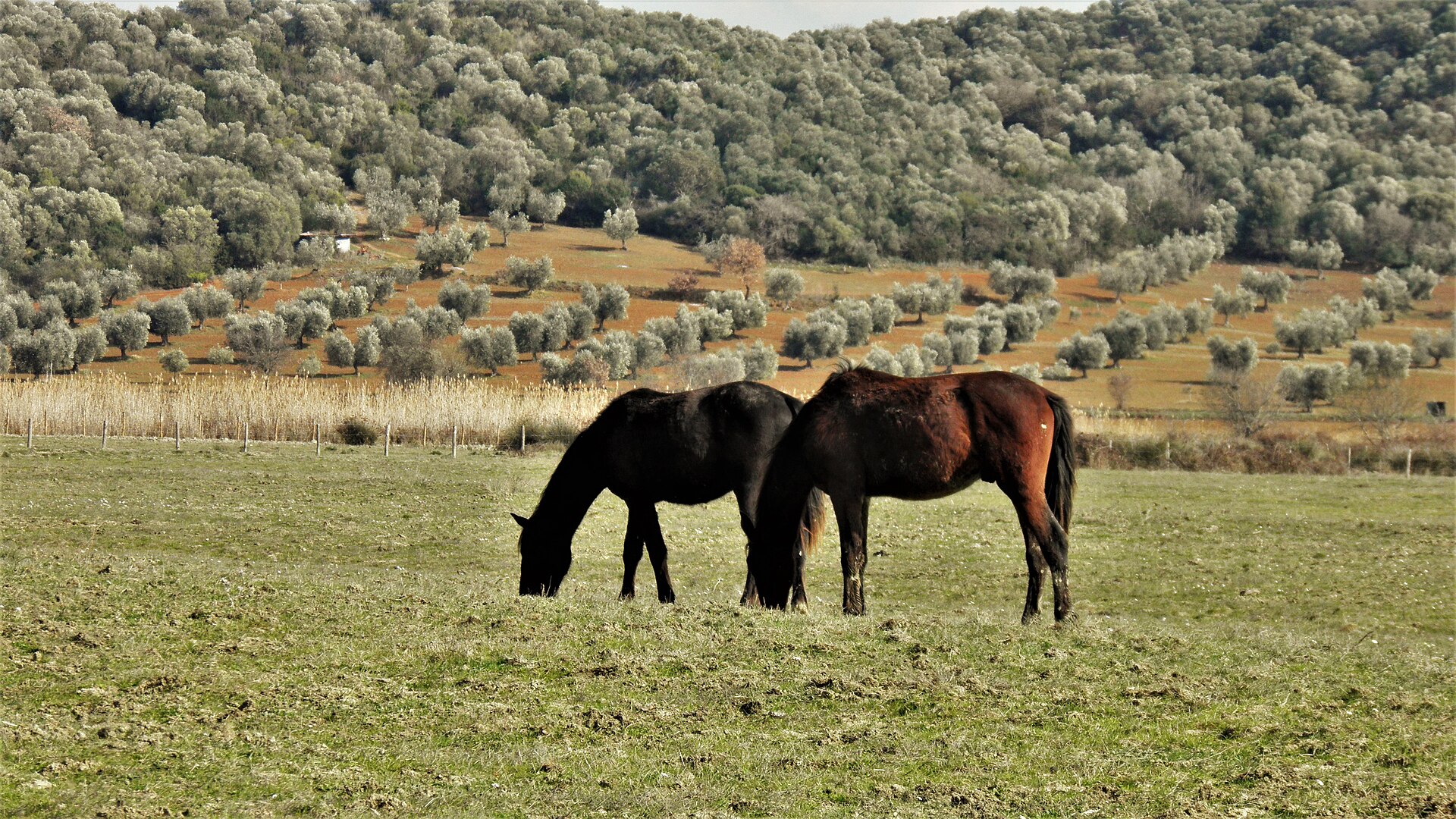
The butteri are mounted herders who manage the Maremma’s cattle. At the Tenuta di Alberese, an estate run by the regional agency Ente Terre Regionali Toscane, they still work the Maremmana cattle and Maremmano horses. In 2020 the regional news site intoscana put the estate at 4,200 hectares, with more than 400 cattle and about 40 horses. In May 2026, Maremma News reported about 3,500 hectares, about 50 horses, and four butteri on the staff. The estate is blunt about it: “our butteri are not a historical or folkloric re-enactment.”
One popular story needs correcting. English-language sources often say Maremma butteri beat Buffalo Bill. The famous contest took place in Rome on 8 March 1890, and the winner was Augusto Imperiali of Cisterna di Latina, with herders from the Agro Pontino in Lazio. When a comedian credited Tuscan butteri on Italian television in 2004, Cisterna’s mayor threatened legal action and he retracted. Our butteri profile tells the real, living story.
A Spanish coast inside Tuscany
For about 250 years, the southern coast was not really Tuscany at all. After Siena fell, Philip II of Spain created the Stato dei Presidi in 1557, with Orbetello as its capital, plus Talamone, Ansedonia, Porto Ercole and Porto Santo Stefano. It passed from Spain to Austria, then to the Bourbons of Naples, and briefly to France in 1801. It joined the Grand Duchy of Tuscany only at the Congress of Vienna in 1815.
You can read that history in stone. Orbetello has Spanish bastions and gates, and Porto Ercole has a fort system Fortezze.it calls “one of the most complex defensive systems ever realized”. The lagoon’s preserving recipes may be the tastiest legacy.
Tufa: towns cut from rock
In the south-east, the ground is volcanic tuff, soft enough to carve and strong enough to build on. Towns stand on its cliffs, cellars and tombs are dug into it, and Etruscan roads cut deep channels through it. The romantic version says the Etruscans carved these vie cave 20 meters deep. The archaeological park corrects it: today’s depth is often more than 10 meters greater than the original, because hooves wore the floor down and later users re-cut it. Nobody is sure what the roads were for; drainage, defense and ritual are all argued.
Thermal water
Hot water rises in several places. At Saturnia, the Cascate del Mulino are free to bathe in, but the municipal car park beside them has been paid since April 2023, and campers are banned. The spa resort Terme di Saturnia gives its own spring a constant 37.5°C; that figure belongs to its spring, not automatically to the falls. Terme di Sorano runs a year-round pool at 37.4°C that includes the 15th-century “Bagno dei Frati”.
When to Visit
Spring
Spring is the best all-round season. You can walk the park’s trails without the summer guide requirement, the tufa gorges are green, and the Tarot Garden opens for its season in April. In Pitigliano, the Torciata di San Giuseppe on the evening of 19 March sees hooded torch-bearers cross the valley and burn a straw effigy of winter.
Summer
Summer belongs to the coast, and it is busy. In summer 2026, from mid-June to mid-September, most trails in the Parco della Maremma could only be walked with a park guide; a few shorter routes stayed open to independent walkers. Check the park’s summer information before you go. Each summer, Tuscany also declares a high fire-risk period with a total ban on burning vegetation, and the park may close areas for fire risk. Coastal towns such as Castiglione della Pescaia and Porto Ercole run evening traffic restrictions in season.
Autumn
Late September and October are our favorite time. The sea is still warm, the harvest is in, and September brings wine festivals in Pitigliano and Scansano and the Sagra del Cinghiale in Capalbio. There is one catch. Tuscany’s hunting season opens on the third Sunday of September, and under recent regional calendars driven wild-boar hunts (braccata) run from October to the end of January, usually on Wednesdays, Saturdays, Sundays and holidays. On those days, wear bright clothing, stay on marked trails, or walk inside protected areas such as the park and the WWF oases.
Winter
Winter is quiet. The Tarot Garden is closed, and some seasonal restaurants shut, but the hot springs are at their best when the air is cold. Pitigliano stages a living nativity in its old Capisotto quarter over the Christmas holidays.
Practical Tips
A car is essential
You can reach the coast by train, but the tufa country and the hill towns are realistically car destinations. Sorano has no railway station at all. Autolinee Toscane buses connect Pitigliano with Grosseto, Orbetello and Siena, but services are thin; check at-bus.it for timetables.
Driving the Aurelia near Capalbio
The SS1 Aurelia is the region’s spine. As of April 2026, a stretch of about 13 km around Capalbio was still an ordinary two-lane road with a poor accident record; plans to complete the motorway date back to 1968. Drive this section with care, keep your distance, and do not overtake on impulse.
Trains on the coastal line
The Tirrenica line between Pisa and Rome stops at Grosseto, Talamone (the station is actually in Fonteblanda), Albinia, Orbetello–Monte Argentario (at Orbetello Scalo), Capalbio and Chiarone. Capalbio’s station is at Capalbio Scalo, about 9 km from the hilltop town. The Siena–Grosseto line is single-track with few direct trains. Alberese station has had no passenger service since 2010, and the Argentario lost its branch line in 1944.
Current closures
The museum at the Cosa archaeological park near Ansedonia has been closed for reinstallation since January 2026, while the park itself stays open (Parchi Archeologici della Maremma). In September 2026 the Strada del Mare bridge to Marina di Alberese closed until further notice (Il Giunco).
ZTLs, parking and tourist tax
Grosseto’s walled center has camera-enforced gates, and Pitigliano, Capalbio, Castiglione della Pescaia and Porto Ercole all have limited-traffic zones. Park outside and walk in. Several comuni charge a tourist tax; ask your accommodation what applies.
Plan your route
Our 7-day Maremma itinerary links the tufa towns, the thermal hills and the Spanish coast in one loop with two bases. For the mining hills to the north, continue into the Colline Metallifere, starting with Massa Marittima.
Information is provided in good faith and may change. Always confirm opening hours, prices, and event dates with the official source before you travel.