
Town · Colline Metallifere
Massa Marittima
Tuscany’s Secret Siena
Last updated:
- Region
- Colline Metallifere
- Province
- Province of Grosseto
- GPS
- 43.0497, 10.8914
- Best season
- Late May (Balestro del Girifalcone + spring light), August (Lirica in Piazza + second Balestro), September–October (quiet, ideal for museums)
- Time needed
- Full day minimum (cathedral + museums + Torre del Candeliere + Fonti dell'Abbondanza + Museo della Miniera = 5–6 hours)
- Difficulty
- moderate
- Known for
- Cathedral of San Cerbone, Piazza Garibaldi, Ambrogio Lorenzetti Maestà, Tree of Fertility fresco, Codice Minerario, Torre del Candeliere, Balestro del Girifalcone, birthplace of San Bernardino of Siena, Bandiera Arancione, Città Slow
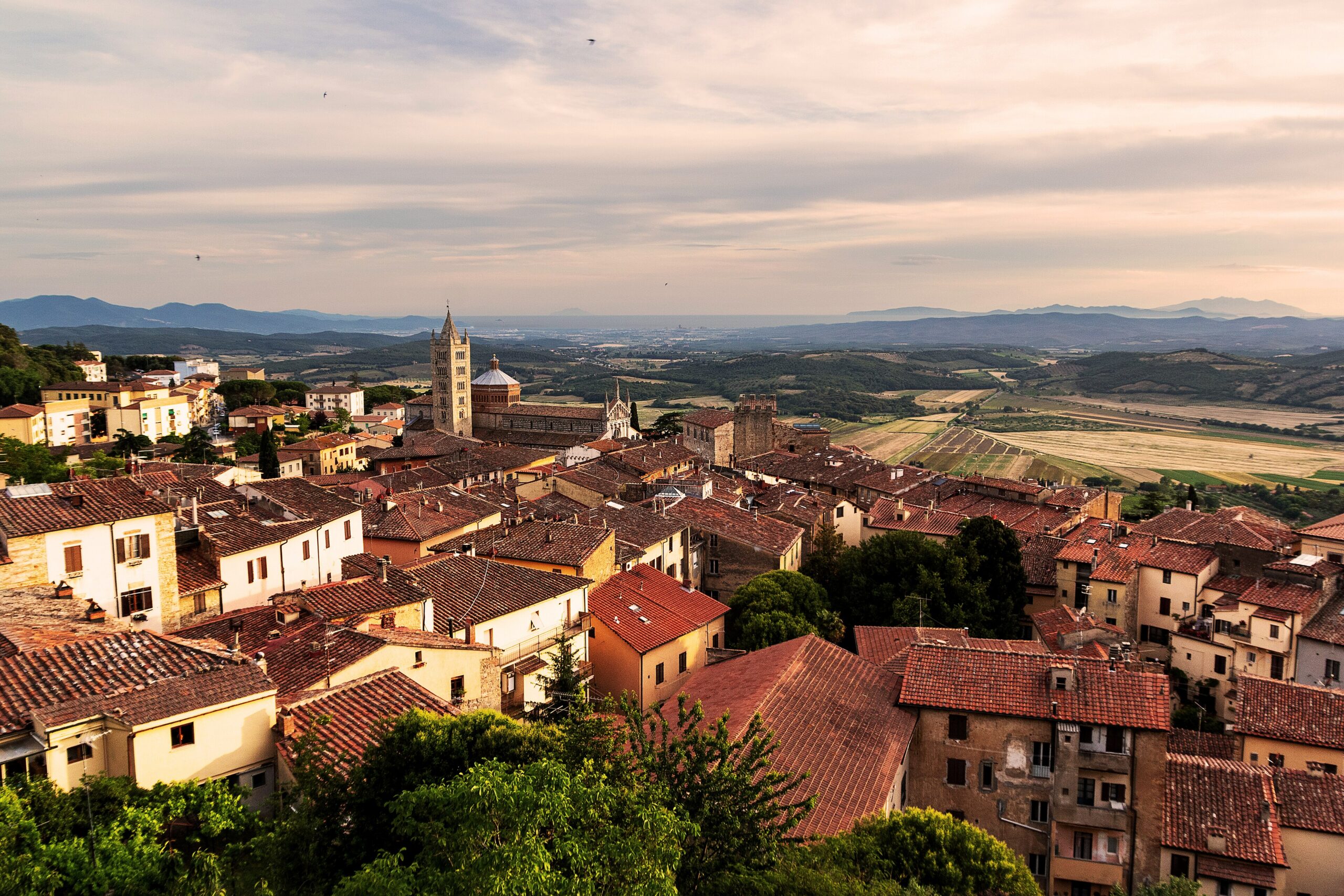
The first time you walk into Piazza Garibaldi in Massa Marittima, you stop. Not because someone tells you to, but because the space makes a physical demand. The piazza is trapezoidal — irregularly shaped, widening as it rises — and the Cathedral of San Cerbone sits not at the center or the far end but diagonally, atop a stepped podium, angled so that it catches the light differently from every approach. Visit Tuscany has compared the effect to a Giorgio de Chirico painting, and the comparison is exact: the geometry is just off-true enough to feel dreamlike.
This is not a piazza you pass through on the way to something else. This is the thing itself — one of the most beautiful public squares in Italy, in a town of 8,200 people that almost no English-speaking traveler has heard of.
Massa Marittima was a Free Commune in the thirteenth century, wealthy enough from copper and silver mining to build a cathedral that rivals anything in Siena, to commission works from the same artists who decorated Siena’s palazzi, and to produce one of the earliest comprehensive mining codes in Europe. It was conquered by Siena in 1335, devastated by the Black Death of 1348 and later epidemics (by 1737 only 527 people lived here), and spent the following centuries in a decline so deep that its treasures were simply forgotten rather than looted. What survives is intact, in place, and waiting.
A Place Shaped by Time
Massa Marittima divides into two distinct quarters. The Città Vecchia (Old Town) clusters around Piazza Garibaldi and the cathedral at the base of the hill — this is the medieval nucleus, built during the Free Commune’s golden age in the twelfth and thirteenth centuries. The Città Nuova (New Town) occupies the ridge above, developed after the Sienese conquest of 1335 and dominated by the fortress the conquerors built to control the population they had just defeated.
The two are connected by the steep Via Moncini and the Porta alle Silici — a gateway cut through the Sienese Fortress wall. The vertical separation between the two quarters is not just topographical but political: the Città Vecchia represents the republic, the Città Nuova represents the occupier. Walking from one to the other is walking across a conquest.
The town’s name — Massa Metallorum, the “mass of metals” — tells you everything about its economic foundation. The episcopal seat transferred here from Populonia (destroyed by Saracen pirates) by 1062, and by 1225 Massa was an independent republic. The population reached an estimated 10,000 to 20,000 by the early 1300s. The commune struck its own coinage from May 1, 1317, and produced the Codice Minerario — the mining code that regulated every aspect of underground work, from safety to anti-theft surveillance, with a sophistication that would not be matched elsewhere in Europe for centuries.
San Bernardino of Siena — Bernardino degli Albizzeschi, Italy’s greatest itinerant preacher and popularizer of the IHS Christogram — was born here on September 8, 1380. His father was governor of the district. Orphaned by age six, Bernardino left for Siena and a life of preaching that would make him one of the most famous religious figures of the fifteenth century. The Palazzo Albizzeschi, the family house, is traditionally pointed out as his birthplace.
What to See and Do
The Cathedral of San Cerbone
Construction began in the early eleventh century in Pisan Romanesque style — blind arcading, lozenge patterns, columns that speak the same architectural language as the cathedrals of Pisa and Lucca. In 1287, Giovanni Pisano modified the upper façade and extended the apse in Gothic style, adding ogival windows and spires that bring a Sienese verticality to the Pisan base. The result is a hybrid that shouldn’t work but does — two centuries of architectural ambition visible in a single façade.
The central portal’s architrave carries five carved panels depicting the life of San Cerbone, an African bishop of Populonia who died around AD 573 and whose legends include bears miraculously refusing to attack him and geese obediently following him to Rome for a papal audience. Inside, the density of significant art is staggering for a town this size. The Madonna delle Grazie attributed to Duccio di Buoninsegna (circa 1316) hangs in the end chapel on the left. The Arca di San Cerbone (1324), by the Sienese sculptor Goro di Gregorio, is an exquisitely carved marble sarcophagus with eight bas-relief scenes from the saint’s life. The baptismal font (1267) by Giroldo da Como is a single travertine block measuring 2.73 meters by 0.98 meters, resting on four sculpted lionesses. Rare fourteenth-century Sienese stained glass and a reused third-century Roman sarcophagus complete the collection. The cathedral was elevated to basilica minor by Pope Paul VI in 1975.
The Lorenzetti Maestà
In the Museo di San Pietro all’Orto, a short walk from the cathedral, hangs Ambrogio Lorenzetti’s Maestà (circa 1335) — a large tempera-and-gold panel (161 × 209 cm) that is a precursor to his more famous Allegory of Good and Bad Government in Siena’s Palazzo Pubblico. The theological virtues frame the Virgin and Child; the civic virtues frame the viewer. For anyone interested in the Sienese school of painting, this panel alone justifies the trip to Massa Marittima. It is not behind rope barriers. It is not in a darkened room behind timed lighting. It is simply there, on the wall, in a small museum in a small town, available for the kind of sustained looking that the Uffizi’s crowds do not permit.
The Tree of Fertility
The Albero della Fecondità (Tree of Fertility) is among Italy’s most remarkable — and most debated — medieval frescoes. Located inside the Fonti dell’Abbondanza (1265), a public fountain building, it was discovered during restoration in 1999 beneath centuries of plaster.
The fresco depicts a large deciduous tree bearing approximately 25 oversized erect phalluses as fruit. Below the tree, eight female figures reach upward — some grasping the “fruits,” others arguing among themselves. The dating is uncertain, falling somewhere between 1265 and 1335. Scholarly interpretations range from a fertility symbol tied to prosperity under good government to the reading of historian George Ferzoco, who sees it as Guelph propaganda warning the town that a return to Ghibelline rule would bring sterility and famine. The argument continues. The fresco, meanwhile, simply exists — vivid, explicit, and utterly unlike anything else in Italian medieval art.
The Torre del Candeliere and the Sienese Fortress
The Torre del Candeliere (1228) was originally 28 meters tall. When Siena conquered Massa in 1335, the occupiers cut a third off the tower’s height — a deliberate humiliation, a conquered town’s pride literally shortened. They then built the Cassero Senese fortress above and connected it to the truncated tower via a dramatic 21-meter flying arch — the Arco Senese — that spans the street below like a stone bridge between oppressor and oppressed.
The tower (reopened to the public in 1985) now houses exhibitions on the commune’s history and its short-lived mint (1317–1319). The views from the top take in the full spread of the Colline Metallifere — hills, coast, and the geothermal steam plumes visible on clear days toward Monterotondo.
The Museo della Miniera
The mining museum occupies 700 meters of actual underground galleries — partly natural caves in travertine, partly medieval quarries expanded as World War II air-raid shelters. Created in 1980 by retired miners, it realistically recreates working environments with original equipment. Guided tours only (approximately 50 minutes). The temperature underground stays at around 12°C, so bring a layer even in August. Tours run at set times that change with the season, so check turismomassamarittima.it before you go.
Eating Like a Local
Massa Marittima’s food is Maremma mining-country cooking. Tortelli maremmani — large ricotta-and-spinach ravioli sealed on three sides — are the signature pasta, served with butter and sage, meat ragù, or wild boar sauce. Acquacotta is the Maremma soul soup: whatever vegetables are at hand, layered over stale bread, finished with a poached egg. Wild boar appears in every form imaginable. The local Monteregio di Massa Marittima DOC includes solid Sangiovese reds and crisp Vermentino whites.
The Wednesday morning market brings produce and goods to the lower town. The restaurant scene is modest in scale but honest — look for trattorias on the streets off Piazza Garibaldi rather than anything directly on the square.
The Balestro del Girifalco
Massa Marittima’s crossbow tournament between the three terzieri — Cittavecchia (white and black), Cittanuova (white and red), and Borgo (gold and blue) — is held twice yearly: the fourth Sunday of May (honoring San Bernardino) and August 14 (commemorating the Free Commune).
Twenty-four crossbowmen fire fifteenth-century replica weapons at a target 36 meters away. A procession of 150 costumed participants with flag-throwers fills Piazza Garibaldi beforehand. The rivalry between the three neighborhoods is generational and genuine — flags appear on balconies weeks before each competition, and the arguments over judging last until the next one.
Getting There and Getting Around
Massa Marittima has no train station — the railway, built in 1902, was destroyed by retreating German forces in 1944 and never rebuilt. By car, it is roughly 2 hours from Florence (via the Firenze-Siena motorway and SP73bis), 1 to 1.5 hours from Siena, and 20 minutes from Follonica. Bus line 49M connects to Follonica station in about 30 minutes.
Parking is available outside the walls — free lots near Piazza XXIV Maggio (lower town) and near the Città Nuova entrance. The centro storico is compact: everything from the cathedral to the fortress fits within a 15-minute walk, though the climb between Città Vecchia and Città Nuova is steep.
Nearby
Lago dell’Accesa (about 7 km south) — A karst lake with swimming and a free Etruscan archaeological park, where you walk among the foundations of an ancient settlement and its tombs.
Monterotondo Marittimo (20 minutes northwest) — Le Biancane geothermal park, free and always open.
Montieri (20 minutes north) — The six-apsed church, the Fibula, Boccheggiano‘s red scoria landscapes.
Follonica (20 minutes southwest) — Cast-iron church, MAGMA museum, Blue Flag beaches, and the nearest train station.
Vetulonia (30 minutes south) — One of the twelve Etruscan Dodecapolis cities, with archaeological ruins and a museum, often overlooked.
Information is provided in good faith and may change. Always confirm opening hours, prices, and event dates with the official source before you travel.