
Town · Colline Metallifere
Roccastrada and Its Villages
Boulders, Battlefields and a Famous Fresco
Last updated:
- Region
- Colline Metallifere
- Province
- Province of Grosseto
- GPS
- 42.9893, 11.1658
- Best season
- April–June (wildflowers, comfortable temperatures); September–October (mushroom season, autumn light)
- Time needed
- Half day to full day (Roccatederighi + Montemassi + Ribolla; add Rocca Sillana for a full day)
- Difficulty
- easy
- Known for
- Roccatederighi (boulder village), Montemassi (Simone Martini fresco debate), Ribolla mining disaster (1954), Farma nature reserve
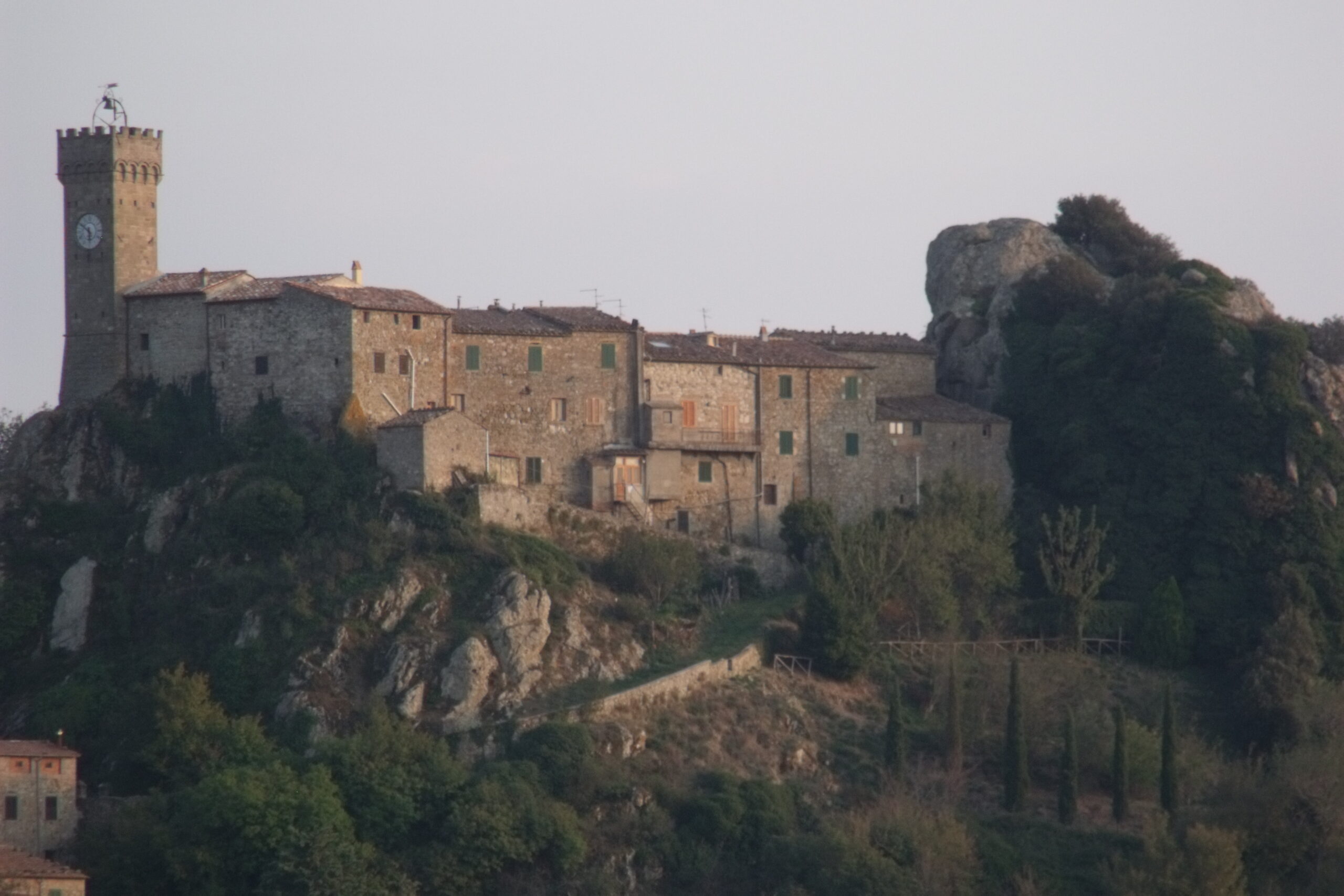
Roccastrada is not really a single town — it is a municipality of roughly 9,200 people scattered across a constellation of villages, each perched on its own geological drama. The main settlement sits on a plug of trachytic rock with sheer cliff faces and views of Monte Amiata, but the real reasons to come here are the frazioni below: a village where houses grow from enormous boulders, a ruined castle that may or may not appear in one of Italian art’s most famous paintings, and a former mining town that holds the memorial to Tuscany’s worst industrial disaster.
The Villages
Roccatederighi — architecture meets geology
Roccatederighi is one of the most visually striking villages in the Maremma — and one of the least visited. Houses and medieval towers grow directly from enormous rhyolite boulders, the stone walls of the buildings merging seamlessly with the natural rock in a fusion of architecture and geology that looks like it was designed by a very ambitious sculptor. The village is entered through a round-arched gate set between worked stone and raw boulder. Inside, the streets climb and twist around the rock formations, with sudden views opening between buildings where the boulders create natural terraces.
This is not a reconstructed heritage village. People live here. The integration of building and boulder developed organically over centuries — medieval builders used the rock formations as foundations, walls, and natural defense, and subsequent generations simply continued building on what was already half-formed by the earth. The effect is architectural-natural in a way that no planned construction could achieve.
Montemassi — the fresco debate
The ruined castle of Montemassi was besieged in 1328 by the Sienese army under the condottiere Guidoriccio da Fogliano. The siege was immortalized in a large fresco (968 × 340 cm) in Siena’s Palazzo Pubblico, traditionally attributed to Simone Martini (documented payment of 16 florins, 1330). The painting — a lone horseman in a diamond-patterned cloak riding before a fortified hilltop — is one of the most reproduced images in Italian medieval art.
The attribution has been fiercely debated since 1977, when American scholar Gordon Moran challenged it. A high-quality earlier fresco discovered beneath during 1980 restoration complicated matters further. No definitive resolution has been reached, and art historians continue to argue. What is not debated is that the castle at Montemassi is the castle in the painting — the ruins are still recognizable from the fresco’s topography. For visitors with an interest in art history, standing at Montemassi and comparing the ruins to the Siena fresco is one of those experiences that connects a painting to its physical reality in a way that no museum label can.
Ribolla — memorial to a disaster
Ribolla is a former lignite mining company town where, on May 4, 1954, a methane explosion at 260 meters’ depth killed 43 miners — the worst post-war mining disaster in Italy. The criminal trial, moved to Verona, ended in the acquittal of all Montecatini company directors, a verdict widely viewed as a grave injustice.
Writer Luciano Bianciardi documented the tragedy in I minatori della Maremma (1956, co-written with Carlo Cassola) and channeled the anger and disillusionment of the aftermath into his masterpiece La vita agra (1962) — a bitter, blackly comic novel that remains one of the most important works of twentieth-century Italian literature. The Monumento al Minatore by sculptor Vittorio Basaglia stands in Ribolla, and annual “La miniera a memoria” commemorations are held each May.
This is not a comfortable stop on a tourist itinerary. It is an important one. The mining towns of the Colline Metallifere carry their industrial history without sentimentality, and Ribolla’s memorial is part of the honest completeness that distinguishes this region from more curated Tuscan landscapes.
Getting There and Getting Around
Roccastrada municipality is roughly 30 minutes east of Massa Marittima and 40 minutes north of Grosseto. The individual villages are connected by winding provincial roads — a car is essential. The Riserva Naturale del Torrente Farma, in the municipality’s eastern reaches, offers wild swimming and hiking along a pristine Mediterranean stream.
Nearby
Massa Marittima (30 minutes west) — Cathedral, museums, Balestro.
Gavorrano (20 minutes south) — Mining park, Teatro delle Rocce, Pia de’ Tolomei.
Rocca Sillana (30 minutes northwest, technically in Pomarance) — A Renaissance fortress at 530 meters, enlarged circa 1473 under Giuliano da Sangallo, visitable by guided tour.
Information is provided in good faith and may change. Always confirm opening hours, prices, and event dates with the official source before you travel.