
Town · Colline Metallifere
Scarlino and the Singing Sands
Cala Violina, a Fortress, and Garibaldi’s Escape
Last updated:
- Region
- Colline Metallifere
- Province
- Province of Grosseto
- GPS
- 42.9058, 10.8311 (Scarlino village); 42.8681, 10.7781 (Cala Violina)
- Best season
- June and September (warm sea, manageable beach reservation); April–May for fortress and hiking without beach crowds
- Time needed
- Half day (Cala Violina with the walk = 3–4 hours); add 1–2 hours for the fortress
- Difficulty
- easy
- Known for
- Cala Violina singing-sand beach, Rocca Pisana fortress, Cala Martina (Garibaldi's escape), Bandite di Scarlino nature reserve, Scarlino Treasure
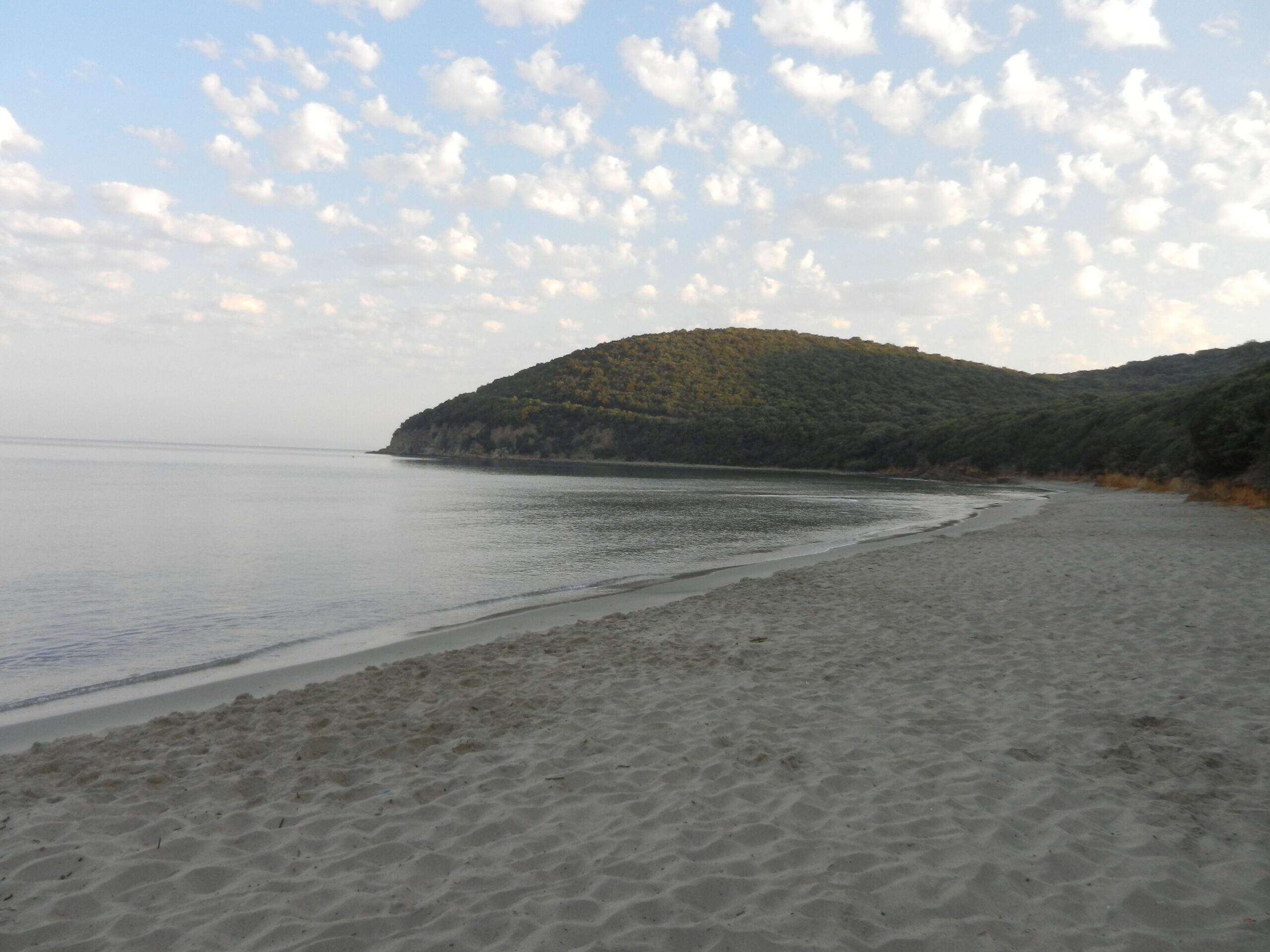
Two things bring people to Scarlino: a fortress and a beach. The Rocca Pisana sits on a hilltop above the village — an irregular pentagonal fortress with three differently shaped towers and views that reach to Elba and, on clear days, Corsica. Below and to the south, Cala Violina hides behind a wall of Mediterranean macchia — a crescent of white quartz sand between two rocky headlands, accessible only on foot, and famous for a rare phenomenon: the sand sings. Walk on it and the quartz grains produce a distinct, high-pitched resonance that sounds, with a little imagination, like a violin.
The combination of fortress and beach, hilltop medieval village and wild coastline, makes Scarlino one of the most satisfying half-day detours in the Colline Metallifere. But you need to plan — Cala Violina’s popularity has forced a reservation system that English-language guides have barely documented, and arriving unprepared means being turned away at the path entrance.
Cala Violina: What You Need to Know Before You Go
From June 1 through September 30, access to Cala Violina requires mandatory online reservation through www.calaviolinascarlino.it. The daily cap is 700 people. The cost is €1 per person aged 12 and over; children aged 1 to 12 go free but still need a reservation. Parking is at Val Martina (€10 per day for cars), and its roughly 200 spaces must also be reserved online. From the parking area, it is a 1.5 to 1.8-kilometer walk to the beach on an unpaved path through the macchia — roughly 20 to 25 minutes, flat to gently descending. No vehicles reach the beach. No dogs are permitted in summer.
The reservation system was introduced because Cala Violina was being loved to death — uncapped access was degrading the beach and the surrounding nature reserve. The 700-person limit has restored a sense of space that most Italian beaches lost decades ago. On a good day in June or September, there might be 300 people on a 400-meter crescent of sand. In August, the 700 slots fill fast — reservations open 72 hours ahead, so book as soon as your date becomes available.
The singing-sand phenomenon is real and consistent: the rounded quartz grains resonate when compressed by footsteps, producing a sound that has been described variously as a squeak, a crunch, and — by the optimistic — a musical note. The effect is strongest on dry sand; wet sand near the waterline does not sing. The beach faces southwest, the water is clear and shallow for wading, and the macchia-covered headlands on either side block wind and contain the space.
Outside the June–September window, no reservation is required and the beach is free. Winter visits offer solitude, dramatic weather, and the singing effect at its clearest.
Cala Martina: Where Garibaldi Disappeared
The neighboring Cala Martina — free, no reservation required even in summer — has a different kind of fame. On September 2, 1849, Giuseppe Garibaldi escaped by sea from this beach, fleeing after the fall of the Roman Republic. Aided by local patriots who hid him in the macchia, he boarded a fishing boat and sailed to safety. A bronze bust by Tolomeo Faccendi (1949) commemorates the event at the beach. The escape is one of the pivotal episodes of the Risorgimento, and the fact that it happened at a Tuscan cove rather than a Roman palace gives it a particular resonance.
Cala Martina is smaller and rockier than Cala Violina, less photographed, and rarely crowded. The 6-kilometer Sentiero delle Scogliere (cliff path) runs from Il Puntone to Cala Civette, passing both coves along the edge of the Bandite di Scarlino, a reserve of dense Mediterranean maquis climbing from the coast to Monte d’Alma.
The Rocca Pisana
The hilltop fortress above Scarlino village was originally Aldobrandeschi and was rebuilt by Pisa around the turn of the fourteenth century into an irregular pentagonal plan with three towers of different shapes — a defensive pragmatism that makes it architecturally unusual and visually memorable. The panoramic views from the fortress — the Gulf of Follonica, the island of Elba, and on the clearest days the mountains of Corsica — are among the best on this stretch of coast; check locally for current access to the interior.
Don’t miss the Scarlino Treasure: 100 gold coins minted between 1387 and 1457, found in 1982 in a jug hidden in a niche in the wall of the fortress’s old church. The coins are now on display at the Centro di Documentazione Riccardo Francovich in Scarlino.
Getting There and Getting Around
By car, Scarlino village is about 10 minutes south of Follonica. The Cala Violina parking area at Val Martina is signposted from the SS322. Scarlino Scalo has a station on the Tirrenica coastal line, useful for reaching the area by train, though the beach requires a car or bicycle from the station.
Nearby
Follonica (10 minutes north) — Cast-iron church, MAGMA museum, family beaches.
Gavorrano (15 minutes east) — Mining park, quarry theater, Pia de’ Tolomei.
Punta Ala (15 minutes south) — An upmarket resort town with a marina, polo club, and some of the Maremma coast’s most exclusive beach clubs.
Information is provided in good faith and may change. Always confirm opening hours, prices, and event dates with the official source before you travel.