
Town · Valdichiana
Montepulciano
First DOCG, First Pievi, and One Very Steep Barrel Race
Last updated:
- Region
- Valdichiana
- Province
- Province of Siena
- GPS
- 43.1003, 11.7828
- Best season
- Late August (Bravio delle Botti), February (Anteprima del Vino Nobile), September–October (vendemmia, warm light, fewer crowds)
- Time needed
- Full day (Piazza Grande + underground cellars + San Biagio + wine tasting = minimum 5–6 hours)
- Difficulty
- moderate
- Known for
- Vino Nobile di Montepulciano DOCG (Italy's first), Pievi subzone, Bravio delle Botti barrel race, Piazza Grande, Tempio di San Biagio, underground cellars, Angelo Poliziano
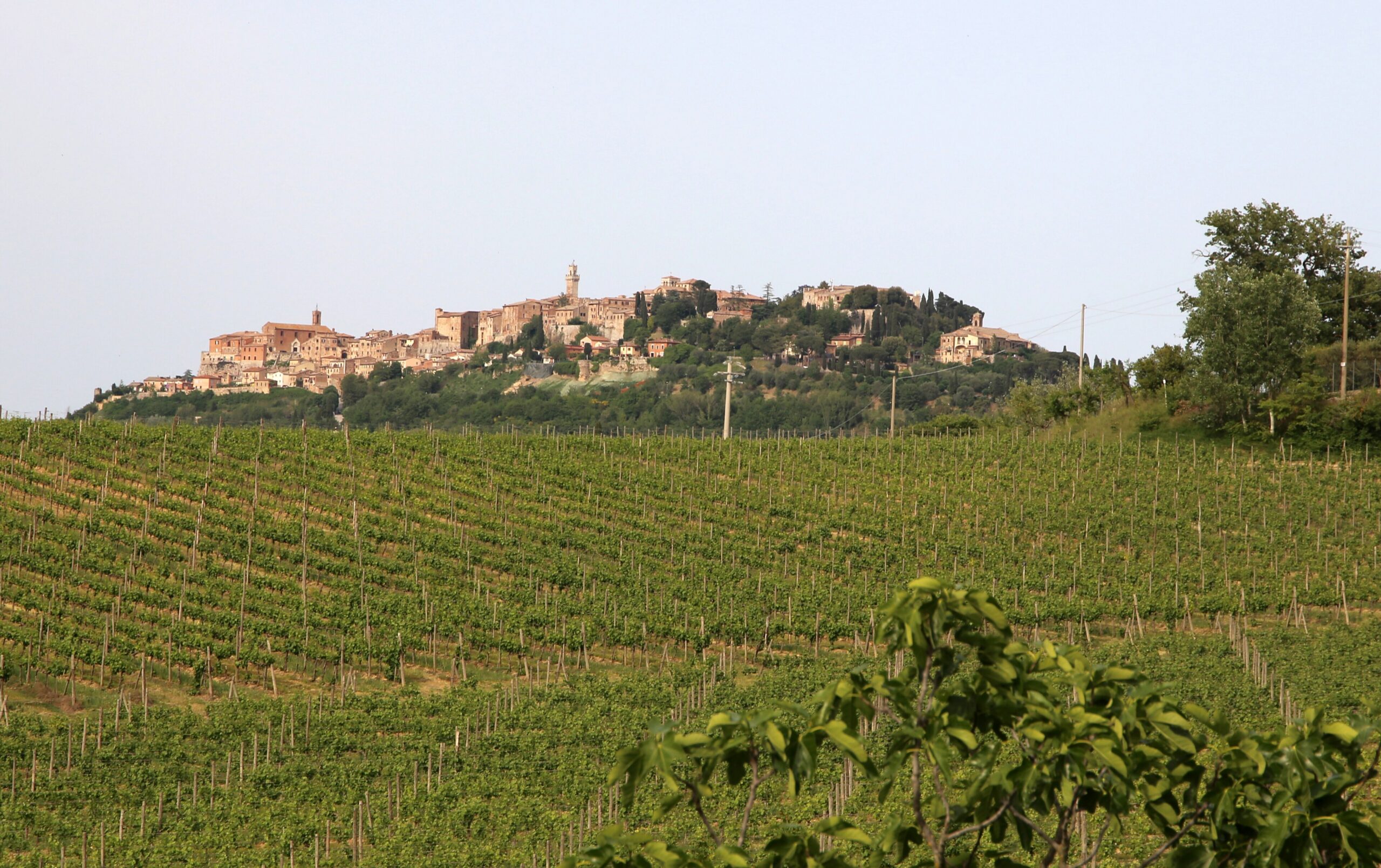
The main street of Montepulciano climbs 1.5 kilometers from Porta al Prato at the base to Piazza Grande at the summit — a continuous, unrelenting ascent past Renaissance palazzi, underground wine cellars, and the accumulated evidence of a town that has been punching above its weight since the fifteenth century. By the time you reach the top, you are breathing hard, your calves are burning, and you are standing in what is frequently called the most perfect Renaissance square in Tuscany. This is Montepulciano’s fundamental proposition: everything here is earned, nothing is easy, and the rewards are proportional to the effort.
The wine came first — or rather, the wine’s reputation came first. In 1685, the poet Francesco Redi wrote in Bacco in Toscana: “Montepulciano d’ogni vino è Re” — Montepulciano is the king of all wines. In 1980, Vino Nobile di Montepulciano became the first Italian wine to receive DOCG status, the highest quality classification. And in 2025, the Consorzio debuted the Pievi subzone — twelve named micro-zones with stricter requirements for Sangiovese percentage, vine age, and aging time — that make up one of the most ambitious terroir-precision projects in Tuscan winemaking.
But Montepulciano is not only about wine, and treating it as a tasting-room stop misses the architecture, the underground city, the barrel race, and the deep Renaissance history that make it one of Tuscany’s most complete small towns.
A Place Shaped by Time
Montepulciano sits on a limestone ridge at 605 meters between the Valdichiana to the east and the Val d’Orcia to the west — a position that gave it strategic importance and, eventually, spectacular views in both directions. The town’s residents are called Poliziani, after the humanist scholar Angelo Poliziano (1454–1494), born here and later secretary to Lorenzo il Magnifico. Poliziano was one of the most brilliant minds of the Florentine Renaissance — his philological work influenced a generation, and his poetry remains read — and Montepulciano has claimed his name for its citizens ever since.
The town was permanently Florentine from 1559, after centuries of oscillating between Florence, Siena, and its own attempts at independence. The Renaissance remade the main street during the fifteenth and sixteenth centuries: Michelozzo redesigned the Palazzo Comunale in Gothic style, giving it a tower that deliberately echoes Florence’s Palazzo Vecchio. The Palazzo Contucci and Palazzo Tarugi flank Piazza Grande. The Duomo of Santa Maria Assunta — whose façade was never finished, leaving a blank wall that somehow adds to the square’s drama — holds Taddeo di Bartolo’s monumental Assumption triptych (1401) on the high altar.
What to See and Do
Piazza Grande
The square at the summit is the payoff for the climb. Piazza Grande is not the largest piazza in Tuscany, nor the most symmetrically designed, but it achieves a balance of scale, architecture, and atmosphere that few Italian squares can match. Michelozzo’s Palazzo Comunale — climbable tower, Palazzo Vecchio echo — anchors one side. The unfinished Duomo face, the Palazzo Contucci (home to one of the oldest wine cellars in town), and the Palazzo Tarugi complete the enclosure. The square feels both intimate and monumental, which is the particular genius of Renaissance civic design.
The Tempio di San Biagio
Below the walls to the southwest, Antonio da Sangallo the Elder’s masterpiece sits among fields and olive groves. First stone laid September 15, 1518, consecrated 1537, the church is a High Renaissance Greek-cross plan in golden travertine from nearby Sant’Albino, with a single completed bell tower of an intended pair. Its genesis traces to an alleged Marian miracle of April 23, 1518 — the Virgin’s eyes reportedly moved in a fourteenth-century Sienese fresco — and Pope Leo X, who had been tutored by Montepulciano’s own Poliziano, patronized the project.
San Biagio is one of those buildings that makes architectural history tangible. The proportions are mathematically derived, the travertine glows warm in the afternoon light, and the setting — alone in open landscape below the town — gives it the quality of a freestanding sculpture. It draws directly from Giuliano da Sangallo’s Santa Maria delle Carceri in Prato but exceeds it in scale and setting.
The underground cellars
Montepulciano’s hill is honeycombed with cellars — Etruscan-era tuff excavations expanded over centuries into a subterranean city of wine aging. The most dramatic are Cantina de’ Ricci (the deepest and most atmospheric, descending through Etruscan-worked rock), Contucci (in the Palazzo Contucci directly on Piazza Grande — you can taste in a medieval cellar 50 meters from the main square), Gattavecchi (whose cellars extend beneath the former church of San Francesco), and Crociani. The Vecchia Cantina co-op is the most accessible for casual visitors.
The underground visits are not simply wine tastings in fancy rooms. They are passages through geological and architectural time — Etruscan excavation methods visible in the oldest sections, medieval vaulting in the middle layers, and modern stainless steel at the working end. The temperature underground holds steady year-round, which is why wine has been stored here for millennia.
Vino Nobile: the first DOCG and the new Pievi
Vino Nobile di Montepulciano DOCG was granted DOC status in 1966 and elevated to DOCG by presidential decree on July 1, 1980 — the first Italian wine to receive the highest classification. Made from a minimum 70% Sangiovese (locally called Prugnolo Gentile) plus complementary native varieties, it ages a minimum of 24 months (annata) or 36 months (Riserva).
One of the most exciting chapters is the Pievi subzone, approved by the national wine committee in October 2024, published in the Gazzetta Ufficiale in February 2025, and debuting with vintage 2021 presented publicly on February 15, 2025, at San Biagio. The requirements are significantly stricter: minimum 85% Sangiovese, only native complementary varieties, estate-grown grapes, vineyards at least 15 years old at elevations between 250 and 600 meters, and aging of 36 months including 12 in wood and 12 in bottle. Twelve named Pievi — Ascianello, Badia, Caggiole, Cerliana, Cervognano, Gracciano, Le Grazie, San Biagio, Sant’Albino, Valardegna, Valiano, and Argiano — map the terroir diversity of the commune with a precision that no other Tuscan appellation has yet attempted.
Expected production is roughly 600,000 bottles per year — about 10% of total Vino Nobile output — at retail prices of €40–100+. Montepulciano also became Italy’s first Equalitas-certified appellation in May 2022.
Top producers to seek out: Avignonesi, Poliziano, Boscarelli, Salcheto (organic/biodynamic pioneer), Dei, Contucci, Carpineto, Tenuta Valdipiatta, Icario, Bindella, Fattoria della Talosa, Canneto, La Braccesca (Antinori).
The Bravio delle Botti
The modern Bravio — established in 1974 by Don Marcello del Balio, drawing on a fourteenth-century tradition documented in a 1373 municipal statute — is Montepulciano’s signature event. Eight contrade — Cagnano, Collazzi, Le Coste, Gracciano, Poggiolo, San Donato, Talosa, Voltaia — push 80-kilogram oak barrels approximately 1,800 meters uphill from the Colonna del Marzocco at the base to Piazza Grande at the summit. It is traditionally held on the last Sunday of August; check the official Bravio website for the exact date.
Entry ticket (gabella) is approximately €3.50. The race itself takes minutes; the atmosphere — flags, drums, the roar when the barrels crest the final slope into the piazza — is unforgettable.
Eating Like a Local
Montepulciano’s dining scene is the most developed in the Valdichiana. Pici here are sometimes called pinci — the local variant name. Classic sauces include all’aglione, cacio e pepe (milder than Rome’s, with Tuscan pecorino), ragù di nana (duck), and alle briciole (toasted breadcrumbs — a Montepulciano specialty). Chianina beef is everywhere. The Anteprima del Vino Nobile in February (held at the Fortezza Medicea) offers the first public tasting of the new vintage.
Notable restaurants include Osteria dell’Acquacheta (famous for bistecca, small, reservations essential), Le Logge del Vignola, and Osteria del Conte. The Thursday market in Piazza P. Nenni is the weekly shopping day.
Getting There and Getting Around
By car, Montepulciano is about 45 minutes from Siena via the Raccordo, 15 minutes from Chiusi, and 40 minutes from Cortona. From the A1, take the Valdichiana/Bettolle exit and follow signs south. From Rome, about 2 hours via the A1.
By train, Montepulciano Stazione is on the regional Empoli–Siena–Chiusi line, but the station sits a full 5 kilometers below the town — not walkable unless you enjoy a very steep climb. Occasional buses connect station to center. Chiusi-Chianciano Terme (15 minutes by car) on the main Florence–Rome line is the practical rail option.
ZTL and parking: Montepulciano enforces a strict ZTL. The practical parking strategy: P1 at Porta al Prato is the largest lot with the most manageable uphill walk. P5 at Piazza P. Nenni (€10/24h, 35 spaces, camper services) is convenient but small. San Donato is closest to Piazza Grande but tricky — overshoot the turn and you enter the ZTL. A shuttle bus climbs from lower lots. Best navigation strategy: set your GPS to “Fortezza” and enter via the San Donato gate for upper parking.
Nearby
Chiusi (15 minutes south) — Etruscan museum, labyrinth, catacombs, lake fish.
Torrita di Siena (15 minutes north) — Donkey palio and the Montefollonico Vin Santo village.
Pienza (20 minutes west) — Pius II’s ideal Renaissance city and pecorino capital.
Bagno Vignoni (30 minutes west) — The thermal village whose entire piazza is a hot-spring basin.
Cortona (40 minutes north) — MAEC Etruscan museum, Severini Via Crucis, and the Sagra della Bistecca.
Information is provided in good faith and may change. Always confirm opening hours, prices, and event dates with the official source before you travel.