
Town · Maremma
Grosseto
A Medici Hexagon on a Reclaimed Plain
Last updated:
- Region
- Maremma
- Province
- Province of Grosseto
- GPS
- 42.7719, 11.1089
- Best season
- year-round
- Time needed
- full day (with Roselle)
- Difficulty
- easy (flat walled center)
- Known for
- Medici walls, MAAM museum, Roselle Etruscan city, Easter Monday 1943 memorial, Thursday market
Most people see Grosseto as a sign on the Aurelia and keep going toward the beaches. That is a mistake, though an understandable one. The modern city sprawls across a flat plain, and nothing about its outskirts suggests there is anything worth stopping for.
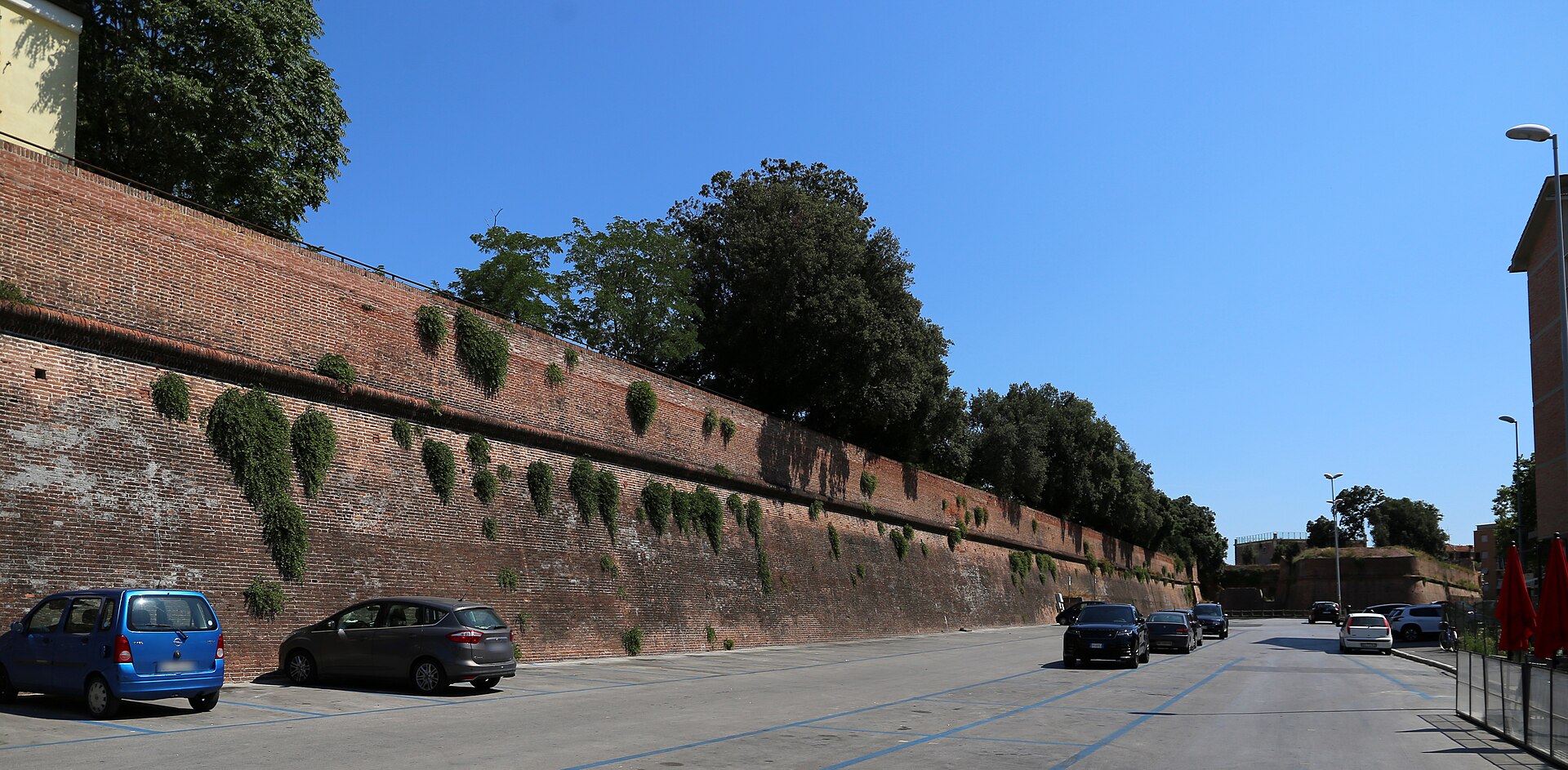
Inside, though, a complete hexagon of Medici walls still wraps the old center, and you can walk the whole circuit on top of them under the trees. A few streets away, a museum explains the Etruscan city on the hill behind you. You can walk around that city’s walls the same afternoon.
Grosseto is also a city with a hard 20th-century story. It keeps that story in public view, in a church crypt and a square outside its southern gate. Come for the walls and Roselle, and give that memory an hour too.
A Place Shaped by Time
A town built on a malarial plain
For centuries the plain around Grosseto was marsh, and the marsh meant malaria. Grand Duke Ferdinando I set up the Ufficio dei Fossi di Grosseto (the Grosseto ditches office) in 1592 to manage the water. It took more than two centuries of drainage schemes before the land became reliably habitable.
The disease shaped how the city was governed. Under a system called the estatatura, formalized in 1780, Grosseto’s public offices and staff moved each summer to healthier hill towns, above all Scansano. The law that abolished it came only in 1897, and seasonal flight from malaria went on informally after that. Every summer, from late June into October, the provincial capital lost its officials. Our Scansano profile tells that side of the story.
The Medici hexagon
Once Grosseto had passed with the rest of the Sienese state to the Medici, Cosimo I de’ Medici ordered new walls for Grosseto. The architect was Baldassarre Lanci. The work took more than 19 years and finished in spring 1593, a date marked by a Medici coat of arms on the Bastione Fortezza.
The result is a hexagon about 3 km around, with six bastions and two gates: Porta Vecchia to the south and Porta Nuova to the north. The builders folded the medieval Cassero Senese, the Sienese keep, into the new defenses. Italian Wikipedia calls it one of the rare city walls in Italy to survive almost intact.
In 1855 Grand Duke Leopoldo II decommissioned them and turned the top into a tree-lined public promenade. Two sentry boxes (garitte) survive from the military years. That 1855 decision gave Grosseto a green, walkable ring around its old center.
Easter Monday, 1943
On Easter Monday, 26 April 1943, at about two in the afternoon, American B-17 bombers approached Grosseto from the sea. Their target was the airfield. No sirens sounded. The bombs fell on the center and on the area just outside Porta Vecchia, where a funfair with carousels had been set up for the holiday.
According to Italian Wikipedia’s account of the raid, 134 civilians were killed, many of them children between five and 13, and more than 200 were wounded. A home for mothers and children and a Red Cross hospital were also hit.
For decades, survivors remembered the planes coming back to machine-gun the children in the square. The historian Giacomo Pacini examined the hospital records and found only fragmentation wounds, with no bullet wounds. He suggests that German aircraft, unable to land, flew low over the city after the raid and fused with the memory of the bombing. The finding takes nothing away from the grief. It is simply what the records show, and his research is published by Grosseto Contemporanea.
The city marks the day every Easter Monday with a civic commemoration.
What to See and Do
Walk the walls
Start here. The promenade on top of the walls is the best way to understand the city, and it costs nothing but time. Look for the Medici arms on the Bastione Fortezza and for the two surviving sentry boxes. Walking the whole hexagon shows you how compact the old center really is.
MAAM, the Maremma’s museum
The Museo Archeologico e d’Arte della Maremma (MAAM) sits on Piazza Baccarini in a former courthouse. It began with the collection of Canon Giovanni Chelli, founded on 1 March 1860. It became municipal property in 1865 and moved to this building in 1974, opening the following year.
The displays run from prehistory to the Middle Ages, with a full section on Roselle and material from across the Maremma. The same building holds the diocese’s museum of sacred art. Visit MAAM before Roselle if you can. The site makes far more sense once you have seen what came out of it. For current hours and tickets, check the official MAAM site.
The memorials of 1943
The Basilica del Sacro Cuore, built in 1954–58, has a crypt that lists the names of the victims of the Easter Monday raid. In Piazza del Sale, a monument by Antonio Lazari has marked the tragedy since 2003. If you walk out through Porta Vecchia, you are standing close to where the funfair was.
Roselle, the Etruscan city on the hill
Roselle (Etruscan and Roman Rusellae) sits on a hill above the plain, within the comune of Grosseto. According to the official park site, it was settled as an organized town from the first half of the 7th century BC. Like Vetulonia across the plain, it looked over Lago Prile, the lagoon that once filled much of this lowland.
Rome conquered the city in 294 BC, and it reached its peak in the imperial age. By the 5th century AD it was a bishopric. In 1138, the park says, papal authority moved the diocese to Grosseto, and Roselle’s life as a city effectively ended. In a sense, the town on the plain inherited the town on the hill.
What survives is substantial. The Etruscan walls run for more than 3 km. Inside are a Roman amphitheater, the forum, a basilica, and baths. There are also houses, including the “casa dell’impluvium” and the Domus of the Augustales, plus kilns and workshops. A church was later built over the imperial baths.
Roselle is run by Parchi Archeologici della Maremma, a Ministry of Culture institute that also manages Vetulonia and Cosa. Older museum web pages for the site are out of date. Check hours, tickets, and weather-alert closures on the official Roselle page before you go.
Istia d’Ombrone, the bishops’ ford
About 6 km east of the city, the village of Istia d’Ombrone grew up where a ford crossed the Ombrone river. From 862 the bishops of Roselle held it, and after the diocese moved to Grosseto the bishops kept a residence here. The 13th-century Porta Grossetana is still the way in.
Inside, the brick church of San Salvatore carries the Piccolomini arms. It holds a wooden Madonna attributed to Domenico di Niccolò dei Cori and a Madonna and Child by Giovanni di Paolo. It is a short, quiet detour, best in the late afternoon.
San Lorenzo in August
Grosseto’s patron saint is San Lorenzo, celebrated on 9–10 August. The procession on the 9th includes butteri, the Maremma’s mounted cattlemen, riding through the center. It is a rare chance to see them in the city.
Eating Like a Local
Grosseto eats like the Maremma around it, which means herders’ food more than city food. Acquacotta (“cooked water”) was the butteri’s field lunch: onion, tomato, celery, and wild greens poured over stale bread, with an egg or ricotta when there was one. Tortelli maremmani are big pasta squares filled with ricotta and chard, served with meat sauce or butter and sage.
Wild boar appears as cinghiale alla cacciatora, braised in red wine with tomato and black olives. Buglione, dialect for “mixture,” is lamb stewed with tomato, herbs, and plenty of garlic. Order any of these and you are eating the plain’s history.
For wine, Grosseto is home to the Consorzio Tutela Vini della Maremma Toscana. Under the Maremma Toscana DOC, Vermentino is the biggest single category. Look out for Ciliegiolo, too: more than half of Tuscany’s Ciliegiolo vineyards are in this province. Within the comune, Fattoria Le Pupille, run by Elisabetta Geppetti, known locally as the “Signora del Morellino,” offers tastings. Book through the estate.
The weekly market is on Thursday. It is the easiest way to see the city at its busiest and most local.
Getting There and Getting Around
By train. Grosseto station is on the Tirrenica line between Pisa and Rome, and it is the terminus of the single-track line from Siena. The Siena line has had repeated closures for works, so check Trenitalia before relying on it.
By car. The SS1 Aurelia runs past the city, and the Siena–Grosseto road (E78) links it to the interior. As of April 2026, a stretch of the Aurelia south of Grosseto, around Capalbio, was still a two-lane road with a poor accident record (Il Giunco), so drive it with care.
ZTL. The walled center is a limited traffic zone (zona a traffico limitato, ZTL). Camera gates record every car that enters, and fines are issued automatically. Do not follow your navigation app through a gate. Park outside the walls and walk in. If your hotel is inside, ask it to register your plate, and see the comune’s ZTL permit page.
Roselle and Istia. You will want a car or taxi for both. Neither has a sourced public transport link we can recommend.
By air. Grosseto’s airport is mainly a military base with no regular scheduled airline network. Most visitors fly into larger airports elsewhere and arrive by train or car.
Nearby
- Castiglione della Pescaia is the nearest seaside town, with a hilltop borgo and the last remnant of the old lagoon at Diaccia Botrona.
- Scansano is the hill town that served as Grosseto’s summer capital during the malaria centuries.
- Magliano in Toscana has medieval walls and a famous olive tree with a witch’s legend.
- Alberese and the Parco della Maremma are Grosseto’s back garden, with the working butteri of the Tenuta di Alberese and trails through the Uccellina hills.
- Massa Marittima is the mining-country cathedral town to the north, the gateway to the Colline Metallifere.
Information is provided in good faith and may change. Always confirm opening hours, prices, and event dates with the official source before you travel.