
Town · Maremma
Magliano in Toscana
Walls, a Witch’s Olive, and an Etruscan Riddle
Last updated:
- Region
- Maremma
- Province
- Province of Grosseto
- GPS
- 42.5989, 11.2931
- Best season
- spring and autumn
- Time needed
- half day (full day with Pereta)
- Difficulty
- easy (a low hill town; San Bruzio and the olive are short trips outside the walls)
- Known for
- town walls, San Bruzio ruins, Olivo della Strega, Piombo di Magliano, Pereta
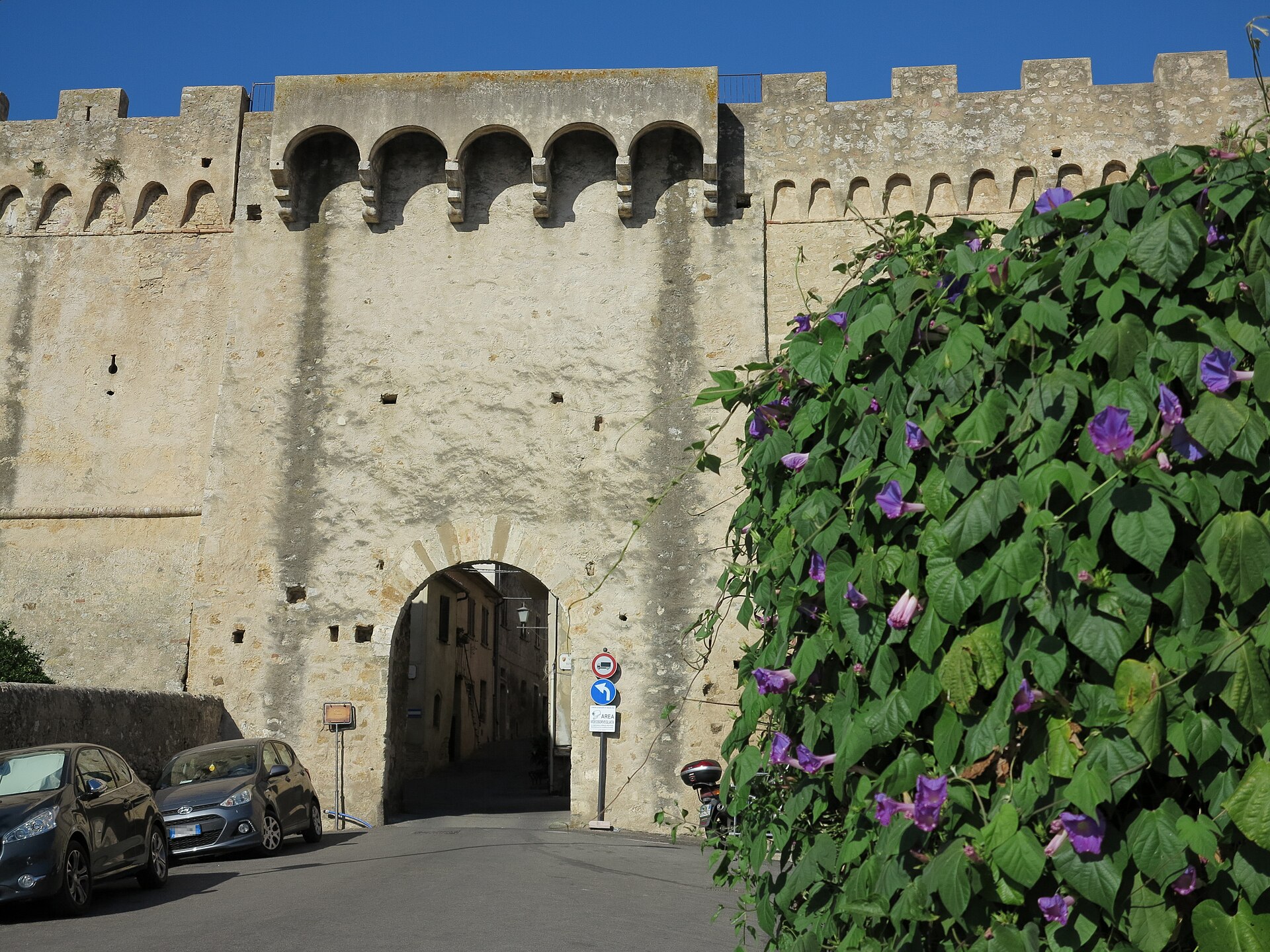
Plenty of Tuscan towns have lost stretches of their walls to roads and modern growth. Magliano in Toscana kept its circuit. The walls still wrap right around the old town, and when you approach from the plain, the whole place looks like the drawing of a fortified town in a history book.
That is the first reason to come. The second is what lies just outside the walls: a roofless monastery church standing alone among olive trees, and an ancient olive tree with a witch in its story. The third is a small lead disc covered in Etruscan writing, one of the most important texts in a language we still only partly understand.
Magliano sits low, at 128 m, and the old town is compact. You can walk its walls and churches in a morning, then spend the afternoon in the countryside around it.
A Place Shaped by Time
Etruscans, lords, and Siena
People lived here long before the walls. The territory is full of Etruscan and Roman sites, including the necropoleis of Heba. In the Middle Ages the Aldobrandeschi counts fortified the settlement. After the family divided its lands in 1274, Magliano became part of the County of Santa Fiora.
By the 14th century Siena was in control, and the Sienese are responsible for much of what you see today. They restored and enlarged the walls during the Renaissance, completing a circuit that had begun in the Middle Ages. From the mid-16th century Magliano followed the rest of the region into the Medici Grand Duchy of Tuscany.
A spiral of Etruscan words
In 1882 a small lead disc turned up in Magliano’s territory. It is about 8 cm across, and both sides carry an Etruscan inscription that spirals inward, about 70 words in all. It dates to the 5th or 4th century BC. Scholars read it as a set of rules for sacrifices to underworld deities, among them Tin, Maris, and Calu.
That makes the Piombo di Magliano (the Magliano lead) one of the key documents of the Etruscan language. It is the fifth-longest Etruscan inscription known. The disc normally lives in the Museo Archeologico Nazionale di Firenze (National Archaeological Museum of Florence), so plan a Florence visit if you want to see the original.
Eleven young men at Maiano Lavacchio
Magliano’s territory also holds one of the Maremma‘s hardest wartime memories. On 22 March 1944, Fascist forces shot eleven young men at Maiano Lavacchio, a rural locality in the comune. Most were around 20 years old. They were renitenti alla leva, draft resisters who had refused to serve the Italian Social Republic and had gone into hiding.
They were captured at Monte Bottigli and taken to the local schoolhouse for a summary trial. Two of them, the brothers Corrado and Emanuele Matteini, wrote on the classroom blackboard: “Mamma, Lele e Corrado un bacio” (“Mom, a kiss from Lele and Corrado”). The victims are remembered as the Martiri d’Istia (the Martyrs of Istia), and a memorial is held every year on 22 March. A Casa della Memoria (House of Memory) now stands at Maiano Lavacchio.
What to See and Do
The walls
Start with the walls, because they are the town. Built in the Middle Ages and completed in the Renaissance, they enclose the whole historic center. Walk the outside first to take in the scale, then enter and follow the main street through the old town. The late-afternoon light on the stone is the best time for photographs.
Churches and palazzi inside the walls
Within the walls you will find three churches: San Giovanni Battista, the Pieve di San Martino, and the Santissima Annunziata. Each adds a layer to the town’s long history.
Look out for two civic buildings. The Palazzo del Podestà dates from the 15th century and was the seat of local government. The Palazzo di Checco il Bello (“handsome Checco’s palace”) is a late-Gothic townhouse with one of the best names in the Maremma.
San Bruzio: a church without a roof
Outside the walls, the ruins of San Bruzio stand on their own among the olives. This was the church of a monastery, built in the 11th and 12th centuries on a Latin-cross plan in stone and travertine. The roof is long gone, and the walls frame the sky.
Sources disagree about the religious order that used it. Some websites call it Camaldolese, but the official heritage record does not confirm that, so treat the claim with caution. Go for the atmosphere, ideally near sunset, when the light comes through the empty arches.
The Olivo della Strega: in the right place
The Olivo della Strega (the Witch’s Olive) is Magliano’s most famous tree, and many English-language sources put it in the wrong spot. It does not stand at San Bruzio. It grows in an olive grove next to the Romanesque church of the Santissima Annunziata.
The trunk measures 8.50 m around at ground level, and the tree is twisted into a shape that explains the legend. Local lore says a witch danced around it every Friday during her sabbaths, and her dancing wrung the trunk into a spiral. The tree has been a protected regional monumental tree since 2007 and is fenced. You will see very large age figures for it online. None of them is backed by a published scientific dating, so enjoy the tree without trusting the number.
The archaeological museum
Magliano’s archaeological museum displays finds from Etruscan and Roman sites in the territory. It also holds a full-scale reproduction of the Tomba delle Chimere, a local tomb that is not open to the public. The original lead disc lives in Florence’s Museo Archeologico Nazionale; it came home only for a temporary exhibition in 2026 (Maremma News). That exhibition left a permanent section on the Etruscan language and writing, with 3D prints and video. Check opening times with the comune before you go.
Pereta: the tower village
Pereta is a frazione (outlying village) of Magliano, not of Scansano as some sources say. It sits north of Magliano on the road toward Scansano, and it deserves at least an hour. The village has a double ring of medieval walls, entered from the lower side through the crenellated Porta di Ponente (West Gate).
Above everything rises the Torre dell’Orologio, a square clock tower of brown sandstone built in the 15th century and 29 m tall. Local legend ties it to Margherita Aldobrandeschi and Nello Pannocchieschi, or to the imprisonment of Pia de’ Tolomei, whom Dante meets in Purgatorio. Treat these as stories, not history. Pereta also has the church of San Giovanni Battista, medieval with a Baroque interior, and the rural 15th-century Pieve di Santa Maria Assunta.
Mineral collectors know Pereta for another reason. The old cinnabar and antimony mines nearby produced very rare minerals, including one named after the village: peretaite.
Eating Like a Local
Wine and olive oil
Magliano sits in some of the Maremma’s most interesting wine country. The Maremma wine consortium names Magliano among the main areas for Ciliegiolo, a red grape documented in Tuscany since 1590. More than half of Tuscany’s Ciliegiolo vineyards are in the Province of Grosseto. If you want to taste something you rarely find elsewhere, ask for a Ciliegiolo.
Part of the comune also falls within the small Capalbio DOC, which includes a Vin Santo. Local wine lists will also carry Maremma Toscana DOC wines, where Vermentino is the largest category and an easy white for warm afternoons.
Olive oil matters here as much as wine. Olive groves surround the town. In autumn, during the olive harvest, ask locally which mills sell new oil.
What to order
The dishes are the same herders’ food you find across the Maremma hills. Look for acquacotta, the butteri’s field lunch of onion, tomato, celery, and wild herbs over stale bread. Tortelli maremmani come stuffed with ricotta and chard, and buglione is a lamb stew with tomato, herbs, and plenty of garlic.
We have not yet vetted restaurants in Magliano, so we are not naming any. Ask your host, and follow the locals.
Getting There and Getting Around
By car
A car is the practical way to visit. Magliano has no railway station of its own. The Tirrenica railway runs along the coast, but check onward bus connections before relying on the train. Pereta lies north of Magliano on the road toward Scansano, in the area crossed by the SP160 “Amiatina”, which runs from the Albinia plain toward Monte Amiata.
We could not confirm ZTL (limited traffic zone) or parking rules for Magliano’s old town. Park outside the walls and walk in. The town is compact, and the walls are best seen on foot anyway.
By bus
Autolinee Toscane runs the province’s bus services. Check the Grosseto lines and timetables before you plan a car-free visit.
When to come
Spring and autumn are best. Summer heat on the plain is intense, and a late-afternoon walk is the only comfortable option in July and August. From October, driven wild-boar hunts take place on set days, so wear bright clothing and stay on marked paths if you walk out to San Bruzio or into the countryside.
Nearby
- Scansano was the summer capital of the Maremma, where Grosseto’s government moved every year to escape malaria, and it is the home of Morellino di Scansano.
- Marsiliana d’Albegna, a frazione of Manciano, is where Prince Tommaso Corsini’s excavations found an ivory writing tablet of about 700–650 BC carrying a 26-letter Etruscan alphabet, now in Florence.
- Grosseto is the provincial capital, with its Medici walls and museums.
- Orbetello was the capital of the Spanish enclave on the Tuscan coast and sits on a lagoon famous for its fishing traditions.
- The Tenuta di Alberese, whose butteri still work Maremmana cattle, lies inside the Parco della Maremma, and the old Alberese station stands on the border between Magliano and Grosseto.
Information is provided in good faith and may change. Always confirm opening hours, prices, and event dates with the official source before you travel.