
Town · Maremma
Scansano
The Hill Town Where Maremma Spent Its Summers
Last updated:
- Region
- Maremma
- Province
- Province of Grosseto
- GPS
- 42.6894, 11.3344
- Best season
- spring and autumn
- Time needed
- half day (full day with Montorgiali and a winery)
- Difficulty
- moderate (a hilltop town with sloping streets)
- Known for
- estatatura (summer capital), Morellino di Scansano, Museo della Vite e del Vino, Teatro Castagnoli, Montorgiali
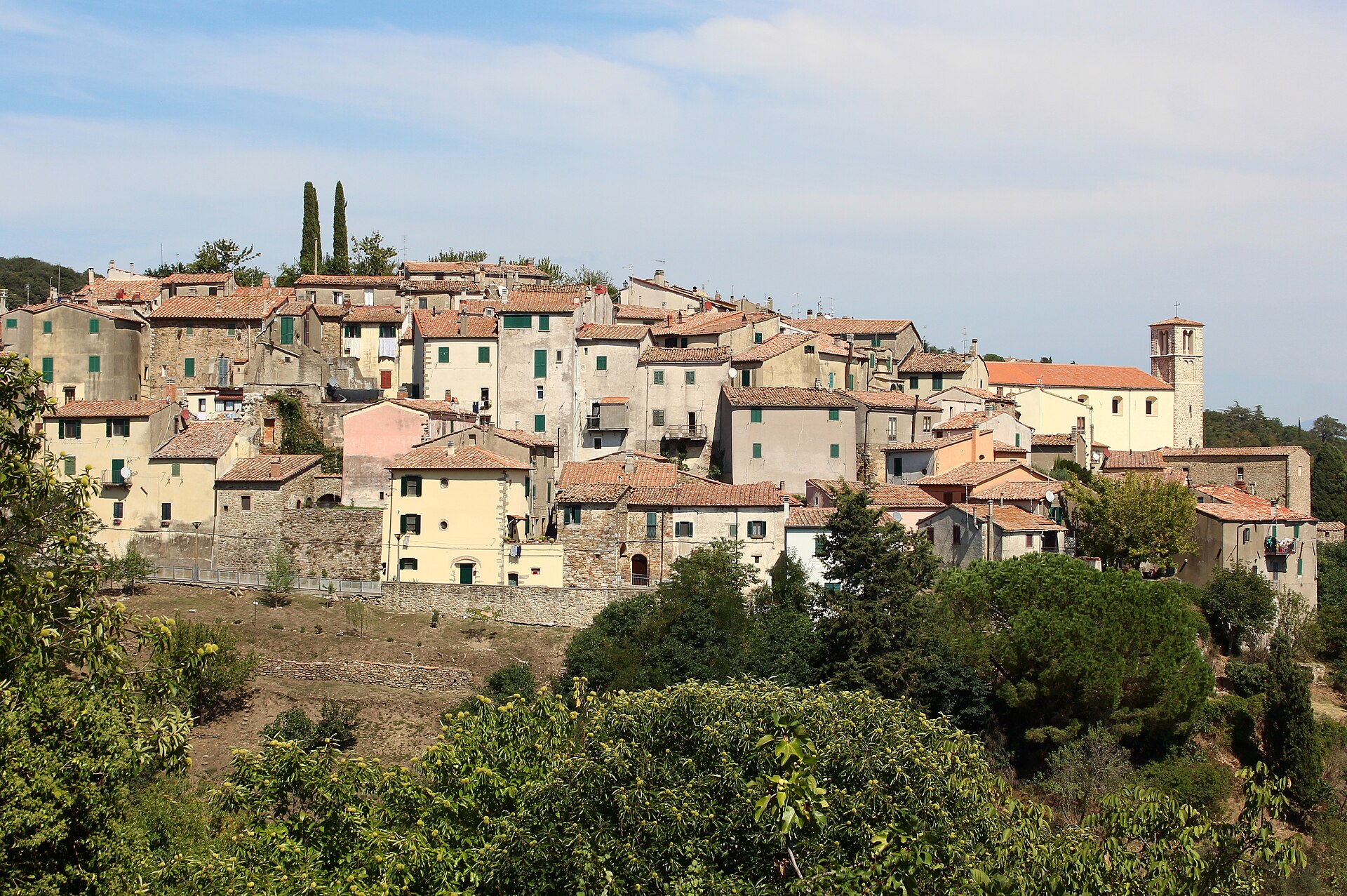
Walk into Scansano and something doesn’t add up. This is a hill town of a few thousand people, yet it has a 19th-century theater, a string of solid palazzi, and the air of a place that once expected important visitors. It did. For most of the 19th century, Scansano was where the Province of Grosseto was governed every summer.
The reason was malaria. Down on the plain, Grosseto emptied out in the hot months, and the state went with it. Judges, clerks, bankers, soldiers, and prisoners moved uphill to Scansano, at 512 m, and stayed until autumn. The Italians called this seasonal migration the estatatura (from estate, summer), and it rarely appears in English-language guides.
Today Scansano is better known for a wine: Morellino di Scansano, the Maremma‘s flagship red. Come for the glass, by all means. But look up at the buildings while you drink it, because they explain why this town looks the way it does.
A Place Shaped by Time
Castles, counts, and a slow handover
Scansano’s territory appears in records in 918, and the castle itself by 1274. In the 14th century the Aldobrandeschi counts and the Sienese Tolomei family fought over it. In 1418 it passed to the Sforza through the marriage of Bosio Sforza and Cecilia Aldobrandeschi, and after 1615 the Medici took over. The walls were begun by the Aldobrandeschi and reinforced later; look for the round tower on the east side and the Porta Grossetana, the gate on the west side.
The estatatura: a government that moved uphill
The summer flight from the plain was old, but in 1780 it got rules. A “Regolamento per l’Estatatura”, dated 15 April 1780, organized the move of Grosseto’s public offices and their staff to healthier hill towns. At first they were spread out among several places. Then a French imperial decree of 1810, from the Napoleonic period, made Scansano the main summer seat and moved the circuit court and the prisons there.
The routine ran from late June through October. The Prefect still had to be reachable in Grosseto two days a week. By the late 19th century, Scansano’s summer population included the Prefettura, the court, the public health commission, the civil engineers, the post office, a branch of the Banca d’Italia, the provincial treasury, the mortgage registry, and a military garrison. Imagine a hill village suddenly hosting a courtroom, a bank vault, and a barracks every July.
Not everyone liked it. Bettino Ricasoli, one of the founding politicians of united Italy, tried to abolish the estatatura in 1860 and failed. A committee for its abolition formed in 1896, and a law finally ended it in 1897. A plaque at the Palazzo Comunale marks the moment. The law did not end the fear, though. Informal summer flight from the plain went on until malaria itself was eradicated in the 20th century.
After the offices left
Scansano kept its public buildings and its taste for civic life. The Teatro Castagnoli was built between 1852 and 1891, right through the estatatura’s final decades. The land around the town changed again after the 1950 land reform, which broke up large estates across the Maremma and handed plots to smallholders. In 2024, Scansano hosted a memory event that gathered testimony from surviving assegnatari (land assignees).
The territory also has a far older claim to fame. In 1958 the lignite mines at Baccinello, one of Scansano’s frazioni (outlying villages), yielded a complete skeleton of Oreopithecus bambolii, a fossil ape.
What to See and Do
Museo Archeologico e della Vite e del Vino
The town’s museum sits in the 15th-century Palazzo Pretorio on Piazza del Pretorio, which later served as a prison. It shares the building with the IAT tourist office, so it is also your best first stop for local information. The museum has two halves under one roof, and both are worth your time.
The archaeological section tells the story of the middle Albegna valley from prehistory onward. Its highlight is material from Ghiaccio Forte, an Etruscan fortified settlement probably founded in the 4th century BC over an older sanctuary and discovered in 1970. Votive statuettes of warriors and animals from the site give you a sense of how people here prayed long before anyone planted a Morellino vineyard.
The wine section, the Museo della Vite e del Vino, walks you through the history of local production, the cycle of vine and wine, and the traditions around harvest. It is modest in size. Visit it before your first tasting, not after, and the wines will make more sense. Check hours and booking on the Musei di Maremma page before you go.
The estatatura in the streets
There is no single estatatura monument, so make your own walk. Start at the Palazzo Comunale and find the plaque recording the abolition of 1897. Then look at the scale of the palazzi along the main streets and ask yourself who needed houses this grand in a town this small. The likely answer is officials and their families, who needed somewhere respectable to spend four months a year.
Finish at the Teatro Castagnoli. A theater of this ambition in a hill town of this size only makes sense once you know that, for most of the 19th century, the province’s officials spent their summers here.
San Giovanni Battista and the walls
The church of San Giovanni Battista is recorded in 1276 and was reworked in the 18th century. Inside are 17th-century works, including some by Stefano Volpi. It is not a major art stop, but it is one of the town’s oldest buildings. Walk the edge of the old town afterward to pick out the round tower and the Porta Grossetana.
Montorgiali: a castle village on the Grosseto side
Montorgiali is a frazione of Scansano, not a separate comune. It grew as a castle after the year 1000, its lords tied themselves to the Aldobrandeschi in the 13th century, and Siena conquered it in the late 14th century. By the mid-16th century it had become part of the Grand Duchy of Tuscany.
The medieval castle still dominates the hilltop. Its original walls survive, and so do two of its old gateways, although the interior is now homes rather than a museum. Beside it stands the church of San Biagio, medieval in origin and remodeled in the Baroque period. Come for the walk around the walls and the views, not for an interior visit. On the Sunday nearest 23 April, the village celebrates the Festa di San Giorgio with a historical procession and horse races toward the sanctuary of San Giorgio.
Eating Like a Local
Morellino di Scansano
Scansano gives its name to the Maremma’s best-known red. Morellino di Scansano became a DOC in 1978 and a DOCG, Italy’s top tier of wine designation, in 2006. The rules require at least 85% Sangiovese. The Riserva raises that minimum to 90%.
In 2026 a new category, Morellino di Scansano Superiore, was added to the rules. A Superiore needs at least 85% Sangiovese, with up to 15% other non-aromatic black grapes. It must reach at least 13% alcohol, comes from lower yields than the standard wine, and cannot be released before 1 January of the second year after the harvest. When you see “Superiore” on a Morellino label, you know the wine has waited longer before release than the standard version.
Ciliegiolo is the other grape worth asking about. More than half of Tuscany’s Ciliegiolo vineyards are in the Province of Grosseto, and Scansano is one of the areas where it grows. If a wine bar lists it, try a glass.
Where to taste
A few producers are worth knowing before you arrive. Terenzi, near Scansano, was founded in the early 1990s by Florio Terenzi, who bought a property with 7 ha of olives and 1 ha of vines. The next generation now runs it, with Francesca Romana Terenzi in charge of hospitality. I Lecci, run by the Milaneschi family, and Moris Farms both make Morellino and were named in coverage of the new Superiore category. Fattoria Le Pupille, near Grosseto, is the estate of Elisabetta Geppetti, known as the “Signora del Morellino”, and offers tastings. Book ahead with any of them, especially at harvest time.
Dishes of the Maremma hills
The food here is herders’ and hunters’ food. Acquacotta was the butteri’s lunch in the fields: onion, tomato, celery, and wild herbs poured over stale bread, with an egg or ricotta when there was one. Tortelli maremmani are large squares of pasta filled with ricotta and chard, served with meat or boar ragù or with butter and sage. Cinghiale alla cacciatora is wild boar marinated and braised in red wine with tomato and black olives. All three belong on the same table as a young Morellino.
We have not yet vetted individual restaurants in Scansano, so we are not naming any here. Ask at the IAT office in the museum, and eat where the tables are full of locals at 1:00 p.m.
The Festa dell’Uva
Scansano’s grape harvest festival, the Festa dell’Uva, falls in September. Dates change every year, so check the current program with the comune or the local Pro Loco before planning a trip around it.
Getting There and Getting Around
By car
Scansano is a car destination. There is no railway station. The provincial road SP159 links the town with Grosseto in one direction and Manciano in the other, and the SP160 heads inland toward Monte Amiata. The roads are winding hill roads, so allow more time than the map suggests.
We could not confirm current ZTL (limited traffic zone) or parking rules for the old town. Park outside the historic center and walk in, and watch for ZTL signs at the gates.
By bus
Autolinee Toscane runs the province’s bus network. Check the Grosseto lines and timetables before relying on them.
When to come
Spring and autumn are the best times. September brings the harvest and the Festa dell’Uva. From October, driven wild-boar hunts take place on set days across the region, so wear bright clothing and stick to marked trails if you walk in the countryside.
Nearby
- Magliano in Toscana is still wrapped in its circuit of medieval walls, with the ruined monastery church of San Bruzio and the famous witch’s olive just outside.
- Pereta, a walled frazione of Magliano in Toscana, is crowned by a 29 m sandstone clock tower from the 15th century.
- Saturnia is where to go for a swim in the free thermal cascades, as long as you know the parking rules.
- Montemerano is a small walled village with a Madonna painting that has a cat flap cut into it, plus a two-Michelin-star restaurant.
- Grosseto, the provincial capital, is the city that emptied out every summer and sent its government up to Scansano.
Information is provided in good faith and may change. Always confirm opening hours, prices, and event dates with the official source before you travel.