
Town · Maremma
Porto Ercole
Spanish Forts and an Honest Caravaggio Story
Last updated:
- Region
- Maremma
- Province
- Province of Grosseto
- GPS
- 42.39389, 11.20361
- Best season
- late spring and early autumn
- Time needed
- half day to full day (add a day for Porto Santo Stefano or the islands)
- Difficulty
- moderate — the harbor is flat, but the forts sit on steep hillsides
- Known for
- Spanish forts, Caravaggio, Sant'Erasmo, Monte Argentario, Passionists
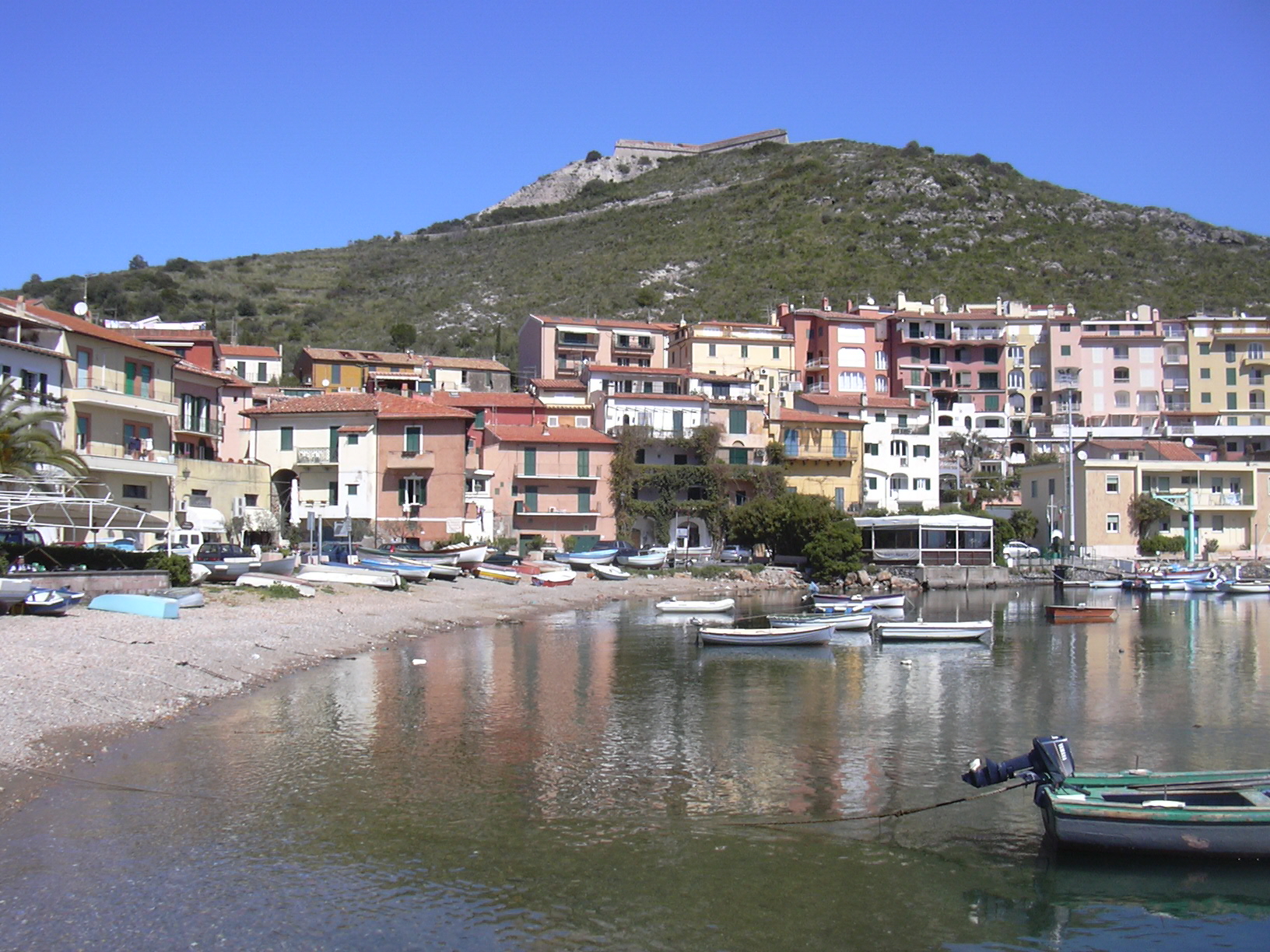
Porto Ercole is a small harbor on the south-east corner of Monte Argentario. The Argentario was once an island. Today two sand spits and a causeway tie it to the mainland. Orbetello is about 7 km away. The town’s old core climbs the hill above the boats, and every ridge around it seems to carry a fortress.
Those forts are the reason to come. For about 250 years, this harbor belonged to the Stato dei Presidi, a Spanish military state on the Tuscan coast. Spain ringed the harbor with forts. The problem is that English guides rarely tell you which of these forts you can actually walk into. We do, below.
The second reason is Caravaggio. Porto Ercole claims to be where the painter died, in July 1610, and has built a whole identity on that claim, including a tomb. The documents are more interesting, and less certain, than the tourist version. We give you both.
A Place Shaped by Time
Spain’s garrison harbor
In 1557 Philip II of Spain created the Stato dei Presidi (the State of the Garrisons) from the coast Siena had lost. Its capital was Orbetello, and Porto Ercole and Porto Santo Stefano were its Argentario harbors. The state was run through the Spanish viceroys of Naples. It passed to Austria in 1708, to the Bourbons of Naples in 1733, and to France in 1801. Only in 1815 did it join the Grand Duchy of Tuscany. Read more in our Orbetello profile.
The defenses grew over about fifty years. Fortezze.it calls the Porto Ercole system “one of the most complex defensive systems ever realized”. It includes the Rocca Spagnola on the hillside above the harbor, Forte Filippo, Forte Stella, Forte Santa Caterina, and the Bastione di Santa Barbara. The Renaissance architect Baldassarre Peruzzi had already studied the site in 1532.
Caravaggio: what the documents say
Here is the honest version. In 2001, according to local sources, a death record turned up in the parish registers of Sant’Erasmo. It reads: “A dì. 18 luglio 1609 nel ospitale di S. Maria Ausiliatrice morse Michel Angelo Merisi” (“On 18 July 1609, in the hospital of S. Maria Ausiliatrice, Michel Angelo Merisi died”). Michelangelo Merisi was Caravaggio’s real name.
Notice the year. Two letters dated 28 and 31 July 1610, sent from Rome to the court of Urbino, report his death as fresh news. The record’s year does not match them, and we have found no convincing explanation for the gap. Other places have also been proposed for his death, including Naples, Palo, and Civitavecchia. The art magazine Artribune notes that, for many, the Porto Ercole story is still “a fable built with art rather than a historical certainty.”
The bones that were never peer-reviewed
In 2010 a private committee led by Silvano Vinceti announced it had found Caravaggio’s bones in Porto Ercole. It used carbon dating, lead levels in the bones (read as exposure to paint), and DNA compared with people named Merisi or Merisio from the town of Caravaggio. Vinceti claimed “100%” certainty. The University of Bologna’s anthropology team, led by Giorgio Gruppioni, gave a probability of about 85–90%.
Critics were scathing. The art historian Vincenzo Pacelli called it “a joke that insults people’s intelligence”. Caravaggio has no direct descendants, so the DNA comparison relied on distant namesakes. In 2014 the art historian Tomaso Montanari called the project a “very expensive farce”. He noted that the bones had surfaced by chance in 1956, not through an archaeological dig. He also noted that the results were never published in a scientific journal, and that the comune spent €65,355.63 on the monument alone.
According to the local site TuttoMaremma, an urn was placed beside a monument in the town center in 2014, and the tomb was moved to the town cemetery in 2019. Our position is simple. The parish record places Caravaggio’s death here, though its date does not fit. The bones are a claim, not a finding.
The Passionists on the mountain
The Argentario also has a quieter history. On 14 September 1737, St Paul of the Cross (Paolo Danei) inaugurated a convent and church on the mountain for the Passionists, the religious congregation he founded. From that year a Passionist community lived there permanently. He died in 1775 and was canonized in 1867. The retreat now houses the Passionist novitiate and is recognized by the local bishops as a spirituality center, so treat it as a place of prayer, not a sight.
What to See and Do
Forte Stella: the one that opens in some seasons
Forte Stella takes its name from the star-shaped plan of its central core. It is state property. The state acquired it in 1982, and a restoration led by the architect Nicoletta Maioli was completed in early 2000. The comune has opened it to visitors in seasonal slots, but the latest notices we found date from 2021–22, and arrangements change from year to year. Check the Comune di Monte Argentario notices before you climb up. Sources disagree about who designed it, so we won’t name an architect.
Forte Filippo: look, don’t knock
Forte Filippo is the big one, and you cannot simply walk in. It was begun in 1558 for Philip II, to a design by Giovanni Camerini. It has a square plan, double walls, double corner bastions, and a moat. It replaced an older Sienese fort, Forte Sant’Ermo.
Its later life is a small history of Italy. It was remodeled by the French and then the Lorraine rulers. At the end of the 19th century it became a prison. During World War II, local people sheltered inside it from air raids. In the second half of the 20th century it was sold to private owners and turned into homes. A private museum can be visited by appointment only. Otherwise, admire it from the road.
The Rocca Spagnola and the harbor
The Rocca Spagnola sits on the hillside directly above the harbor. We could not confirm its current ownership or visiting arrangements, so plan to see it from outside. Walk up through the old town anyway. The lanes are the point, and the views back over the harbor explain why Spain wanted this place.
Sant’Erasmo in early June
The town’s big day is the feast of its patron, Sant’Erasmo, around 2 June. A procession carries the saint’s bust down to the harbor. It goes aboard a decorated fishing boat with the bishop, followed by a flotilla. At sea, wreaths are cast for sailors who never came home. The return is greeted with sirens and fireworks. The feast is documented since 1786 and has been held every year since 1898. Dates vary slightly each year, so check the Borghi Toscana listing.
Porto Santo Stefano
Porto Santo Stefano, on the north side of the Argentario, is the comune’s main town and the ferry port for the islands. It is bigger and busier than Porto Ercole, and it has two things worth your time.
The Fortezza Spagnola
The Spanish fortress above the old center was built in the early 17th century to defend the town and harbor from pirate raids. It now holds two permanent exhibitions. “Memorie Sommerse” (Submerged Memories) covers underwater archaeology around the Argentario,. “Maestri d’Ascia” (Master Shipwrights) is about traditional wooden boat-building. The fortress is only partly accessible. Check hours on the Musei di Maremma page.
The Palio Marinaro on 15 August
Every 15 August, Porto Santo Stefano’s four rioni (districts), Croce, Fortezza, Pilarella, and Valle, race rowing boats in the Palio Marinaro dell’Argentario. Each boat is named after a wind and carries four rowers and a helmsman. The course is 4,000 m, ten laps of 400 m around buoys. The race has been run officially since 1937. Local tradition traces it to a legendary 16th-century escape from Barbary pirates. The days before bring rione dinners, a historical procession, and the formal measuring of the boats. See the Palio’s own site.
The Panoramica and Beyond
Driving the Panoramica
The Strada Panoramica circles Monte Argentario along the cliffs. It is the obvious drive, but it is prone to closures, whether after heavy rain or for roadworks. Always check the Comune di Monte Argentario notices before you set out. Do not assume you can drive the full loop.
Giglio and Giannutri
Ferries run from Porto Santo Stefano to Giglio Porto all year. Toremar and Maregiglio operate the route, and the crossing takes about an hour. Giglio is where the Costa Concordia was wrecked in January 2012, with 32 dead.
Giannutri, the small island further south, is strictly regulated. Its Roman villa of the Domitii Ahenobarbi can only be visited with National Park guides. You can land only at Cala Maestra and Cala Spalmatoio, a landing fee applies, and there are no motor vehicles. Check sailings on the Maregiglio timetable and rules on Visit Giglio Island.
Eating Like a Local
Caldaro, the fishermen’s soup
The Argentario’s own dish is caldaro, a fishermen’s soup once made on board from low-value rock fish. Il Giunco calls it the Maremma‘s answer to Livorno’s cacciucco. Ask for it by name, and expect it to depend on the day’s catch.
From the lagoon next door
Orbetello’s lagoon is just across the water, and its products appear on Argentario menus. Look for bottarga (cured grey mullet roe) and anguilla sfumata (smoked eel). Bottarga is a product of the Slow Food Presidium for traditional lagoon fishing, and our Pescatori di Orbetello profile tells the story behind both.
The local white
Drink Ansonica Costa dell’Argentario DOC, a white from a small zone that covers the Argentario, Giglio, and neighboring mainland comuni. It is the natural partner for anything from the sea.
Getting There and Getting Around
By train and bus
The Argentario’s own railway branch closed in 1944. The nearest station is Orbetello–Monte Argentario, on the Tirrenica line between Pisa, Grosseto, and Rome. From there, Tiemme runs local buses on the Argentario and Autolinee Toscane runs intercity lines. Check timetables before you rely on them, especially off-season.
By car, ZTL, and parking
Most visitors drive, via the SS1 Aurelia and Orbetello. In summer, Porto Ercole runs evening ZTLs (limited-traffic zones) around the harbor and the old town on published dates, and every day in August. The dates and hours change each year. Check the current ordinance on the comune’s ZTL page and the parking page. Monte Argentario charges a tourist tax; your accommodation will tell you the rate.
When to come
Late spring and early autumn are best. You avoid the August crowds and most of the summer evening ZTL dates, and the forts are easier to climb in mild weather. Come in early June for Sant’Erasmo, or in mid-August for the Palio in Porto Santo Stefano.
Nearby
- Orbetello — the lagoon town that was capital of the Stato dei Presidi, with Etruscan walls and a museum in a Spanish powder store.
- Ansedonia and Cosa — a Roman colony founded in 273 BC on the Ansedonia promontory, covered in our Orbetello profile.
- Riserva Duna Feniglia — a car-free pinewood on the sand spit between Porto Ercole and Ansedonia, open on foot and by bike.
- Capalbio — a walled hill village south along the Aurelia, near Niki de Saint Phalle’s Tarot Garden.
- Isola del Giglio — the island an hour’s ferry ride from Porto Santo Stefano.
Information is provided in good faith and may change. Always confirm opening hours, prices, and event dates with the official source before you travel.