
Town · Versilia
Viareggio
The Town Rebuilt After the 1917 Fire
Last updated:
- Region
- Versilia
- Province
- Province of Lucca
- GPS
- 43.8745, 10.2568 (town hall)
- Best season
- winter for the Carnival; spring and autumn for the seafront
- Time needed
- full day (add a day for Torre del Lago)
- Difficulty
- easy (flat, with long level promenades)
- Known for
- Carnival and papier-mâché floats, the Liberty Passeggiata, yacht building, cacciucco alla viareggina, Lorenzo Viani
The Viareggio you walk today is the second one. The first seafront was built largely of wood, and most of it burned in a single night in October 1917. In its place now stands the Liberty (Italian Art Nouveau) Passeggiata, the promenade of cafés and bathing establishments that still defines the town.
Viareggio is also Versilia‘s largest town, with about 60,600 residents, and a working one. Behind the promenade, the Darsena (the harbor basins) builds yachts for buyers worldwide. Every winter the seafront becomes a two-kilometer parade circuit for a Carnival first held in 1873.
If you want medieval stone, go inland to Camaiore or Pietrasanta. Viareggio’s story is younger and louder: a town of boatbuilders, painters, papier-mâché artists, and one opera composer who spent his last years here.
A Place Shaped by Time
Lucca’s door to the sea
The name is usually traced to the medieval Via Regia (Via Regis), the road that linked the coastal fort to Lucca. Viareggio stayed Lucchese for centuries. In 1513 a papal arbitration by Leo X placed Pietrasanta, Seravezza, Stazzema, and Forte dei Marmi under Florence, but Camaiore and Viareggio stayed with Lucca (see our Versilia hub).
On 5 June 1534 Lucca’s government decreed a tower to guard its warehouses, its port, and the settlement at the mouth of the Fossa della Selice canal. Completed in 1542, it is today’s Torre Matilde.
The land around it was marsh. In 1741 the engineer Bernardino Zendrini built floodgates between Lake Massaciuccoli and the port. Between 1740 and 1766 the Republic of Lucca also cut the coastal forest and replanted it with maritime and stone pines. The aim was to shield crops from the sea wind and improve the air once the malarial marsh was drained. Viareggio’s famous pinewoods are planted, not wild.
A villa built for love
In 1822 work began on a villa for Pauline Bonaparte Borghese, designed by Giovanni Lazzarini. She wanted to be near her lover, the composer Giovanni Pacini, who had a house in Viareggio. In 1823 she was also granted the beach in front, where she planted a double row of trees. When she died, the villa passed to her sister, Caroline Murat.
1873: boats and a carnival
Two of Viareggio’s defining institutions date from the same year. In 1873 Lorenzo Benetti bought a shipyard and founded what became the Benetti yacht company. That February the Carnival began, born at the tables of the Caffè del Casinò among the well-to-do young men of Viareggio. The first parades ran along Via Regia.
Triumphal floats appeared at the end of the 19th century. In 1923 a Pierrot float moved mechanically. In 1925 the float builders introduced papier-mâché (cartapesta), the material that still defines the Carnival. In 1930 Uberto Bonetti created Burlamacco, the mask that became its symbol.
The night of the fire
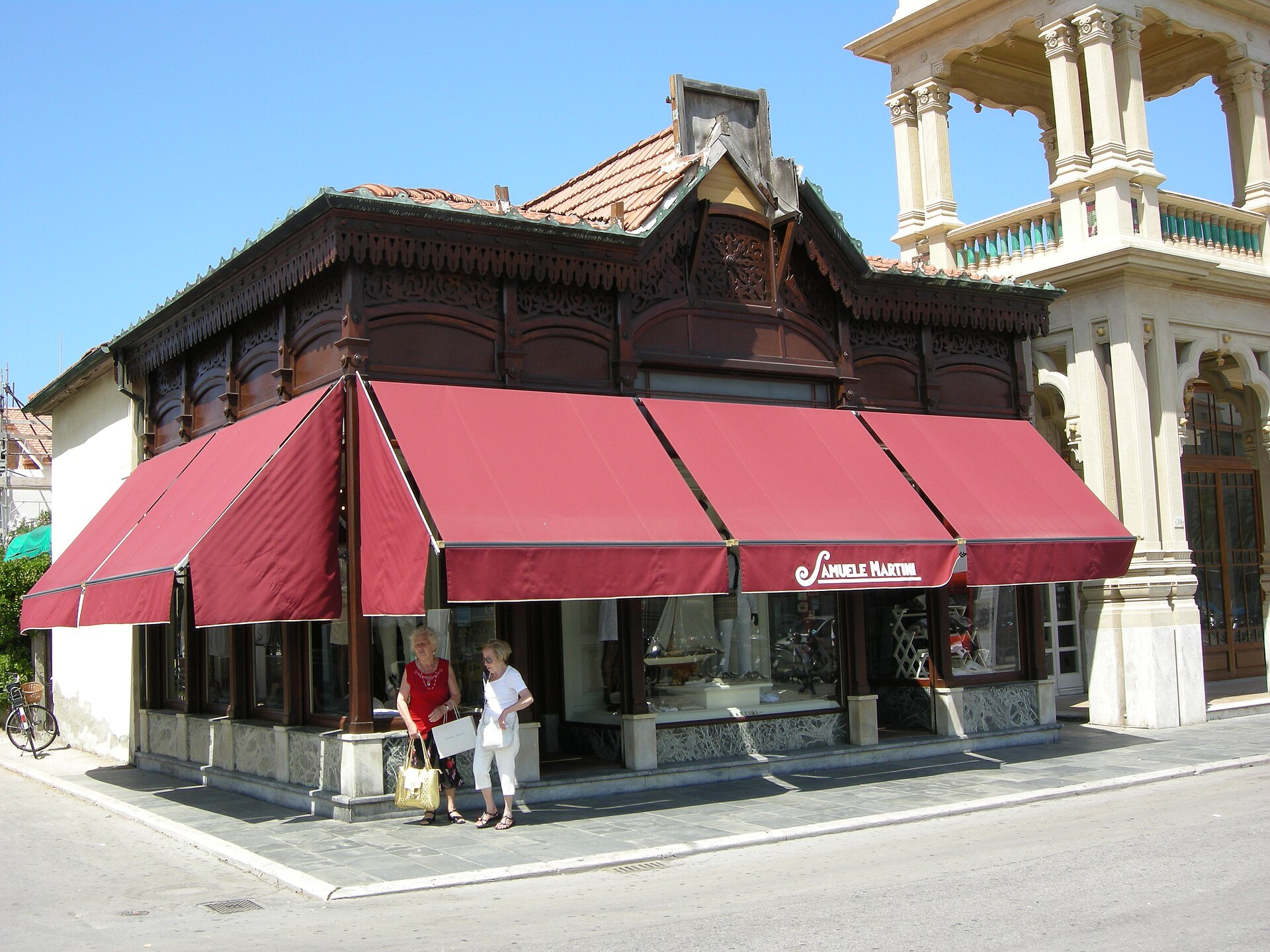
On the night of 17–18 October 1917 a fire destroyed most of the wooden seafront. It was first rebuilt quickly, much as before. Within a few years Alfredo Belluomini and Galileo Chini gave it the Liberty character you see today. According to Lucca’s tourism board, only the Chalet Martini, from 1899, was saved.
Giacomo Puccini became part of the new seafront’s life. In 1919 he became president of the Club Gianni Schicchi, which met at the bar of the same name on the Passeggiata. In December 1921 he moved into a villino in town designed by Vincenzo Pilotti. A peat-extraction works on the lake had driven him from Torre del Lago, where his villa, lake, and grave have their own article.
29 June 2009
On the night of 29 June 2009 a freight train carrying liquefied petroleum gas derailed just past Viareggio station. The fire that followed killed 32 people. In June 2026 Italy’s highest court made final the convictions of former rail chief Mauro Moretti and ten others.
What to See and Do
The Passeggiata, building by building
The Gran Caffè Margherita began in 1902 as a wooden building. In 1928 Belluomini rebuilt it in masonry, with Chini’s ceramics on the exterior. Puccini was one of its most frequent customers, and a 1949 plaque records his table.
Belluomini also designed Bagno Balena (1928), decorated by Chini. Lucca’s tourism board lists more Liberty and Déco landmarks in town. Among them are the Supercinema Savoia (1927, with Chini ceramics), the Grand Hotel Principe di Piemonte (1925), and Villa Nistri (1913), nicknamed “the mosque.”
Carnival and the Cittadella
The Carnival is held on several dates each year, usually in February; the dates follow the Easter calendar, so they change every year. On each Carnival weekend one of the town’s four neighborhoods takes its turn hosting street parties with food, music, and dancing. Check the dates on the official Carnival site before you plan a trip around them.
Outside the season, go to the Cittadella del Carnevale on Via della Foce. Since 2001 the float builders have worked here, in workshops ringed around a large circular square; before that they used hangars on Via Marco Polo. The Museo del Carnevale inside shows models of recent winning floats, official posters from 1925 on, and works by Enrico Prampolini, Lucio Venna, and Moses Levy. There is also a papier-mâché demonstration. Visit Tuscany lists the museum as open all year; check the details before you go.
Villa Paolina
Pauline’s villa now holds the town’s civic museums. The Museo Archeologico Alberto Carlo Blanc covers prehistory. The Museo degli Strumenti Musicali Giovanni Ciuffreda shows mostly non-European instruments. In the north turret, the painter Alfredo Catarsini worked for more than 50 years; his atelier opens by reservation. Pauline’s own apartment, with French-style interiors by Federico Marsili, is used for exhibitions. Check hours on the Ministry of Culture page.
GAMC and Lorenzo Viani
If you see one museum, make it the GAMC, the modern and contemporary art gallery in Palazzo delle Muse on Piazza Mazzini. It began in 1979, when the city acquired 50 works by Lorenzo Viani. It now holds more than 3,000 works of the 20th century, with a strong graphics collection.
Viani (1882–1936) was a painter, woodcut artist, and writer born in Viareggio. As a barber’s apprentice he met the anarchist Pietro Gori and the painter Plinio Nomellini. He drew the anarchists and ex-convicts of the Darsena and carved more than 250 woodblocks. Look for Benedizione dei morti in mare (Blessing of the Dead at Sea) and Volto Santo. Details are on gamc.it.
Torre Matilde
The tower has nothing to do with Matilda of Canossa; the name is a historical mistake. For more than a century it served as a prison. From 1823 to 1847 it was a bagno dei forzati (convict labor prison), and from 1850 until the Second World War a magistrate’s prison with six cells. The novelist Mario Tobino described it as “squat, with a certain sulk.”
Restored between 1969 and 1982, it returned to the city in 1983. A digital museum opened inside in November 2024, covering the town’s history and its shipbuilding. Check current opening on the comune’s website.
The Darsena and its boatyards
Benetti’s yard built the 86 m Nabila in 1979–80 for Adnan Khashoggi; the yacht later appeared in Never Say Never Again (1983). The district’s exports topped €1 billion for the first time in 2023. In 2024 Il Sole 24 Ore reported that a shortage of workers could slow its growth.
For the craft side, read our profile of Cantiere Del Carlo. The same family has run it since 1963, and it now specializes in restoring wooden boats. One of them, Portola (1928), appeared in a 1959 Marilyn Monroe film.
The pinewoods and the beach
The Pineta di Ponente is the smaller urban park near the Passeggiata. The Pineta di Levante is wilder and runs for about 6 km to Torre del Lago, past Viale dei Tigli and Villa Borbone. You can cycle it.
In 2021 the comune said felled pines would be replaced with holm oaks, calling the pines “not native”; Italia Nostra and a citizens’ committee protested.
Most of Viareggio’s shore is run by bathing establishments: in 2022 Legambiente found 71.5% of the comune’s beach under concession. The Lecciona, between Viareggio and Torre del Lago, is different. It is a dune reserve inside the Migliarino–San Rossore–Massaciuccoli regional park, not a free beach. It has no beach establishments, so treat it as a protected area.
Eating Like a Local
Start with cacciucco alla viareggina. Visit Tuscany notes that the dish originates in Livorno, but Viareggio’s version is lighter, with a red broth. It has no sage and a generous amount of shellfish, which gives it a slightly sweet aftertaste. Livorno’s is thick and dark, built on garlic, pepper, and sage. Here it is cooked in the traditional cast-iron pot and served on garlic-rubbed bread.
Then try the arselle, tiny clams once dug by hand from Viareggio’s sand. They are cooked with garlic, chili, and tomato and served on toast or with spaghetti. Pancotto viareggino is a one-pot dish of prawns, arselle, and stale bread cooked in tomato. Look also for spaghetti alla trabaccolara, and for tordelli, the meat-filled pasta served on feast days across Versilia. The fish market is in Piazza Cavour.
For a sit-down meal, Viareggio is well served. Il Piccolo Principe holds two MICHELIN stars, and Romano and Lunasia hold one each. Giardino di Mari, Da Miro alla Lanterna, and MaMe are listed in the MICHELIN Guide. Buonumore holds the Chiocciola in Slow Food’s Osterie d’Italia, and a 2021 Scatti di Gusto headline named its arselle the best.
Getting There and Getting Around
By train: Viareggio station is on the Tirrenica line between Genoa and Pisa, and long-distance trains stop here. Torre del Lago Puccini has its own station on the same line. Check times on Trenitalia.
By car: check traffic restrictions and parking on the comune’s website before you drive into the center. On Carnival days the seafront is the parade route, so plan around it.
By bike and on foot: the town is flat. Visit Tuscany lists cycle routes from Viareggio, including “Il lago di Puccini in bicicletta” (12.7 km).
When to go: come in Carnival season (usually February; check the official dates) for the parades, or in spring and autumn for quieter walks on the promenade.
Nearby
- Torre del Lago Puccini: Puccini’s villa, lake, and grave, reached through the Pineta di Levante.
- Massarosa and Lake Massaciuccoli: a Roman villa and marsh country on the far side of the lake.
- Camaiore: another town that stayed Lucchese in 1513, with its own beach at Lido di Camaiore.
- Pietrasanta: the marble and bronze workshop town, a short trip north.
- Forte dei Marmi: the former marble wharf that became a resort.
Information is provided in good faith and may change. Always confirm opening hours, prices, and event dates with the official source before you travel.