
Town · Maremma
Pitigliano
The Tufa Town With a Ghetto Inside It
Last updated:
- Region
- Maremma
- Province
- Province of Grosseto
- GPS
- 42.6356, 11.6744
- Best season
- spring and autumn
- Time needed
- full day
- Difficulty
- moderate (steep lanes and steps; the Jewish itinerary is not wheelchair accessible)
- Known for
- Jewish heritage, tufa cliffs, Palazzo Orsini, vie cave (Etruscan sunken roads), Bianco di Pitigliano wine
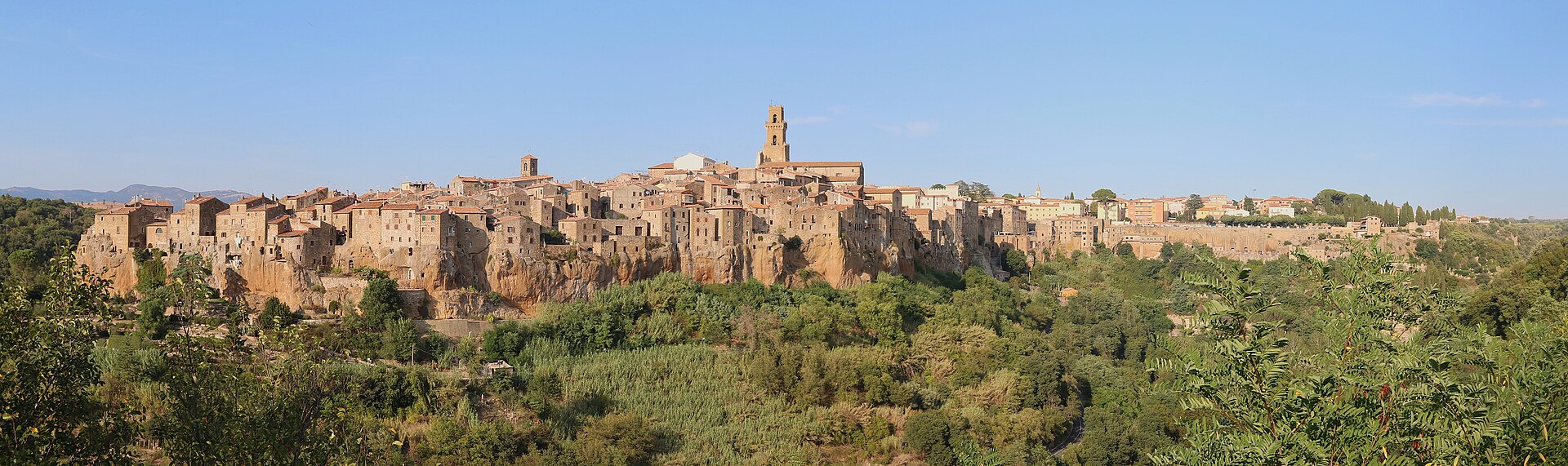
Pitigliano sits on a ridge of tufa, the soft volcanic stone of southern Maremma. The houses rise straight out of the cliff, and it is hard to tell where rock ends and wall begins. Underneath the streets, the stone is hollowed into cellars, stores and old workrooms. That is the first thing you notice, and every photograph you have seen is true.
The second thing takes longer to find. For more than three centuries this small town held a Jewish community large enough to earn a nickname. People came to call it la Piccola Gerusalemme (Little Jerusalem). According to the food and culture site InformaCibo, the name came from Livorno’s Jews in 1854.
Most English guides mention the nickname and move on. This profile tells the story properly, with dates and names, then gives you the practical detail to see it for yourself. Pitigliano is small (about 3,500 residents), but it rewards a full day.
A Place Shaped by Time
Aldobrandeschi, Orsini and a county lost to debt
The first written record of Pitigliano is a papal bull of 1061. The town then belonged to the Aldobrandeschi, the counts who ruled much of inland southern Tuscany from their seat at Sovana. In 1293 Anastasia Aldobrandeschi married Romano Orsini, and the seat of the county moved here.
The Orsini, a great Roman baronial family, turned Pitigliano into a small Renaissance capital. Their rule ended through debt rather than war. Count Gian Antonio Orsini handed the county to the Medici Grand Duchy of Tuscany in the early 1600s.
Refuge, synagogue and ghetto
Jews came to Pitigliano as refugees. Italian Wikipedia links the community’s growth to the papal expulsions of 1569 and 1593, when Jews were expelled from most of the neighboring Papal States. But the community was older than that. In 1556 the Orsini count Niccolò IV granted land for a Jewish cemetery, which proves an earlier presence.
The synagogue was completed in 1598. According to the Jewish cultural magazine JoiMag, it was paid for by a weaver, Leone di Sabato. The freedom did not last. In 1622, under the Medici grand dukes, Pitigliano’s Jews were confined to a ghetto around the synagogue. According to Italian Wikipedia, Jews from nearby Sovana and Sorano were also ordered to move into it.
Little Jerusalem at its height
Confinement did not end the community. JoiMag counts 222 Jews in 1784, about 7% of the town, and 424 in 1858. Italian Wikipedia puts the peak at about 500 out of 6,000 inhabitants. Natives of the community include the scholar Dante Lattes; Samuele Colombo, rabbi of Livorno; the biologist Mazzini Pergola; and the lawyer and member of parliament Ugo Sorani.
Emancipation in the 19th century opened the cities, and families moved away. By 1938, when Fascist Italy passed its racial laws, only about 70 Jews remained.
Deportation and the Righteous
Twenty-two members of the community were deported during the Second World War. They were held first at the camps of Roccatederighi and Fossoli and died in Nazi camps. Others survived because local Catholic families hid them: about 30 Jews in all, according to the Musei di Maremma. Among them were five members of the Paserman-Cukier family, who reached Pitigliano in early 1943.
Yad Vashem has recognized Pitigliano rescuers as Righteous Among the Nations. They are Fortunato Sonno (2002); the Dainelli, Perugini, Nucciarelli, Simonelli and Bisogni families (2002); and Pietro Felici (2008). Their names are the reason to take this history seriously as a visitor, not as a picturesque backdrop.
After the war the synagogue was abandoned and collapsed. Sources disagree on the exact dates, but it was restored and reopened between the 1990s and the early 2000s. The ghetto’s 400th anniversary was marked in 2022.
What to See and Do
The Jewish itinerary (book ahead)
The synagogue, museum and ghetto form the Percorso Ebraico (Jewish itinerary). It is run by the association La Piccola Gerusalemme from Vicolo Manin, by guided visit on reservation. Book before you arrive: call 0564 614230 or 328 190 7173, and check current times and prices on the Musei di Maremma page. The route has steps and is not wheelchair accessible.
Go for the rooms cut into the tufa below the synagogue. According to JoiMag, they include a mikveh (ritual bath), a matzah oven used until 1939, a kosher butchery, a wine cellar and a dyeing room. Together they show a whole working community, not just a place of prayer. The community’s cemetery holds about 280 tombs.
Palazzo Orsini
The Orsini palace began as an 11th–12th-century convent and became an Aldobrandeschi fortress in the 1250s. The Orsini remodeled it, with work attributed to Baldassarre Peruzzi and Antonio da Sangallo the Younger. Look for the Renaissance well-cistern in the courtyard and the loggia with Ionic columns.
The palace holds the Museo Diocesano d’Arte Sacra (the diocesan museum of sacred art) and, through a separate entrance, the Museo Civico Archeologico (civic archaeological museum). The comune has announced a restoration of the palace, so check what is open on the museum’s official site before you plan your day around it.
Churches and the Medici aqueduct
The Duomo of Santi Pietro e Paolo is medieval, with a late-Baroque façade. The Santuario della Madonna delle Grazie began as a 14th-century chapel and was remodeled in the 16th century. The Acquedotto Mediceo (Medici aqueduct) was begun in the mid-16th century and finished in the 17th.
Walk the vie cave
The vie cave are Etruscan roads cut deep into the tufa between high rock walls. The Parco Archeologico Città del Tufo names the Via Cava di San Giuseppe at Pitigliano. A local guide describes a 6 km loop from Porta di Sovana along the Via Cava di Poggio Cani, with a branch to Madonna delle Grazie. That descent is steep and slippery, so wear proper shoes.
One correction is worth knowing. The walls can top 20 m, but the park itself explains that today’s depth is often more than 10 m greater than the original. Centuries of hooves wore the floors down, and people re-cut them. Their original purpose is still debated: drainage, roads, defense or ritual.
The Torciata di San Giuseppe (19 March)
Pitigliano’s signature festival takes place every year on the evening of 19 March. About 40 hooded torch-bearers carry burning bundles of reeds up from the Via Cava del Gradone, across the Meleta valley, to Piazza del Comune. There a straw figure of winter, the invernacciu, is burned on a bonfire. Traditionally the ashes are gathered for luck. Check pitigliano.org for the program.
Eating Like a Local
The sfratto: a pastry named for an eviction
Pitigliano’s most famous sweet is the sfratto (“eviction”). It is a pastry cylinder 20–30 cm long, filled with honey, walnuts, orange zest and spices. Its shape recalls the stick officials used to knock on Jewish doors when families were ordered into the ghetto. It is on Tuscany’s official list of traditional food products (PAT) simply as “Sfratto”, and you will also see it sold as sfratto dei goym.
Other Pitigliano specialties on the same list include focaccia bastarda, the salted Easter focaccia, the sweet tortello and the tozzetto biscuit. The thin cheese-topped fritter that Manciano calls ciaffagnone is known here as migliaccio. You will also find the Maremma staples: acquacotta (the herders’ vegetable soup poured over bread), tortelli maremmani stuffed with ricotta and chard, and wild boar braised in red wine.
Where to eat
Il Tufo Allegro, on Vicolo della Costituzione near the synagogue, is selected by the MICHELIN Guide. Its dining rooms are carved into the rock. Chef Domenico Pichini has been called a champion of cucina goym, the local crossover of Jewish and non-Jewish cooking. A 2023 Italian regional guide adds Il Caveau (Via Vignoli, with a panoramic terrace) and Hostaria del Ceccottino (Piazza San Gregorio VII, for pici and traditional meats). Check hours directly before going.
Wine: Bianco di Pitigliano and the kosher bottles
Bianco di Pitigliano became a DOC by decree on 28 March 1966. WineNews calls it the sixth DOC recognized in Italy. It is based on Trebbiano Toscano, locally called Procanico, at no less than 40%. In early September the old town’s tufa cellars open for tastings at Settembre diVino; see Visit Pitigliano for dates.
Sidebar: kosher wine from a Tuscan cooperative The Cantina di Pitigliano makes a Bianco Kasher and a Rosso Kasher (Sangiovese and Canaiolo). The Rabbi of Livorno supervises the whole process. The vines must be at least four years old, and observant Jewish workers handle the grapes and wine with kosher equipment. Each year, in the rite of Terumat Ma’aser, 1% of the new wine is set aside and discarded. Bottles are sold through the Cantina di Pitigliano shop.
Getting There and Getting Around
By car
A car is the practical way to explore the tufa towns. Pitigliano has several car parks, listed by Visit Pitigliano. Via San Michele (paid, cars only) is closest to the center. Piazza Nenni (paid) is the largest and takes campers. Piazza Dante is free but fills up at busy times. Via Santa Chiara has free and paid bays, about five minutes’ walk away, with a panoramic walkway into Piazza della Repubblica.
The old town has a ZTL (limited traffic zone). Do not drive in without a permit; the rules are on the comune’s ZTL page.
By bus
Pitigliano has no train station. Autolinee Toscane buses leave from the Pitigliano bus station: line 41P to Grosseto via Manciano and Albinia, 11P to Orbetello, and 57P to Siena. Check timetables before you rely on them, as rural services are thin.
On foot
The old town is compact but steep, with steps and uneven paving. A tourist tax applies to overnight stays; check with your accommodation.
Nearby
- Sorano – a second tufa town with an Orsini fortress, a landslide-scarred old citadel and the cave village of Vitozza.
- Sovana – a tiny village with a Romanesque cathedral and a major Etruscan necropolis.
- Saturnia – free thermal bathing at the Cascate del Mulino, with a paid car park beside it.
- Montemerano – a walled hill village in the Manciano countryside, known for its painted “cat-flap” Madonna.
Information is provided in good faith and may change. Always confirm opening hours, prices, and event dates with the official source before you travel.