
Town · Maremma
Saturnia
Free Water, Paid Parking and a Roman Gate
Last updated:
- Region
- Maremma
- Province
- Province of Grosseto
- GPS
- 42.66639, 11.50417
- Best season
- year-round
- Time needed
- 2–3 hours for the falls; half day with the village
- Difficulty
- moderate (the village is easy; the travertine pools are uneven and slippery)
- Known for
- Cascate del Mulino, thermal water, Terme di Saturnia resort, Porta Romana, Roman Aurinia
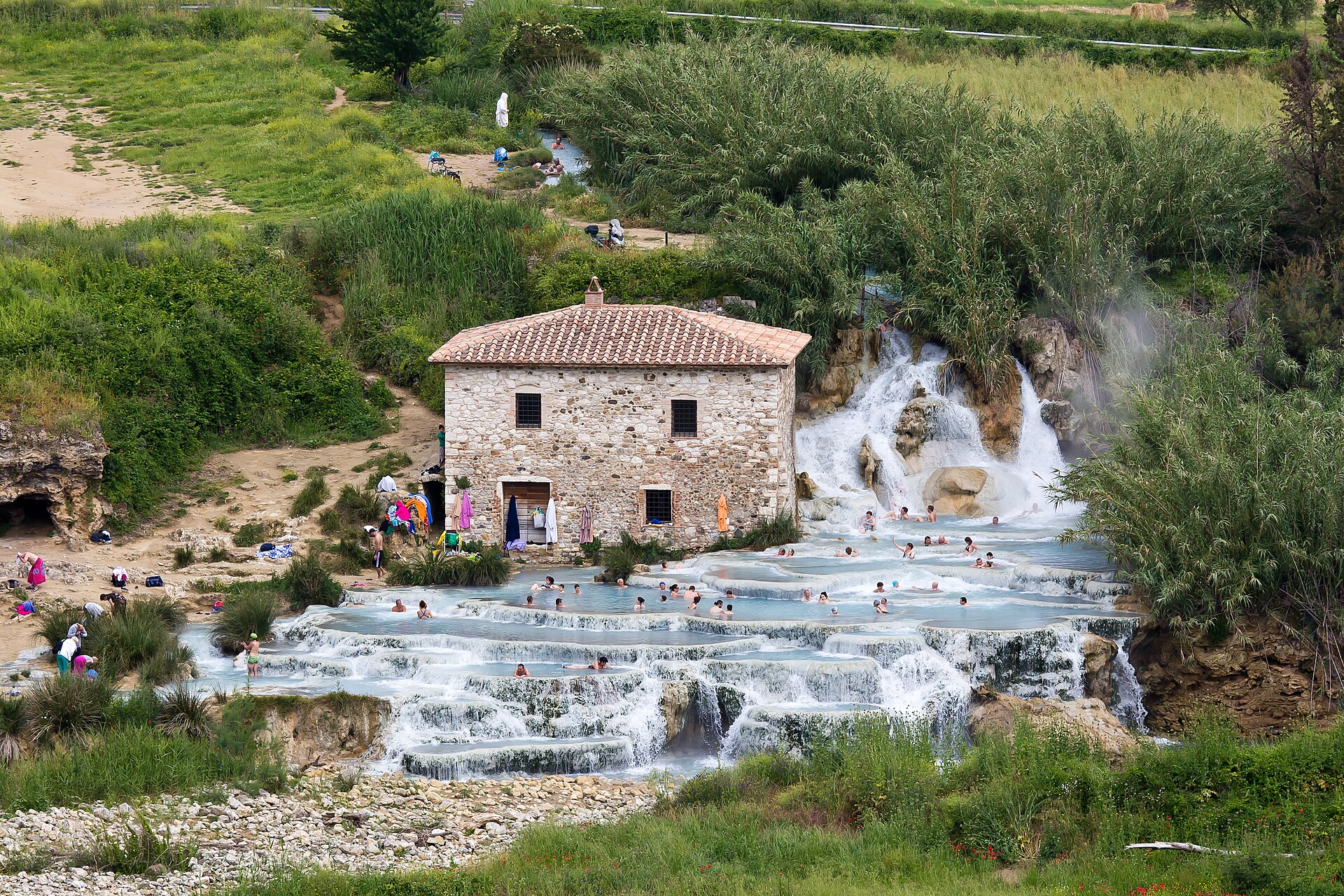
Say “Saturnia” to most people and they picture one image: pale terraces of travertine, full of steaming blue water, with people sitting in the pools like a Roman painting. That is the Cascate del Mulino (Mill Falls), and bathing there is free.
But there is a second Saturnia most visitors skip. The village itself sits on a travertine plateau at 294 m, above the left bank of the Albegna river. About 280 people lived there in 2010. It is a frazione (village district) of the comune of Manciano, and it holds a Roman gate you can still walk through and a small archaeological museum.
This profile covers both. It also covers the part the photographs leave out. The water is free, but the car park beside the falls is not. Knowing the real rules before you arrive will save you a frustrating first half hour.
A Place Shaped by Time
Etruscans before the Romans
People were burying their dead around Saturnia long before Rome. The surrounding necropoleis, with names like Pian di Palma and Sede di Carlo, run from Villanovan pozzetto graves (small pit burials for cremation urns) to Etruscan chamber tombs holding bucchero, the glossy black Etruscan pottery.
Aurinia: the Roman colony on the Via Clodia
The Roman writer Pliny the Elder gives the town’s ancient name as Aurinia. Rome took the area around 280 BC. In 183 BC it founded a colony here, under three commissioners named in the sources: Q. Fabius Labeo, C. Afranius Stellio and Ti. Sempronius Gracchus. The town had four gates, set on its two main streets, the cardo and the decumanus. It stood on the Via Clodia, one of the roads north from Rome, and it appears on the Tabula Peutingeriana, the famous medieval copy of a Roman road map.
The water was already part of the story. The Treccani Enciclopedia dell’Arte Antica records the remains of “a large thermal building” at Bagno di Saturnia. Popular English sources often go further and describe legionaries bathing at the falls. We found no source for that detail, so we leave it out.
Goths, Lombards, Siena
Late antiquity was hard on Saturnia. It suffered Gothic incursions in 411 and Lombard ones in 570. A papal privilege of 1188 mentions its castle, its church and baths that were still working. Then, in 1299, the Sienese destroyed the town. What you walk through today is the small village that grew up again on the site.
The thunderbolt legend
Almost every English page about Saturnia repeats a myth. In one version, Saturn, angry at humanity’s wars, hurled a thunderbolt that opened the hot spring. In another, it was Jupiter. These inconsistent versions are the clue. We found no classical source for either story, and the Italian articles that tell it cite no ancient author. Treat it as modern local folklore, not Roman myth.
The genuine ancient detail is the name Aurinia, which comes straight from Pliny. Some popular articles add further claims, such as Pelasgian founders, again without a source. The real history is interesting enough without them.
What to See and Do
The Cascate del Mulino: free bathing, real rules
The Cascate del Mulino lie outside the village. The water flows over a series of natural travertine basins, and you can sit in them for as long as you like. There is no ticket and no gate. Access has been argued over locally, though. In 2020 a local figure insisted the falls “must remain public”, and in 2021 a plan to allow entry only by booking drew a public appeal to the mayor. For now, bathing stays free.
The practical catch is parking. On 6 April 2023, the municipal car park beside the falls became paid, and campervans were banned: it is for cars and motorbikes only. The Comune di Manciano runs it as a “provisional” car park under a mayor’s ordinance. It is planned to open ten months a year while the council works on a permanent planning solution. Guests of local accommodation have been able to get a reduced-rate pass through the municipal police; ask your host. Rates and rules can change, so check the Comune di Manciano news page before you go.
A warning about websites: many sites with names like “cascate-del-mulino” are commercial and unofficial. For rules, trust the comune.
How to enjoy the falls well
Go early in the morning, or late in the day. The pools feel very different before the day’s visitors arrive. Wear water shoes, because the travertine is uneven and slippery. Bring a towel and something warm to change into, especially in winter.
Treat the place with care. When paid parking began, the comune put staff on site for assistance and cleaning. Help them: take your rubbish home, leave glass in the car, and don’t chip or scrape the travertine. Also be aware that sulfurous water has a strong smell and can tarnish silver jewelry, so leave it in the car.
The Terme di Saturnia resort: the paid alternative
The Terme di Saturnia is a private spa resort with its own spring. It publishes striking figures: water at a constant 37.5°C, a flow of “500 litres per second”, and a “40-year journey underground”. These are the resort’s own figures for its spring. Many English articles apply them to the free falls, but no independent source we found does. The resort is the choice if you want changing rooms, loungers and treatments. Check termedisaturnia.it for access and prices.
Porta Romana and the Via Clodia
Of Roman Saturnia’s four gates, only Porta Romana survives. It is a round arch on the line of the old Via Clodia. Walk through it and you are following a road that carried traffic to and from Rome more than 2,000 years ago. It is the single best reason to drive up from the falls to the village.
Castello Ciacci and Santa Maria Maddalena
The Rocca Aldobrandesca, the castle of the Aldobrandeschi counts from the late 12th century, was rebuilt in 1924 as the neo-medieval Castello Ciacci. So what looks medieval is largely a 20th-century rebuilding. The church of Santa Maria Maddalena is mentioned in 1188 and was restructured in 1933. It holds work by the Sienese Renaissance painter Benvenuto di Giovanni.
The Museo Archeologico di Saturnia
The small archaeological museum holds the Ciacci collection of local finds. Check opening times on the Musei di Manciano site before you go. Pair it with the Porta Romana to see the Etruscan and Roman town that the pools make people forget.
Eating Like a Local
Food of the Albegna hills
Saturnia sits in herding country, and the food shows it. Look for acquacotta, the soup that was the typical lunch of the butteri (Maremma cowboys): onion, tomato, celery and wild herbs over stale bread, with an egg or ricotta when available. Tortelli maremmani are big ricotta-and-chard parcels with ragù or butter and sage. Cinghiale alla cacciatora is wild boar braised in red wine with tomato and black olives.
Manciano’s own specialty is the ciaffagnone, a thin fritter topped with pecorino and folded like a handkerchief. You may hear that it is the ancestor of the French crêpe. That is a local legend, not history.
Cheese and wine
The local pecorino tradition has a home next door. The Caseificio Sociale Manciano, a cheese cooperative founded in 1961 by 21 farmers, now has nearly 500 members and has made Pecorino Toscano DOP since 1996. Its site is at Piano di Cirignano, in the comune of Manciano.
For wine, try Ciliegiolo, a red grape grown mainly in a handful of Maremma comuni, Manciano among them. More than 55% of Tuscany’s Ciliegiolo vineyards are in the province of Grosseto, so this is the place to drink it. Parts of the comune also fall within the Sovana, Capalbio and Ansonica Costa dell’Argentario DOCs.
Where to eat
In Saturnia, the MICHELIN Guide lists I Due Cippi dal 1976. For a special occasion, Da Caino in nearby Montemerano holds two MICHELIN stars under chef Valeria Piccini. Manciano has La Filanda, also listed by the Guide. Book ahead for all three, and check closing days.
Getting There and Getting Around
By car
Saturnia is a car destination. It lies about 56 km from Grosseto, the nearest city. The regional bus line 41P, which links Pitigliano, Manciano and Grosseto, does not appear to serve Saturnia, and there is no railway station. If you drive up from Rome on the SS1 Aurelia, take care around Capalbio: as of April 2026, about 13 km there were still two-lane, with a poor accident record (Il Giunco, April 2026).
Parking and moving between the falls and the village
At the falls, use the paid municipal car park described above, and don’t leave a camper there. The village is small, and you will see it best on foot.
When to go
The falls are open to bathers in every season. Spring and autumn offer the best balance of comfortable air temperature and smaller crowds. In winter, the contrast between cold air and warm water is the whole point; just bring warm clothes for the walk back to the car.
Nearby
Montemerano is a small walled village with the “cat-flap Madonna” in its church of San Giorgio and the two-star Da Caino (our Montemerano profile also covers Manciano).
Manciano, the comune seat, has an Aldobrandeschi fortress that now houses the town hall and a museum of the prehistory of the Fiora valley; see our Montemerano profile.
Sovana is a village of 122 people (2011 census) with a Romanesque cathedral and an Etruscan necropolis.
Pitigliano is the tufa town on a cliff, with its synagogue and Jewish museum.
Scansano is the hill town that served as Grosseto’s summer capital and is home to Morellino di Scansano.
Information is provided in good faith and may change. Always confirm opening hours, prices, and event dates with the official source before you travel.