
Town · Maremma
Capalbio
Double Walls, a Brigand’s Legend and a Tarot Garden
Last updated:
- Region
- Maremma
- Province
- Province of Grosseto
- GPS
- 42.4542, 11.4225
- Best season
- spring and early autumn
- Time needed
- full day (village, Tarot Garden and Lago di Burano)
- Difficulty
- easy to moderate; a compact hilltop village inside walls
- Known for
- double circuit of walls, Giardino dei Tarocchi, Lago di Burano WWF oasis, "piccola Atene", Sagra del Cinghiale
Italians know Capalbio as a name before they know it as a place. For decades it was shorthand for the summer homes of Rome’s political and cultural left. English-language guides tend to repeat that label, add a line about “VIPs,” and move on. That misses most of what is here.
Capalbio is a small hilltop village completely enclosed by a double ring of walls. Below it lies a stretch of the southern Tuscan coast with Italy’s first WWF nature reserve. In the countryside nearby, the French-American artist Niki de Saint Phalle spent almost two decades building a garden of giant mosaic figures. And the village’s most famous “folk hero,” the brigand Domenico Tiburzi, turns out to have been something rather different from the legend.
This profile sorts the stories from the facts, and gives you what you need to plan a day that is not just a walk around the walls.
A Place Shaped by Time
An abbey’s castle on a frontier
Capalbio enters the written record early. In 805 its castle was part of a donation attributed to Charlemagne in favor of the Abbey of Saints Vincent and Anastasius at Tre Fontane, near Rome. The Aldobrandeschi counts later took the land from the abbey. After them came Orvieto, Siena and the Orsini, who completed the Rocca, the fortress at the top of the village. An inscription of 1404 on the walls has the town declare itself “Capalbio felice, difeso dal leone senese” (happy Capalbio, defended by the Sienese lion).
In 1555, during the war that ended the Republic of Siena, Spanish troops allied with the Medici took Capalbio, and it passed to Cosimo I de’ Medici. Then came a long decline. The surrounding plain was marsh, and malaria emptied the countryside. For more than a century, from 1842, Capalbio was not even its own municipality: it was administered as part of Orbetello and only gained its administrative independence in 1960.
Land reform and a new landscape
The modern landscape around Capalbio is largely a 20th-century creation. After the national land reform of 1950, the Ente Maremma, the reform agency created in 1951, divided the old estates among smallholders. Borgo Carige, a farming settlement below the village, grew out of that reform. Much of the farmland you drive through around Capalbio was shaped by that policy.
Tiburzi: the legend and the correction
Domenico Tiburzi, nicknamed “Domenichino,” is the Maremma’s most famous brigand, and Capalbio is where his story ended. He was born in 1836 at Pianiano, near Cellere, then in the Papal States. Local tradition calls him “il brigante amato dal popolo” (the brigand the people loved), and English sources often call him the Robin Hood of the Maremma.
The Dizionario Biografico degli Italiani of the Treccani encyclopedia, Italy’s standard national biographical dictionary, draws a harder picture. His band worked as armed private security for large landowners, including the Marchese Guglielmi, in return for a tribute known as the “tassa sul brigantaggio” (brigandage tax). Treccani quotes the view that this “transformed crime into a contract.” Most strikingly, it says Tiburzi helped put down, “with rifles leveled,” strikes by harvesters and seasonal farmworkers on the great estates. That is the opposite of a Robin Hood. An 1893 trial in Viterbo had 89 defendants, including laborers and local officials, which shows how far the network reached.
On the rainy night of 23–24 October 1896, Tiburzi took shelter at the farmhouse of the sharecropper Nazzareno Franci at Le Forane, near Capalbio. Carabinieri wounded him in the legs and then killed him with a shot to the head. His companion Luciano Fioravanti escaped. The photographer Ausonio Ulivi then photographed the body, dressed as a brigand and propped against a column.
Then there is the grave. The story you will hear, repeated by local Italian sources, is that Tiburzi was buried as a compromise, half inside and half outside the Capalbio cemetery: his legs in consecrated ground, his head and torso outside. It is a wonderful story. Treccani, however, states that the body was “regolarmente sepolto” (buried in the normal way) and calls the half-in, half-out version “un’infondata leggenda popolare” (an unfounded popular legend). Enjoy the legend, but know that the best reference work in Italy does not accept it.
“Piccola Atene”: little Athens
In the 1980s Capalbio became the summer meeting place of intellectuals and politicians close to the Italian Communist Party. The literary critic Alberto Asor Rosa coined the name “piccola Atene” (little Athens) for it. Achille Occhetto was a regular, and photographs by Elisabetta Catalano of Occhetto kissing his wife, Aureliana Alberici, caused a stir inside the party.
The 1990s brought a different crowd: Milanese professionals and Socialists around Claudio Martelli. Prince Nicola Caracciolo was a unifying figure. Italian commentators describe the “little Athens” as a phenomenon of the past, and politics moved on too: in 2019 the Democratic Party lost the town hall to an independent mayor. Today’s Capalbio is a country village with a famous name, not a salon.
What to See and Do
The walled borgo
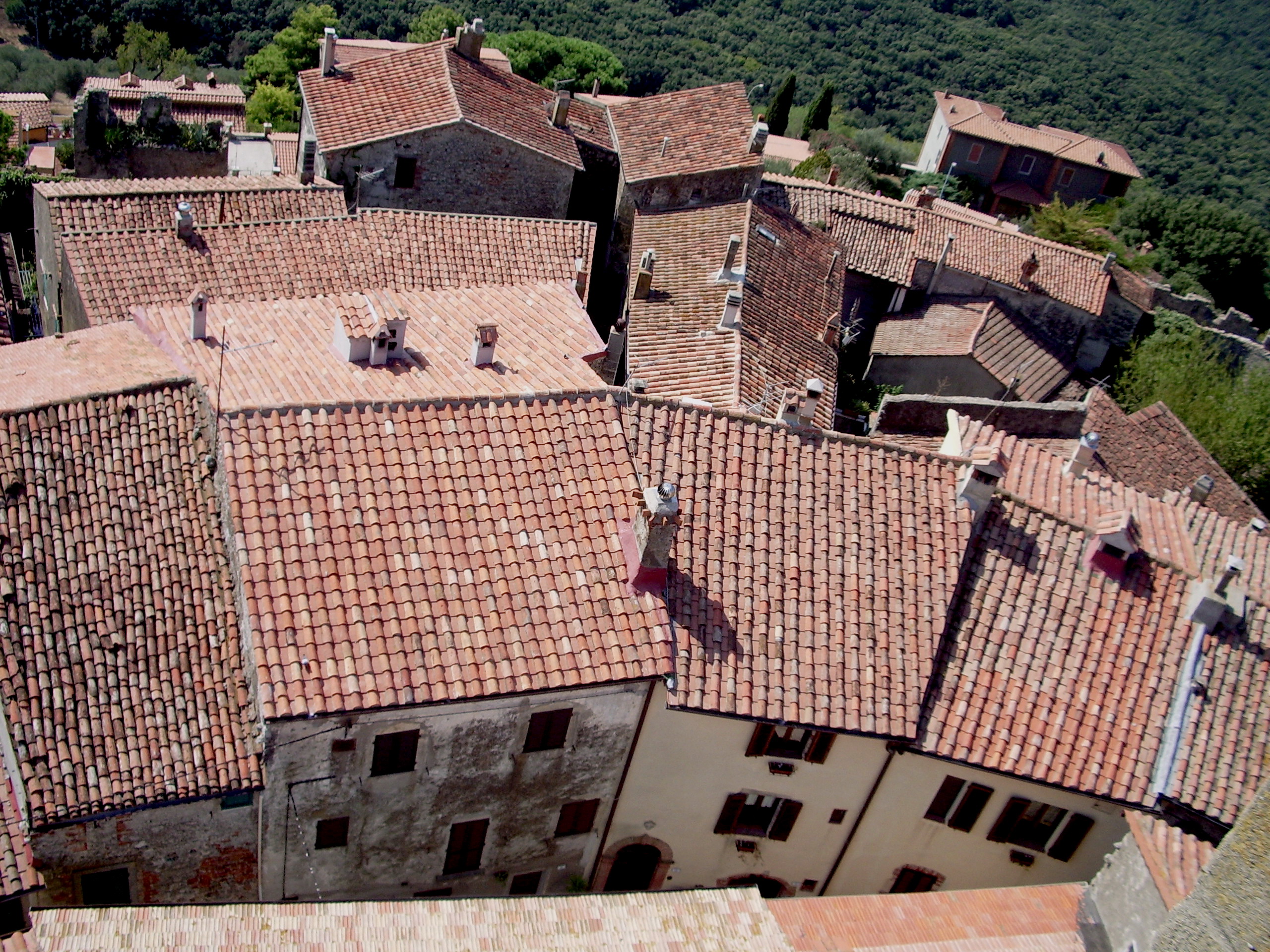
Start with the walls. A double circuit fully encloses the old village, with patrol walkways at different levels. Walking them is the best way to understand the place: you look down on the coastal plain the walls were built to watch. Inside, look for the church of San Nicola, which keeps medieval and Renaissance frescoes, and the Renaissance Palazzo Collacchioni, built against the medieval Rocca. Just outside the walls, the Oratorio della Provvidenza holds 16th-century frescoes. Also outside the walls stands a Nana fountain by Niki de Saint Phalle, a small preview of what waits in the countryside.
Giardino dei Tarocchi (the Tarot Garden)
This is the reason many people come, and it deserves the trip. Niki de Saint Phalle bought land on a hillside near Garavicchio and Pescia Fiorentina in 1979; the land came from the Caracciolo family. She built 22 monumental figures representing the Major Arcana of the tarot, in reinforced concrete covered with mirror and ceramic mosaic. The garden opened to the public in 1998, and the artist died in 2002.
Her models were other visionary gardens and buildings: Gaudí’s Park Güell in Barcelona, the Parco dei Mostri at Bomarzo, the Palais Idéal of the French postman Ferdinand Cheval, and the Watts Towers in Los Angeles. Some of the larger figures can be walked through. For several years she lived inside one of them, the sphinx-like Empress, while the garden took shape.
Plan this visit carefully, because the rules are strict and English sources often get them wrong. The garden is open only for part of the year, from spring into autumn, and only in the afternoons. Visitor numbers are capped. Only an online ticket for a fixed date and time guarantees entry, and tickets cannot be changed or refunded, even if it rains. There are no guided tours, and dogs are allowed on a leash. Allow about an hour and a half. Check the current season, hours and prices on the official site, ilgiardinodeitarocchi.it. Note the “il” at the start of the address; other spellings are not the official site.
WWF Oasi Lago di Burano
The Lago di Burano reserve, near the coast at Capalbio Scalo, was Italy’s first WWF oasis. It covers about 410 ha, with a further 600 ha closed to hunting around it. The lake itself is about 140 ha and only about 1 m deep. More than 300 bird species have been recorded here, and wolves pass through.
You cannot simply wander in. Visits are guided only, on set days and times that change between the summer and autumn–winter seasons, and you must book by early afternoon the day before. Find the current schedule and booking details on the WWF Italia page. In autumn and winter, when wild-boar hunts take place in the countryside on set days, the oasis and its no-hunting zone are one of the calmer places to walk.
The coast and its towers
Capalbio’s municipality runs down to the sea. On the coast stands the Torre di Buranaccio, described by Italian sources as the southernmost coastal tower in Tuscany. Chiarone was once a customs post, and the Torre di Selva Nera marked the old border between the Grand Duchy of Tuscany and the Papal States.
Eating Like a Local
The Sagra del Cinghiale
Capalbio’s big food event is the Sagra del Cinghiale (wild boar festival), held every year in the second week of September. It takes place just outside the old town. The menu is a catalog of Maremma boar cooking: polenta with boar sauce, cinghiale alla cacciatora (boar marinated and braised in red wine with tomato and black olives), grilled boar steak, and ammazzafegati, a local specialty. There is also acquacotta, the herders’ soup of vegetables and wild herbs over stale bread, and cotiche e fagioli (pork rind with beans). Check the dates on the official sagra site before you go.
Wine from the coast
Capalbio gives its name to a small wine appellation, Capalbio DOC, created in 1999. It covers parts of Capalbio, Manciano, Magliano in Toscana and Orbetello, and includes a Vin Santo. The area also falls within Ansonica Costa dell’Argentario DOC, a white-wine appellation for the coast and islands. Ask for both when you eat locally.
Getting There and Getting Around
By train
Capalbio is one of the few Maremma villages with a railway station, but read the name carefully. The station is at Capalbio Scalo, about 9 km from the hilltop village, near Lago di Burano. All regional trains on the Tirrenica line between Grosseto, Pisa and Rome stop there. Chiarone station is also in the municipality. From the station you will need onward transport to reach the village or the Tarot Garden.
By car, and a safety note on the Aurelia
Most visitors drive, on the SS1 Aurelia, the main coastal road. Take care on it. As of April 2026, about 13 km of the Aurelia around Capalbio was still a two-lane road with what local press called an “alarming accident rate,” while plans to complete the motorway upgrade remained unfinished (Il Giunco). Keep your distance and do not take chances overtaking on the two-lane stretch.
Parking and ZTL
The historic center has a ZTL (zona a traffico limitato, restricted traffic zone), and the comune has at times added temporary restrictions. Park outside the walls and walk in. Check the rules on the comune’s ZTL and parking pages. A tourist tax applies to overnight stays; your accommodation will tell you the current rate.
When to go
Spring and early autumn are the best times: the Tarot Garden is open and the heat is gentler for walking the walls. September adds the boar festival and, in recent years, the Capalbio Film Festival at Borgo Carige, a newer event distinct from the older Capalbio Cinema short-film festival.
Nearby
- Orbetello is the old capital of the Spanish Stato dei Presidi, set on its lagoon; see our Orbetello profile.
- Porto Ercole has Spanish forts on Monte Argentario and the honest version of the Caravaggio story; see our Porto Ercole profile.
- Montemerano has a 15th-century Madonna with a cat flap and a two-star kitchen; see our Montemerano profile.
- Magliano in Toscana is a walled hill town with an olive tree tied to a witch legend; see our Magliano in Toscana profile.
- Pitigliano is the tufa town known as “Little Jerusalem”; see our Pitigliano profile.
Information is provided in good faith and may change. Always confirm opening hours, prices, and event dates with the official source before you travel.