
Town · Maremma
Castiglione della Pescaia
A Lagoon Saved, a City Found
Last updated:
- Region
- Maremma
- Province
- Province of Grosseto
- GPS
- 42.7656, 10.8808
- Best season
- spring and early autumn; summer for the beach
- Time needed
- full day (with Vetulonia)
- Difficulty
- moderate (steep lanes up to the walled borgo)
- Known for
- Blue Flag beaches, walled hilltop borgo, Casa Rossa Ximenes, Diaccia Botrona wetland, Etruscan Vetulonia
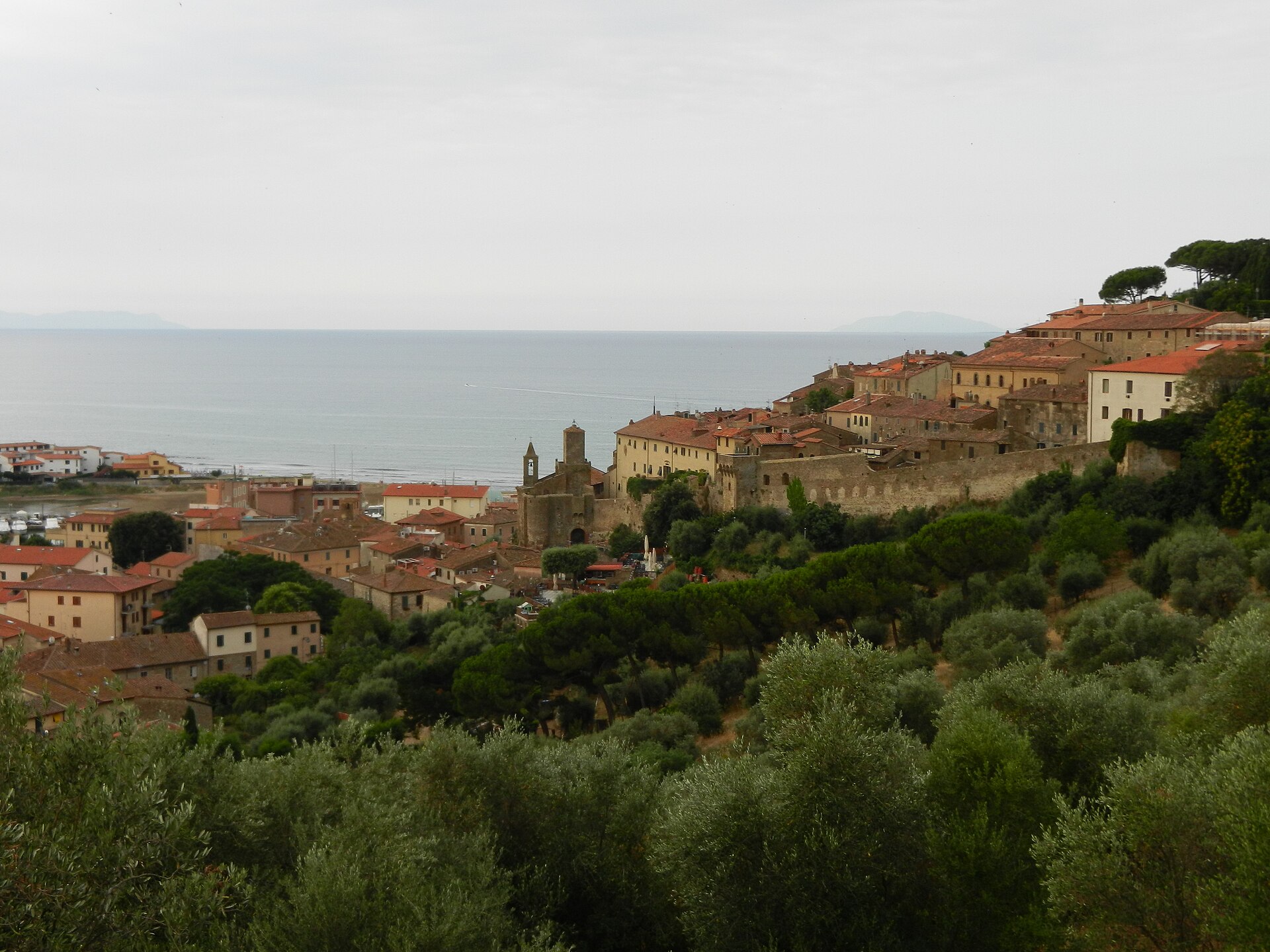
In summer, Castiglione della Pescaia is a seaside resort, and a good one. It is a long-running Blue Flag town, with a harbor canal through the middle and a walled borgo on the hill above. Plenty of visitors never go further than the sand, and that is fine.
But the town sits at the edge of a much bigger story. Behind it lies the plain that was once Lago Prile, a lagoon that gave Etruscan cities their route to the sea. Over the generations, engineers disagreed about what to do with that water. The first plan was to manage it; a later one filled it in. The losing idea survives as a nature reserve you can visit by boat.
Up in the hills, a country doctor found a lost Etruscan city in the 1880s and spent years proving everyone wrong. You can visit both in a single day, and the two stories explain each other.
A Place Shaped by Time
A fishery and a watchtower
The town’s name points to its origin: English Wikipedia links the “Pescaia” to a large fishery here. The oldest part of the castle is the Torre Pisana, a coastal watchtower the Pisans built around the 10th century. Pisa held the area, with interruptions, until the 13th century.
Pirates shaped the town’s layout. According to Italian Wikipedia, people moved from the lower settlement up onto the promontory for defense. The walls you see today mostly date from the 15th century, built first by the Aragonese and then by the Sienese.
Aragon, a pope’s nephew, and the Medici
In 1447 Alfonso of Aragon, king of Naples, took Castiglione after a siege of a few days and had the fortress strengthened. That is why the castle is usually called the “Rocca aragonese.” Strictly speaking, it is a Pisan structure that the Aragonese reinforced.
In 1460 Alfonso handed Castiglione and the island of Giglio to the legate of Pope Pius II. The pope’s nephew, Antonio Piccolomini, received them. In 1558 both were sold to the Medici for 30,000 lire, according to the local history site Tuttatoscana. A port was built around 1590.
Ximenes versus Fossombroni: regulate or drain?
For centuries Lago Prile was both a resource and a killer. As the Ombrone river silted it up, the lagoon turned to marsh, and malaria followed.
In 1765–68 the Jesuit engineer Leonardo Ximenes built the Casa Rossa, the “Red House,” at the lagoon’s outlet. His idea was not to drain the marsh but to control its water levels. He wanted to stop the water from stagnating and keep the lake for fishing. The building’s sluices and gates, some still partly working, were the tools of that plan.
His successor, Pietro Ferroni, reversed course from 1781 toward partial draining. Then, on 27 November 1828, Grand Duke Leopoldo II authorized Vittorio Fossombroni’s far bigger scheme. The plan was to fill the lake with river sediment, a technique called colmata. Alessandro Manetti directed the work, digging drainage basins and three channels: the Bilogio, San Leopoldo, and San Rocco.
Fossombroni’s approach won, but slowly. According to the Treccani encyclopedia, by 1861 only 5,500 of a targeted 62,000 hectares of the Maremma had been reclaimed. Large-scale works only sped up after 1905. The Diaccia Botrona wetland, behind the town, is what remains of the lake. In a sense, it is Ximenes’s “regulate, don’t drain” option, still alive.
The doctor who found a city
Isidoro Falchi was a country doctor from Montopoli in Val d’Arno, with no archaeological training. In May 1880, at the hill village of Colonna di Buriano, he identified the lost Etruscan city of Vetulonia. His evidence was massive “cyclopean” walls, tombs, and coins inscribed “Vatl.”
The archaeological establishment pushed back hard. His leading opponent was Luigi Amedeo Milani, director of the Etruscan museum in Florence. Even so, a royal decree of 22 July 1887 renamed the village Vetulonia. Ministerial commissions and the Accademia dei Lincei only confirmed Falchi’s identification in 1893–94.
Falchi dug at Vetulonia for more than 25 years, and his finds went to Florence. The Treccani biographical dictionary notes the limits of his documentation. That is a fair caveat, but it does not change the result: the doctor was right.
What to See and Do
The walled borgo
Walk up from the harbor into the old town. According to Italian Wikipedia, the 15th-century walls still enclose the borgo with 11 towers: square medieval ones and round Renaissance ones. The “Portaccia,” in the lower part, is the only surviving piece of the Pisan walls apart from some towers.
On the way up, the town’s tourism site points out the Porta Urbica, the church of the Madonna del Giglio, the Clock Tower, and Palazzo Centurioni. The lanes are steep, so wear proper shoes.
The castle, from outside
The castle stands at the top: three towers with sloping bases, arranged in a triangle, with the Pisan tower on the east. After Italian unification it became state property and was left abandoned. It is now privately owned again and, as the town’s own tourism site says, difficult to visit. Enjoy it from the lanes around it and don’t plan on going inside.
Casa Rossa Ximenes and the Diaccia Botrona
The Casa Rossa is now a multimedia museum and the starting point for guided visits to the Diaccia Botrona reserve. You can join boat trips, walks, cycling, and birdwatching outings from here. This is the single best thing to do in Castiglione that is not the beach.
The Region of Tuscany’s news portal, intoscana, gives the reserve 1,274 hectares. It has been a reserve since 1996 and is a Ramsar-listed wetland. The same source names mallards, coots, and shelducks, and reports a growing presence of flamingos. On a former island in the marsh, the Isola Clodia, stand the ruins of the abbey of San Pancrazio al Fango, a reminder that this was once open water.
For boat-trip times and bookings, contact the museum through Musei di Maremma.
Vetulonia: the museum
Vetulonia is a frazione of Castiglione, up in the hills, and it deserves at least half a day. Start at the Museo Civico Archeologico Isidoro Falchi, known as MuVet, on Piazza Vetluna. It reopened on both floors in 2000 and has seven rooms.
The collection covers roughly a thousand years of Etruscan history. Highlights include Villanovan grave goods and gold and silver from Orientalizing-period circle tombs, among them the Circolo dei Leoncini d’Argento and the Circolo della Fibula d’Oro. There is also the carved stone stele of a warrior named Feluske, which the museum uses as its logo. Musei di Maremma says the museum is accessible to visitors with disabilities, and it also stages temporary exhibitions. Check the museum’s website for hours and current shows.
Vetulonia: the tombs and the city
The open-air sites belong to the Parco Archeologico di Vetulonia. The Tomba della Pietrera is a monumental 7th-century BC tumulus on the old “road of the tombs.” Further down is the Tomba del Belvedere, an archaic chamber tomb. As of September 2026, the park lists the Tomba del Diavolino II as temporarily closed.
In the village itself, the Poggiarello Renzetti excavations show part of the Etruscan town from the 3rd to the mid-1st century BC. Costa Murata and Costia de’ Lippi add a sanctuary area and Hellenistic terraced houses. Stand at the edge of the village and look toward the sea. In Etruscan times you would have been looking out over Lago Prile, the lagoon that connected this city to the Mediterranean. Check opening days and weather-alert closures on the park’s official page.
The beaches
Castiglione’s beaches have held the Blue Flag year after year, and the award also covers the port of Punta Ala, in the same comune. In July and August they are busy. In June and September you get the same sea with far more room.
Eating Like a Local
This is a fishing town by name and by history. The old lagoon was a fishery for centuries, and Italian Wikipedia lists eels, sea bass, sole, and mullet among the fish of today’s Diaccia Botrona. When you eat by the harbor canal, ask what came in that day rather than ordering from the laminated menu.
Inland, the food turns to the Maremma’s herders’ kitchen. Look for acquacotta, the butteri’s bread-and-vegetable soup, and tortelli maremmani filled with ricotta and chard. Cinghiale alla cacciatora is wild boar braised in red wine with olives. These are the dishes to order in Vetulonia or on the hill roads.
For wine, stay local. Vermentino is the largest category of the Maremma Toscana DOC, and it suits this coast well.
Getting There and Getting Around
By car. The practical way to arrive is by car from the Aurelia, via Grosseto. Vetulonia is a separate drive up into the hills. Most of the beach and the borgo can be done on foot once you have parked.
By train and bus. Castiglione has no railway station of its own. The nearest mainline hub is Grosseto, on the Pisa–Rome Tirrenica line. From there, check Autolinee Toscane for the current Grosseto-area bus routes.
Summer ZTL. In recent summers, the comune has run an evening limited traffic zone (ZTL) in the center from mid-June to mid-September. It is camera-enforced, with red and green signs at the entrances. Some streets allow no parking at all during those hours, and others let cars parked earlier stay put. Hours and zones can change from year to year, so check the comune’s ZTL page before you drive in on a summer evening. If your accommodation is inside the zone, ask it to arrange a permit.
Timing. Go to Vetulonia in the morning and save the Casa Rossa and the borgo for the afternoon. In summer, the borgo is at its best after the beach crowd has gone home.
Nearby
- Grosseto has Medici walls you can walk on top of, the MAAM museum, and Etruscan Roselle, Vetulonia’s sister city across the old lagoon.
- Follonica is the next Blue Flag beach town up the coast, in the Colline Metallifere area.
- Gavorrano is a hill town with a mining heritage, where the Colline Metallifere begin.
- Massa Marittima is the finest medieval hill town inland from this stretch of coast.
- Scansano is the heart of Morellino wine country and the Maremma’s former summer capital.
Information is provided in good faith and may change. Always confirm opening hours, prices, and event dates with the official source before you travel.