
Town · Maremma
Sovana
A Cathedral, a Necropolis and 122 Residents
Last updated:
- Region
- Maremma
- Province
- Province of Grosseto
- GPS
- 42.65694, 11.64444
- Best season
- spring and autumn
- Time needed
- half day to full day
- Difficulty
- moderate (the village is flat; the necropolis and sunken roads have uneven, sometimes slippery paths)
- Known for
- Etruscan necropolis, vie cave (sunken roads), Romanesque cathedral, Pope Gregory VII, the San Mamiliano gold hoard
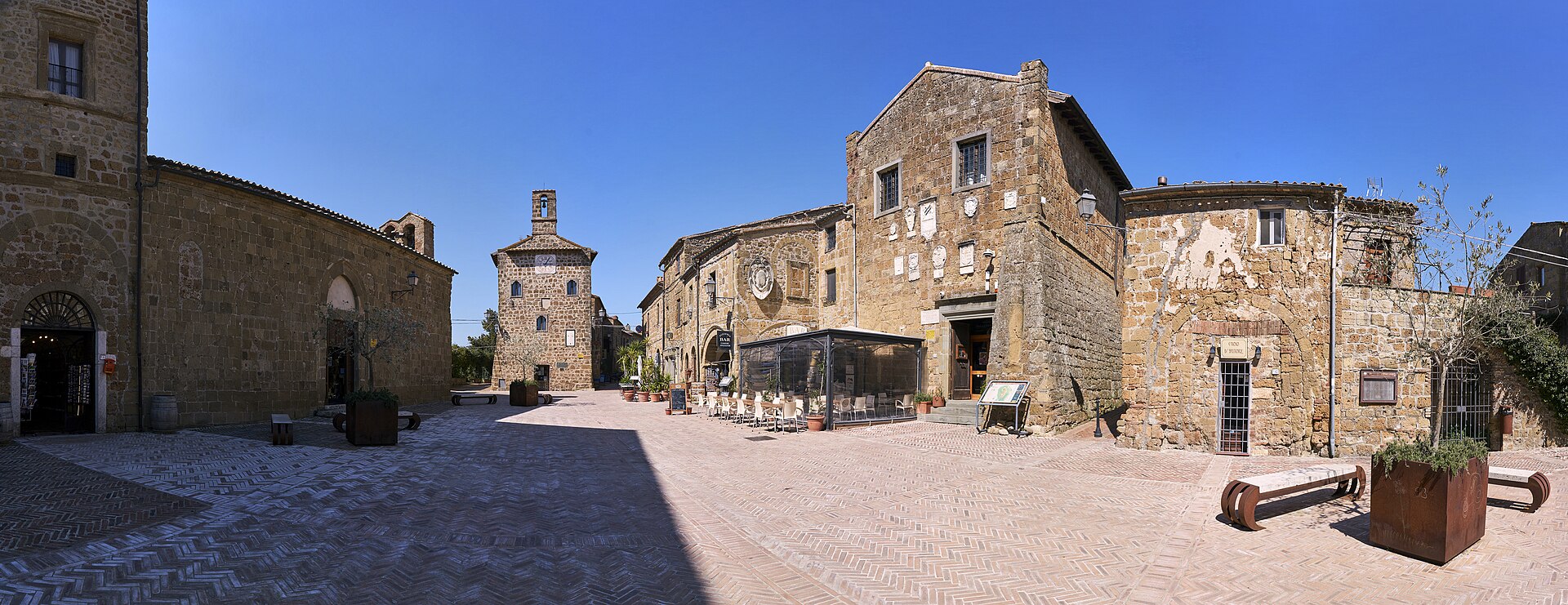
Sovana is almost absurdly small for what it holds. At the 2011 census, 122 people lived in the village itself. Yet it has a cathedral, a 9th-century altar canopy, a medieval town hall, a ruined fortress and, in the woods below, an Etruscan necropolis of about 100 monumental tombs. It is a frazione (village district) of the comune of Sorano, in the tufa country of the southern Maremma.
The reason is simple: Sovana used to matter a great deal. It was an Etruscan town, then a Roman one, then a bishop’s seat, and later the capital of a medieval county. Then plague emptied it. What survives is a single main street, with the big buildings still standing along it, like furniture left behind in a house that has lost its family.
Come for the combination, not for any one thing. In a single day you can walk an Etruscan road cut into rock, stand in a crypt restored in 1999, and see the museum that was robbed of its Roman gold in 2019. Few villages this size can offer that.
A Place Shaped by Time
Etruscan Suana and the Romans
The Etruscan town of Suana grew from the 7th century BC. Its fate was tied to Vulci, the great Etruscan city to the south. When Rome conquered Vulci in 280 BC, Suana was Romanized and became a municipium, a self-governing Roman town. The people of Suana buried their dead in the cliffs around the village, and that cemetery is why most visitors come today.
Bishops, counts and a move to Pitigliano
By the 5th century AD, Sovana was already a bishop’s seat. Around the year 1000, the Aldobrandeschi family built a castle here and made Sovana the capital of their county, which covered much of the inland south. In 1293 Anastasia Aldobrandeschi married Romano Orsini, and the seat of power moved to Pitigliano. The Orsini held Sovana into the 15th century; then came Siena, and after Siena, the Medici. The cathedral is still a co-cathedral, and the diocese still carries the village’s name: Pitigliano-Sovana-Orbetello.
The village that nearly vanished
Sovana’s decline was steep. After a series of plague epidemics, only 24 people lived here in 1702. The village survived as a near-ghost until the 20th century, when archaeologists and then tourists rediscovered the tombs.
A pope from Sovana? What the sources actually say
Sovana is proud to be the birthplace of Hildebrand, who became Pope Gregory VII, one of the most forceful popes of the Middle Ages. The village celebrated the thousandth anniversary of his birth in 2020, taking 1020 as the year, and his remains were brought here on 22 February 2020 for the occasion. Italian Wikipedia says it is “known for certain” that he was born at Sovana, probably between 1015 and 1020.
The scholarly picture is more careful. The Dizionario Biografico degli Italiani, published by Treccani and the standard Italian biographical reference, says information on Hildebrand’s life is scarce. It says he was born “forse” (perhaps) at Soana, today’s Sovana, between 1025 and 1030. So tradition and local pride point firmly to Sovana, but the standard reference hedges. That is worth knowing when a guide or a plaque tells you the matter is settled.
What to See and Do
The Duomo (Concattedrale dei Santi Pietro e Paolo)
The cathedral is the reason to walk the full length of the village. Look closely at the capitals, which are carved with biblical scenes. The crypt holds relics of San Mamiliano and has been open since a 1999 restoration. Inside you will also find a Crucifixion of St Peter painted in 1671 by Domenico Manenti.
Santa Maria Maggiore and its ciborium
This church has 12th-century origins and was remodeled in the 16th century. Its treasure is a 9th-century ciborium, a stone canopy over the altar raised on four tapering columns. Pieces this early are rare, so give it a few minutes. The walls carry frescoes dated 1508 and 1527.
Palazzo Pretorio and the Rocca Aldobrandesca
The Palazzo Pretorio, the old seat of local government, is documented in 1208. The Sienese restored it after 1413. The Rocca Aldobrandesca, the castle built around the year 1000, stands in ruins on Etruscan foundations.
The Necropoli di Sovana (Etruscan necropolis)
The necropolis holds about 100 monumental tombs, split into two sectors by the Calesine stream. The named tombs include the Sirena, the Tifone, the Pola and the Tomba dei Demoni Alati (Tomb of the Winged Demons). Wear proper shoes: the paths run through woodland and along rock faces. The site belongs to the Parco Archeologico “Città del Tufo” (the Tufa City Archaeological Park).
The Tomba Ildebranda: check before you go
The Tomba Ildebranda is Sovana’s most famous monument, and its story is more complicated than most guides admit. It dates from the 3rd–2nd century BC. It is a temple-like structure cut from the living tufa, with six columns on a podium and staircases at the sides. A corridor leads down to a burial chamber with a single bench, found empty and probably looted in antiquity. Gino Rosi found it in 1924, and it was named for Ildebrando di Soana, the future Gregory VII. The archaeologist Ranuccio Bianchi Bandinelli studied it in 1929, and it was restored in 1974.
In April 2013, a court ended a 13-year legal dispute by returning the land to a private family. The court accepted that the English traveler George Dennis had already described the tomb in 1843. That was before the 1909 law that made archaeological finds state property. The Comune di Sorano was ordered to pay the family about €293,000 in damages. The park still lists the tomb as an itinerary and notes its deteriorated condition, but it does not say whether you can visit. We could not confirm current access, so ask before you plan your day around it. The quickest way is to phone the park office in Sovana (+39 0564 614074) or email info@leviecave.it. The park’s Tomba Ildebranda page describes the monument, and the park is based on Piazza del Pretorio in Sovana itself.
The Cavone and the vie cave
The vie cave (sunken roads) are passages cut deep into the tufa, linking settlements and cemeteries. Their walls are sometimes more than 20 m high. The park itself corrects the romantic version: today’s depth is often more than 10 m greater than the original, because hooves wore down the floor and the roads were re-cut over the centuries. Nobody knows for certain why the Etruscans cut them. Drainage, travel, defense and ritual are all proposed.
The best-known example at Sovana is the Cavone. On its left wall, about 170 cm above today’s ground, you can find the Etruscan family name “Vertna“. The height shows how far the road has sunk since someone carved those letters. Later, in the Middle Ages, people added niches with sacred images, called scacciadiavoli (devil-scarers) to protect travelers.
The Museo di San Mamiliano and the stolen gold
In 2004, excavations beneath the former church of San Mamiliano found 498 gold solidi, late Roman coins, hidden in a ceramic pot. Above them lay Renaissance burials and the remains of Roman baths. The sources agree the coins are from the 5th century but disagree on which emperors and mints they represent. The museum opened after restoration work that ran from 2004 to 2012.
Then, on the night of 3–4 November 2019, thieves disabled the alarm and the security cameras and took most of the coins on display. Reports differ slightly: one says 65 of 83 coins, another 66. We found no report of their recovery. Just know that the hoard you see is what the thieves left behind.
Practical note on the park
The Parco Archeologico “Città del Tufo” covers the necropolis, the Museo di San Mamiliano, the vie cave and sites around Sorano. Its office is in Piazza del Pretorio, Sovana (tel. 0564 614074, 0564 633099 or 0564 633767; info@leviecave.it). The park website does not publish hours or ticket prices, so phone or email before you go, especially outside summer.
Eating Like a Local
What to order
Sovana is a place for simple, hearty food. Look for acquacotta, the herders’ soup of onion, tomato, celery and wild herbs poured over stale bread, sometimes finished with an egg. Tortelli maremmani are large pasta squares filled with ricotta and chard, served with meat ragù or butter and sage. Around Sorano and Pitigliano, the thin cheese-topped fritter that Manciano calls ciaffagnone goes by the name migliaccio.
For something sweet, the neighboring town of Pitigliano makes the sfratto, a stick-shaped pastry filled with honey and walnuts. Its name means “eviction”, and by tradition it recalls the order that moved the Jews of Pitigliano, Sovana and Sorano into Pitigliano’s ghetto.
Wine with Sovana’s name on it
Sovana gives its name to a wine. Sovana DOC was recognized in 1999 and covers all of Pitigliano and Sorano and part of Manciano. Its red must be at least 50% Sangiovese, and there is a sweet Aleatico Passito. The better-known white is Bianco di Pitigliano DOC, approved in 1966 and, according to WineNews, the sixth DOC recognized in Italy. Its consortium is the Consorzio di Tutela Bianco di Pitigliano e Sovana.
Where to eat
Choice inside the village is limited. A 2023 Italian regional guide lists Taverna Etrusca (Piazza del Pretorio 16), a rustic place with a summer terrace. For more choice, drive to Pitigliano, where Il Tufo Allegro is selected by the MICHELIN Guide. Check opening days before you set out.
Getting There and Getting Around
By car
Sovana is a car destination. It lies about 75 km from Grosseto and about 9 km from Sorano. The comune of Sorano has no railway station. Pitigliano, the area’s bus hub, has Autolinee Toscane services to Grosseto, Orbetello and Siena, but we could not confirm a bus link to Sovana itself. If you are relying on public transport, check at-bus.it first and plan the last stretch in advance.
Parking
Sovana has paid car parks. Current tariffs were not published in any source we could check, so bring coins or a card. The village itself is short and flat, and you will want to walk it anyway.
Walking the necropolis and vie cave
The tombs and sunken roads are reached on foot from the village. Paths are uneven and can be slippery after rain, so wear shoes with grip. From October, driven wild-boar hunts take place in the Tuscan countryside on set days of the week. On walks outside the park’s marked routes, wear bright clothing and stay on the trail.
Nearby
Pitigliano is the tufa town built on a cliff edge, with a synagogue, a Jewish museum and a web of its own vie cave.
Sorano has the Orsini fortress, the Masso Leopoldino and, in its outlying villages, the remains of a tiny county that stayed independent until 1616.
Saturnia is where you go for the free thermal water of the Cascate del Mulino, plus a Roman gate on the old Via Clodia.
Montemerano keeps the “cat-flap Madonna” in its church of San Giorgio and has one of the region’s most celebrated restaurants.
Terme di Sorano is a thermal resort in a park near Sorano, with a year-round warm pool, for when you want hot water with changing rooms.
Information is provided in good faith and may change. Always confirm opening hours, prices, and event dates with the official source before you travel.