
Town · Val d'Orcia
Monticchiello
The Village That Writes Its Own Play Every Summer
Last updated:
- Region
- Val d'Orcia
- Province
- Province of Siena
- GPS
- 43.0683, 11.7253
- Best season
- summer for the play; spring and autumn for quiet lanes
- Time needed
- 2–3 hours; a full evening in summer
- Difficulty
- easy to moderate (a small hilltop village with sloping lanes; no practical bus, so come by car or taxi)
- Known for
- Teatro Povero, the autodramma, pici, a 13th-century church, medieval walls
A Village That Talks About Itself in Public
Most Tuscan hill villages are admired from the outside. Monticchiello asks to be listened to. Every summer since 1967, the people who live here have written a new play about their own lives. Then they perform it themselves, on summer evenings, in their own square.
This is not a costume pageant laid on for visitors. The Teatro Povero di Monticchiello (the “Poor Theater of Monticchiello”) calls each new show an autodramma, a play written and acted by the community about itself. The idea grew out of a crisis. When sharecropping collapsed after the Second World War, the village lost about half its people. The ones who stayed decided to talk about it, out loud, in the piazza.
That decision still shapes daily life. The theater’s cooperative runs the village restaurants, a museum, a guest house, and a shop. So when you order pici here or book a seat for the play, you are part of how Monticchiello keeps going. Come for a summer performance if you can. If your dates don’t match, come anyway for the walls, the church, and the story.
A Place Shaped by Time
A walled village on the Pienza side
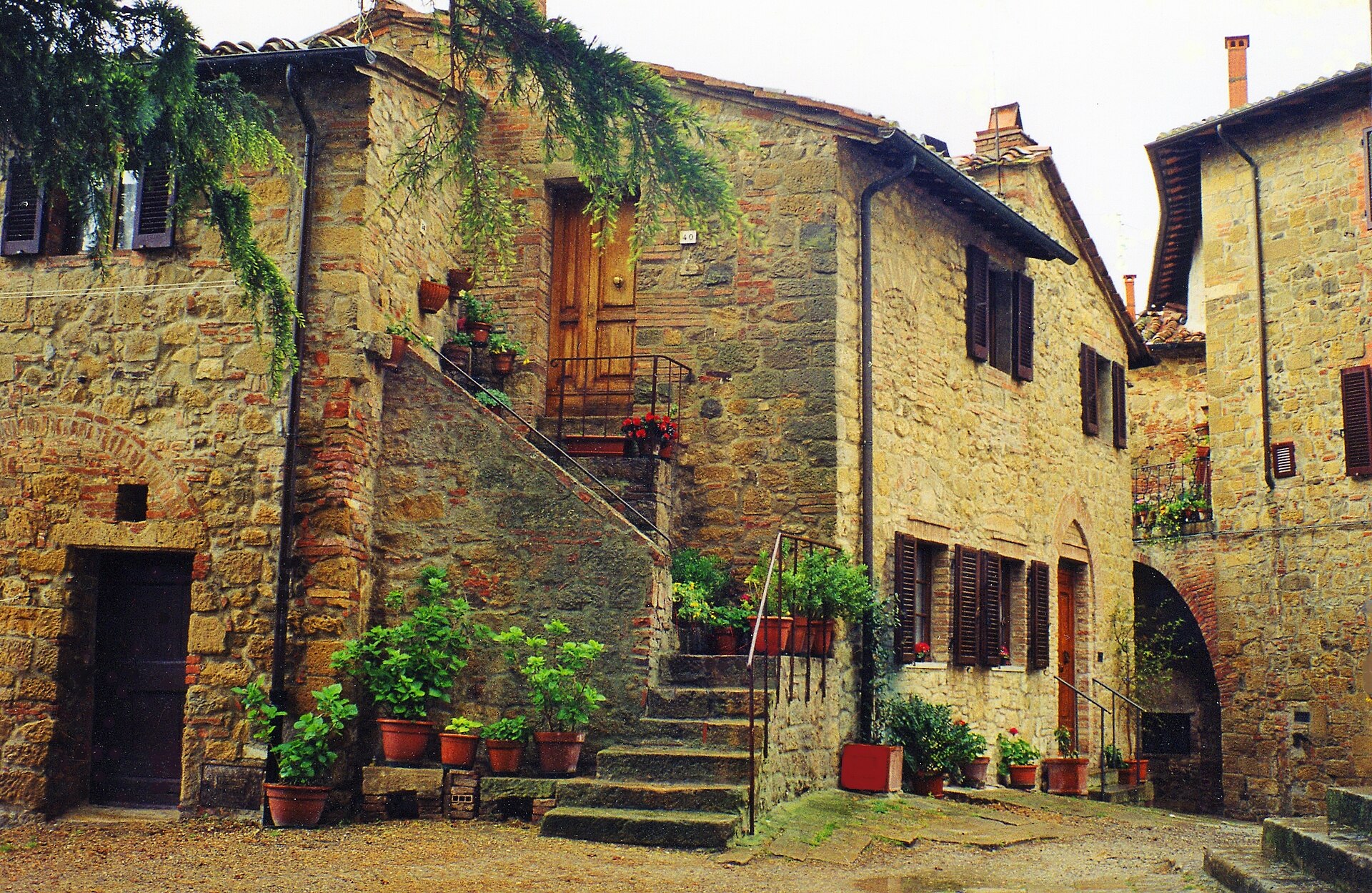
Monticchiello belongs to the comune of Pienza and lies inside the UNESCO World Heritage area of the Val d’Orcia. Its medieval walls still wrap around the village. Above them rises the Cassero, the old defensive tower, which you will see from almost every lane.
The parish church was built in the second half of the 1200s, when the community was growing. According to the Teatro Povero’s own history of the building, its T-shaped plan follows the Burgundian Romanesque-Gothic model that Cistercian monks brought to Italy. The village you walk through today is small and built in stone, and it rewards slow looking.
The battle of April 1944
Monticchiello remembers the Second World War as something that happened in its own streets. On 6 April 1944, partisans fought Fascist Republican troops here, in what is remembered as the “Battle of Monticchiello.” The Fascist troops were forced to withdraw. Sources disagree on how many men fought on each side.
Two partisans lost their lives. Mario Mencatelli was awarded the Gold Medal of Military Valor after his death, according to the partisans’ association ANPI. A memorial stone for Marino Cappelli records that he fell here for liberty. Keep these names in mind if you see a play here. The war and the Resistance are part of the village’s own story, and they returned on stage in the 60th play.
When the sharecroppers left
For centuries the land around Monticchiello was worked under mezzadria (sharecropping). Families farmed estates they did not own and split the harvest with the landowner. The village museum now fills an 18th-century granary, the kind of building where that harvest was once stored for the landlords.
After the war the system fell apart. According to the Teatro Povero, the village went through “una profonda crisi” (a deep crisis) at the start of the 1960s, and its population halved. Farms emptied around it.
In 1967 the villagers answered in an unexpected way. As Legacoop Toscana puts it, “in un paese senza un teatro venne deciso di aggregarsi attorno a un’idea di teatro in piazza.” In a village without a theater, people decided to gather around the idea of theater in the square. The first play was L’eroina di Monticchiello (The Heroine of Monticchiello).
How a whole village writes a play
The method is the most remarkable part. According to the theater’s history, an assembly of villagers meets and argues for months. A smaller group then turns their ideas into a script. The actors are not professionals, and their style draws on old traditions of oral storytelling.
The word autodramma itself came from outside. The theater credits the director Giorgio Strehler with proposing it. The writer Mario Guidotti, who helped with the early scripts, called himself the “notary of Monticchiello.” Andrea Cresti, a founding member, has directed the summer productions since 1981.
In 1980 the group formed a cooperative, the Cooperativa del Teatro Povero. In 2026 it staged its 60th autodramma, L’occhio oltre (The Eye Beyond). That play turned the theater’s own history into drama. It followed a boy born in 1944 through sharecropping, war, the Resistance, peasant struggles, and the dream of the cooperative.
What to See and Do
The summer play in Piazza della Commenda
The play is the reason to plan your trip around Monticchiello. Performances take place on summer evenings in Piazza della Commenda, usually from late July to mid-August. The village itself is the set, and the neighbors are the cast.
Book ahead through the Teatro Povero booking page, which also offers dinner packages with the cooperative’s restaurant. The villagers write and perform in Italian, so read up on the season’s theme beforehand. You will follow far more than you expect from faces, voices, and the setting.
TePoTraTos, a museum that behaves like a stage
The TePoTraTos museum (“Scenes of Traditional Popular Tuscan Theater”) is on Piazza Nuova, in that 18th-century granary. The Fondazione Musei Senesi describes it as suspended between museum and theatrical show. It celebrates peasant life and the popular poetry of the Tuscan countryside.
Two rooms stay with you. La camera oscura (the dark room) invites you to follow sounds and voices in dim light. La quercia (the oak) shows an oak tree hung upside down, a picture of “the world turned upside down.” Entry is free, and donations are welcome. Allow half an hour.
The Pieve dei Santi Leonardo e Cristoforo
The Pieve dei Santi Leonardo e Cristoforo (parish church of Saints Leonard and Christopher) was first dedicated to San Leonardo of Limoges. It has a T-shaped plan and walls of squared local sandstone. The façade is the most decorated part. Its portal has slender colonnettes rising to a pointed gable, and its rose window is divided by small columns carrying pointed trefoil arches.
The interior has a turnaround story. In the 18th century the walls were whitewashed, hiding 14th-century Sienese-school frescoes. Five Baroque altars went in, and a huge plaster high altar was finished in 1797. Then, in 1933, a restoration removed the Baroque altars and plaster and uncovered the frescoes, some whole, some in fragments. Look for the painted surfaces that survived two centuries under whitewash.
The walls and the Cassero
Walk the lanes inside the walls and let the village’s shape guide you. The medieval Cassero tower is state property and not open to visitors, but it dominates every view.
Eating Like a Local
Pici, made the village way
This is pici country. The regional tourism portal, Visit Tuscany, describes these thick, hand-rolled strands of flour and water as “laces” connecting Val d’Orcia villages, Monticchiello among them.
The cooperative runs two restaurants that take turns. The Taverna di Bronzone, in a crypt facing the square, opens mainly during the summer shows and on some holidays. Bronzino covers the rest of the year. Its own page promises strictly local, seasonal ingredients and adds, with feeling, “we don’t want to give up our pici!” Details and bookings are on the restaurants page.
Cheese and wine from the Pienza side
Pienza, next door, is a pecorino town, largely thanks to Sardinian shepherd families who settled on abandoned farms from the 1960s. One note on labels: “Pecorino di Pienza DOP” does not exist. The protected cheese is Pecorino Toscano DOP. Pienza’s barrique-aged pecorino is recognized as a regional traditional product.
For a tasting, Caseificio Cugusi, founded in 1962 by a couple from Sardinia, offers bookable tastings on the Pienza road. Strictly speaking, it sits in Montepulciano‘s territory. For wine, Capitoni, a family farm near Pienza, makes Orcia DOC and offers cellar visits and tastings.
Getting There and Getting Around
Plan on driving. We found no practical bus service to Monticchiello in official timetables. Without a car, the realistic option is a taxi from Pienza or Montepulciano. Autolinee Toscane’s line 112 links Siena with both towns. The nearest mainline station is Chiusi-Chianciano Terme, on the Florence–Rome line.
Once you arrive, explore on foot: the lanes inside the walls are best seen that way. They slope, so wear decent shoes. If you are coming for the play, think about the drive home on dark country roads. The cooperative’s guest house makes a night in the village an easy answer.
What we know vs. what’s repeated: Some English sources describe Monticchiello as a town in its own right. It is a frazione of Pienza, a village inside Pienza’s municipality, and the Comune di Pienza is its local authority. Better still, think of it the way the villagers do: the Teatro Povero is a living community, not a show put on for visitors.
Nearby
- Pienza: the Renaissance town that runs Monticchiello, with its own separate UNESCO listing and a serious pecorino habit.
- Castelmuzio: an edge village in the comune of Trequanda, built around a confraternity and a stone linked to San Bernardino.
- San Quirico d’Orcia: a Medici-era garden, a portal attributed to Giovanni Pisano, and the Barbarossa festival.
- Bagno Vignoni: a village whose main square is a pool of hot spring water (look, don’t swim).
- Montepulciano: just outside the valley, and the other easy taxi base for Monticchiello.
Information is provided in good faith and may change. Always confirm opening hours, prices, and event dates with the official source before you travel.