
Maker · Val d'Orcia
Meet the Oleificio Val d’Orcia
The Growers Who Built Their Own Mill
Last updated:
- What they make
- extra virgin olive oil (Terre di Siena DOP, Toscano IGP, organic, and an unfiltered early-harvest oil), plus a shop of local foods
- Region
- Val d'Orcia
- Location
- Loc. La Fonte, Castiglione d'Orcia (Province of Siena)
- Generation
- a growers' cooperative, founded in 1962 according to its own history page
- Visit possible
- by appointment; tastings with a mill tour are listed on the cooperative's website; contact the cooperative to arrange one
A mill that belongs to the growers
Many famous Tuscan oils come with a family name and a villa on the label. The Oleificio Val d’Orcia is different. It is a cooperative: the olive growers of the Val d’Orcia own the mill together, bring their harvest to it, and sell the oil under one name. Its home page sums up its pitch in a line: “50 anni di esperienza,” fifty years of experience.
The mill stands at Loc. La Fonte, below the hill town of Castiglione d’Orcia. Don’t expect a picturesque stone frantoio (olive mill) in a medieval cellar. It is a working plant, with modern machinery, a bottling room, and a large sales and tasting area. That is exactly why it is worth your time. This is a working mill, not a museum, and the cooperative says it became the hub of oil processing in the area in the 1990s.
To understand why a cooperative mill exists here at all, you have to go back to the years when the valley’s old farming world was falling apart.
Story: from sharecroppers’ valley to growers’ cooperative
For centuries, the Val d’Orcia was farmed under mezzadria, or sharecropping. Families worked land they did not own and split the harvest with the landowner. After the Second World War that system collapsed, and the farms emptied. In the village of Monticchiello, the population halved; in 1967 the villagers answered by writing a play about their own lives, and they still stage one every summer.
Around the same time, the olive growers took a more practical step. According to the cooperative’s history page, the Cooperativa Oleificio Val d’Orcia was born in 1962 “to orchestrate the activity of a mill built by the Ente Maremma.” The Ente Maremma was the state agency set up in 1951, under Italy’s post-war land reform, for the Tuscan and Lazio Maremma. That reform broke up large estates and gave land to farm workers, and cooperatives grew up alongside it to plan production and sell the harvest together.
The cooperative’s own account never mentions sharecropping, and we won’t claim a direct link. But the dates line up: it was born in the years the old farming system was coming apart. At first, the cooperative says, it had only a few founding members. The mill opened only in the heart of the oil season. It says that in those first years it handled about 1,500 quintals of olives, around 150 tonnes.
Bad weather and a pact
The next turning point, in the cooperative’s telling, came with the weather. In 1985 “climatic events” put the valley’s olive groves to a hard test. Two years later, in 1987, local growers signed what the cooperative calls “a historic pact.” In its words, the pact united the growers’ efforts in running a single mill. Innovarurale, the innovation portal of Italy’s Rete Rurale Nazionale (national rural network), calls it an agreement among local growers’ associations to run one mill. The portal also says the 1985 damage came from frost.
In the 1990s, the cooperative says, it became the center of oil processing for the area. It made significant investments that expanded its capacity, and began distributing its members’ oil commercially. In 2001, both the cooperative and Innovarurale say, a separate company, Enoteca Toscana, was set up to promote and sell the oil.
Growing past the valley
New milling equipment arrived in 2008, and 2013 brought a commercial and logistics expansion. Since 2014, the cooperative says, its membership has grown to several hundred growers. Its area now runs “through the olive-growing heart of the Val d’Orcia” as far as Seggiano. That comune sits on the northwestern foothills of Monte Amiata, above the Orcia valley, in the Province of Grosseto. Seggiano’s land, the cooperative notes, is known for a local variety, the Olivastra seggianese.
That is the real story here: not one estate, but hundreds of growers sharing a mill that none of them could run alone.
The Products
The cooperative sells several lines of extra virgin olive oil. It describes them as follows, and we have kept to its own words.
The Terre di Siena DOP carries a protected designation of origin. The cooperative says it is made from cold-processed olives and keeps “clean aromas, a rich taste, and aromatic balance.” The Toscano IGP carries the Tuscan regional protected indication; the cooperative presents it as an elegant oil “designed to go with everyday cooking.”
The organic Toscano is labeled “leggermente fruttato,” lightly fruity. The cooperative describes delicate fruit, fresh green notes, hints of artichoke and thistle, and a gentle peppery finish. There is also a line of 100% Italian oil. An oil branded GEO2 is presented as sustainable and fully traceable, from a project supported by the Regione Toscana.
Primolio: the first oil of the season
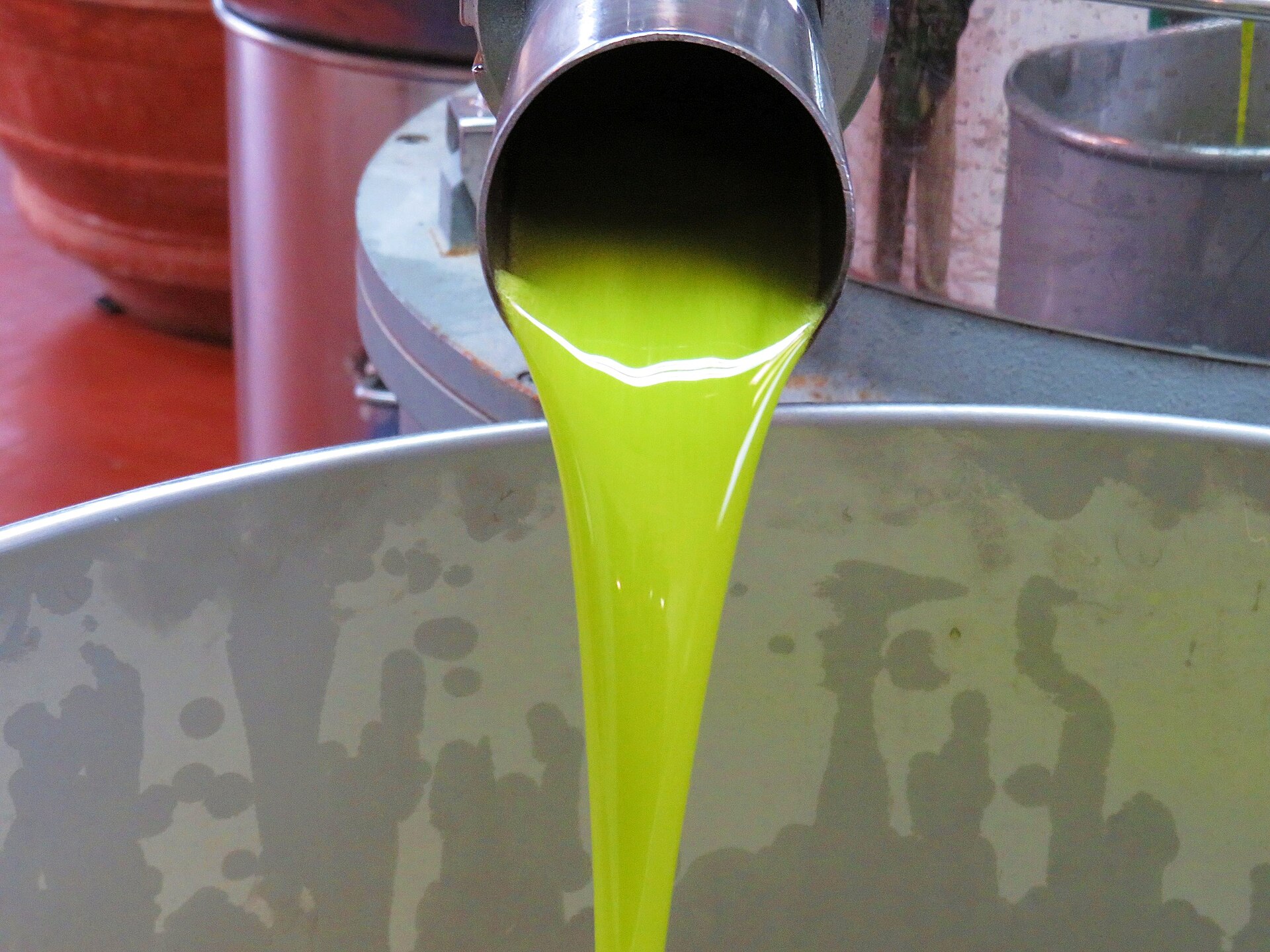
The most interesting bottle for a visitor is the Primolio, the season’s first oil. It is unfiltered and made from a single variety, Correggiolo. The cooperative says the olives for it are picked “very early,” in the second half of October.
The tasting notes promise an intense green color and an “intense fruity” oil that recalls fresh grass and unripe olives. It is bitter and spicy, with a long finish of artichoke and thistle. The cooperative suggests using it raw: on bruschetta, on ribollita (Tuscan bread and vegetable soup), and on rustic traditional dishes.
Bitter is good
If that sounds aggressive, it is meant to. On its blog, the cooperative makes a point worth knowing: “amaro e piccante non sono difetti,” bitterness and pungency are not defects. Tasting a young oil next to a milder one is a good way to learn the difference.
Beyond oil, the shop stocks cheeses, cured meats, pasta, preserves, sweets, and wine. There is also an online shop on the cooperative’s website.
Inside the mill
The cooperative runs two continuous-cycle extraction lines made by Pieralisi. It says the temperature during processing never goes above 27 °C.
The website walks through the process step by step. The olives are loaded into a hopper and carried under suction to strip leaves and twigs, then washed. A hammer crusher breaks fruit and stones into a paste. The paste is then kneaded in heated tanks for 30 to 40 minutes, a step called gramolazione, until the oil begins to separate. A horizontal centrifuge splits oil, water, and pulp by density, without adding water. A vertical centrifuge then cleans the oil further.
Behind the production floor, the building has a bottling room and a storage room kept at a steady temperature, away from direct light. At the front is what the cooperative calls a large sales and tasting area.
Visiting the Oleificio Val d’Orcia
The cooperative’s website lists several “esperienze in frantoio” (mill experiences). The simplest, “Primo assaggio” (first taste), combines a tasting of two of its oils, bruschetta and small appetizers, and a guided tour of the production areas, from harvest to bottling. Longer versions add cured meats, Tuscan crostini, vegetables in oil, and a glass of wine.
Availability on the online booking pages changes, so contact the cooperative directly by phone, WhatsApp, or the form on its contact page. Check the shop’s opening times before you drive out.
When to go
Timing changes the experience. The cooperative’s blog notes that during the campagna olearia, the autumn milling season, the mill is in full swing. Outside that season, visits are quieter and leave more room to look at the process and ask questions. Autumn gives you noise, smell, and fresh oil. The rest of the year gives you time.
Make a day of it
The mill pairs well with Castiglione d’Orcia itself. One ticket covers its Rocca Aldobrandesca fortress and the small Sala d’Arte San Giovanni, with its Madonna by Simone Martini and workshop. The same ticket covers the Rocca a Tentennano at Rocca d’Orcia next door. They open seasonally, roughly April to early November; check the current season on the Fondazione Musei Senesi page.
If you are in the valley in early December, the new oil has its own party. San Quirico d’Orcia‘s Festa dell’Olio (olive oil festival) usually falls around the Immacolata holiday weekend, with producers’ stands, guided tastings, mill visits, and plenty of bruschetta. Check the current year’s program on the Comune di San Quirico’s event page.
Information is provided in good faith and may change. Always confirm opening hours, prices, and event dates with the official source before you travel.