
Town · Val d'Orcia
Castiglione d’Orcia
Two Fortresses and a Madonna’s Swallow
Last updated:
- Region
- Val d'Orcia
- Province
- Province of Siena
- GPS
- 43.017, 11.617
- Best season
- spring and autumn (the fortresses and gallery open seasonally, roughly April to early November)
- Time needed
- half day, or a full day with Rocca d'Orcia
- Difficulty
- moderate (steep lanes and a climb to the fortress)
- Known for
- Rocca Aldobrandesca, Simone Martini, Pietro Lorenzetti, olive oil, Via Francigena
A Hilltop Where a Child Holds a Bird
From the road below, Castiglione d’Orcia is a fortress on a hill, across from the tower of Rocca d’Orcia. It is worth leaving the road, because this small hill town holds a painting worth the detour on its own. In a former oratory in the old center, a Madonna by Simone Martini and his workshop shows the Christ Child gripping a small swallow. The Fondazione Musei Senesi describes it well: the Child holds it tight in his little hand, “like a toy.”
Then there are the fortresses. The Rocca Aldobrandesca crowns Castiglione itself. About a kilometer away, the tower of Rocca a Tentennano rises above the hamlet of Rocca d’Orcia. Together they watched the Via Francigena, the pilgrim road to Rome, at the southern edge of the Sienese state. Today one ticket covers both, plus the small gallery with the swallow.
Castiglione is also the seat of a large comune (municipality), 141.7 km² in area. It stretches from the valley floor up toward Monte Amiata. So the town is a good base for exploring two landscapes: the clay hills of the Val d’Orcia and the chestnut woods of the mountain.
A Place Shaped by Time
A fortress built for crossroads
According to the Fondazione Musei Senesi, the Rocca Aldobrandesca rose in the Middle Ages and is linked to the Aldobrandeschi, the powerful counts of southern Tuscany. Its hilltop position controlled the routes between Monte Amiata, the Val d’Orcia, and the Maremma. Inside the walls were homes, workshops, water cisterns, a 12th-century church, and a keep.
The story of this corner of the valley is a story of frontier politics. Castiglione and its neighbors sat on the edge of Siena’s territory, close to the Via Francigena. Whoever held these hills could watch who passed along the road below.
Bankers, raiders, and a saint
In the 14th and 15th centuries, the Salimbeni, Siena’s rich banking family, turned the valley into a private power base. From Rocca a Tentennano, Cocco Salimbeni raided neighboring villages until Siena defeated him in 1418. Decades earlier, in 1377, Catherine of Siena stayed at Tentennano. The two episodes sum up the valley’s Middle Ages well: holiness and violence, a short walk apart.
Decline and a long restoration
According to the Fondazione Musei Senesi, the Rocca Aldobrandesca lost its strategic importance once the Grand Duchy of Tuscany was formed. In the 17th century the Marquis Riario, lord of the fief, tried to build a palace on its remains, but the work was soon abandoned. A long decline followed. The fortress came back through more than twenty years of restoration. A panoramic staircase now takes you up through the complex.
What to See and Do
The Sala d’Arte San Giovanni and its swallow
The Sala d’Arte San Giovanni is small, and that is part of its charm. It occupies the former oratory of San Giovanni Battista, built between the late 16th and early 17th centuries, and opened as a museum in 2006. The core of the collection is five panels of the Madonna and Child by Sienese painters of the 14th and 15th centuries.
The star is the Madonna col Bambino (Madonna and Child) by Simone Martini and workshop, dated about 1320–25. Look closely at the Child’s hand, where he clutches the swallow. It is a tender, almost playful detail in an art usually full of solemn gold. The gallery also shows panels by Vecchietta and Giovanni di Paolo, and liturgical objects from local churches, including old stamps for marking bread.
Plan for 20 to 30 minutes. The Sala’s opening days can differ from the fortresses’, so check the current season on the Fondazione Musei Senesi page and the Comune’s museum page before you go.
The Pieve dei Santi Stefano e Degna
The town’s other great painting is not in the museum at all. Pietro Lorenzetti’s Madonna col Bambino hangs in the parish church, the Pieve dei Santi Stefano e Degna. The Comune calls it the painter’s “youthful masterpiece.” Locals know it as the Madonna delle Grazie (Madonna of Graces), and it is still a venerated devotional image. Visit it as a church, not a gallery: quietly, and not during services.
What we know vs. what’s repeated: Some English-language guides place Pietro Lorenzetti’s Madonna in the Sala d’Arte San Giovanni. According to the Comune di Castiglione d’Orcia, it is in the parish church of Santi Stefano e Degna. The Sala holds the Simone Martini, Vecchietta, and Giovanni di Paolo panels.
The Rocca Aldobrandesca
Climb up for the views as much as the stones. From the top, you look across the valley toward Rocca d’Orcia and out over the UNESCO landscape. The restored walls, cisterns, and keep give you a clear sense of how a hilltop fortress actually worked. Allow about an hour, including the climb.
Piazza Vecchietta
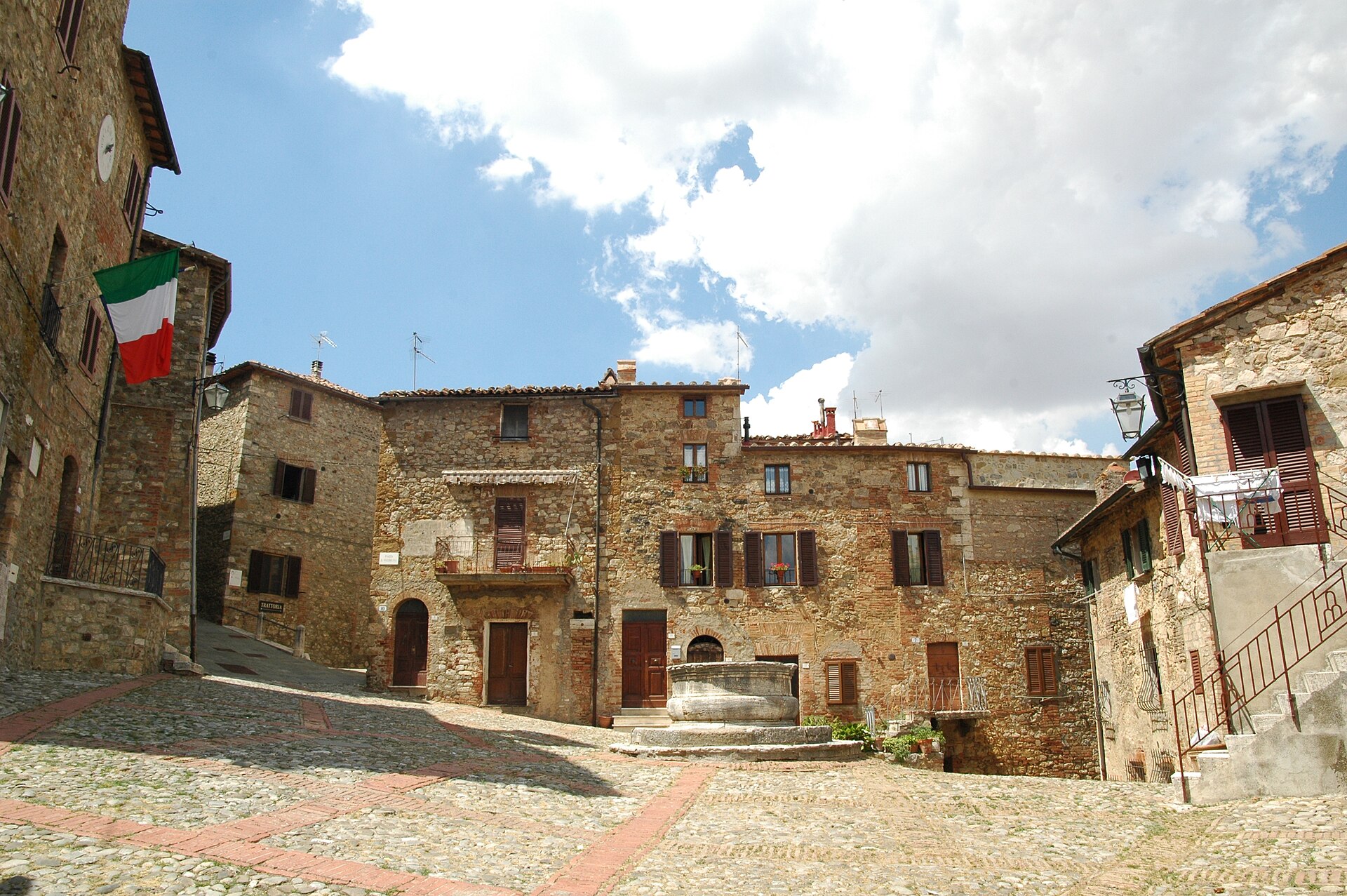
The main square is named after the painter Vecchietta. Italian Wikipedia notes that until the 1970s he was believed to be a native of Castiglione. At the center of the square stands a 16th-century travertine well. It’s a good spot to pause and let the town’s rhythm set in.
Rocca a Tentennano, next door
The tower of Rocca a Tentennano stands on a rock above the hamlet of Rocca d’Orcia, about a kilometer from Castiglione’s center. A footpath of about 300 m leads up to it, and the same ticket covers it. According to the Fondazione Musei Senesi, the tower stands more than 20 m high on a limestone rock and first appears in records in 853, as property of the abbey on Monte Amiata. It now hosts art exhibitions. See our Rocca d’Orcia profile for its full story.
How to plan your half day
Start at the top. Climb the Rocca Aldobrandesca first, while your legs are fresh. Then walk down to Piazza Vecchietta, see the swallow in the Sala d’Arte if it’s open, and step into the Pieve for the Lorenzetti. After lunch, drive or walk the short distance to Rocca d’Orcia and finish at Tentennano. Keep your ticket: it covers both fortresses and the Sala.
The frazioni: a comune of many villages
Castiglione’s territory includes five frazioni (outlying villages), each with a different character. Rocca d’Orcia is the Salimbeni stronghold next door. Bagni San Filippo has a free hot stream in the woods. Campiglia d’Orcia holds the Festa del Marrone (chestnut festival) on the last Sunday of October. Vivo d’Orcia grew around a Camaldolese hermitage and still sends spring water to Siena through a 63 km aqueduct. Gallina lies on the bus route toward Amiata.
Eating Like a Local
Oil from the growers’ cooperative
The best reason to shop in Castiglione is olive oil. The Oleificio Val d’Orcia is the valley’s olive growers’ cooperative, at Località La Fonte. By its own account, it brings “50 anni di esperienza” (fifty years of experience) to the job. It runs mill visits, tastings, and a shop. Its range includes DOP Terre di Siena and organic oils, and its own blog discusses the classic Tuscan cultivars Frantoio, Leccino, and Moraiolo. Read our profile of the Oleificio Val d’Orcia for the story of the cooperative. Autumn is pressing season, so a visit then tells you the most.
Pici, chestnuts, and mountain wine
The valley’s pasta is pici, thick hand-rolled strands of flour and water. You’ll find them on menus all over the valley. As you climb toward Amiata, the food turns to chestnuts, and Campiglia’s Festa del Marrone is the season’s big event.
For wine, the local appellation is Orcia DOC, a small area of family cellars between Brunello di Montalcino and Vino Nobile di Montepulciano. In the frazione of Campiglia, Cantina Campotondo was founded in 2000 to revive the village’s tradition of peasant mountain wine and welcomes visits.
The comune is also inside the production zone of Zafferano della Val d’Orcia, the valley’s revived saffron. Flowering and harvest fall in October and November.
Getting There and Getting Around
By car
Most visitors arrive by car. Castiglione lies on the road from San Quirico d’Orcia toward Monte Amiata. The old center is compact but steep, so wear good shoes.
By bus and train
Two Autolinee Toscane lines serve the town. Line 54A runs from Siena through San Quirico, Bagno Vignoni, Rocca d’Orcia, Castiglione, and on to the Amiata villages. Line 52A links Arcidosso and San Quirico, stopping at Castiglione and its frazioni. Timetables change with the school year, so check the line pages before you travel.
The nearest working train stations are Buonconvento, on the Siena–Grosseto line, and Chiusi-Chianciano Terme, on the Florence–Rome line. From either, you continue by bus. Ignore guides that suggest Torrenieri station: it has had no regular trains since 1994.
On foot
Stage 36 of the Via Francigena, from San Quirico d’Orcia to Radicofani, offers an optional detour to Castiglione d’Orcia. It’s a long, demanding stage, so the detour makes most sense as a separate short walk from Bagno Vignoni or Rocca d’Orcia.
Nearby
- Rocca d’Orcia (about 1 km): the Salimbeni tower of Tentennano, on the same ticket as Castiglione’s fortress.
- Bagno Vignoni (short drive): a village square made of hot water, and the mills below it.
- San Quirico d’Orcia (short drive): a Medici-era garden and a church with remarkable carved portals.
- Bagni San Filippo (toward Amiata): a free hot stream in the woods, with rules you need to know.
- Radicofani (south): the papal border fortress that was blown up in 1735.
Information is provided in good faith and may change. Always confirm opening hours, prices, and event dates with the official source before you travel.